

The Honesty Tax is the systemic disadvantage honest candidates carry when a hiring process rewards confident self-presentation over accuracy. Staffing has a version of this problem sharper than most industries, because the thing agencies compete on, how fast they fill a role, is the same variable that determines how much verification happens before a candidate reaches a client.
Key Takeaways
- GCheck’s Trust in Hiring Report found 53% of candidates who embellished did so because they believed employers would not verify everything (PERCEPTION), and only 26% report ever being detected (INCIDENCE)
- A staffing agency’s core competitive metric, time-to-fill, directly reduces the window available to be the exception to that 26% figure
- The agency, not the candidate, absorbs the liability when an unverified misrepresentation reaches a client and something goes wrong
- Closing the gap does not require slower placements across the board; it requires knowing which claims actually need pressure-testing and disclosing verification scope upfront
- Candidates who know what will be checked, and when, have less reason to gamble on an exaggeration a faster process might never detect
What the Honesty Tax Means for Staffing Specifically
Careerfishing is GCheck’s term for the systematic embellishment, distortion, or fabrication of professional qualifications as a deliberate competitive strategy, driven by market pressure and weak verification expectations. The Honesty Tax is what that strategy costs the candidates who don’t use it: a structural disadvantage where accurate, transparent self-presentation loses out to confident exaggeration, not because employers prefer dishonesty, but because most hiring processes cannot tell the difference quickly enough to matter.
Every employer faces some version of this. Staffing agencies face a sharper version, for a reason specific to the business model. A direct employer controls its own timeline and answers only to itself if a hire underperforms. A staffing agency is paid to move fast, often under an explicit service-level agreement with a client, and it is placing someone into another organization’s operations, with its own name attached to the outcome. The same market pressure that drives the general embellishment pattern GCheck’s research documents is amplified here by a second pressure: the agency’s own incentive to fill the role before a competing agency does.
The distinction between Careerfishing and simple exaggeration matters for how an agency should respond. Careerfishing describes a deliberate strategy, not an honest misunderstanding about what a role required. Treating every discrepancy an agency discovers as evidence of the same underlying behavior risks both over-punishing candidates who made a genuine error and under-scrutinizing the specific, deliberate claims that actually predict whether someone can perform a role. The goal is not to treat every candidate as a suspect. It is to build a process that can tell the difference, quickly enough that speed and accuracy stop competing.
Why Speed-to-Placement Is the Mechanism
A background check, a reference call, an employment verification, each takes time that doesn’t compress no matter how urgently a role needs filling. Third parties respond on their own schedule, not the agency’s fill-rate metric.
This creates a specific and predictable tension. An agency that verifies thoroughly before every placement will, on average, fill roles more slowly than one that verifies lightly or defers most of it until after a candidate starts. Clients rarely reward the slower agency for its diligence unless something has already gone wrong; they reward the agency that fills the req. That incentive runs in exactly the wrong direction for solving the Honesty Tax problem, since it makes thorough verification a competitive disadvantage precisely when a candidate is deciding whether embellishing is worth the risk.
None of this requires assuming staffing candidates are more dishonest than anyone else. GCheck’s own research treats embellishment as a rational response to a system that rewards it, not a character flaw, and that framing holds here without modification. A candidate calculating whether to inflate a claim is making a reasonable bet about detection odds. Staffing’s timeline structurally improves those odds in the candidate’s favor, whether or not anyone at the agency intends that outcome.
That structural effect shows up differently depending on what stage of the placement process a given check happens at, and how much time that stage typically has before a client expects a candidate to start.
| Placement stage | Typical time pressure | Effect on verification depth |
| Initial screening and resume review | Highest; often same-day or next-day turnaround expected | Claims are taken largely at face value; deep verification rarely happens here |
| Reference and employment verification | High; third parties respond on their own schedule, not the agency’s | Often initiated late, or treated as a formality completed after placement rather than before |
| Credential or license confirmation | Moderate to high, depending on role | Frequently deferred to before the client’s own onboarding deadline rather than before the offer |
| Post-placement follow-up | Lower, since the candidate has already started | The stage where discrepancies are most often actually discovered, per GCheck’s 26% detection figure, which is also the stage where the cost of discovery is highest for everyone involved |
The pattern in that table is not unique to staffing. What is specific to staffing is how consistently the earliest, fastest stages are the ones actually treated as decision points, while the stages capable of surfacing a fabricated credential happen closest to, or after, the point at which a client has already accepted the candidate.
What the Data Shows About the Calculation Candidates Are Already Making

GCheck’s Trust in Hiring Report surveyed 1,500 U.S. workers who had actively applied for jobs in the past 18 months and found that 93% had embellished or misrepresented some aspect of their experience during the hiring process (INCIDENCE, n=1,500). That figure alone describes a general hiring population, not staffing specifically. What makes it relevant here is the reasoning behind it.
Fifty-three percent of those who embellished said they did so because they believed employers would not verify everything on their resume (PERCEPTION, n=1,394 embellishers), and the data suggests that belief is well-founded rather than paranoid. Only 26% report that an employer actually verified their claims and found a discrepancy (INCIDENCE, n=1,394). Only 28% report that an exaggeration was ever discovered in a way that cost them the opportunity (INCIDENCE, n=1,394). Sixty percent say they do not believe they would have been hired at all if they had presented their experience with full accuracy (PERCEPTION, n=1,394).
Read together, these numbers describe a system where embellishment is, in a narrow sense, the rational move: the perceived cost is low, the perceived upside is a job offer that might not otherwise arrive, and actual detection rates back up that perception more often than they contradict it. A staffing agency operating under placement-speed pressure does not create this calculation. It inherits one candidates are already making across the hiring market generally, and its own timeline pushes the numbers further in the direction that already favors exaggeration.
This is also why 88% of respondents in the same survey agree that candidate misrepresentation puts businesses at risk (PERCEPTION, n=1,500), even though the overwhelming majority of that same population has personally embellished. That is not hypocrisy. It describes a population of rational participants inside a system whose incentives point one way for the individual candidate and a different way for the businesses relying on the resulting hires.
For a staffing agency specifically, that gap between individual incentive and business risk is not an abstraction. The candidate absorbs no direct cost from an agency’s placement failing to identify a fabricated credential; the agency and its client absorb it, in the form of rework, retraining, early termination, or the safety and quality problems an unqualified placement can create depending on the role. The 88% figure suggests most candidates already understand this trade-off exists in general terms. What they are betting on is that the specific placement in front of them will not be the one where it surfaces.
Where the Liability Lands When the Calculation Goes Wrong
When an unverified misrepresentation reaches a client and later surfaces, the exposure does not land primarily on the candidate. It lands on the agency that vouched for them. GCheck has covered the specific mechanics of negligent referral liability elsewhere in detail: an agency that presents a candidate to a client without adequate verification can be held responsible for the resulting harm, separate from whatever the candidate themselves misrepresented. This is a state common-law claim, not a uniform federal standard, so the specific elements an agency must be shown to have failed, and the strength of the claim, vary by state; agencies operating across multiple states should not assume the exposure looks the same everywhere, and contract terms with a given client, including any indemnification language, can also shift where the financial cost ultimately lands even where the underlying liability exists.
That liability structure is worth naming plainly here because it changes the economics of the speed-versus-verification tradeoff. A faster placement looks like a win on a fill-rate report. It only stays a win if nothing about the placement later requires the agency to explain, to a client or in a legal proceeding, what it actually confirmed before making the introduction. The Honesty Tax dynamic and the negligent referral exposure it can create are the same underlying gap looked at from two different angles: one describes what happens to honest candidates, the other describes what happens to the agency that didn’t distinguish them from the ones who weren’t.
The exposure also compounds across placements in a way a single fill-rate number doesn’t capture. An agency that consistently defers verification until after placement is not making one risky bet; it is making that same bet on every req it fills that way, which means the actual probability that one of those placements eventually surfaces a discrepancy climbs with volume, even if any single placement looks low-risk in isolation. A client relationship built on a high fill rate can absorb one disappointing placement. It absorbs a pattern of them far less easily, and the pattern is exactly what a speed-first verification approach tends to produce over time.
There is a separate procedural point worth stating plainly here rather than assuming it. If a verification step, an employment check, a reference call, a credential confirmation, surfaces a discrepancy serious enough that an agency declines to place a candidate, or a client removes someone from a role after the fact, and that discrepancy came from a consumer report obtained through a background screening company, the FCRA’s adverse action requirements apply to that decision. That means a pre-adverse action notice, a copy of the report, the Summary of Rights Under the FCRA, a reasonable opportunity for the candidate to respond, and a final adverse action notice once the decision is made. This applies whether the decision is made by the staffing agency, the client, or both, and it applies to placements as much as it does to direct hires. Speed pressure is not a reason to skip this sequence, and skipping it creates its own liability separate from anything the underlying discrepancy involved.
Holding Speed and Verification Together
The tradeoff between speed and verification is real, but it is not as fixed as it looks. A few practices let an agency keep both without treating every placement identically.
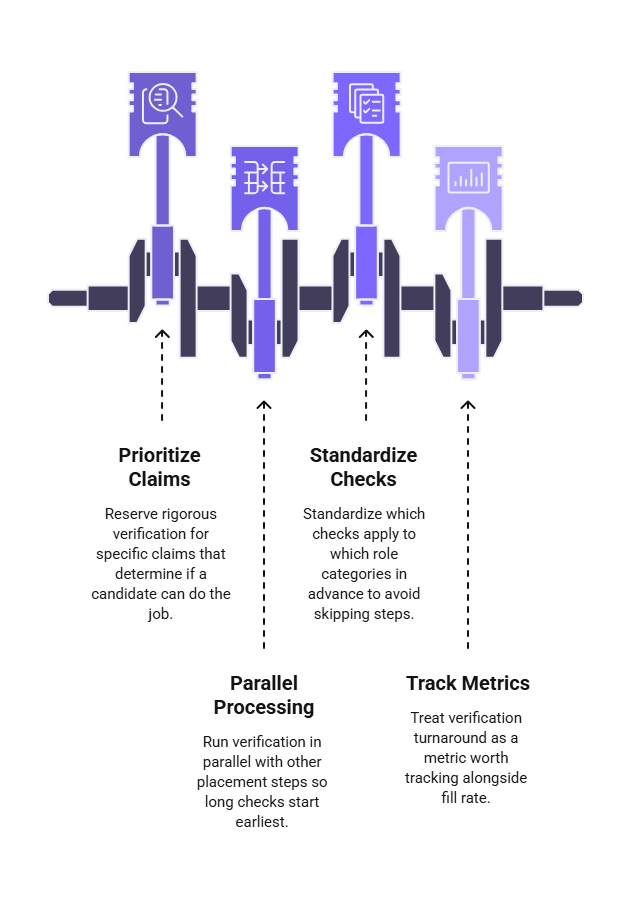
- Not every claim on a resume carries equal weight for a given role. Reserve rigorous verification, direct reference calls, credential confirmation with the issuing body, for the specific claims that actually determine whether a candidate can do the job, rather than spreading equal scrutiny across every line item
- Run verification in parallel with other placement steps rather than sequentially after them, so the checks that take the longest start the earliest instead of sitting at the end of the process where they compete directly with a client’s fill deadline
- Standardize which checks apply to which role categories in advance, so a rushed placement does not become an excuse to skip a check that role would otherwise always receive
- Treat verification turnaround as a metric worth tracking alongside fill rate, not a cost that only becomes visible after something goes wrong
None of these steps require an agency to slow down every placement equally. They require deciding, in advance and consistently, what actually needs confirming before a candidate reaches a client, rather than letting that decision get made implicitly by whatever the calendar allows on a given req.
Parallel processing deserves particular emphasis because it is the change most likely to close the gap without touching time-to-fill at all. Most placement workflows run linearly by default: source, screen, interview, verify, place, simply because that is the order the steps occur to a recruiter in. Nothing about verification requires waiting for an offer before starting; the moment a candidate becomes a serious contender is the moment verification can begin, running alongside the remaining interview and negotiation steps rather than after them. An agency that restructures its workflow this way can hold both current fill speed and materially deeper verification, because the two stop competing for the same calendar time once they stop happening in sequence.
Technology has a role here too. Automated verification requests, electronic consent, and systems that route a request the moment a candidate is shortlisted rather than after an offer is signed all reduce the manual overhead that makes verification feel slower than it needs to be. None of this changes what gets verified; it changes how much staff time a given level of verification consumes, which is usually the real constraint behind a decision to skip or defer a check under placement pressure.
Why Transparency Closes the Loop Faster Than Slowing Down Does
GCheck’s research points to a specific, low-cost lever that doesn’t require an agency to choose between speed and rigor: telling candidates upfront what will be verified. The same Trust in Hiring Report found that 56% of workers cite not understanding what employers can see or verify as their leading concern about the screening process (PERCEPTION, n=1,500), and separately found that 82% of workers want a clear explanation of what is being checked before it happens (PERCEPTION, n=1,500).
The connection to embellishment is direct. A candidate who doesn’t know what will be verified defaults to assuming the answer is not much, and calibrates what they’re willing to claim accordingly, which is exactly the calculation the 53%/26%/28% cluster describes. A candidate who is told plainly, before applying, that a specific credential will be confirmed directly with the issuing institution, or that a claimed title will be checked against a former employer’s records, has a clear reason to recalibrate that same bet. This costs an agency nothing in placement speed. It is a disclosure, not an additional verification step, and it can run alongside whatever tiered verification approach an agency already uses.
For a staffing agency, this disclosure can happen earlier and more visibly than it typically does in direct hiring, since agencies already communicate with candidates repeatedly before a client ever sees a resume. A standard line in the initial screening conversation, naming which categories of claims get verified and roughly when, costs nothing to add and reaches every candidate at the exact moment they are deciding how to present themselves. This is a structural advantage staffing agencies have over direct employers that nothing in the current speed-first model is set up to use.
This is where Fair Compliance and Transparent Compliance meet in practice. Fair Compliance means applying a consistent verification standard so accurate candidates are not structurally disadvantaged against embellished ones. Transparent Compliance means telling candidates what that standard actually is, which is the mechanism that gives an honest candidate a reason to expect their accuracy will be recognized rather than penalized. Both sit inside Compliance for Good™, GCheck’s operating standard for treating verification as something that protects candidates and clients together. Neither pillar asks an agency to sacrifice the speed clients are paying for. Both ask it to be deliberate about what speed is actually costing when verification becomes an afterthought instead of a stated standard.
The alternative, saying nothing about what gets verified and simply tightening scrutiny quietly for candidates who seem suspicious, produces the outcome GCheck’s brand research consistently warns against: a process that reads as surveillance rather than fairness, applied unevenly based on impression rather than a consistent standard. The fix is not less verification. It is verification candidates can see coming, applied the same way to everyone a given role category is placed through.
Frequently asked questions
What is the Honesty Tax in staffing?
The Honesty Tax is the disadvantage honest candidates face when a hiring process rewards confident self-presentation over accuracy. In staffing specifically, the pressure to fill roles quickly shrinks the time available to verify claims before a candidate reaches a client, which structurally favors candidates willing to embellish over those who don’t.
Why is staffing more exposed to this than direct hiring?
A staffing agency competes partly on time-to-fill, often under a service-level agreement with a client. Verification steps like reference checks and credential confirmation take time that doesn’t compress under placement pressure, so an agency under speed pressure has less room to be the exception to the low detection rates GCheck’s research documents across the general hiring population.
Does verifying more thoroughly mean placing candidates more slowly?
Not necessarily. Reserving rigorous verification for the specific claims that determine job performance, running checks in parallel with other placement steps rather than after them, and standardizing which checks apply to which roles in advance all reduce the practical tradeoff between speed and verification.
Who is liable if an unverified misrepresentation reaches a client?
The staffing agency that presented the candidate typically carries the exposure, separate from what the candidate themselves misrepresented. This is the basis of negligent referral liability, which GCheck covers in detail elsewhere. Because this is a state common-law claim rather than a federal standard, the specific exposure varies by state and can also be shaped by indemnification terms in the agency’s contract with the client.
What happens if a background check surfaces a problem before or after placement?
If the discrepancy comes from a consumer report and leads to declining to place a candidate or removing them from a role, that decision is an adverse action under the FCRA. It requires a pre-adverse action notice, a copy of the report, the Summary of Rights Under the FCRA, a reasonable opportunity to respond, and a final adverse action notice, regardless of whether the staffing agency, the client, or both are making the decision.
Does telling candidates what will be verified actually reduce embellishment?
GCheck’s Trust in Hiring Report found that 56% of workers cite not knowing what will be verified as their top concern about the screening process, and that many candidates who exaggerate do so specifically because they don’t expect verification. Disclosing what will be checked directly addresses the assumption that drives that behavior, without adding time to the placement process.

ABOUT THE CREATOR
Charm Paz, CHRP
Recruiter & Editor
Charm Paz is an HR professional at GCheck, specializing in background screening, fair hiring, and regulatory compliance. She holds from the Professional Background Screening Association (PBSA) and helps organizations navigate employment regulations with clarity and confidence.
With a background in Industrial and Organizational Psychology, she translates policy into practice to build ethical, compliant, human-centered hiring systems that strengthen decision-making over time.