

Candidates ghost during background checks because the process goes quiet at the exact moment their anxiety is highest. They have said yes to a job, handed over sensitive information, and then heard nothing for days. Silence in that gap reads as a bad sign, and a candidate who assumes the worst often stops responding rather than waiting to find out. Employers can stop most of this by replacing silence with a stated timeline, proactive status updates, and a real point of contact.
What “ghosting” means at the background check stage
Ghosting, in general recruiting usage, means a candidate cuts off communication rather than formally declining. At the background check stage specifically, ghosting looks different from an interview no-show or an offer decline. The candidate has typically already accepted the job. They are not evaluating whether to take the role anymore; they are sitting inside a process they cannot see into, waiting for a result they were never told the timeline for. That distinction matters, because the fix for interview-stage ghosting (faster scheduling, better candidate communication) is not the same as the fix for screening-stage ghosting, which is specifically about visibility into a process that has already started.
Why candidates go quiet instead of just saying no
A 2017 CareerBuilder survey conducted by Harris Poll found that 38% of employers had lost a candidate specifically because of a negative background check experience (CareerBuilder, “Nearly 2 in 5 Employers Have Lost a Job Candidate Because of a Poor Experience with Their Background Check Process,” 2017, PRNewswire). The same survey found that only 44% of HR managers who run background checks had ever tested their own process from the candidate’s side, and among those who did, roughly 1 in 6 rated the experience as fair or poor.
That gap matters more than it looks. Most employers are running a process they have never personally experienced, which means the silence a candidate sits in is invisible to the people who could fix it. GCheck’s 2026 Trust in Hiring Report found that 56% of workers say their leading concern about background checks is simply not understanding what an employer can see or verify (GCheck, 2026 Trust in Hiring Report, PERCEPTION, n=1,500). A candidate carrying that concern into a silent, multi-day wait does not experience the silence as neutral. They experience it as evidence something has gone wrong, and many respond by disengaging rather than asking.
The four specific triggers behind screening-stage ghosting
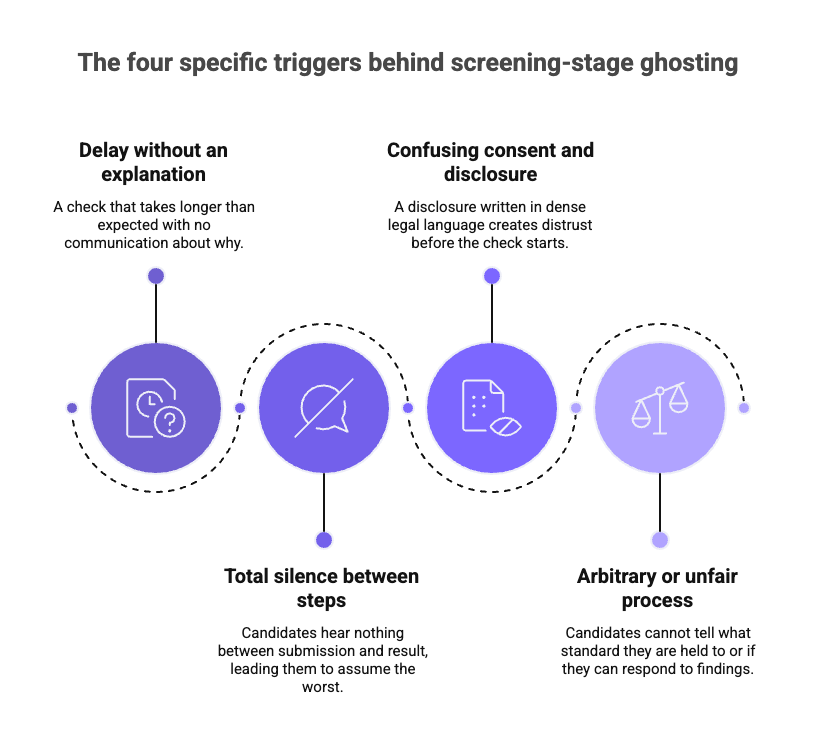
Four mechanisms show up repeatedly in candidate-experience research and account for most of the drop-off at this stage:
- Delay without an explanation. A check that takes longer than expected is manageable. A check that takes longer than expected with no communication about why is not.
- Total silence between submission and result. Candidates who hear nothing assume the worst, particularly if they already have some anxiety about what the check might surface.
- Confusing consent and disclosure paperwork. A disclosure written in dense legal language, disconnected from any explanation of what it actually means for the candidate, creates distrust before the check even starts.
- A process that feels arbitrary or unfair. Candidates who cannot tell what standard they are being held to, or whether they will get a chance to respond to anything the check finds, disengage rather than risk a decision they had no part in.
Each of these is a transparency failure, not a candidate-quality problem. A candidate who ghosts at this stage is not usually someone who was never serious about the job. They are someone who was serious enough to accept an offer and then found the next step of the process opaque enough to walk away from.
What it costs beyond the one lost hire
The CareerBuilder research also found that 56% of candidates think less of a company after a negative experience with its HR technology, a category that includes the background check process itself. That reputational cost outlives the specific requisition. A candidate who disengages during screening does not just leave one role unfilled; they carry the impression into how they talk about the company afterward, which affects the next candidate pool before a recruiter ever reaches out to it.
For a deeper standard on what a fully transparent, fair, and human-reviewed screening process looks like end to end, GCheck’s own candidate experience framework lays out a full twelve-point checklist covering disclosure, timeline communication, dispute rights, and human review. This article focuses specifically on the silence problem that drives ghosting; that piece is the fuller operational standard.
How to stop it: replace silence with a stated timeline
The single highest-leverage fix is telling candidates, before the check starts, roughly how long it will take and what happens if a specific component runs long. A standard background check package typically completes in 24 to 48 hours, while checks involving county courthouse records, international searches, or manual verifications can take a week or more, since those steps depend on third parties and court systems outside the employer’s control. Stating that range up front, rather than promising a speed the process cannot reliably deliver, prevents the exact gap that produces silence-driven ghosting.
Four practices convert that timeline into an ongoing communication cadence rather than a one-time disclaimer:
- State the expected timeline at the disclosure stage, before the check begins, including which components can run long.
- Send an automatic status update whenever the check moves between stages, even when there is nothing new to report.
- Proactively notify the candidate the moment a specific component exceeds its expected window, with a plain explanation of why.
- Give the candidate a way to check status themselves, rather than requiring them to reach out and ask.
How to stop it: make the consent and disclosure moment mean something
Under the Fair Credit Reporting Act, an employer using a third-party screening provider must give the candidate a standalone written disclosure and obtain written consent before the check runs (Federal Trade Commission & Equal Employment Opportunity Commission, “Background Checks: What Employers Need to Know,” ftc.gov). That requirement is a floor, not a ceiling. A disclosure that simply satisfies the statute, without explaining in plain language what will be checked and why it matters for the specific role, does little to reduce the anxiety that produces ghosting. Reframing the disclosure moment as the first real communication in the process, rather than a compliance formality, is one of the more direct ways to reduce the confusion that makes candidates disengage.
How to stop it: give candidates a real point of contact
A candidate who has a named person or support channel to ask “where is my check right now” is far less likely to simply stop responding than one who has no channel at all. This does not require a large team. It requires making sure every candidate knows, from the disclosure stage forward, who to contact and that a response will come back within a reasonable window, typically one business day. The absence of a contact point is itself a form of silence, even when the background check vendor is actively working the file.
Frequently asked questions
What’s the difference between ghosting during an interview and ghosting during a background check?
Interview-stage ghosting usually means a candidate is still deciding whether to take the job and disengages before committing. Background-check-stage ghosting typically involves a candidate who has already accepted an offer and disengages while waiting on a process they cannot see into, which points to a different fix: visibility and communication rather than faster scheduling.
How common is it for candidates to disappear during a background check?
A 2017 CareerBuilder survey found that 38% of employers had lost a candidate specifically due to a negative background check experience, and that only 44% of HR managers had ever tested their own process from the candidate’s side.
How long should a background check take?
A standard package typically completes in 24 to 48 hours. Checks involving county courthouse records, international searches, or manual employment and education verification can take a week or longer, since they depend on third parties and court systems.
Does sending more communication actually reduce ghosting?
The available research points to proactive, plain-language communication, especially around timeline and status, as the highest-leverage fix. Candidates who receive updates when the process moves stages, and who are proactively told when a component is running long, are less likely to fill the silence with worst-case assumptions.
Is ghosting during a background check a sign the candidate had something to hide?
Not typically. GCheck’s 2026 Trust in Hiring Report found that most workers’ top concern about background checks is simply not understanding what is being checked, a confusion-driven anxiety rather than a guilt-driven one. Treating disengagement as a red flag rather than addressing the silence that likely caused it tends to compound the problem for future candidates.

ABOUT THE CREATOR
Charm Paz, CHRP
Recruiter & Editor
Charm Paz is an HR professional at GCheck, specializing in background screening, fair hiring, and regulatory compliance. She holds from the Professional Background Screening Association (PBSA) and helps organizations navigate employment regulations with clarity and confidence.
With a background in Industrial and Organizational Psychology, she translates policy into practice to build ethical, compliant, human-centered hiring systems that strengthen decision-making over time.