
Driver identity fraud happens when the commercial driver’s license a carrier verified doesn’t reflect who actually earned it, or who is actually driving under it. A Louisiana bribery scheme that produced guilty pleas in July 2026 shows exactly how this happens: at least 124 people received CDLs without legitimately passing a single one of the three federally required tests.
Key Takeaways
- CDLIS confirms a license exists, its status, and its history across states. It does not confirm the underlying testing was legitimately completed or that the presenter is the original holder
- In a Louisiana case, a scheme ringleader bribed motor vehicle employees and driving instructors to fabricate knowledge test, training, and skills test records for CDL applicants who never took them
- Early in that scheme, the ringleader personally posed as an applicant and drove the test vehicle so a falsified skills test would look legitimate
- FMCSA has removed thousands of training providers from its Training Provider Registry since December 2025 for certification and safety-standard violations
- Closing the gap takes two layers: verifying a license and its training provider are legitimate at hire, and confirming the license stays valid and the holder stays consistent afterward
What Driver Identity Fraud Actually Means
Driver identity fraud is when the person behind the wheel isn’t the person a CDL, background check, or hiring process actually verified. It is a distinct problem from credential fraud, where the correct person holds the license but the license itself was never legitimately earned. A driver who exaggerates years of experience on a job application has committed a form of misrepresentation. A driver whose CDL reflects a knowledge test, training record, or skills test that someone else completed on paper, or that no one completed at all, has a fraudulent credential regardless of who is currently holding it.
The distinction matters because carriers tend to check for one and assume the other. Motor vehicle records and CDLIS confirm a license’s status and history. They say nothing about whether the testing behind it was real, and they say nothing about whether the person a carrier interviewed is the person who will actually be driving six months into the job. A carrier that runs every federally required check can still end up with a driver whose credential was never legitimate, because none of those checks were built to answer that question.
A Louisiana prosecution that produced guilty pleas in July 2026 shows both problems inside a single scheme, and shows how a fraudulent license and an impersonated test can start out as two separate acts and end up looking, on paper, exactly like a legitimate hire.
How a Fraudulent CDL Gets Made: Inside the Louisiana Bribery Scheme
The Commercial Driver’s License qualification process has three federally mandated steps: a written knowledge test, entry-level driver training, and a skills test administered by a state-authorized examiner. Passing the knowledge test earns a commercial learner’s permit, a prerequisite for the training and skills test that follow. Each step is designed to confirm something specific: that the applicant understands vehicle safety systems and emergency procedures, that they have practiced operating a commercial vehicle under supervision, and that they can demonstrate safe driving maneuvers on a public road.
On July 29, 2026, three defendants, Mahmoud Alhattab, Jonathan Parsons, and Marline Roberts, pleaded guilty in the Eastern District of Louisiana to bribery charges connected to a scheme that defeated all three steps at once.
- Alhattab, described in court documents as a local restaurant owner, acted as the scheme’s organizer. Applicants paid him an average of roughly $5,000 each for an unearned CDL
- To defeat the knowledge test, Alhattab bribed two motor vehicle office employees, who entered passing scores for applicants who never took the test. Alhattab was allowed through a non-public entrance and sometimes personally operated the office camera to take an applicant’s permit photo
- To defeat the training requirement, Alhattab bribed Parsons and another training-business operator to falsely report in a federal database that applicants completed training they never received
- To defeat the skills test, Parsons and the other operator, both certified as skills-test examiners, falsely reported that applicants passed tests they never took. A third defendant, Roberts, created falsified scoring sheets on several occasions to support those reports
The detail that matters most for driver identity fraud specifically comes from early in the scheme. According to the plea, Alhattab would sometimes personally pose as the applicant and drive the commercial vehicle used for testing, so that it would appear Parsons was administering a real skills test to a real candidate. Eventually the two decided this step was unnecessary, and Parsons simply filed false test reports with no vehicle, no driving, and no applicant present at all. What started as one person impersonating another during a driving test ended as a scheme where the test itself stopped happening in any form.
By the time the scheme ended in February 2024, Alhattab admitted to causing at least 124 people to fraudulently receive CDLs. Parsons admitted to causing at least 118. Each defendant pleaded guilty to one count of Bribery Concerning Programs Receiving Federal Funds, which carries up to 10 years in prison. Sentencing is scheduled for October 28, 2026. Other defendants named in the original indictment are awaiting trial and are presumed innocent unless proven guilty.
What makes this case useful beyond its own facts is how ordinary the fraud looked from the outside. Every one of the 124 CDLs Alhattab admitted to obtaining would have entered CDLIS as a normal, properly issued license. Nothing about the record itself would have flagged a problem to a carrier running a routine check. The fraud was invisible because it happened where a credential is created, not anywhere downstream where a carrier or a screening service would typically look.
This Isn’t an Isolated Case
Separate from the Louisiana prosecution, federal oversight of CDL training providers has intensified over the same period. The Federal Motor Carrier Safety Administration has removed nearly 10,000 training providers from its Training Provider Registry since a first wave of removals began in December 2025, and in February 2026 issued notices of proposed removal to more than 550 additional schools found in violation of federal safety standards. As of mid-2026, FMCSA has identified approximately 75 entry-level driver training schools under active investigation for suspected fraudulent activity, including improper certifications and falsified training records, with the Department of Homeland Security’s Homeland Security Investigations division now assisting.
The scale of that registry activity is worth noting regardless of any single case’s outcome: a training provider being removed from the registry means FMCSA found reason to doubt that provider’s certifications. A carrier that hired a driver trained at one of those schools, in good faith and with a CDL that passed every routine check, would have had no way to know from the license itself.
What CDLIS Actually Confirms, and What It Doesn’t
The Commercial Driver’s License Information System is the federal database states are required to check before issuing, renewing, or updating a CDL. It confirms whether an applicant already holds a license from another jurisdiction, which prevents a driver from holding CDLs in multiple states at once, and it surfaces license status, class, endorsements, and restrictions across every state where a driver has been licensed. States must also check the Problem Driver Pointer System, which flags disqualifications recorded elsewhere, and must pull a complete driving record from every jurisdiction where the applicant held a license in the past 10 years.
None of that confirms the testing behind the license was real. CDLIS is a records-consistency system: it checks whether the license that exists is the only one that exists and whether it is properly reflected across states. A CDL entered into the system through bribery, like the ones in the Louisiana case, looks the same as a legitimately earned one to anyone pulling a CDLIS record, a motor vehicle report, or a Pre-Employment Screening Program report. The fraud lives upstream of what those systems check.
This is the same gap that shows up whenever a verification system answers a narrower question than the one a carrier actually needs answered. A motor vehicle record confirms driving history. CDLIS confirms status and uniqueness. Neither confirms the license was earned honestly, and neither confirms the person presenting it today is the person it was issued to.
| System | What it confirms | What it doesn’t confirm |
| Motor Vehicle Record | Driving history, violations, and suspensions in a given state | Whether the license itself was legitimately earned |
| CDLIS | License status, class, endorsements, and whether a driver holds licenses in multiple states | Whether the underlying knowledge test, training, or skills test was real |
| PSP Report | Crash and roadside inspection history over several years | Anything about how the CDL was originally obtained |
| Training Provider Registry status | Whether a named training provider is currently active and compliant | Whether a specific applicant actually completed training there |
Closing the Gap at Hire
Point-of-entry verification for a commercial driver needs to go beyond confirming a license exists and is clean. A few specific steps close pieces of the gap the Louisiana case exposes:
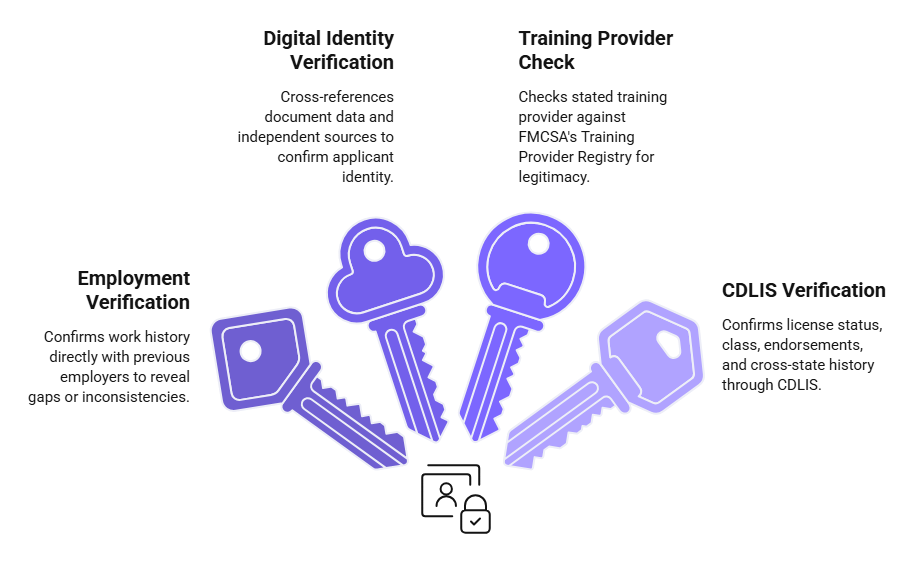
- Employment Verification confirms a driver’s prior work history directly with previous employers, rather than relying on a resume or application alone, which surfaces gaps or inconsistencies a fabricated credential wouldn’t otherwise reveal
- Digital Identity Verification cross-references document data and independent sources to confirm an applicant’s identity before screening begins, addressing the possibility that the person applying isn’t the person the license belongs to
- Checking a driver’s stated training provider against FMCSA’s Training Provider Registry confirms whether that provider is currently active and in good standing, rather than assuming any named school is legitimate
- CDL Information System verification through CDLIS confirms license status, class, endorsements, and cross-state history, and should be treated as one input among several rather than a complete identity or credential check on its own
Employment Verification, CDLIS checks, and motor vehicle record pulls are consumer reports when obtained through a background screening company, which means they carry the FCRA’s standard disclosure and authorization requirements before a carrier can request them. If a driver’s identity verification involves biometric elements such as facial matching or liveness detection, that collection triggers a separate layer of state law: Illinois’s Biometric Information Privacy Act, along with comparable statutes in Texas and Washington, require specific notice, consent, and data retention practices beyond standard background check authorization.
None of this is about treating drivers as suspects. The overwhelming majority of CDL holders earned their licenses honestly, through real testing, and have every reason to want a hiring process that can distinguish them clearly from the small number of licenses that were bought rather than earned. A verification process that only checks whether a license is clean, without checking whether it was legitimately issued, protects fraudulent credentials just as much as it protects legitimate ones.
Keeping Confirmation Current After Hire
GCheck’s research frames this specific limitation as the Verification Half-Life: the assurance a company buys with a one-time background check begins to decay the moment onboarding ends, because nothing in a standard screening workflow reconfirms the underlying facts as time passes. This describes a pattern in how verification works, not a measured decay rate, and it applies to background screening broadly rather than to any single scheme or industry.
A CDL verified as clean and current on a driver’s first day carries that same status until something changes it, a suspension, a new violation, an expiration, and nothing in a standard hiring workflow automatically surfaces those changes as they happen. Ongoing verification closes that window:
- Driver Monitoring tracks license status, violations, and disqualifications on an ongoing basis rather than only at the point of hire, so a change is identified close to when it happens rather than at the next scheduled rescreen
- Professional License Monitoring detects suspensions, revocations, and disciplinary actions as licensing authorities publish them
- Periodic re-verification against CDLIS confirms a license that was valid at hire remains valid and hasn’t been superseded, suspended, or flagged in another jurisdiction since
Applied to the Louisiana case specifically, ongoing monitoring would not have identified the original fraud, since the falsified records made the license look legitimate at the source. What it does address is the broader pattern the case points to: a credential’s status today is not a permanent fact, and treating a clean check at hire as though it holds indefinitely is the same assumption that let 124 fraudulent licenses circulate for years before anyone identified them.
One point belongs here rather than a footnote. If Driver Monitoring, Professional License Monitoring, or a periodic CDLIS re-check surfaces a problem with a driver’s license, an expired credential, a fraud finding, a new disqualification, and a carrier acts on that information by suspending or terminating the driver, that decision is an adverse action under the FCRA. The same notice sequence applies as it would at the point of hire: a pre-adverse action notice, a copy of the report, a reasonable opportunity to respond, and a final adverse action notice once the decision is made. A finding surfaced through ongoing monitoring is not exempt from that process simply because it came from a monitoring product rather than a point-of-hire background check.
What Carriers Can Do Right Now

A few concrete steps address the specific gap this case demonstrates, without requiring a carrier to treat every applicant as a suspect:
- Confirm a driver’s named training provider is active on FMCSA’s Training Provider Registry rather than accepting a training certificate at face value
- Verify employment history directly with named prior employers instead of relying on self-reported dates and roles
- Treat CDLIS and motor vehicle record checks as confirmation of license status, not confirmation of how the license was earned
- Build in periodic re-verification of license status rather than treating the point-of-hire check as sufficient for the life of the employment relationship
- Apply the same verification standard to every driver hired through a given channel, whether direct or through a staffing intermediary, so that consistency itself doesn’t become a gap fraud can exploit
Why This Matters Beyond One Case
GCheck’s broader workforce research offers useful context here, with an important caveat: it reflects the general US workforce, not a transportation-specific sample. Even so, the pattern it describes lines up with what the Louisiana case shows in a regulated licensing context. Seventy-one percent of US workers report having worked with someone who turned out not to be what they claimed professionally. That figure describes a general workforce experience, not commercial driving specifically, but it establishes that discovering a credential or identity wasn’t what it appeared to be is not a rare experience for American workers generally, which is worth keeping in mind before treating a licensing-specific fraud case as a one-off anomaly.
That context supports both Protective Compliance and Fair Compliance as the pillars this issue sits under. Protective Compliance is the more obvious fit: a driver whose CDL wasn’t legitimately earned is a road-safety risk to the public, not just a liability question for the carrier that hired them. Fair Compliance matters just as much here, in a narrower sense: CDLIS itself is built on the principle that every state should check the same system the same way, so that a license means the same thing regardless of where it was issued. A carrier that applies inconsistent verification standards, checking some drivers more thoroughly than others based on where they trained or how they were referred, undermines that same principle at the hiring stage. Consistency isn’t just fair to drivers. It’s the only way a verification standard actually holds.
Both pillars sit inside Compliance for Good™, GCheck’s operating standard for treating verification as something that protects the public and the driver together rather than something aimed at one at the expense of the other. A driver who legitimately earned a CDL through real testing has as much reason to want fraudulent credentials identified as any carrier does, since every fraudulent license in circulation makes the credential itself worth less to everyone who earned theirs honestly.
Frequently asked questions
What is driver identity fraud?
Driver identity fraud is when the person actually driving under a commercial driver’s license isn’t the person the license was verified for, or when the license itself reflects testing that never legitimately happened. It is distinct from ordinary resume misrepresentation, since it involves the credential itself rather than just claims made about it.
Can CDLIS detect a fraudulently issued CDL?
Not directly. CDLIS confirms a license’s status, class, endorsements, and whether a driver holds licenses in more than one state. It does not verify that the knowledge test, training, or skills test behind the license was legitimately completed. A fraudulently issued license that was properly entered into a state’s system looks the same in CDLIS as a legitimately earned one.
What happened in the Louisiana CDL bribery case?
Three defendants pleaded guilty in July 2026 to a bribery scheme that fraudulently obtained CDLs for at least 124 people by falsifying knowledge test scores, training records, and skills test results. Early in the scheme, the ringleader personally posed as an applicant and drove a test vehicle to make a falsified skills test appear legitimate.
How can carriers verify a driver’s training provider is legitimate?
FMCSA maintains a Training Provider Registry listing active, compliant entry-level driver training providers. Checking a driver’s named school against this registry confirms whether that provider is currently in good standing, rather than assuming any named training certificate is valid.
What is the Verification Half-Life?
The Verification Half-Life is a conceptual frame describing how the assurance from a one-time background check decays the moment onboarding ends, since nothing in a standard screening process reconfirms the underlying facts as time passes. It describes a pattern in how verification works, not a measured or claimed statistic.
Does ongoing monitoring prevent fraud like the Louisiana case?
Not the original fraud itself, since falsified records made the licenses appear legitimate at the point of issuance. Ongoing monitoring addresses a related but separate problem: confirming a license that was valid at hire remains valid, unsuspended, and unflagged over time, rather than assuming a clean check at hire holds indefinitely.
If ongoing monitoring flags a problem, can a carrier act on it right away?
A carrier can act, but suspending or terminating a driver based on a finding from a consumer report, including a monitoring product, is an adverse action under the FCRA. It requires the same notice sequence as a point-of-hire decision: a pre-adverse action notice, a copy of the report, a reasonable opportunity to respond, and a final adverse action notice.
Total word count: 3,106 words
Sources cited
- U.S. Department of Justice, U.S. Attorney’s Office, Eastern District of Louisiana. (2026, July 31). Three Plead Guilty in Bribery Scheme That Enabled Over 100 Drivers to Fraudulently Obtain Commercial Driver’s Licenses. https://www.justice.gov/usao-edla/pr/three-plead-guilty-bribery-scheme-enabled-over-100-drivers-fraudulently-obtain
- Federal Motor Carrier Safety Administration. Training Provider Registry enforcement update, July 16, 2026 (operational facts only). https://www.fmcsa.dot.gov/newsroom/trumps-departments-transportation-homeland-security-team-crack-down-fraud-cdl-schools
- Federal Motor Carrier Safety Administration. State CDL registration requirements (CDLIS, PDPS, NDR). https://www.fmcsa.dot.gov/registration/commercial-drivers-license/states
- GCheck. (2026). The Rise of the Shadow Workforce. Proprietary survey of 1,500 U.S. employed adults, fielded June 2026.
- Illinois Biometric Information Privacy Act, 740 ILCS 14/1 et seq.
- Fair Credit Reporting Act, 15 U.S.C. § 1681b(b)(3)

ABOUT THE CREATOR
Charm Paz, CHRP
Recruiter & Editor
Charm Paz is an HR professional at GCheck, specializing in background screening, fair hiring, and regulatory compliance. She holds from the Professional Background Screening Association (PBSA) and helps organizations navigate employment regulations with clarity and confidence.
With a background in Industrial and Organizational Psychology, she translates policy into practice to build ethical, compliant, human-centered hiring systems that strengthen decision-making over time.