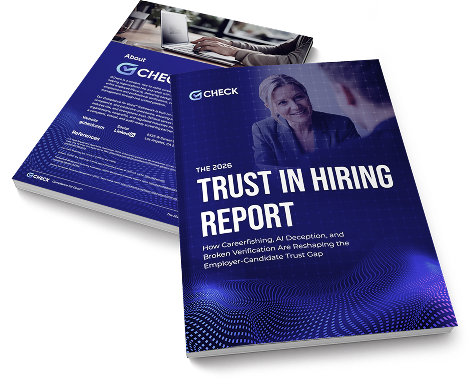
93% of Job Seekers Are Lying to You. Here's
What They Admitted.
New research from 1,500 recent job applicants reveals how career-fishing,
AI deception, and resume verification are eroding trust on both sides
of the hiring process, and what HR leaders can do about it.
Executive Summary
The modern hiring process is caught in a credibility crisis. In a national survey of 1,500 U.S. working adults who actively applied for jobs within the past 18 months (GCheck, 2026), 93% admitted to engaging in at least one form of embellishment or misrepresentation. The behavior spans every generation, gender, and demographic group, driven primarily by competitive job market pressure (72%), weak verification expectations (53%), and the belief that honesty is a competitive disadvantage (60%).
The consequences extend in both directions. Among those who embellished, 39% experienced post-hire stress or anxiety, 29% found their overstatement became apparent on the job, and 25% faced negative workplace outcomes because their skills did not match their resume. From an organizational perspective, 88% of all respondents acknowledge that candidate misrepresentation puts businesses at risk.
Beyond credential inflation, the survey documents widespread identity concealment (64% of Hispanic and 56% of Black job seekers altered their appearance or communication style for interviews to avoid bias), AI-assisted misrepresentation (25% used an AI avatar of themselves in a virtual meeting), and pervasive digital self-censorship (80% have avoided posting honest views online due to employer concerns).
Yet the same workforce overwhelmingly supports transparent, fair, and human-led screening: 82% want a clear explanation of what is being checked, and 81% want human review rather than fully automated decisions. The path forward requires compliance approaches that balance rigorous verification with candidate transparency, consistent fairness, and human oversight.
Methodology
Online survey of 1,500 U.S. adults employed full-time who actively applied for at least one job in the past 18 months. Fielded February 14–22, 2026 via Pollfish. Demographics: 783 male / 717 female; 245 Gen Z (≤29) / 717 Millennials (30–45) / 494 Gen X (46–61) / 44 Baby Boomers (62+); 854 White / 301 Black / 202 Hispanic / 91 Asian. Margin of error: ±2.5% at 95% confidence (wider for subgroups). Conditional questions about motivations and consequences asked only of those who reported embellishment. Multi-select questions allow totals exceeding 100%.
In Today's Hiring Market, Exaggeration Is the Norm
The Professional Background Screening Association (PBSA, 2023) has consistently reported that over 95% of employers conduct some form of background screening. The Society for Human Resource Management (SHRM, 2024) has documented rising concerns about candidate misrepresentation. But the scale of these findings goes well beyond what most HR leaders expect, or what existing screening processes are designed to catch. The most common behaviors were exaggerating expertise in a skill (61%) and inflating the scope of previous roles (59%). At the far end of the spectrum: 27% listed fake references and 25% claimed educational credentials they never earned.
13 Embellishment Behaviors Ranked by Prevalence
The Generational Divide
Baby Boomers reported the highest overall embellishment rate at 97%, but every generation participated at very high levels: 96% of Gen Z, 93% of Millennials and 91% of Gen X. The generational differences become more pronounced on fabrication behaviors: 40% of Gen Z listed fake references compared to 7% of Boomers, and 37% of Gen Z claimed unearned educational credentials compared to 17% of Boomers. Similarly, 41% of Gen Zers have described a job departure as voluntary when they were actually terminated, compared to 17% of Boomers. Gender differences were comparatively modest (95% of men vs. 91% of women). Embellishment is a market problem, not a demographic one.
Top 5 Behaviors by Age Cohort
Percentage (%)
Exaggerated expertise
Inflated role scope
Interview stories
Adjusted dates
Unperformable skills
Reference Manipulation
Reference checks are widely treated as a final validation of a candidate’s claims. The findings suggest that trust may be misplaced. When nearly half of candidates actively prepare their references to deliver a scripted narrative, the signal-to-noise ratio in traditional reference checking drops substantially.
How Candidates Game the Verification Process
Careerfishing is the systematic embellishment, distortion, or fabrication of professional qualifications across resumes, interviews, and references as a deliberate competitive strategy, driven by market pressure and weak verification expectations.
Why Candidates Feel Forced to Exaggerate
Among those who engaged in embellishment, the motivational factors point decisively toward structural incentives rather than individual dishonesty. Competitive pressure was the single most cited driver, followed by extended job searches and the assumption that other candidates were doing the same. Sixty percent said they would not have been hired if they had presented their experience fully accurately.

The Verification Feedback Loop
Competitive pressure alone does not fully explain why embellishment has become so pervasive. A second, self-reinforcing mechanism is at work: weak employer verification creates the expectation of weak verification, which incentivizes further inflation. Just over half of those who embellished (53%) did so because they believed employers would not verify everything. That belief is not unfounded. Only 26% reported that someone actually verified their claims and found a discrepancy, while only 28% lost an opportunity over a detected exaggeration. When the probability of detection is this low, embellishment becomes a rational calculation.
COMPLIANCE FOR GOOD®:
Transparent Compliance
The verification feedback loop thrives in opacity. When candidates do not know what will be checked (56% report this concern), they assume the answer is minimal and calibrate their embellishment accordingly. Organizations that clearly communicate what will be verified before candidates apply can disrupt this cycle at its root.

The Fallout: Stress, Mismatch, and Workplace Risk
The Careerfishing Paradox
The paradox is the point. Candidates are rational participants in a broken system.

Bias and Digital Scrutiny Are Reshaping Candidate Behavior
Among fathers in the same situation, the rate was 38%. The 12-point gap reflects the documented motherhood penalty in hiring. Additional identity concealment behaviors included removing cultural or identity-related details from resumes (31% overall, 40% among Asian respondents), using a gender-neutral version of their name (24%) using a different name to avoid ethnicity questions (21%, rising to 32% among Black respondents) and concealing age indicators (36%, rising to 47% for Baby Boomers).
Digital Self-Censorship
Employer scrutiny of social media has created a culture of digital self-censorship. Eighty percent of respondents reported that concerns about employer interpretation have caused them to avoid posting honest views online. The behavioral modifications go further: 58% made accounts private during a job search, 53% stopped posting certain opinions, and 48% paused posting altogether.
AI as Accomplice: Technology Is Blurring Preparation and Deception
One in four respondents reported using an AI-generated avatar in a video interview or meeting, a finding that represents a fundamental shift in what remote hiring verification can assume. The broader AI picture is equally consequential: 61% used AI to practice interview answers until they sounded more impressive than authentic, 48% used AI to complete take-home assignments, and 27% used AI during live interviews for real-time answer generation.
Trust in Screening Is Conditional, Not Absent
Despite high embellishment rates, 80% of respondents said ongoing or periodic background screening is important, either for all roles (31%) or for safety-sensitive roles (49%). Their support, however, comes with specific conditions. The most widely shared concern (56%) is not understanding what employers can see or verify. The most widely requested feature (82%) is a clear explanation of what is being checked. Close behind, 81% want human review of findings rather than fully automated decision-making. These six trust-building factors map directly to the principles of transparent, fair, and protective compliance.
- 82% want to know what’s checked
- 74% want AI transparency
- 77% want dispute ability
- 75% want consistent standards
- 81% want human review
- 76% want secure data handling

The Path Forward: Rebuilding Credibility in Hiring
The data reveals a hiring ecosystem under significant strain. Candidates increasingly feel pressure to exaggerate qualifications to remain competitive, while employers face growing difficulty verifying credentials efficiently and fairly. As technology expands both opportunity and risk, trust in the hiring process is weakening on both sides.
Restoring credibility requires modern verification practices that balance rigor with fairness, use technology responsibly, and provide candidates with clear visibility into the process. The future of hiring depends not only on identifying talent but on rebuilding trust in an increasingly AI-driven environment.
Foundational Principles for a Trust-Based Model
Addressing the “careerfishing” trend requires alignment around three core principles reflected in candidate feedback:
Transparency as a Standard
With 82% of candidates wanting clarity, organizations must communicate verification practices openly rather than relying on opaque screening processes.
Commitment to Fair Opportunity
As 46% of candidates report concealing aspects of their identity to avoid perceived bias, verification must be standardized and context-aware to support objective evaluation.
Human-Centric Decision Making
With 81% of respondents calling for human oversight, automated systems should be overseen and manually verified by trained human review to ensure accuracy and proper context.

Proactive Disclosure
Communicating verification standards in job postings is the most cost-effective intervention to discourage embellishment before it starts.
Independent Verification
Validating employment and education history directly from the source closes the gaps left by relying on self-reported narratives.
Biometric & Deep Fake Detection
Deploying advanced AI safeguards and live-proctored assessments effectively counters identity fraud and real-time AI answer generation.
Human-Centric Review
Manual human review of all findings ensures accuracy and context, reduces bias-driven concealment, and maintains FCRA and EEOC Compliance (U.S. Equal Employment Opportunity Commission, 2012).
Audit-Ready Infrastructure
Standardizing hiring criteria and adverse action documentation protects the organization from potential legal challenges.
Transparency as a Talent Magnet
Leading with clear communication about screening practices attracts candidates who value integrity, helping build a more reliable talent pool.
The Bottom Line: Rebuilding trust in hiring isn’t just about catching embellishments; it’s about creating an environment where integrity is expected, verified, and rewarded.

The Honesty Tax:
A Defining Dynamic in Modern Hiring
Taken together, the findings in this report point to a structural pattern in hiring: candidates are often penalized for accuracy and rewarded for optimization.
This pattern is reflected in what we describe as The Honesty Tax. Transparent, realistic candidates are more likely to be filtered out, while embellished or AI-enhanced profiles are more likely to advance.
The dynamic aligns with earlier findings: 60% of candidates believe full honesty would cost them the job, while only 26% report that discrepancies are actually detected.
- Skills described with precision losing to inflated “expert” claims
- Realistic salary expectations reducing leverage
- Employment gaps penalized relative to constructed narratives
- Honest work style preferences interpreted as lack of fit