

What is the Honesty Tax in hiring? The Honesty Tax is a structural dynamic in which hiring processes systematically filter out candidates who represent themselves accurately, while advancing those who optimize their presentation beyond what is true. Most hiring processes are designed to find the best candidate. The problem is that many of them, by design or by default, are filtering for the best-presented one. That distinction matters more than most organizations realize. The gap between the two is where we find what the 2026 Trust in Hiring Report names the Honesty Tax.
Key Takeaways
- The Honesty Tax is a structural dynamic, not a candidate character problem: the hiring process penalizes accuracy and rewards optimized presentation.
- 60% of job seekers believe full honesty would have cost them the job, and only 26% report that a discrepancy was ever detected.
- When embellishment goes undetected at that rate, misrepresentation becomes a rational calculation rather than an ethical failure.
- The cost does not disappear at the point of hire: 39% of embellishers experienced post-hire anxiety, and 25% faced direct workplace consequences from skill mismatch.
- Downstream outcomes including underperformance, team strain, and early attrition are frequently misidentified as culture or management problems when the origin is a verification gap.
- Proactive disclosure of what will be verified, applied consistently and reviewed by humans, changes the incentive calculation before embellishment enters the pipeline.
- Rebuilding hiring integrity does not require screening harder. It requires screening more transparently.
What the Honesty Tax in Hiring Actually Is
The Honesty Tax is not a metaphor for dishonest candidates. It is a structural dynamic in which the hiring process systematically disadvantages candidates who represent themselves accurately, and rewards those who optimize their presentation beyond what is true.
The mechanism is straightforward. When 60% of recent job seekers say they would not have been hired if fully transparent about their qualifications, that is not a statement about individual ethics. It is a statement about how the process is experienced. Candidates are telling us, directly, that honesty functions as a competitive liability. The data confirms they are not wrong to think so.
The figures below show how candidate misrepresentation persists precisely because detection rates remain low.
| Metric | Finding |
| Candidates who say honesty would have cost them the job | 60% |
| Embellishments ever detected by employers | 26% |
| Candidates who lost an opportunity over a detected exaggeration | 28% |
When the probability of detection is that low, embellishment stops being a risk and starts being a strategy. The candidate who writes “Expert” is more likely to clear initial screening thresholds. The one who writes “Proficient, with two years of applied experience” may not, particularly in processes where keyword filtering precedes human review.
The tax is collected at the point of entry. The cost shows up later.
Why the Hiring Process Produces Resume Embellishment
It would be convenient to locate the problem in candidate behavior. The data does not support that framing.
The 2026 report surveyed 1,500 working adults who had actively applied for jobs in the past 18 months. Ninety-three percent reported some form of embellishment or misrepresentation. That number spans every generation, every demographic, and every education level. Baby Boomers came in at 97%. Gen Z came in at 96%. The spread between men and women was four percentage points. When a behavior is this universal, the explanation is not a character flaw distributed across the population. The explanation is the environment.
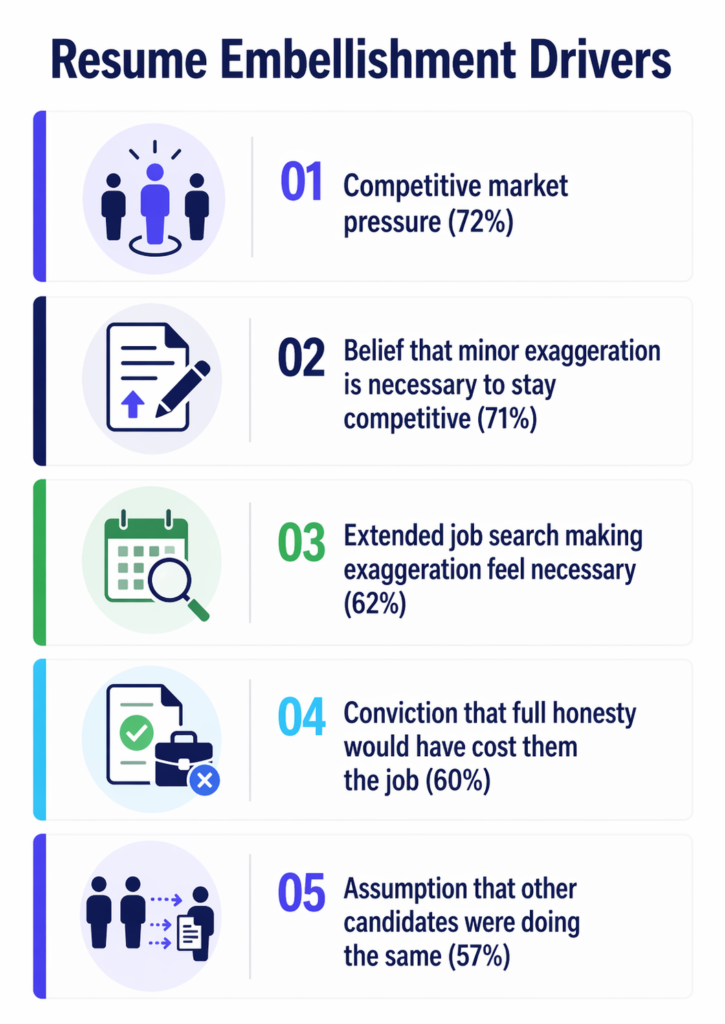
The five primary drivers candidates cited:
- Competitive market pressure (72%)
- Belief that minor exaggeration is necessary to stay competitive (71%)
- Extended job search making exaggeration feel necessary (62%)
- Conviction that full honesty would have cost them the job (60%)
- Assumption that other candidates were doing the same (57%)
The driver that carries the most structural weight is the one on verification. Fifty-three percent of embellishers specifically said they misrepresented because they did not believe employers would verify their claims. That belief points to a self-reinforcing loop.
Weak verification creates the expectation of weak verification. That expectation makes embellishment rational. Rational embellishment, spread across a candidate pool, raises the floor of what a competitive application looks like. Candidates who do not participate are not more ethical. They are simply less likely to advance.
An opacity problem compounds the loop further. Fifty-six percent of candidates report not knowing what employers can actually see or verify through background check and employment verification processes. When the process is opaque, candidates cannot accurately assess their risk. They assume verification is minimal and calibrate their applications accordingly. Transparency about what will be checked, communicated before a candidate applies, is the most cost-effective intervention available. It changes the calculation before any embellishment decision is made.
The Deferred Cost of Candidate Misrepresentation
This is where the conversation typically ends: with the observation that resume embellishment is widespread and background check verification is weak. The more important question is what happens after the hire.
The 2026 report followed the downstream trail among candidates who embellished and were subsequently hired. The results show that the consequences of misrepresentation do not stay with the candidate.
| Post-Hire Outcome | Rate Among Embellishers |
| Experienced stress or anxiety once hired | 39% |
| Overstatement became apparent on the job | 29% |
| Faced negative workplace consequences due to skill mismatch | 25% |
These are not abstract compliance statistics. They describe real situations that land on real teams.
The organizational cost appears in three compounding forms:
- A manager who budgeted for a skill level that was not delivered
- A team absorbing work that was supposed to be handled by the new hire
- A new employee operating under ongoing anxiety about a gap they cannot close
Each of these affects performance, judgment, and retention in ways that are difficult to trace back to the original hiring decision. The Honesty Tax has a deferred cost structure. The candidate pays upfront by being filtered out for accuracy. The organization pays later through mismatch, reduced team performance, and early attrition.
The downstream cost rarely gets connected to the upstream decision. It surfaces as a performance management issue, an onboarding failure, or a culture problem. In many cases, the origin is a verification gap that was never identified as such.
The central paradox the report surfaces makes this dynamic even clearer. Eighty-eight percent of respondents, drawn from a population where 93% embellished, agreed that candidate misrepresentation puts businesses at risk. These are the same people. They understand the system they are participating in is harmful. They participate anyway because the process, as currently experienced, does not make honesty the competitive choice. That is not hypocrisy. That is a market failure.
What Candidate Misrepresentation Means for HR and Hiring Teams
The practical implication is not that organizations need to screen harder. They need to screen more transparently and more consistently.
The report is direct on what candidates actually want from the hiring process.
What candidates are asking for:
- A clear explanation of what is being checked (82%)
- Human review of findings rather than fully automated decisions (81%)
- The ability to review or dispute results (77%)
- Secure data storage and deletion (76%)
- Consistent screening standards applied across all candidates (75%)
- Transparency about AI use in the screening process (74%)
These are not unreasonable requests. They describe a process most organizations would say they already run. The gap between that assumption and actual candidate experience is where the Honesty Tax finds its conditions.
Three structural interventions that directly address the Tax:
- Proactive disclosure of verification standards, communicated before the application process begins, signals to candidates that claims will be checked. It also creates a fairer environment for candidates who choose to represent themselves accurately, because it levels the competitive floor.
- Source-verified employment and education history, conducted through a consistent and properly authorized process, narrows the gaps that self-reported narratives leave open. It also reduces the structural advantage that resume embellishment currently holds over accurate representation.
- Consistent human review of all background check findings ensures that context is applied and edge cases are handled with judgment rather than automation alone. It is one of the conditions under which a process is more likely to produce accurate, fair, and well-documented outcomes.
None of this reflects distrust of candidates. It reflects a commitment to building a process that does not force candidates to choose between accuracy and competitiveness.
The Compliance for Good Perspective on Hiring Process Transparency
The Honesty Tax will persist as long as the incentive structure that produces it remains intact. That structure has three components:
| Component | Effect |
| Competitive pressure | Rewards optimization over accuracy |
| Verification gaps | Lowers the perceived probability of detection, which reduces the deterrent effect on embellishment |
| Process opacity | Prevents candidates from making informed decisions about their risk |
Compliance is often framed as a cost center, a box to check, a protection mechanism against legal exposure. That framing is too narrow. A well-designed compliance process is also the mechanism by which organizations create the conditions for accurate hiring. When background check verification is consistent, transparent, and human-reviewed, it changes what a rational candidate calculates. It reduces the competitive advantage of embellishment. It creates space for the candidate who told the truth to advance on equal footing.
The Honesty Tax is not an inevitable feature of hiring. It is a predictable output of a system that has not been designed to address it. The data tells us what candidates need in order to trust the process. The question for every HR leader is whether their current process delivers that.
If it does not, the tax is still being collected. The organization is just the one paying it.
What is the Honesty Tax in hiring?
The Honesty Tax is a structural pattern in which candidates who represent themselves accurately are more likely to be filtered out of hiring processes, while those who embellish or optimize their qualifications beyond what is true are more likely to advance. It is a systemic dynamic produced by competitive pressure, weak verification, and process opacity, not a reflection of individual character.
Why do candidates exaggerate on resumes and in job applications?
According to the 2026 Trust in Hiring Report, the primary drivers are competitive market pressure (72%), the belief that minor exaggeration is necessary to stay competitive (71%), and the assumption that other candidates are doing the same (57%). Fifty-three percent specifically said they embellished because they did not believe employers would verify their claims. The behavior is widespread across every generation and demographic group, which points to a structural incentive rather than an individual one.
How common is resume embellishment and candidate misrepresentation?
The 2026 Trust in Hiring Report found that 93% of recent job seekers reported some form of embellishment or misrepresentation during the hiring process. The most common behaviors were exaggerating expertise in a skill (61%) and inflating the scope of previous roles (59%). The rate was consistent across generations, with Baby Boomers at 97% and Gen Z at 96%.
Do employers actually detect resume lies and embellishments?
Infrequently. Only 26% of candidates who embellished reported that a discrepancy was ever detected, and only 28% lost an opportunity as a result. That low detection rate is a significant driver of the behavior. When the probability of consequence is this low, misrepresentation becomes a rational calculation within the hiring process as candidates currently experience it.
How can companies reduce candidate misrepresentation in hiring?
The most direct interventions are proactive disclosure of what will be verified before candidates apply, source-verified employment and education history conducted through a properly authorized process, and consistent human review of all screening findings. The 2026 report found that 82% of candidates want clarity on what will be checked, suggesting that hiring process transparency alone changes the incentive structure before embellishment enters the pipeline.
About the 2026 Trust in Hiring Report
The 2026 Trust in Hiring Report is a proprietary research study published by GCheck, based on a national survey of 1,500 U.S. adults employed full-time who actively applied for at least one job in the past 18 months. Fielded February 14-22, 2026 via Pollfish, the study examines how Careerfishing, AI-assisted deception, identity concealment, and broken verification expectations are reshaping the employer-candidate trust gap. The report introduced the Careerfishing framework and documented that 93% of recent job seekers have engaged in at least one form of resume embellishment or misrepresentation. The full report, including methodology, demographic breakdowns, and the Compliance for Good framework for rebuilding trust in hiring, is available at gcheck.com/whitepapers/trust-in-hiring-report/.

ABOUT THE CREATOR
Houman Akhavan
Founder and CEO, GCheck
Houman Akhavan is the Founder and CEO of GCheck, a hire-to-retire screening platform built on the principle of Compliance for Good®. He is and serves on the boards of two NASDAQ-traded companies (POWW and CDON.ST), where he contributes to audit, compensation, and corporate governance.
With more than 25 years of experience building and scaling technology businesses, Houman brings a rare combination of operational discipline and compliance expertise to the background screening industry. Previously, as Chief Marketing Officer at CarParts.com (NASDAQ: PRTS), he directed $50M+ annual budgets and helped lead the company through a significant period of digital transformation and growth. He also served on Google's Retail Advisory Council.
Houman founded GCheck on a straightforward belief: background screening should be fast, fair, and transparent for both employers and candidates. He lives and works in the Los Angeles area.