

Random screening is an unannounced testing program in which employees in a covered population are selected for drug and alcohol testing at unpredictable intervals throughout the year. Its risk-reduction value comes less from how often testing happens and more from how completely and unpredictably it covers everyone who is supposed to be in the pool.
Key Takeaways
- Random screening reduces risk through unpredictability, not frequency. A program that employees can anticipate loses most of its protective effect.
- Federal minimum random testing rates apply to specific regulated categories, currently 50 percent for controlled substances and 10 percent for alcohol for CDL drivers under 49 CFR Section 382.305, and 50 percent for CY 2026 for PHMSA-covered pipeline employees under 49 CFR Section 199.105.
- Outside these federally regulated categories, state law governs whether and how random testing may be conducted, and requirements vary significantly by state.
- Coverage gaps, meaning eligible employees or locations left out of the pool, weaken both regulatory standing and legal defensibility.
- Consistent, uniformly applied selection is also a defense against disparate-treatment claims under Title VII, since inconsistent application of a testing policy is what typically draws EEOC scrutiny.
- Random screening works best as one piece of a complete program that also includes pre-employment, post-accident, and reasonable-suspicion testing.
What random screening is and how selection works
Random screening selects employees from a defined testing pool using a method that gives every eligible person an equal chance of being chosen each time a selection cycle runs. Under 49 CFR Section 382.305(i), which governs random testing for commercial drivers, the selection method must meet three requirements:
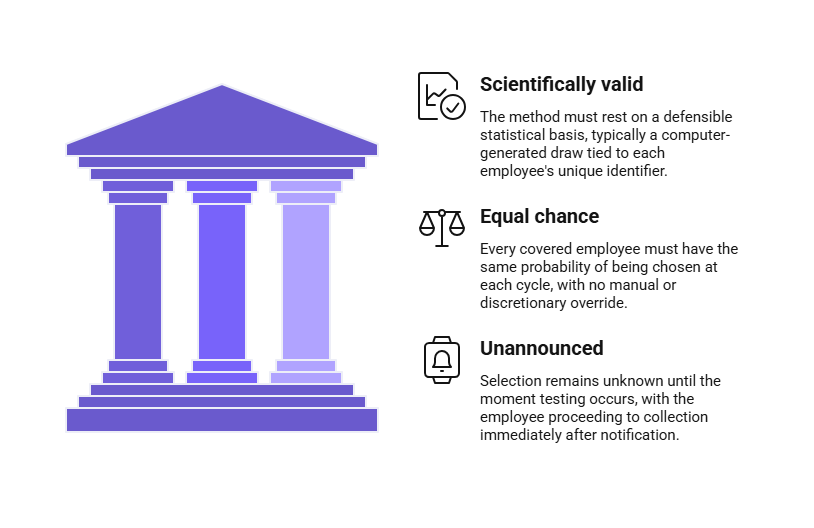
- Scientifically valid. The method must rest on a defensible statistical basis, typically a computer-generated draw tied to each employee’s unique identifier.
- Equal chance of selection. Every covered employee must have the same probability of being chosen at each cycle, with no manual or discretionary override.
- Unannounced. Selection remains unknown until the moment testing occurs, with the employee proceeding to collection immediately after notification.
Because the rule requires an equal chance at every cycle, a person who is tested does not leave the pool afterward. They go back in with everyone else, which means the same employee can be selected more than once in a year while another goes unselected. This is different from event-triggered testing: pre-employment testing happens once, at hire, while post-accident and reasonable-suspicion testing happen in response to a specific event. Random screening is the only category that runs continuously, without a triggering incident, which is what gives it its distinct risk-reduction value.
Program administrators sometimes assume a larger testing pool is inherently more random than a smaller one, but pool size and randomness are separate properties. A twelve-person pool selected by a genuinely unbiased algorithm is more defensible than a thousand-person pool selected through a process with any manual override, exception list, or supervisor discretion built in. What regulators and courts look at is the integrity of the method, not the size of the population it draws from.
Why unpredictability, not frequency, is what reduces risk

The protective value of random screening comes from the fact that no one, including the person administering the program, knows in advance who will be tested or when. That unpredictability is what discourages substance use on an ongoing basis, rather than only around a known testing date. A program that tests predictably, for example always in the first week of a quarter, functions closer to a scheduled check than a random one, and the deterrent effect weakens once employees learn the pattern.
The difference between a genuinely random program and a predictable one usually comes down to a few concrete design choices:
- Selection cycles spread irregularly across the year, not clustered in the same week or month each quarter.
- No fixed day of the week or time of month associated with a testing draw.
- A selection algorithm that runs independently of manual scheduling decisions.
- Notification and collection windows short enough that advance planning around a positive result is not realistic.
Increasing the testing rate without addressing predictability does not close this gap. A program that tests a high percentage of its population but always at the same point in the quarter is more exposed than a program that tests a smaller percentage at genuinely unpredictable intervals. This is one of the more counterintuitive findings for organizations new to program design: the instinct to solve a weak deterrent effect by testing more people often misses the actual variable that needs fixing.
How coverage gaps turn a safeguard into a liability
Workplace deaths tied to unintentional overdose from the nonmedical use of drugs rose by almost 500 percent between 2012 and 2020, according to the CDC’s National Institute for Occupational Safety and Health (NIOSH, Substance Use and Work). That trend is part of why regulators and courts increasingly treat continuous testing coverage, not a one-time check, as the baseline expectation for a safety-sensitive workforce. Random screening only reduces risk if the population it covers is complete, and a pool that excludes an eligible role, a location, or a class of employee is not a smaller safeguard. It is a specific and identifiable gap, and gaps are what regulators, plaintiffs’ attorneys, and auditors look for.
Regulatory exposure from incomplete pools
For employers subject to DOT regulation, population coverage is a documented, auditable requirement, not a general aspiration. A pool that omits a newly hired driver, keeps a separated employee active, or fails to include a role that should be covered under the applicable safety regulation does not just fall short of the letter of the rule. It creates a record that the program did not function as designed at the exact moment an FMCSA compliance review is built to check.
Common-law exposure from foreseeable harm
Beyond direct regulatory citations, incomplete coverage also feeds into negligent-hiring and negligent-supervision exposure, a body of common-law liability that asks whether an employer knew or should have known about a risk and failed to act on it. An organization that maintains a random screening program in name but leaves gaps in who is actually covered has a harder time showing it took reasonable, consistent steps to prevent a foreseeable harm, which is precisely the standard courts apply in these cases.
This distinction matters most after an incident has already occurred, when a plaintiff’s attorney or a regulator reconstructs the program’s history. A defensible program shows a complete, continuous roster and a documented selection record for every cycle. A program with an unexplained gap, an employee who somehow never appeared in a single draw, or a location that was added to operations but never added to the pool, gives the opposing side a specific, dated failure to point to rather than a general argument about safety culture.
Consistent selection as a defense against discrimination claims
The same mechanism that makes random screening protective, an equal and unbiased chance of selection for every eligible employee, is also what protects an organization from claims that a testing program was applied unfairly. Title VII prohibits treating employees differently because of a protected characteristic, and a testing policy that is applied inconsistently across a workforce is exactly the kind of evidence a discrimination claim points to.
The EEOC’s own published guidance reinforces the shape of this risk. Under the ADA, the agency has made clear that drug testing decisions, particularly those touching prescription medication or a disability-related condition, require individualized assessment rather than automatic action on a test result. The consistent thread across the EEOC’s guidance is that inconsistent or automatic application of a testing policy is what creates exposure, while a documented, uniformly applied random selection process is what defends against it.
This is why random screening functions as both a Fair Compliance mechanism and a Protective Compliance one, depending on which risk it is addressing:
| Program mechanism | Primary risk it addresses | Pillar |
| Equal, unbiased chance of selection for every eligible employee | Disparate-treatment and discrimination claims | Fair Compliance |
| Complete, unbroken population coverage across roles and locations | Safety incidents and negligent-hiring exposure | Protective Compliance |
| Documented individualized assessment before adverse action on a result | ADA-related discrimination claims | Fair Compliance |
A program that selects the same way, documents the same way, and applies consequences the same way across every location and every employee is what allows an organization to show that a testing decision was procedural rather than targeted.
Random screening as one piece of a complete program
Random screening reduces risk most effectively when it operates alongside, not instead of, the other testing categories a complete program needs. Each category addresses a different point in the employment relationship, and together they close the gaps any single category would leave open.
| Testing category | When it happens | What it addresses |
| Pre-employment | Once, at hire | Risk at the point of entry into the workforce |
| Reasonable-suspicion | Triggered by observed behavior | A specific, observed concern |
| Post-accident | Triggered by an incident | Risk after an incident has occurred |
| Random | Ongoing, unannounced | The time between events, when no single trigger exists |
An organization that relies only on pre-employment testing has protected itself against one moment in an employee’s tenure and nothing after it. Adding a well-managed random screening program extends that protection across the full length of employment, which is the difference between a program that manages risk at hire and one that manages risk continuously.
Employers sometimes treat these four categories as interchangeable ways to satisfy a general testing obligation, but each one is answering a different question. Pre-employment testing answers whether a candidate is fit to start. Reasonable-suspicion and post-accident testing answer whether a specific, already-occurring concern needs a response. Only random screening answers the ongoing question of whether the workforce, as a whole, remains free of impairment on any given day, which is why removing it from a complete program leaves a gap none of the other three categories can fill.
Random screening requirements across regulated industries
Several federal regulatory regimes require random screening for specific safety-sensitive populations, and the applicable rate depends on which regime governs a given role. The table below summarizes the current federal minimum rates for the confirmed regulated categories.
| Regulatory regime | Covered population | Current minimum random rate |
| DOT / FMCSA (49 CFR Part 382) | CDL holders in safety-sensitive functions | 50% controlled substances, 10% alcohol |
| Pipeline Safety (PHMSA, 49 CFR Part 199) | Pipeline, LNG, and underground gas storage employees in covered functions | 50% for CY 2026 |
| Nuclear Regulatory Commission (10 CFR Part 26) | Employees with unescorted access to protected areas | Set by each licensee’s fitness-for-duty program under NRC oversight, not a single fixed national percentage |
FMCSA sets its rate based on industry-wide reported positive test rates. Under 49 CFR Section 382.305, the controlled substances rate defaults to 50 percent unless the industry-wide positive rate stays below 1 percent for two consecutive years, at which point the agency may lower it to 25 percent. PHMSA follows a parallel structure under 49 CFR Section 199.105, confirming in a December 2025 Federal Register notice that its rate remains 50 percent for calendar year 2026. The Nuclear Regulatory Commission takes a different approach under 10 CFR Part 26: rather than publishing a single fixed national percentage, it requires each licensee’s fitness-for-duty program to maintain a statistically valid random testing plan, which NRC reviews and can require the licensee to adjust. Employers operating across more than one regulatory regime need to track each population against its own applicable rate or program standard rather than applying a single rule organization-wide.
State law governs random testing outside these federally regulated categories
The rates above apply specifically to the federally regulated safety-sensitive categories described: DOT-covered drivers, PHMSA-covered pipeline and gas storage employees, and NRC-licensed facility personnel with unescorted access. For any other position, state law, not a federal minimum rate, determines whether and how random testing may be conducted, and several states restrict or prohibit random testing for employees outside a safety-sensitive or federally mandated role.
An organization considering random screening for a workforce that is not federally regulated should confirm the applicable state and local requirements before adopting a program, rather than assuming the federal framework above applies more broadly. This is a jurisdiction-by-jurisdiction determination, not a single national standard, and it is worth revisiting whenever an organization expands into a new state or adds a new class of covered role.
What a risk-reducing random screening program requires operationally
Translating the regulatory and legal reasoning above into a working program comes down to a small number of operational requirements:
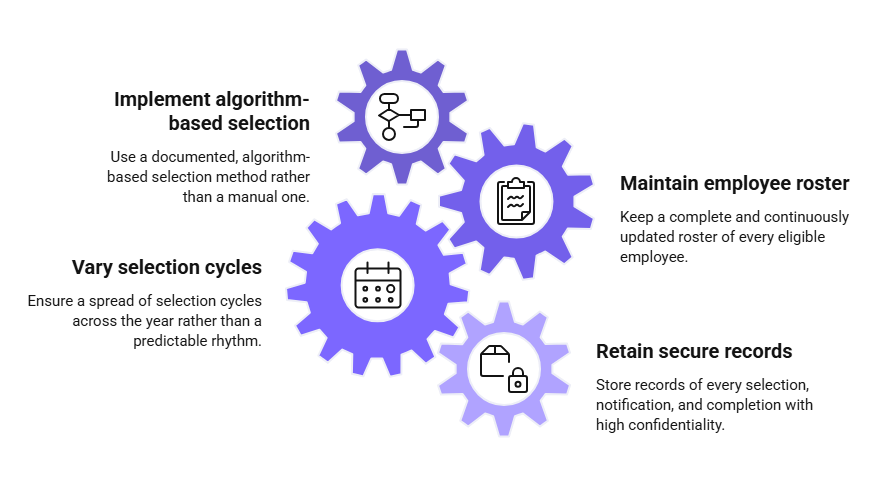
- A documented, algorithm-based selection method rather than a manual one.
- A complete and continuously updated roster of every eligible employee.
- A spread of selection cycles across the year rather than a predictable rhythm.
- Retained records of every selection, notification, and completion, stored with the confidentiality that drug test and health-related information requires.
None of these requirements are complicated individually. What makes them hard to sustain is scale: a program covering a few dozen employees at one location can often be tracked manually, but that approach breaks down once an organization is managing thousands of employees across multiple locations, shifts, and regulatory categories. A roster that is updated monthly instead of continuously, for example, will eventually miss a termination or a new hire, and that single missed update is enough to create the kind of coverage gap discussed earlier in this article.
GCheck’s Random Screening Management service is built around that operational gap: full population tracking across every location, algorithm-based selection spread across the year, and complete documentation ready for the moment an auditor or regulator asks for it. For organizations that have outgrown a spreadsheet-based approach, that is the difference between a program that exists on paper and one that actually reduces risk.
Frequently asked questions
Is random screening actually random, or can employers choose who gets tested?
Random screening uses a documented, algorithm-based method that gives every eligible employee an equal chance of selection each cycle, with no manual or discretionary input into who is chosen. Employers cannot select specific individuals, and a person who is tested remains in the pool and can be selected again in a later cycle. This is what distinguishes random screening from targeted testing.
Does random screening actually reduce workplace incidents?
Random screening reduces risk primarily through deterrence. Because selection is unannounced and unpredictable, employees cannot plan around a known testing date the way they could with a scheduled or announced test. That ongoing unpredictability, sustained across the full length of employment, is what gives random screening a different risk profile than one-time or event-triggered testing.
What happens if an employer’s random screening pool has gaps?
A pool that omits an eligible role, location, or employee creates a documented gap that regulators and auditors specifically look for during compliance reviews, and it can also weaken an employer’s defense in negligent-hiring or negligent-supervision claims. Coverage completeness, not just the testing rate, is what determines whether a program functions as a genuine safeguard.
Can inconsistent random screening create discrimination exposure?
Yes. Title VII prohibits treating employees differently based on a protected characteristic, and an inconsistently applied testing policy is the kind of evidence a disparate-treatment claim relies on. A documented, uniformly applied selection process protects against this exposure, while ad hoc or manual selection increases it.
Do all industries follow the same random screening rate?
No. The applicable rate depends on the regulatory regime that governs a given role. DOT-regulated CDL drivers and PHMSA-regulated pipeline employees currently fall under a 50 percent minimum controlled substances random testing rate under 49 CFR Part 382 and Part 199 respectively, while DOT alcohol testing sits at a 10 percent floor. Nuclear Regulatory Commission licensees instead maintain their own NRC-reviewed random testing plan under 10 CFR Part 26 rather than following a single published national percentage. Outside these federally regulated categories, state law governs whether and how random testing may be conducted.
Is random screening enough on its own, or does it need to be part of a larger program?
Random screening works best alongside pre-employment, post-accident, and reasonable-suspicion testing rather than as a standalone measure. Pre-employment testing addresses risk at hire, reasonable-suspicion and post-accident testing address specific events, and random screening is what covers the time in between, when no single triggering event has occurred.
Sources cited
- U.S. Government (eCFR). 49 CFR Section 382.305, Random testing. https://www.ecfr.gov/current/title-49/subtitle-B/chapter-III/subchapter-B/part-382/subpart-C/section-382.305
- U.S. Government (Federal Register). Pipeline Safety: Minimum Random Drug Testing Rate for Calendar Year 2026, published December 9, 2025. https://www.federalregister.gov/documents/2025/12/09/2025-22326/pipeline-safety-minimum-random-drug-testing-rate-for-calendar-year-2026
- U.S. Equal Employment Opportunity Commission. Employment Tests and Selection Procedures. https://www.eeoc.gov/laws/guidance/employment-tests-and-selection-procedures
- Centers for Disease Control and Prevention, National Institute for Occupational Safety and Health. Substance Use and Work. https://www.cdc.gov/niosh/substance-use/about/index.html
- U.S. Government (eCFR). 10 CFR Part 26, Fitness for Duty Programs. https://www.ecfr.gov/current/title-10/chapter-I/part-26

ABOUT THE CREATOR
Charm Paz, CHRP
Recruiter & Editor
Charm Paz is an HR professional at GCheck, specializing in background screening, fair hiring, and regulatory compliance. She holds from the Professional Background Screening Association (PBSA) and helps organizations navigate employment regulations with clarity and confidence.
With a background in Industrial and Organizational Psychology, she translates policy into practice to build ethical, compliant, human-centered hiring systems that strengthen decision-making over time.