


A CDL background check is not a single report with a pass/fail result. It is a coordinated stack of checks, each pulling from a different government database, each with its own lookback period, and each governed by its own federal regulations. This article breaks down every component, what it actually surfaces, what it deliberately does not surface, and how results translate into hiring decisions for carriers and fleet compliance teams.
Key Takeaways
- A CDL background check is a multi-component stack, not a single report. Missing any one component leaves a specific, documented blind spot with real liability consequences.
- Four checks are federally mandated before a CDL driver enters service: MVR, FMCSA Drug and Alcohol Clearinghouse full query, Safety Performance History, and pre-employment DOT drug test.
- A driver can have a clean MVR and a PSP full of federal inspection violations. The MVR and PSP pull from entirely different databases and do not overlap.
- The Clearinghouse only captures violations recorded after its launch date. Pre-launch drug and alcohol history requires Safety Performance History inquiry to surface.
- Mandatory FMCSA disqualification categories are absolute regulatory bars. Carrier discretion does not apply to them.
- Criminal history checks are not federally required for most CDL positions, but they surface convictions the MVR and Clearinghouse will not. The HAZMAT endorsement is the specific exception requiring a TSA security threat assessment.
- Every hiring decision based on background check results must be documented and retained in the Driver Qualification File for three years after employment ends.
The CDL Background Check Stack: Mandatory vs. Optional
Understanding which checks are federally mandated and which are carrier-discretion is the foundation of a defensible CDL screening program. Mandatory checks are required before a driver enters service regardless of carrier policy. Optional checks, by contrast, are not required by federal regulation but address blind spots the mandatory stack does not cover. Carriers who treat the optional checks as genuinely optional should understand that each optional component addresses a specific category of risk the mandatory stack does not reach.
| Check | Status | Regulatory Framework |
| Motor Vehicle Record (MVR) | Mandatory | FMCSA pre-employment driver qualification regulations |
| FMCSA Drug and Alcohol Clearinghouse full query | Mandatory | FMCSA drug and alcohol testing regulations |
| Safety Performance History (prior DOT employers, 3 years) | Mandatory | FMCSA pre-employment driver qualification regulations |
| Pre-employment DOT drug test | Mandatory | FMCSA drug and alcohol testing regulations |
| PSP report | Optional | FMCSA program |
| CDLIS check | Optional | FMCSA program |
| Criminal history check (CRA) | Optional (required for HAZMAT TSA assessment) | N/A (HAZMAT: TSA security regulations) |
| DOT physical and Medical Examiner’s Certificate | Mandatory (medical qualification) | FMCSA driver medical qualification regulations |
Carriers with questions about the specific regulatory provisions governing each component should verify current requirements against the eCFR at ecfr.gov/current/title-49 or confirm with qualified legal counsel and DOT compliance advisors.
Motor Vehicle Record: What It Shows and What It Misses
What the MVR Returns
The MVR is the foundational check in the CDL stack. It returns current CDL status and class, active endorsements and restrictions, Medical Examiner’s Certificate status, moving violations and traffic convictions, license suspensions and revocations, DUI and DWI convictions in the state of record, and state-reported accident history. Consequently, the MVR is the primary document confirming that a driver holds a valid, unrestricted CDL at the class required for the position.
What the MVR Does Not Return
The MVR does not return FMCSA roadside inspection violations. Inspection violations are recorded in FMCSA’s MCMIS database by federal and state inspectors and do not transmit automatically back to state DMVs. As a result, a driver can accumulate multiple out-of-service violations, hours-of-service violations, and vehicle defect violations at roadside inspections without any of them appearing on the MVR. The MVR also does not return Clearinghouse drug and alcohol violations, criminal convictions unrelated to driving, or driving history from states not covered by the three-year pull.
The Multi-State Pull Requirement
FMCSA pre-employment driver qualification regulations require carriers to obtain an MVR from every state where the driver held a commercial license or a motor vehicle operator’s license in the past three years. Pulling only the driver’s current state of residence is a citable FMCSA violation if the driver held a license in another state during the lookback period. Therefore, the CDLIS check is the tool carriers use to identify which states to pull before ordering MVRs.
“Rarely does one report provide a full account.” This is one lesson I learned while working within an HR and compliance environment. As I dug deeper into the screening process, I found that each screen had its purpose and showed another aspect of risk, liability, and accountability. Good hires are never made based on assumptions or quick fixes; they are the result of spending time figuring out how each piece fits into the whole puzzle. �
FMCSA Drug and Alcohol Clearinghouse: What It Shows and What It Does Not
The FMCSA Drug and Alcohol Clearinghouse is a federal database of CDL driver drug and alcohol program violations. Before hiring a CDL driver for a safety-sensitive function, carriers must conduct a full query. The query returns one of two results: Not Prohibited or Prohibited.
What a Full Query Returns
A full Clearinghouse query returns the following violation types when present:
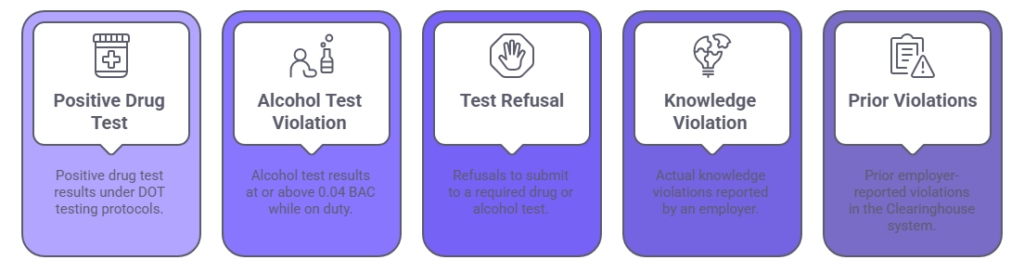
- Positive drug test results under DOT testing protocols.
- Alcohol test results at or above 0.04 BAC while on duty.
- Refusals to submit to a required drug or alcohol test.
- Actual knowledge violations reported by an employer.
- Prior employer-reported violations in the Clearinghouse system.
A Not Prohibited result confirms that no unresolved violations appear in the system for that driver. A Prohibited result, on the other hand, means the driver has an unresolved violation and cannot perform safety-sensitive functions until the return-to-duty process is complete.
What the Clearinghouse Does Not Return
The Clearinghouse does not return violations that occurred before the system launched. Carriers must therefore capture pre-launch drug and alcohol history through Safety Performance History inquiries to prior employers. The Clearinghouse also does not return state DUI convictions outside the CDL-regulated testing context or non-DOT drug test results. A full query, which requires the driver’s prior consent, is necessary to access violation details. Without driver consent, only a limited query is available, returning only a match or no-match notification rather than violation specifics.
Annual Limited Query Requirement
For currently employed CDL drivers, carriers must conduct an annual limited query to confirm no new violations appear in the system. The limited query does not require driver consent but returns only a notification of whether a full query is needed. If the limited query returns a match, a full query with driver consent is required.
PSP Report: What It Shows That the MVR Misses
The Pre-Employment Screening Program report is the most misunderstood component in the CDL stack. Unlike the MVR, which pulls from state DMV records, the PSP pulls from FMCSA’s MCMIS database, which federal and state inspectors maintain at roadside. These are entirely different data sources. Accordingly, a driver with a clean MVR can have a PSP full of federal inspection violations.
PSP Lookback Periods and Coverage
The PSP returns five years of FMCSA-reportable CMV crash data and three years of roadside inspection violation data. It surfaces inspection results, out-of-service orders, hours-of-service violations, vehicle condition violations, and driver violations recorded at federal roadside inspections. Notably, FMCSA program data indicates that carriers using PSP reports in pre-employment screening show meaningfully lower crash rates than carriers that do not, according to the program’s published impact analysis. Current program statistics are available at psp.fmcsa.dot.gov.
What the PSP Does Not Return
The PSP does not return personal vehicle incidents, crashes that did not meet FMCSA reportability thresholds, data from jurisdictions that do not submit to MCMIS, Clearinghouse violations, or criminal history. However, drivers can review their own PSP report at no cost at psp.fmcsa.dot.gov and dispute inaccurate entries through FMCSA’s DataQs system.
Safety Performance History: What Prior Employers Must Disclose
The Regulatory Requirement
FMCSA pre-employment driver qualification regulations require carriers to contact every DOT-regulated employer for whom the driver worked in the preceding three years, specifically requesting Safety Performance History. This inquiry must be complete within 30 days of the driver’s hire date. During that 30-day window, the carrier has hired a driver whose full DOT employment history is not yet confirmed, creating interim liability exposure if an incident occurs.
What It Surfaces and What It Does Not
A prior employer’s Safety Performance History response must include employment dates and positions, crash history during the employment period, all drug and alcohol test results including positives, refusals, and return-to-duty completions, and whether the driver was subject to DOT testing requirements. Importantly, this is the only mechanism for surfacing pre-launch Clearinghouse drug and alcohol violations not in the system. Safety Performance History does not cover non-DOT-regulated employers, subjective performance evaluations, disciplinary records unrelated to safety, or employment records older than three years.
Documentation and Driver Rights
When a prior employer does not respond, the carrier must document at least two good-faith contact attempts. That documentation protects the carrier in an FMCSA audit or negligent hiring claim. Additionally, drivers have the right to review prior employer disclosures and submit a rebuttal, which the carrier must retain in the Driver Qualification File.
Criminal History: Not Federally Required But Nearly Universal
A criminal history check is not federally required for most CDL positions. However, a criminal history check surfaces conviction categories that no federally mandated check will return. These findings may offer some background information that could be important for safety-sensitive driving jobs. Many transport companies find it helpful to have an extra level of screening when making hiring decisions.
What a Criminal History Check Surfaces
A CRA-sourced criminal history check returns the following for CDL hiring purposes:
- Felony convictions, particularly those involving violence, fraud, or drug distribution.
- Drug possession or distribution convictions not captured by the Clearinghouse.
- DUI and DWI convictions in personal vehicles that did not involve a CMV and therefore did not enter the MVR system as CDL-reportable events.
- Pattern behavior relevant to operating a commercial vehicle.
For HAZMAT endorsement holders, a TSA security threat assessment under federal TSA security regulations includes criminal history review. That assessment is government-administered and does not constitute a consumer report under FCRA. It is also separate from and in addition to any CRA-sourced criminal history check, which does trigger FCRA obligations.
Mandatory Disqualification vs. Carrier Discretion
FMCSA driver disqualification regulations establish specific criminal convictions that trigger mandatory CDL disqualification. These are absolute regulatory bars with no carrier discretion. Disqualification periods vary by offense type and by whether hazardous materials were involved, and some offenses carry lifetime disqualification for a second offense. Carriers should therefore confirm the applicable disqualification period for each specific finding directly against the current FMCSA disqualification regulations at ecfr.gov/current/title-49 or with qualified legal counsel.
For criminal history findings outside the mandatory disqualification categories, individualized assessment under federal anti-discrimination law applies. Carriers must consider the nature and gravity of the offense, the time elapsed, and the direct relationship between the offense and the CDL role. Furthermore, EEOC guidance on criminal history in employment has been subject to formal administrative revision, and carriers should confirm the current operative individualized assessment framework with qualified legal counsel. Criminal history evaluation for CDL positions involves both FMCSA regulatory requirements and FCRA and EEOC compliance obligations. Carriers should consult qualified legal counsel before establishing or updating their criminal history evaluation policies.
The Master Shows and Does Not Show Table
No single CDL check tells the complete story. Each component addresses a category of risk the others do not reach, and carriers who skip any component leave that blind spot unaddressed.
| Check | Lookback Period | What It Shows | What It Does Not Show |
| Motor Vehicle Record (MVR) | 3 years (all license states) | CDL status and class, endorsements, violations, suspensions, revocations, DUI/DWI, state-reported accidents | FMCSA roadside inspection violations, Clearinghouse violations, criminal history, out-of-state history not in the 3-year pull |
| FMCSA Drug and Alcohol Clearinghouse | Post-launch violations only | Positive drug tests, alcohol violations at 0.04+ BAC, refusals, actual knowledge violations, prior employer-reported violations | Pre-launch violations, state DUI outside CDL-regulated testing, non-DOT drug test results |
| PSP Report | 5 years (crashes), 3 years (inspections) | FMCSA-reportable CMV crashes, roadside inspection results, out-of-service orders, HOS violations, vehicle and driver violations | Personal vehicle incidents, non-reportable crashes, Clearinghouse violations, criminal history |
| Safety Performance History | 3 years (DOT employers only) | Employment verification, crash history, all DOT drug and alcohol test results, return-to-duty completions | Non-DOT employer history, subjective performance data, pre-launch Clearinghouse violations if prior employer does not respond |
| Criminal History (CRA) | Varies by state law and CRA scope | Felony and misdemeanor convictions, drug distribution and possession, non-CMV DUI and DWI, pattern behavior | Non-conviction records in states with restrictions, expunged records, Clearinghouse violations, PSP violations |
| CDLIS | Current status | All states where CDL is held or was held, license status in each state | Violations, crashes, drug and alcohol history |
What CDL Background Check Results Mean for Hiring Decisions
Results That Automatically Disqualify With No Carrier Discretion
Certain results trigger mandatory disqualification under FMCSA regulations with no hiring discretion available. These include:
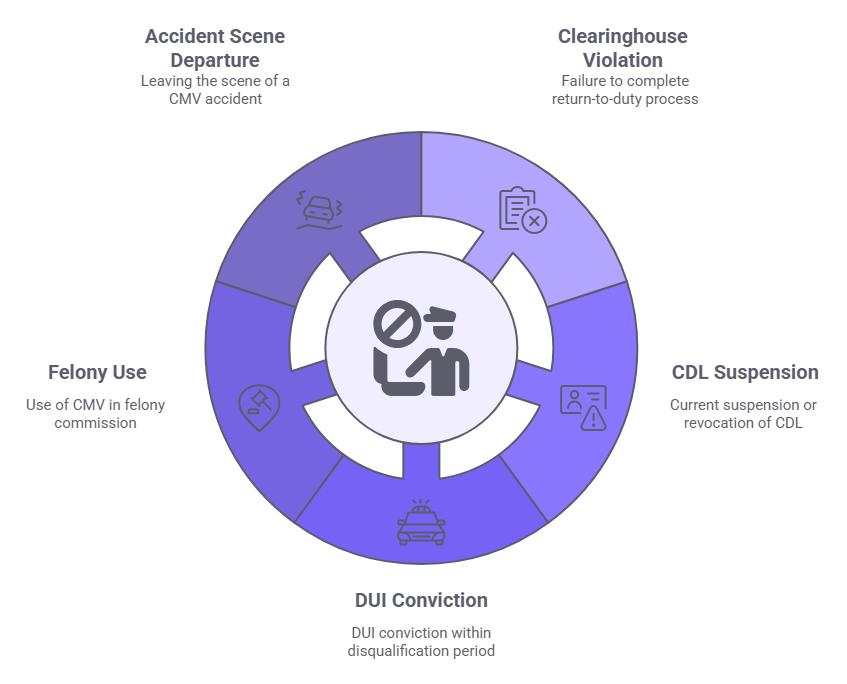
- A Clearinghouse Prohibited result where return-to-duty has not been completed.
- A current CDL suspension or revocation in any state.
- A DUI conviction in a CMV within the applicable disqualification period under FMCSA driver disqualification regulations.
- Use of a CMV in the commission of a felony.
- Leaving the scene of a CMV accident.
Carriers who hire drivers with these disqualifying findings are in direct regulatory violation regardless of any other factor.
Results That Require Evaluation and Where Carrier Discretion Applies
Outside the mandatory disqualification categories, carriers exercise discretion subject to documented, consistent evaluation standards. PSP roadside violation entries require review of violation type, frequency, and recency. Similarly, Safety Performance History crash records require evaluation of fault, severity, and pattern. Criminal history findings outside mandatory disqualification categories require individualized assessment under federal anti-discrimination law, considering the nature and gravity of the offense, the time elapsed, and the direct relationship between the offense and the CDL role. That assessment must be documented and applied consistently across candidates.
When a carrier uses a PSP report in a hiring decision, FCRA adverse action obligations may apply to PSP-based adverse action decisions. Carriers should therefore confirm FCRA compliance requirements for PSP-based adverse action with qualified legal counsel before implementing their program.
Results That Affect Specific Endorsements Without Revoking the Base CDL
Some findings affect only specific endorsements without disqualifying the driver from operating a CMV under the base CDL. For example, a failed TSA security threat assessment disqualifies a driver from holding a HAZMAT endorsement but does not affect other CDL privileges. Certain medical findings may also restrict specific vehicle configurations without affecting the base license. Carriers should confirm endorsement-specific findings with qualified legal counsel before making adverse action decisions that affect a driver’s broader CDL eligibility.
Documentation Requirements
Driver Qualification File Retention
Whether a carrier hires, declines to hire, or takes adverse action based on background check results, the decision and its basis must go into the Driver Qualification File. FMCSA driver qualification file regulations require retention for the duration of employment and for three years after employment ends.
FCRA Adverse Action for Criminal History Decisions
For criminal history adverse action based on a CRA-sourced report, the FCRA adverse action process applies. The pre-adverse action notice must include a copy of the consumer report and the Summary of Rights Under the FCRA, and must inform the driver of their right to dispute the accuracy or completeness of the report. The carrier must then allow a waiting period of generally at least five business days per CFPB and FTC guidance. The final adverse action notice must identify the CRA by name, address, and telephone number, state that the CRA did not make the adverse action decision and cannot give specific reasons for it, and inform the driver of their right to obtain a free copy of the report within 60 days.
FCRA Adverse Action for Re-Screened Drivers
The FCRA adverse action process applies equally to employment decisions affecting current CDL drivers who face re-screening. This includes termination or reassignment decisions made in response to re-screening results, in the same way it applies to pre-employment applicants.
Conclusion
A CDL background check is a stack of checks, not a single report. Each component pulls from a different data source, covers a different lookback period, and surfaces a different category of risk. Carriers who treat any one component as sufficient leave the others’ blind spots unaddressed. A complete, documented CDL screening program runs all mandatory components, evaluates optional components against the risk profile of each role, and retains the full decision record in the Driver Qualification File. Carriers with questions about their specific screening program obligations should confirm requirements with qualified legal counsel and DOT compliance advisors.
Frequently Asked Questions
What does an FMCSA background check show?
An FMCSA background check is not a single check. It includes an MVR from all license states in the past three years, a Drug and Alcohol Clearinghouse full query, Safety Performance History from all prior DOT-regulated employers, and a pre-employment DOT drug test. Each component surfaces different data from different government databases. A complete stack is required before a CDL driver enters safety-sensitive service.
Does a CDL background check show criminal history?
Criminal history checks are not federally required for most CDL positions. Most carriers run one because it surfaces convictions the MVR and Clearinghouse will not. HAZMAT endorsement holders require a separate TSA security threat assessment that includes criminal history review. Criminal history findings outside mandatory FMCSA disqualification categories require individualized assessment under federal anti-discrimination law before any adverse action decision is made.
How far back does a CDL background check go?
The lookback period depends on the component. MVR covers the past three years across all license states. The Clearinghouse covers violations recorded after its launch date. The PSP covers five years of crash data and three years of roadside inspection data. Safety Performance History covers three years of DOT-regulated employment. Criminal history lookback periods vary by state law and CRA search scope.
Will a DUI show up on a CDL background check?
Yes, depending on the context. A DUI in a CMV appears on the MVR and may trigger mandatory FMCSA disqualification under federal driver disqualification regulations. A DUI in a personal vehicle appears on the MVR and a CRA criminal history check. A Clearinghouse alcohol violation at or above 0.04 BAC on duty appears in the Clearinghouse. Multiple components may each capture different aspects of the same driver’s DUI history.
Can a driver see what their CDL background check shows?
Yes. Drivers can review their PSP report at psp.fmcsa.dot.gov and dispute inaccuracies through FMCSA’s DataQs system. Drivers can also access their Clearinghouse record at clearinghouse.fmcsa.dot.gov. If a carrier uses a CRA-sourced report and takes adverse action, FCRA requires the carrier to provide the driver a copy of the report and notice of dispute rights.
What shows on a CDL background check that a regular background check does not?
Three components are unique to the CDL stack. The FMCSA Drug and Alcohol Clearinghouse captures only DOT-regulated violations with no standard equivalent. The PSP report captures five years of CMV crash data and three years of roadside inspection violations from federal inspector records. Finally, Safety Performance History captures DOT-specific employment verification and all prior DOT drug and alcohol test results directly from prior regulated employers.
Additional Resources
- FMCSA Drug and Alcohol Clearinghouse
https://clearinghouse.fmcsa.dot.gov - FMCSA Pre-Employment Screening Program (PSP)
https://www.psp.fmcsa.dot.gov - Title 49 CFR: Federal Motor Carrier Safety Regulations (eCFR)
https://www.ecfr.gov/current/title-49 - FMCSA: Driver Qualification File Requirements
https://www.fmcsa.dot.gov/regulations/driver-qualification-files - FMCSA: Commercial Driver’s License Standards and Disqualifications
https://www.fmcsa.dot.gov/regulations/commercial-drivers-license - FTC: Using Consumer Reports for Employment Purposes
https://www.ftc.gov/business-guidance/resources/using-consumer-reports-employment-purposes

ABOUT THE CREATOR
Charm Paz, CHRP
Recruiter & Editor
Charm Paz is an HR professional at GCheck, specializing in background screening, fair hiring, and regulatory compliance. She holds from the Professional Background Screening Association (PBSA) and helps organizations navigate employment regulations with clarity and confidence.
With a background in Industrial and Organizational Psychology, she translates policy into practice to build ethical, compliant, human-centered hiring systems that strengthen decision-making over time.