

A manager whose behavior makes a team miserable and an individual contributor who does the same thing are not judged the same way, even when the behavior is identical. GCheck’s Consequence Gap Report found managers get protected at a meaningfully higher rate, and removed at about half the rate, of employees seen as easier to replace. The gap has a specific, mostly avoidable mechanism behind it.
Key Takeaways
- GCheck’s The Consequence Gap Report found that managers and senior leaders whose behavior consistently made coworkers’ jobs worse were rewarded or protected in 36% of cases and removed in only 21%. Junior coworkers faced close to the opposite pattern: 24% protected, 41% removed.
- Workers exposed to a toxic manager report dread about the workday at nearly one and a half times the rate of workers exposed to a toxic peer, 76% versus 53%.
- The protection isn’t usually a conscious decision to look the other way. It comes from a specific set of organizational mechanisms: performance attribution, sponsor relationships, replacement cost, and HR’s own caution around senior terminations.
- A consistent standard doesn’t require treating every case identically. It requires separating the question of performance from the question of conduct, and applying the same conduct standard regardless of title.
- Workers themselves rank managers addressing problems early and consequences that hold regardless of performance as the top two fixes, well ahead of anything about softer standards.
What the Data Actually Shows
The Rank Gap in Numbers
GCheck’s Consequence Gap Report surveyed 1,500 US workers about a coworker whose behavior consistently made their job harder, and it found that the outcome depended heavily on the coworker’s rank:
| Coworker’s rank | Rewarded or protected | Removed or left |
| Manager or senior leader | 36% | 21% |
| Junior coworker | 24% | 41% |
Two Gaps, Not One
A manager accused of the same behavior as a junior employee is protected at roughly one and a half times the rate, and removed at about half the rate. The damage runs the opposite direction: workers exposed to a toxic manager report increased dread about the workday at a rate of 76%, compared with 53% when the difficult coworker was a peer, and the share who say the experience changed them for the worse rises from 26% to 36%. The cases an organization is least willing to touch are the ones its own employees say hurt the most.
Put plainly, the data describes two separate gaps stacked on top of each other. The first gap is in outcome: what actually happens to the person. The second is in harm: how much worse the experience is for the people underneath them. An organization that only tracks the first gap, whether the manager eventually leaves, misses the second one entirely, since a manager who is quietly protected for two years before finally moving on has already done two years of damage that the eventual outcome doesn’t capture.
Not a Character Difference
This is not a story about managers being worse people than individual contributors. The behaviors involved (constant complaining, escalating small conflicts, undermining people privately, taking credit for others’ work) are the same regardless of who’s doing them. What changes is what happens next, and that’s a structural finding, not a character one.
One respondent to GCheck’s original research described exactly that reversal: “I ended up getting fired from that job, but I dreaded coming into work every day because she was there and made it miserable for me.” The manager stayed. The employee describing the experience did not.
What This Costs the Team

The rank gap doesn’t stay contained to the manager in question. The same research found that where a difficult coworker was rewarded or protected instead of addressed, the people exposed to them left the job before that coworker did at roughly four times the rate seen when the organization actually acted. Applied to a toxic manager specifically, that means the team members reporting to a protected manager are the ones most likely to leave first, not the manager. A department that protects a difficult manager because replacing them looks expensive can end up paying that cost anyway, just distributed across several quieter departures instead of one visible one.
That distribution matters because it’s harder to see. A single manager termination shows up as one clear line item: a departure, a transition plan, a new hire. A slow bleed of individual contributors leaving a team over eighteen months rarely gets traced back to the manager who was never held accountable. It shows up instead as “this team just has high turnover,” treated as a property of the role or the market rather than a consequence of a decision made, or avoided, further up the chain.
Recruiting and onboarding costs compound the problem further. Every departure driven by a protected manager triggers a full hiring cycle: sourcing, interviewing, onboarding, and months of ramp-up before the new hire is fully productive. None of that cost gets attributed to the manager whose behavior drove the departure, because by the time the new hire’s own manager reviews their onboarding cost, the connection to the original conduct complaint is several steps and several months removed.
What This Isn’t Arguing
Holding managers to a high bar is not the same as treating every demanding manager as toxic. Plenty of effective managers push their teams hard, give direct feedback, and hold people to a high standard, and none of that is what this article is describing. The distinction that matters is the same one that separates performance from conduct throughout this piece: a manager who sets a high bar and communicates clearly about it is doing their job. A manager who complains constantly, undermines people privately, or takes credit for a direct report’s work is engaging in the specific kind of behavior GCheck’s research measured, regardless of how their team’s numbers look. Conflating the two either lets real misconduct hide behind “they’re just a tough manager,” or unfairly brands an effective, demanding manager as toxic. Neither serves the team.
Why the Gap Runs This Direction
Performance Attribution
Four mechanisms show up often enough to explain most of the pattern, starting with performance attribution. A manager’s team hitting its numbers gets credited to the manager, and that credit becomes a kind of insulation. A complaint about how the manager treats people competes against a metric everyone above them can already see. An individual contributor rarely has an equivalent shield; their conduct and their output are judged separately by default, while a manager’s conduct often gets folded into “but look at their results.” The stronger the team’s numbers, the more this shield tends to hold, which means the managers producing the best visible outcomes are often the hardest to hold accountable for how they produced them.
Sponsor Relationships
Managers are frequently hired or promoted by a specific executive, and that executive has a personal stake in the decision looking correct in hindsight. Acting on a conduct complaint about someone you personally elevated means admitting the elevation might have been wrong. That’s a harder admission to make than acting on a complaint about someone you had no hand in choosing. This is especially pronounced for a manager promoted from within, since a promotion decision is also a public statement about the promoting executive’s own judgment.
Replacement Cost
A manager carries team relationships, process knowledge, and often client or cross-functional context that took months or years to build. Replacing an individual contributor is comparatively fast and low-risk. Replacing a manager means a gap in coverage, a learning curve for whoever steps in, and a real chance the team’s output dips for a quarter or two. That cost gets weighed, explicitly or not, against the cost of the behavior, and unlike the behavioral cost, the replacement cost is immediate, quantifiable, and easy to put in front of a budget-conscious executive.
HR’s Own Risk Aversion
Senior terminations are often treated internally as carrying more legal and reputational exposure than junior ones, whether or not that’s actually true in a given case, which can push HR toward documentation, delay, and negotiated exits rather than the faster process applied further down the org chart. The caution is understandable. It’s also exactly what produces the removal-rate gap in the data, since a process built around delay and negotiation will, by construction, remove people more slowly than one built around a documented standard applied promptly.
A relocation or a demotion can look like accountability without actually being it. One respondent described precisely this outcome: “Either I left, or they were moved to another position, location, or demoted. Currently, I am still dealing with bullying and harassment from this same micromanaging manager and leadership.” The manager’s title changed. The behavior, and the harm, did not.
How the Mechanisms Stack Together
None of these four mechanisms requires anyone to consciously decide that senior misconduct matters less. They operate quietly, in the space between a complaint being filed and a decision being made, and they push in the same direction often enough to produce a 12-point gap in reward rates and a roughly two-to-one gap in removal rates.
It’s worth walking through how these mechanisms stack rather than treating them as four independent factors. Consider a hypothetical: a director hired eighteen months ago by the VP of Sales has hit every quota, and three people on her team have quietly requested transfers. The performance attribution mechanism means her numbers get discussed in the leadership meeting while the transfer requests get handled by an HR generalist with no visibility into the pattern. The sponsor relationship means the VP who hired her reads any conduct concern as a referendum on his own judgment. The replacement cost means finding, hiring, and ramping a new director would cost a visible quarter of disruption. None of these three factors is a decision to protect her. Each one is a reasonable-sounding reason to wait, and together they add up to eighteen months of a team quietly losing people while the director’s file shows nothing but strong numbers.
A Framework for Consistent Accountability Regardless of Rank
The Five Pieces
Workers themselves are specific about what would help. Asked what would most keep this kind of behavior from spreading, they ranked managers addressing problems early (61%) and consequences that hold regardless of performance (52%) as the top two answers, well ahead of anything about softer standards. Turning that into an actual process takes five concrete pieces:
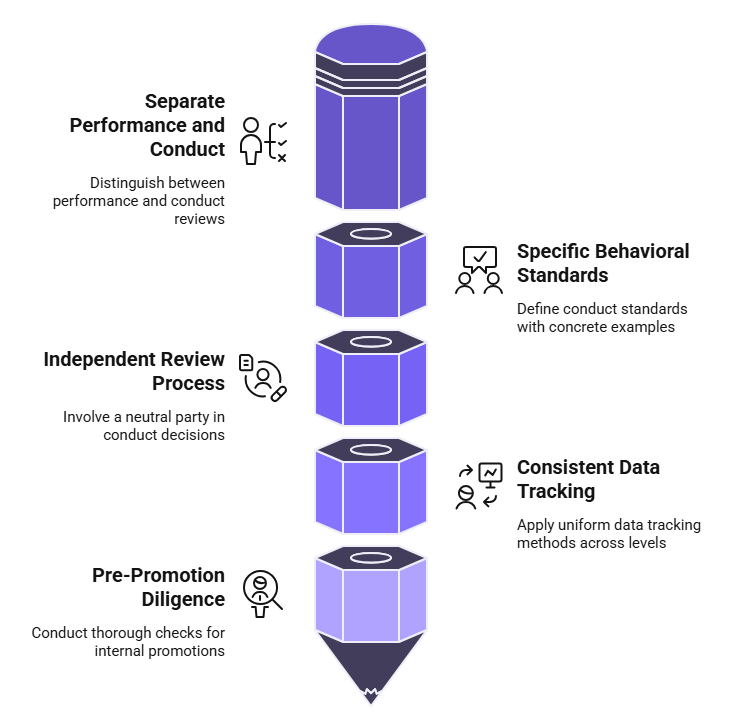
- Separate the performance review from the conduct review. Give them different forms, different timing, or at minimum a section that cannot be skipped. A manager’s strong quarter should never be the reason a conduct complaint gets filed away rather than followed up on. In practice, this can be as simple as a standing conduct-review checkpoint that happens on its own schedule, independent of the performance cycle, so the two conversations never get merged into one where the stronger data point wins by default.
- Write the conduct standard down as specific behaviors, not general values. “Respectful communication” is not enforceable. “Does not take credit for a direct report’s work in front of leadership” is. The more specific the standard, the harder it is for a good quarter to argue its way around it, and the easier it is for a reviewer to point to the exact line that was crossed rather than relying on a subjective read of “tone” or “culture fit.”
- Route conduct decisions through someone without a stake in the outcome. The executive who hired the manager should not be the sole decision-maker on whether that manager’s conduct crosses a line. A second reviewer, an HR partner, or a small panel breaks the sponsor-relationship mechanism without requiring anyone to admit a past decision was wrong. This person’s only job in the conversation is the conduct question; they should not be asked to weigh in on the manager’s performance at the same time.
- Track pattern data the same way at every level. If turnover on a manager’s team is reviewed informally while turnover reported up to a director gets a real root-cause process, that inconsistency is itself part of the problem. The same review trigger, for instance, three or more departures from one team within twelve months, should apply whether the person in question has two direct reports or two hundred.
- Apply the same pre-promotion diligence internally that a new hire would get externally. An external candidate for a management role typically goes through Professional Reference Checks; an internal promotion into the same role often doesn’t, on the assumption that the organization already knows the person. That assumption is exactly the sponsor-relationship mechanism in a different form. Running the same reference process for an internal promotion, asking a candidate’s current peers and reports the same conduct-focused questions a reference check would ask, surfaces a pattern before someone is handed a title that makes it harder to address.
Why This Works
None of these five pieces requires new technology or a large program. They require deciding, in advance and in writing, what the standard is and who applies it, so the decision doesn’t have to be made fresh, under pressure, every time a valuable manager’s name comes up. The value of deciding this in advance is specifically that it removes the moment of judgment call, the exact moment where the four mechanisms above have room to operate, and replaces it with a standard that was already agreed to before anyone’s specific case was on the table.
A useful test for whether a framework like this is actually working: pull the last five conduct complaints filed against managers and the last five filed against individual contributors, and check whether they moved through the same steps, on a similar timeline, reviewed by a similarly independent party. If the manager complaints consistently took longer, involved more people, or ended in a different kind of resolution, the standard isn’t actually consistent yet, regardless of what the policy document says.
Keeping It Consistent Over Time
This test also works as an ongoing audit, not just a one-time check. Run it quarterly rather than once, since a framework that looks consistent on the day it’s adopted can quietly drift back toward the old pattern within a year if no one is checking. The mechanisms described earlier in this article don’t go away because a policy was written; they’re still there, still pushing in the same direction, and the only thing keeping them from winning again is someone periodically confirming that the process is still being followed as written.
What This Framework Doesn’t Require
This is not a case for treating every manager as a suspect or adding new monitoring on top of performance reviews. The framework above is about decision structure, who reviews what, and when, not about watching people more closely. It’s also not a claim that every manager accused of difficult behavior is guilty, or that performance should stop mattering; performance is still the right basis for performance decisions. The point is narrower: conduct and performance are two different questions, and an organization that only has a process for one of them will keep discovering, after the fact, that its best-reviewed managers were sometimes also its most protected ones.
It’s also not a claim that every organization needs a large new compliance function to do this. The five pieces above (separating the reviews, writing the standard down, routing the decision away from the sponsor, tracking pattern data consistently, and applying the same reference-check diligence to internal promotions) can be implemented by a single HR leader with the authority to insist on them. The barrier is rarely resources. It’s usually the discomfort of applying a written standard to someone senior enough that no one has had to do it before.
Nothing here is a substitute for legal guidance on a specific termination decision. Employment law varies by jurisdiction and by the specifics of a case, and a documented, consistent process is a foundation for a fair decision, not a legal opinion about any particular one. The goal of the framework above is to make sure that whatever decision gets made, made with legal counsel where appropriate, is being made on the same footing a similar decision about a junior employee would already receive.
Frequently Asked Questions
Why don’t bad managers get fired as often as bad employees?
Research on this pattern found that managers whose behavior consistently made coworkers’ jobs harder were rewarded or protected in 36% of cases and removed in only 21%, compared with 24% protected and 41% removed for junior coworkers in the same situation. The gap comes from performance attribution, sponsor relationships, replacement cost, and HR’s own caution around senior terminations, not from senior misconduct being less serious.
Does a toxic manager actually cause more damage than a toxic coworker at the same level?
By workers’ own account, yes. Employees exposed to a toxic manager report dread about the workday at a rate of 76%, compared with 53% for a toxic peer, and are more likely to say the experience changed them for the worse. The cases organizations are least willing to address are the ones employees say hurt the most.
How can HR apply the same standard to managers and individual contributors?
Separate the conduct review from the performance review so a strong quarter can’t quietly bury a complaint, write the conduct standard as specific behaviors rather than general values, route conduct decisions through someone without a personal stake in the manager’s success, and apply the same pattern-tracking (like team turnover) at every level rather than only scrutinizing it lower in the org chart.
Is holding managers accountable the same as increasing surveillance of leadership?
No. The framework here is about decision structure and consistent standards, not about monitoring managers more closely. Workers themselves rank early intervention and consistent consequences as the top fixes for this pattern, well ahead of anything involving closer oversight or softer standards.
What’s the biggest reason toxic managers get protected?
No single reason accounts for all of it, but replacement cost and sponsor relationships tend to matter most. A manager who carries institutional knowledge and was personally promoted by someone still in the organization benefits from two forms of protection an individual contributor usually doesn’t have.

ABOUT THE CREATOR
Charm Paz, CHRP
Recruiter & Editor
Charm Paz is an HR professional at GCheck, specializing in background screening, fair hiring, and regulatory compliance. She holds from the Professional Background Screening Association (PBSA) and helps organizations navigate employment regulations with clarity and confidence.
With a background in Industrial and Organizational Psychology, she translates policy into practice to build ethical, compliant, human-centered hiring systems that strengthen decision-making over time.