

LEGAL & COMPLIANCE

Understand the importance of a workplace drug testing policy and how it impacts employment decisions and legal obligations.
Created by

A workplace drug testing policy is not a statement of intent. It is a legal document that governs adverse employment decisions, triggers ADA duties, determines whether FCRA rules apply, and exposes an organization to enforcement when it is missing, vague, or out of date. This article gives HR managers and legal leads the framework they need to build or audit a policy that will hold up in 2024 and beyond.
A verbal drug testing policy fails in four concrete ways. First, without a written standard, supervisors make enforcement calls rather than following documented criteria, and inconsistent enforcement across protected classes is a discrimination claim waiting to happen. Second, a verbal policy does not give employees and applicants legally sufficient notice, which many states require and which undermines any adverse action an employee can claim they were not informed about. Third, federal contractors with contracts of $100,000 or more must have a written drug-free workplace policy under the Drug-Free Workplace Act, and grant recipients must comply regardless of grant amount. Fourth, without written chain-of-custody and privacy procedures, specimen integrity challenges and privacy claims have nothing to rebut them.
A written policy serves three core functions:
Two federal frameworks set the floor for workplace drug testing. The Drug-Free Workplace Act requires federal contractors above the $100,000 threshold and all federal grant recipients to maintain a written drug-free workplace policy and an employee awareness program. DOT regulations under 49 CFR Part 40 set mandatory drug and alcohol testing procedures for employers in safety-sensitive transportation industries. For DOT-regulated employers, the regulation sets mandatory procedures with no deviation allowed for covered positions.
The ADA creates three specific obligations relevant to drug testing programs. Past addiction qualifies as a covered disability, and an employee with a history of substance use disorder who is not currently using illegal drugs must receive reasonable accommodation review before any adverse action. Employees in medication-assisted treatment programs, including those taking buprenorphine or methadone under a licensed prescription, are protected from adverse action based solely on that treatment. An employer may act if the medication creates a direct threat to workplace safety, but that determination must rest on an individualized assessment of the employee’s current ability to safely perform the essential job functions, supported by objective medical evidence. General assumptions about MAT medications do not meet the direct threat standard.
Alcohol addiction receives a specific ADA treatment. An employee with alcoholism may qualify as an individual with a disability even if currently drinking. Employers may hold employees with alcoholism to the same conduct and performance standards as all other employees. Termination for conduct or performance violations that apply uniformly to all employees does not require reasonable accommodation before execution. However, termination based solely on the disability itself, rather than on conduct or performance, requires individualized reasonable accommodation review. FMLA separately entitles eligible employees to leave for inpatient substance abuse treatment.
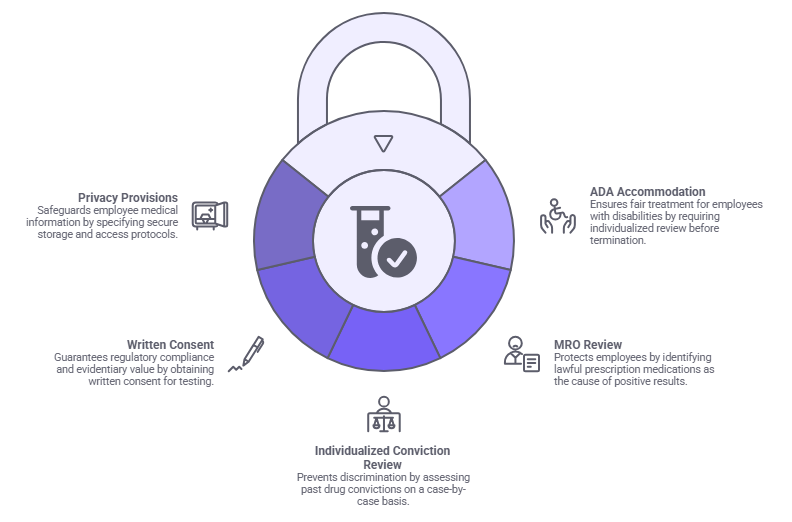
Automatic termination language for any positive drug test result, without MRO review or individualized accommodation review, may violate ADA reasonable accommodation obligations. Qualified legal counsel should review all termination language before the policy is finalized.
As of 2024, a majority of U.S. states have legalized recreational or medical cannabis, and a growing number have enacted explicit employment protections for off-duty cannabis use. Both the legalization landscape and employment protection frameworks continue to shift as state legislatures act. This creates a direct conflict for private employers not subject to federal mandates: state law may prohibit adverse action based on off-duty cannabis use or a positive test result without evidence of current impairment, while an existing policy may require termination for any positive result. Employers should confirm the current status in each operating state with qualified legal counsel rather than relying on any published count, and in most cases policy language revision will be required.
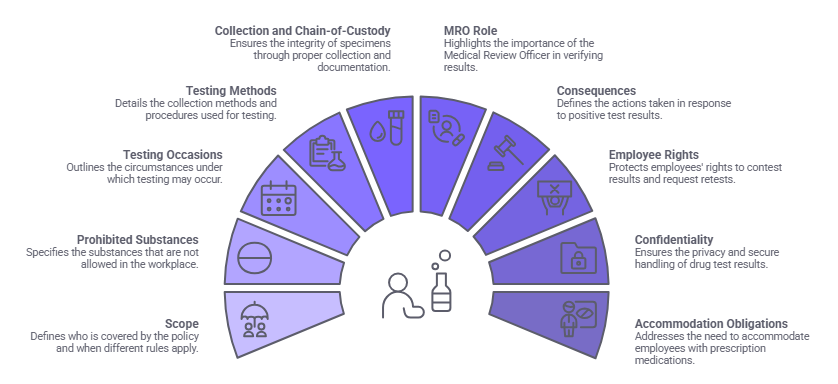
A compliant workplace drug testing policy must contain the following ten components. Each is a legally operative element, not a formatting requirement.
Most drug testing policies existed before cannabis legalization was widespread and before state employment protection laws took hold. Those policies typically ban the presence of any detectable substance. In states with cannabis employment protections, that language creates direct liability. A urine test positive for cannabis metabolites does not establish current impairment. Cannabis metabolites can stay detectable in urine for varying periods after last use depending on how often someone uses and their individual metabolism, meaning a positive urine result does not show when use occurred or whether impairment existed at the time of the test. Acting on that result without evidence of current impairment exposes the employer to state law claims.
The correct policy framing in cannabis-protective states is to ban being under the influence of or impaired by any substance during work hours, rather than banning the presence of any detectable substance at any time. This framing aligns with what state employment protection laws actually allow employers to enforce.
DOT-regulated employers and federal contractors have a clear answer to the cannabis question. Federal law governs their testing programs, and state cannabis employment protections do not override federal requirements for safety-sensitive positions. These employers must reflect the federal requirement in their policy and state explicitly that federal law governs testing for covered positions.
Oral fluid testing is more defensible than urine testing for cannabis policy enforcement in cannabis-protective states. Its detection window of 24 to 48 hours more closely tracks recent use and potential impairment. The DOT approved oral fluid as an alternative specimen type in 2023. However, practical use depends on the availability of SAMHSA-certified oral fluid testing labs. Carriers should confirm current lab availability with their CRA and DOT compliance advisor before implementing oral fluid testing under DOT programs. Most state cannabis employment protection laws include exceptions for safety-sensitive positions. Over-broad use of the safety-sensitive label across all positions creates its own liability. Safety-sensitive positions must appear in the policy with a documented operational reason for that classification.
| Testing Occasion | Legal Trigger | Documentation Required |
| Pre-employment | After conditional offer, before start date | Written consent, MRO review before adverse action |
| Random | Computer-generated selection from covered pool | Selection methodology documentation |
| Reasonable suspicion | Specific observed behavior or physical signs | Two supervisors for DOT; contemporaneous written documentation |
| Post-accident | Objectively reasonable basis to believe drug use contributed | Incident report, supervisor documentation of basis |
| Return-to-duty | Following confirmed positive or policy violation | SAP evaluation; follow-up testing schedule |
| Follow-up | Per SAP-prescribed schedule after return-to-duty | SAP follow-up testing plan |
| Method | Detection Window | Key Considerations |
| Urine | Varies by substance and individual metabolism | Most widely used; positive result does not show when use occurred or whether impairment was present |
| Oral fluid | 24 to 48 hours | DOT-approved since 2023 pending lab availability; more defensible for cannabis testing; resistant to tampering |
| Hair follicle | Approximately 90 days | Not DOT-approved; differential drug binding in melanin-rich hair creates disparate impact litigation risk; requires legal review before adoption |
| Breath alcohol | Current impairment only | No prior-use detection; primary method for alcohol reasonable suspicion and post-accident testing |
OSHA’s 2016 rule on electronic recordkeeping established that blanket post-incident drug testing policies may constitute unlawful retaliation if they deter injury reporting. For general industry employers not subject to DOT requirements, post-accident drug testing is only allowed when there is an objectively reasonable basis to believe that drug use by the reporting employee contributed to the incident. Blanket policies requiring testing after any injury report, regardless of circumstances, risk classification as retaliatory under 29 CFR 1904.35.
“What makes a workplace policy truly effective, the document itself or the way people actually understand and apply it?” One thing I have learned in HR is that policies become risky when organizations treat them as templates instead of living systems that affect real people and real decisions. In particular, a drug testing policy isn’t something simple as being concerned with enforcement; it’s also about being clear, consistent, and finding the right balance between accountability and fairness. �
The following five policy elements must never appear.
Outdated substance lists that omit synthetic opioids including fentanyl and do not reflect the expanded DOT opioid panel create additional compliance and documentation gaps that must also be corrected.
Different industries and employer categories face distinct governing frameworks. The table below maps each category to its key policy obligation.
| Employer or Industry | Governing Requirement | Key Policy Obligation |
| DOT-regulated employers | 49 CFR Part 40 | Mandatory procedures, no deviation for covered positions, SAP program |
| Federal contractors and grantees | Drug-Free Workplace Act | Written policy and employee awareness program |
| Healthcare employers | State licensing board rules, CMS Conditions of Participation | Facility-specific requirements vary by state and license type |
| Staffing agencies | Client contract terms, joint employer analysis | Clarify which entity’s policy governs each worker category |
| Construction and general industry | OSHA 29 CFR 1904.35 | Post-accident testing requires objectively reasonable basis |
| Transit employers | FTA Drug and Alcohol Program | FTA-specific random testing rates and SAP requirements |
Distribute the policy before it takes effect and collect a signed acknowledgment from every covered employee. Store acknowledgments separately from drug test results. For applicants, disclose the testing requirement before extending a conditional offer in states that require pre-offer disclosure. The acknowledgment is not a waiver of rights. It is proof that the employee received notice of the policy.
Supervisors are the front-line enforcement point for reasonable suspicion testing, and untrained supervisors produce inconsistent determinations that create discrimination exposure. Training must cover behavioral and physical signs of impairment, documentation requirements, and the DOT two-supervisor concurrence requirement for regulated programs. Supervisors must write down their observations at the time they occur, not after the fact.
Cannabis law shifts fast enough that an annual policy review is not enough in many states. Organizations with multi-state operations should set calendar triggers for state legislative sessions and federal regulatory announcements. On every substantive update, re-distribute the policy and collect new signed acknowledgments. For employees who refuse to sign, document the refusal in writing with a witness present, note that the refusal does not cancel the policy, and include language stating the organization may consider the refusal in employment decisions to the extent permitted by applicable law.
Drug testing, like most medical inquiries under the ADA, must occur after a conditional offer is extended. Pre-offer testing creates ADA exposure because the result may reveal a disability before the employer has made a decision based on non-medical factors. Post-offer drug testing must also apply consistently to all entering employees in the same job group. Selective testing within a job group at the post-offer stage is a separate ADA violation regardless of timing.
Drug test and background check results may run in parallel after the conditional offer. If both come through a consumer reporting agency, both may qualify as consumer reports under FCRA and each triggers independent disclosure and authorization requirements. Employers should confirm with their CRA and qualified legal counsel whether a single combined disclosure satisfies FCRA for both checks or whether separate authorizations are needed.
When a third-party company collects and reports drug test results to an employer, that reporting may qualify as a consumer report under FCRA, triggering disclosure and authorization requirements before the test. If the employer uses the result in an adverse employment decision, the full FCRA adverse action two-step process applies: a pre-adverse action notice with a copy of the consumer report and the Summary of Rights Under the FCRA, followed by a waiting period, then a final adverse action notice identifying the consumer reporting agency and informing the applicant of their dispute rights. Employers should confirm with their testing vendor and qualified legal counsel whether FCRA applies to their specific arrangement. Consistent workflow across all candidates for the same position is an important part of a defensible screening program and helps guard against claims of selective or unequal screening.
A workplace drug testing policy built before 2020, never reviewed by legal counsel, or based on a downloaded template is likely missing at least one of the ten required components and may contain at least one of the five liability-generating elements this article identifies. The cannabis impairment versus presence distinction has fundamentally changed what a legally defensible cannabis testing policy must say in states with employment protections. The ADA accommodation obligation, the MRO review requirement, and the FCRA sequencing requirement are not technical details. They are the failure points where organizations face the most concrete legal exposure when a positive result faces a challenge. A policy review by qualified legal counsel, updated for current state law in every operating location, is the right baseline for any organization with an active drug testing program.
A compliant policy must include scope, prohibited substances, testing occasions, testing methods, chain-of-custody procedures, MRO review process, consequences, employee rights, privacy procedures, and accommodation obligations for prescription medications. Each component is a legally operative element. Missing any one creates a specific and documentable legal exposure.
Yes, in most states and for most private employers. However, some states limit random testing to safety-sensitive positions. DOT-regulated employers must follow mandatory random testing rates for covered positions. The policy must specify which employee groups are subject to random testing and the selection method used.
No. Immediate termination before MRO review may violate ADA reasonable accommodation obligations. The MRO must review the result and issue a final determination before the employer takes any adverse action. Consequences should follow a documented process that includes MRO review and, where applicable, individualized accommodation review.
The MRO contacts the employee during review and evaluates whether a lawful prescription explains the result. If confirmed, the MRO reports the result to the employer as negative. The employer should not receive information about the specific medication unless the MRO determines it creates a direct threat to workplace safety based on individualized assessment.
Generally yes, if they fall within the policy’s scope. However, reasonable suspicion testing is harder to apply for remote workers. The policy should address whether and how reasonable suspicion testing applies to remote employees and how supervisors will document their observations.
Retention requirements vary by employer type. DOT-regulated employers must follow retention periods in 49 CFR Part 40. For non-DOT employers, applicable state law governs. Records supporting any adverse action based on a drug test result should be kept for the duration of any applicable statute of limitations for employment claims.
A Medical Review Officer is a licensed physician who reviews drug test results, contacts employees about lawful prescription explanations, and sends final results to employers. MRO review is mandatory under DOT regulations for regulated programs and best practice for all programs. Acting on a lab result without MRO review creates direct ADA exposure.
Recruiter & Editor
Charm Paz is an HR professional at GCheck, specializing in background screening, fair hiring, and regulatory compliance. She holds from the Professional Background Screening Association (PBSA) and helps organizations navigate employment regulations with clarity and confidence.
With a background in Industrial and Organizational Psychology, she translates policy into practice to build ethical, compliant, human-centered hiring systems that strengthen decision-making over time.

Contact us today for efficient, FCRA-compliant screening solutions
designed to keep your hiring process moving safely and smoothly.



LEGAL DISCLAIMER: The information provided in this article is for general informational and educational purposes only and should not be construed as legal advice or a substitute for consultation with qualified legal counsel. While we strive to ensure accuracy, employment screening laws and regulations—including but not limited to the Fair Credit Reporting Act (FCRA), Equal Employment Opportunity Commission (EEOC) guidelines, state and local ban-the-box laws, industry-specific requirements, and other applicable federal, state, and local statutes—are subject to frequent changes, varying interpretations, and jurisdiction-specific applications that may affect their implementation in your organization. Employers and screening decision-makers are solely responsible for ensuring their background check policies, procedures, and practices comply with all applicable laws and regulations relevant to their specific industry, location, and circumstances. We strongly recommend consulting with qualified employment law attorneys and compliance professionals before making hiring, tenant screening, or other decisions based on background check information.