

Employer drug testing programs built before 2022 are increasingly out of alignment with a legal landscape shaped by expanding state marijuana protections, conditional offer timing requirements, and state-specific restrictions that vary materially across jurisdictions. This article provides the 2026 operational framework that HR managers and compliance officers need to understand what their pre-employment drug testing program can legally require, where it may be creating exposure, and what a defensible policy looks like going forward.
Key Takeaways
- No federal law requires pre-employment drug testing for most private employers, but no federal law prohibits it either. The framework for most employers is voluntary and governed primarily by state law.
- Drug testing must generally occur after a conditional offer of employment, not before. Testing before a conditional offer is the most common sequencing error in employer programs.
- State marijuana employment protections have expanded significantly. In a growing number of states, employers cannot rescind a conditional offer based solely on a positive pre-employment marijuana test for off-duty use.
- The scope of substances tested must be defined in a written policy and applied consistently across all candidates for the same role. Inconsistent application creates discrimination exposure.
- Medical Review Officer review is a required step before an employer acts on a positive result. Rescinding an offer before MRO determination is a common and consequential program error.
- DOT pre-employment drug testing requirements apply only to safety-sensitive roles in regulated industries. They are distinct from, and more demanding than, the voluntary employer framework.
- FCRA adverse action requirements may apply when drug test results come through a consumer reporting agency. Employers should confirm whether their drug testing vendor qualifies as a CRA.
- State drug testing laws change frequently. Any policy built before 2023 should be reviewed against the current state law landscape in every jurisdiction where the employer hires.
What Can Employers Legally Require in a Pre-Employment Drug Test?
Most private employers in the United States have the legal right to require pre-employment drug testing as a condition of employment. No federal statute prohibits drug testing by private employers for most roles. The at-will employment doctrine generally permits employers to make hiring decisions contingent on a negative drug test result. A legally permissible pre-employment drug testing program requires the following elements:
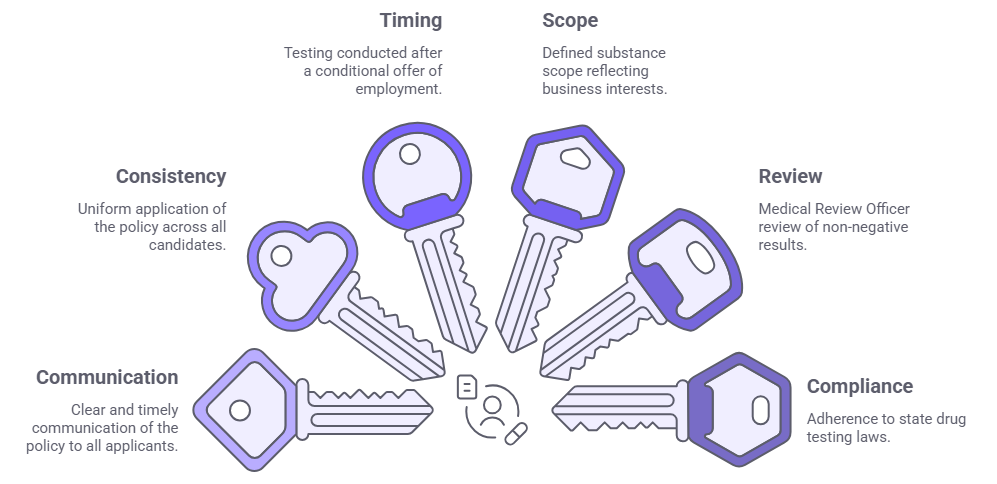
- A written drug testing policy communicated to all applicants before testing occurs.
- Consistent application of the policy across all candidates for the same position or job category.
- Testing that occurs after a conditional offer of employment has been extended, not during or before the application process.
- A defined substance scope that reflects the employer’s legitimate business and safety interests.
- Medical Review Officer review of all non-negative results before the employer takes any adverse action.
- Compliance with applicable state drug testing laws in every jurisdiction where hiring occurs.
The voluntary employer framework above is distinct from the mandatory DOT drug testing framework that applies to regulated industries. DOT-regulated employers must satisfy FMCSA, FAA, FRA, FTA, and PHMSA requirements. Those requirements are more specific, more procedurally demanding, and not subject to employer discretion. For DOT-regulated employer obligations, see the DOT drug testing section of this article and the full DOT drug testing framework separately.
What Drugs Can and Cannot Be Tested For
Standard Panel Configurations
The most common pre-employment drug test is a urine-based 5-panel screen. It tests for marijuana metabolites, cocaine, amphetamines, opiates, and phencyclidine. A 10-panel screen adds benzodiazepines, barbiturates, methaqualone, methadone, and propoxyphene. Employers may also add synthetic opioids such as fentanyl, which standard opiate panels do not detect. The substance scope is a policy decision the employer makes, not a legal requirement in the voluntary framework.
| Specimen Type | Detection Window | Common Use Case |
| Urine | Days to weeks depending on substance | Standard pre-employment screening |
| Oral fluid | Hours to 1 to 3 days | Post-accident, reasonable suspicion |
| Hair follicle | Up to 90 days | Extended lookback, not accepted under DOT |
Employers may use urine, oral fluid, or hair follicle specimens depending on the detection window they need and the testing options their vendor offers. Oral fluid testing works well for post-accident and reasonable suspicion contexts. Hair follicle testing provides the longest detection window but does not qualify under the DOT framework for regulated employers.
Prescription Medications and ADA Considerations
Employers who test for prescription medications, including opioids, benzodiazepines, and amphetamines, must proceed carefully. A positive result for a legally prescribed medication may trigger ADA obligations if the medication treats a qualifying disability. Before taking adverse action based on a prescription medication result, employers should consult qualified legal counsel to assess whether a reasonable accommodation review is required.
Employers should also know that asking about the nature of a medical condition during or after MRO review may violate ADA disability-related inquiry restrictions. The MRO review process identifies legally prescribed medications as part of the non-negative result evaluation. Employers who skip MRO review and act on raw positive results risk both ADA exposure and program integrity failures.
Is your drug testing policy keeping up with how quickly employment laws are changing? That is becoming one of the biggest challenges for HR teams managing multi-state hiring and compliance. What worked a few years ago may no longer align with current expectations around timing, marijuana protections, and candidate rights. Strong policies today are not just strict. They are clear, consistent, well-documented, and regularly reviewed against the realities of the current legal landscape. �
Marijuana and Pre-Employment Drug Testing: The 2026 Employer Position
What State Legalization Does and Does Not Change
As of the date of this article, federal authorities are reviewing marijuana’s scheduling classification. Employers should confirm the current federal status with qualified legal counsel, as employer drug testing rights connect directly to federal controlled substance classifications. Any final rescheduling action may affect those rights. Under current federal law, state legalization does not change an employer’s right to test for marijuana in most jurisdictions.
Most private employers retain the right to maintain a marijuana-free workplace policy, test for THC metabolites in pre-employment screening, and rescind conditional offers based on a positive marijuana test result. However, this right is subject to the state-specific restrictions described in this section. In a growing number of states, the right to act on off-duty marijuana use in non-safety-sensitive roles has been restricted or eliminated.
States With Pre-Employment Marijuana Testing Restrictions
The following states have enacted laws that, as of 2026, restrict employer adverse action based on pre-employment marijuana test results in at least some circumstances. This list reflects the confirmed statutory landscape and does not cover pending legislation or regulatory guidance that may affect additional jurisdictions.
| State | Restriction Summary |
| California | Employers generally cannot refuse to hire based on a test that detects non-psychoactive cannabis metabolites, which is the standard result in most urine-based THC screens. California law does not prohibit testing for psychoactive THC impairment. Exceptions exist for safety-sensitive positions and federally regulated roles. Confirm current requirements with qualified legal counsel. |
| New York | The state’s Marihuana Regulation and Taxation Act protects applicants from discrimination based on lawful off-duty marijuana use. Pre-employment marijuana testing is effectively restricted for most non-safety-sensitive positions. New York City’s Human Rights Law adds further restrictions that may go beyond state law. Employers with New York City operations should confirm both state and local requirements with qualified legal counsel. |
| New Jersey | Protections for off-duty marijuana use limit pre-employment adverse action in non-safety-sensitive roles. |
| Minnesota | Employers cannot refuse to hire based on off-duty marijuana use, with limited exceptions for safety-sensitive roles and federally regulated employers. |
| Washington | Off-duty marijuana use protections apply in certain contexts. Employers should confirm current requirements with qualified legal counsel. |
| Montana, Rhode Island, and others | Varying levels of employment protection for off-duty marijuana use are in effect. |
Employers operating in multiple states must build state-by-state marijuana testing policy review into their program. State law in this area changes frequently. Employers should verify current requirements with qualified legal counsel before updating their drug testing policy.
State Law Variability: Where Employer Drug Testing Rights Are Most Restricted
Beyond marijuana-specific restrictions, several states impose broader limits on pre-employment drug testing programs. These include conditional offer requirements, prohibited substance lists, and procedures for how testing must be conducted and results handled. States with the most significant restrictions beyond marijuana include California, New York, Montana, Minnesota, Rhode Island, and New Jersey, among others.
Some states require advance written notice to applicants before testing. Others restrict which labs employers may use or require specific chain-of-custody steps. Certain states exempt industries such as healthcare, transportation, and law enforcement from restrictions that apply to other private employers. Multi-state employers cannot rely on a single policy to cover all locations. Annual legal review of state requirements in each hiring jurisdiction, conducted by qualified legal counsel, is the right approach.
When in the Hiring Process Drug Testing Can Occur
The Conditional Offer Requirement
Most state drug testing laws require that pre-employment drug testing occur after a conditional offer of employment has been extended. A conditional offer is an offer contingent on the applicant satisfying defined post-offer requirements, including drug testing and background checks. Testing before a conditional offer, including during interviews or as a pre-screening step, does not satisfy the timing requirement in states that impose it.
The most common sequencing error is initiating drug testing before the conditional offer stage. This typically happens when employers bundle their drug test and background check into a single pre-offer screening process. Separating those steps and confirming the conditional offer is in place before either begins is the correct approach.
How Drug Testing Sequencing Interacts With Background Check Timing
Drug testing and background check timing interact in states with ban-the-box or fair chance hiring laws. In those states, employers may not ask about criminal history until after a conditional offer. If the employer also requires a post-offer drug test, both steps must be sequenced after the conditional offer. Employers who start either process before the conditional offer stage may violate drug testing timing rules and ban-the-box rules at the same time. Documenting that the conditional offer is in place before any post-offer step begins is an essential part of program design.
What Employers Can Do With a Positive Result
The MRO Review Requirement
Before taking any adverse action based on a non-negative drug test result, the employer must let the Medical Review Officer finish their review. The MRO is a licensed physician who evaluates non-negative lab results, contacts the donor to ask about legitimate medical explanations, and issues a final determination of positive, negative, or test canceled. An employer who rescinds a conditional offer before the MRO issues that determination may rescind a valid offer based on a result the MRO would have cleared.
The employer’s role during MRO review is to wait. Employers should not contact the donor directly to discuss a positive result during MRO review. The donor’s medical disclosures to the MRO are private, and the employer is not part of that conversation. Trying to obtain the specific medical details the donor shared with the MRO may violate ADA and HIPAA privacy rules.
Rescinding a Conditional Offer and FCRA Considerations
When an employer rescinds a conditional offer based on a confirmed positive drug test result, the adverse action process depends on how the test was obtained.
- If the drug test came through a consumer reporting agency, the FCRA adverse action two-step process applies. The employer must provide a pre-adverse action notice that includes a copy of the actual CRA-produced report, including the lab result documentation, and the Summary of Rights Under the FCRA. The employer must then allow a waiting period of generally at least five business days per CFPB and FTC guidance. If proceeding, the employer must provide a final adverse action notice. Sending a verbal notification or summary letter without the actual CRA-produced report does not satisfy the FCRA copy-of-report requirement.
- If the drug test came directly through a testing facility that does not qualify as a CRA, the FCRA adverse action process does not apply to that result. However, it may still apply to any background check the employer obtained through a CRA in the same hiring process.
Employers should confirm with qualified legal counsel and their drug testing vendor whether their arrangement qualifies the vendor as a CRA under FCRA.
DOT-Regulated Employers: Where Mandatory Testing Requirements Apply
Employers in DOT-regulated industries who hire workers for safety-sensitive roles, including CDL drivers under FMCSA, aviation workers under FAA, rail and transit operators under FRA and FTA, and pipeline workers under PHMSA, must follow mandatory pre-employment drug testing requirements under 49 CFR Part 40. These requirements are not optional and are not subject to state law override. DOT-regulated employers must use a DOT-approved collection process, a SAMHSA-certified laboratory, and a qualified MRO. As of 2023, the DOT has authorized oral fluid as an alternative specimen type, though employers should confirm lab certification availability before switching.
State marijuana employment protections do not override DOT pre-employment drug testing for safety-sensitive roles. A CDL driver who tests positive for marijuana in a DOT-mandated pre-employment screen is disqualified from safety-sensitive duties regardless of the state’s marijuana employment protection laws.
Building a Legally Defensible Pre-Employment Drug Testing Policy
What a Defensible Policy Requires
A defensible pre-employment drug testing policy is a documented system of consistent practices, not a single document. It must satisfy federal baseline requirements, state-specific rules in every hiring jurisdiction, and the employer’s legitimate business and safety interests. The core components are:
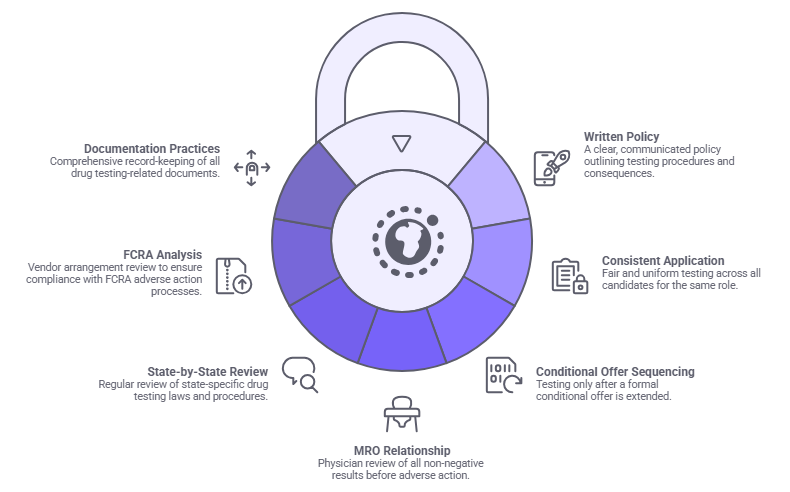
- A written drug testing policy communicated to applicants before testing, covering substances tested, specimen type, timing, and consequences of a positive result.
- Consistent application of the policy across all candidates for the same role or category. Selective testing creates discrimination exposure.
- Documented conditional offer sequencing confirming that testing begins only after the conditional offer is formally in place.
- An MRO relationship ensuring all non-negative results receive physician review before any adverse action.
- A state-by-state policy review cadence covering marijuana testing restrictions, conditional offer timing requirements, and state-specific procedural rules in each hiring jurisdiction.
- A FCRA analysis of the employer’s drug testing vendor arrangement to confirm whether the FCRA adverse action process applies to drug test results.
- Documentation practices retaining the conditional offer, drug test authorization, chain-of-custody documentation from specimen collection, the lab result, the MRO determination, the CRA-produced report where applicable, and any adverse action notices for the applicable retention period.
The Case for Annual Policy Review
Drug testing law is one of the fastest-changing areas of employment compliance. State marijuana employment protections have grown significantly since 2020 and continue to shift through legislation, regulation, and litigation. A policy that worked in 2021 may have real gaps in 2026. Annual review of the policy against current state law in each hiring jurisdiction, led by qualified legal counsel, is the right cadence for any employer with ongoing multi-state hiring activity.
Conclusion
Pre-employment drug testing remains a legally permissible employer practice in most jurisdictions, but the rules governing what employers can require, when testing can occur, and what they can do with a positive result have become far more complex. State marijuana protections, conditional offer timing requirements, and FCRA considerations now intersect in ways that most existing drug testing policies have not fully addressed. Employers who audit their current program against the 2026 legal landscape, build state-specific compliance into their policy design, and confirm their approach with qualified legal counsel are in a much stronger position than those relying on policy documents that have not been updated in years.
Frequently Asked Questions
Can an employer require a drug test before a job offer?
In most states, pre-employment drug testing must occur after a conditional offer of employment has been extended, not before. Testing during the application process or before a formal conditional offer does not satisfy the conditional offer timing requirement in states that impose it. Employers should confirm applicable timing requirements in each hiring state with qualified legal counsel.
Can you fail a pre-employment drug test for marijuana in a legal state?
It depends on the state and the role. In most states, employers retain the right to test for marijuana and rescind a conditional offer based on a positive result. However, states including California, New York, New Jersey, and Minnesota restrict employer adverse action based solely on off-duty marijuana use for non-safety-sensitive roles. DOT-regulated safety-sensitive roles are not subject to state marijuana employment protections.
What happens if you fail a pre-employment drug test?
An employer who receives a confirmed positive result after MRO review may rescind the conditional offer. If the test came through a CRA, the FCRA adverse action two-step process applies, including providing the actual CRA-produced report. Employers must also consider state-specific restrictions that may limit their ability to act on certain positive results, particularly for marijuana in states with off-duty use protections.
What drugs show up on a pre-employment drug test?
The standard 5-panel urine test detects marijuana metabolites, cocaine, amphetamines, opiates, and phencyclidine. A 10-panel test adds benzodiazepines, barbiturates, methaqualone, methadone, and propoxyphene. Employers may add expanded panels including synthetic opioids such as fentanyl. DOT-regulated employers must use the substance panel defined by 49 CFR Part 40.
Is pre-employment drug testing legal in all states?
Pre-employment drug testing is legal in all states, but the rules governing how it must be conducted, when it can occur, and what substances can support adverse action vary materially by state. Multi-state employers must build state-by-state legal review into their drug testing program rather than applying a single policy across all locations.
Does FCRA apply to pre-employment drug tests?
FCRA applies to drug test results when the test comes through a consumer reporting agency. Whether a drug testing vendor qualifies as a CRA depends on the structure of the testing arrangement. Employers should confirm their vendor’s CRA status with qualified legal counsel before determining whether the FCRA adverse action process applies.
What is an MRO and why does MRO review matter?
A Medical Review Officer is a licensed physician who evaluates non-negative drug test results, contacts the applicant to assess whether a legitimate medical explanation exists, and issues a final determination before notifying the employer. Employers who act on a positive result before MRO review is complete may create program integrity failures and potential ADA and HIPAA exposure.
What is the difference between DOT and non-DOT pre-employment drug testing?
DOT pre-employment drug testing applies only to employers in regulated industries hiring for safety-sensitive roles. It is mandatory, uses a federally defined substance panel, requires a SAMHSA-certified laboratory and qualified MRO, and is not subject to state marijuana employment protections. Non-DOT testing by private employers outside regulated industries is voluntary and governed by employer policy and state law.
Additional Resources
- DOT Office of Drug and Alcohol Policy and Compliance
https://www.transportation.gov/odapc - SAMHSA: Mandatory Guidelines for Federal Workplace Drug Testing
https://www.samhsa.gov/workplace/mandatory-guidelines - CFPB: Summary of Consumer Rights Under the FCRA
https://www.consumerfinance.gov/consumer-tools/credit-reports-and-scores/consumer-reporting-companies/fcra-summary-of-rights/ - EEOC: ADA and Employment
https://www.eeoc.gov/disability-discrimination - 49 CFR Part 40: DOT Procedures for Transportation Workplace Drug and Alcohol Testing
https://www.ecfr.gov/current/title-49/subtitle-A/part-40 - FTC: Using Consumer Reports for Employment Purposes
https://www.ftc.gov/business-guidance/resources/using-consumer-reports-employment-purposes

ABOUT THE CREATOR
Charm Paz, CHRP
Recruiter & Editor
Charm Paz is an HR professional at GCheck, specializing in background screening, fair hiring, and regulatory compliance. She holds from the Professional Background Screening Association (PBSA) and helps organizations navigate employment regulations with clarity and confidence.
With a background in Industrial and Organizational Psychology, she translates policy into practice to build ethical, compliant, human-centered hiring systems that strengthen decision-making over time.