
GCheck’s own research found that 63% of US workers have exaggerated or lied about their AI skills to appear more capable (INCIDENCE, n=1,500), and that 64% say their employer has never attempted to verify the claim (INCIDENCE, n=1,500). The finding is the easy part. What a hiring team is supposed to do about it is where most guidance stops.
Key Takeaways
- Sixty-three percent of workers have exaggerated their AI skills (INCIDENCE), and 64% report their employer has never tried to verify the claim (INCIDENCE), according to GCheck’s Automation Anxiety Report 2026, n=1,500.
- No standardized product tests AI competency directly in most hiring pipelines today. Verifying a claim in practice means confirming it against a candidate’s actual work history, not administering a skills test.
- Employment verification and reference checks can confirm whether a candidate’s claimed AI-driven responsibilities match what a former employer actually observed, closing part of the gap without a dedicated testing tool.
- If a verified mismatch leads to declining a candidate or reversing an offer, and the information came from a consumer report, the FCRA’s adverse action sequence applies the same way it would to any other disqualifying finding.
- Employers considering a direct AI-skills test should know that California’s FEHA regulations on automated-decision systems, effective October 2025, explicitly name computer-based skills assessments as a covered category.
- Forty-eight percent of workers say they want their AI skills tested directly (PERCEPTION), which means building a testing practice correctly is also a stated candidate preference, not only a compliance obligation.
- Twenty-nine percent of workers say they would present themselves more honestly if employers disclosed verification scope upfront (PERCEPTION), a low-cost practice change with a direct line to the same detection-rate problem this piece is about.
Why the Finding Needs an Operational Answer, Not Just Awareness
GCheck’s Automation Anxiety Report documented a workforce inflating its AI credentials, a pattern the report calls the AI Skills Bubble, while simultaneously working to slow AI adoption in its own workplace, a contradiction it calls Double Distortion. The piece covering these findings closes with a call for employers to offer clarity about what will be verified, human oversight of decisions, and consistent standards across candidates. All three are the right questions. None of them is a process on its own.
This piece is the operational half of that call. It answers three specific questions a hiring team runs into the moment it tries to act on the finding: how do you actually verify a claimed AI skill when no standardized test exists in most screening workflows, what do you do procedurally if a verified mismatch affects a hiring decision, and what is the legal exposure if you decide to test the skill directly instead of verifying the claim after the fact.
None of these questions has a single universally correct answer. All three have a defensible starting point, which is what the rest of this piece works through. What they share is a common failure mode worth naming upfront: treating AI-skills claims as a special category needing a bespoke response, rather than recognizing the underlying problem, a self-reported claim that may or may not hold up, is the same one hiring teams already manage for every other resume line. The specific tools and legal citations below are new. The discipline of applying them consistently is not.
What Verifying an AI Skills Claim Actually Looks Like
The Gap Between “Verify” and “Test”
Most conversations about AI-skills verification quietly assume a testing product exists, something that could administer a standardized assessment and return a score the way a typing test or a coding challenge does for other skills. For AI competency specifically, that kind of tool is not yet a standard part of most screening workflows. Verifying a claim in practice means something narrower: confirming that a candidate’s account of their AI-related experience holds up against independent sources, not measuring their actual proficiency against a benchmark.
That distinction matters because it changes what a hiring team should expect from verification. A confirmed claim tells you the candidate’s account of their history is accurate. It does not tell you how skilled they actually are with the tools they used, any more than confirming a job title tells you how well someone performed in that role. Both are legitimate, useful confirmations. Neither is a substitute for the other.
Using Existing Verification Tools for a New Kind of Claim
Two tools already built into most screening programs apply directly here, even though neither was designed with AI skills specifically in mind. Employment verification confirms the roles, responsibilities, and dates a candidate lists, which surfaces a mismatch if someone claims an AI-heavy role their former employer’s records don’t support. Reference checks add a layer verification alone cannot: a former supervisor can speak to whether a candidate’s day-to-day work actually involved the tools and workflows the candidate describes, which is closer to a proficiency signal than a personnel record is.
Neither tool closes every gap. A candidate could genuinely have held the role described and still have exaggerated their comfort level with the specific tools involved, a distinction that sits closer to ordinary interview-stage impression management than to something a background check is built to surface. The realistic goal is narrowing the gap, not closing it entirely.
What Each Verification Step Actually Confirms
The two tools answer different questions, and knowing which one answers which question keeps a reviewer from expecting either to do more than it can.
| Verification step | What it confirms | What it doesn’t confirm |
| Employment verification | Dates, titles, and confirmed responsibilities for a claimed role | Whether the candidate was actually skilled with the specific AI tools that role involved |
| Reference checks | A former supervisor’s account of how a candidate actually used AI tools day to day | Whether that account is complete, current, or free of the same social pressure to overstate that affects self-reported claims |
| Neither | A direct, standardized measure of AI competency, since no such test is a standard part of most screening workflows today |
Reading the table this way keeps the two tools from being treated as interchangeable. A confirmed job title with AI-related duties is not the same evidentiary weight as a supervisor specifically confirming hands-on tool use, and neither is the same as a direct competency score, which remains unavailable through either method.
What the FCRA Requires If a Verified Mismatch Affects a Hiring Decision
The Notice Sequence
If employment verification or a reference check surfaces a discrepancy between a candidate’s claimed AI experience and what a former employer confirms, and that information came from a consumer report obtained through a background screening company, declining to hire or reversing an offer based on that discrepancy is an adverse action under the Fair Credit Reporting Act. The same two-step sequence applies here as it does to any other consumer-report-based finding: a pre-adverse action notice including a copy of the report and the Summary of Rights, a reasonable window for the candidate to respond, and a final adverse action notice if the employer proceeds.
Nothing about the fact that the discrepancy involves an AI-skills claim specifically changes this sequence or exempts an employer from it. A mismatched claim about AI experience is, procedurally, no different from a mismatched job title or an unconfirmed employment date once a consumer report is the source of the finding. Employers who treat AI-skills discrepancies as a new, informal category of finding, rather than routing them through the same adverse action process as anything else the report surfaces, are creating a compliance gap that has nothing to do with AI and everything to do with process discipline.
Individualized Assessment Still Applies
The notice sequence is a procedural requirement. It is separate from, and does not substitute for, the substantive question of whether the discrepancy actually warrants declining the candidate. The EEOC’s individualized assessment principle, developed specifically in the context of criminal history review, is a useful discipline to extend by analogy here: consider the specific discrepancy in front of the reviewer, how material the misrepresented AI skill actually is to the role, and whether the gap reflects an overstated comfort level or a fabricated claim, rather than applying a blanket rule that treats every AI-skills mismatch the same regardless of context.
A candidate who overstated familiarity with a tool they had briefly used is in a different position than one who claimed daily use of a platform they had never opened, and a role where the AI skill is central to daily work carries different stakes than a minor, incidental line on a job posting. Neither distinction changes the notice procedure. Both should change what a reviewer makes of the finding once the procedure has run its course.
A short checklist keeps this consistent across reviewers rather than decided case by case:
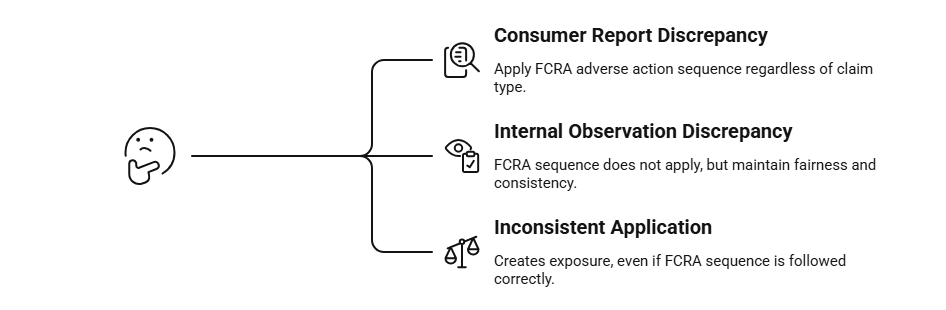
- Did the discrepancy come from a consumer report obtained through a background screening company? If yes, the FCRA’s adverse action sequence applies regardless of what kind of claim the discrepancy involves.
- Is the employer’s own internal observation, separate from any report, the actual basis for the decision? If an AI-skills mismatch surfaces through an internal interview process rather than a consumer report, the FCRA sequence does not apply, though the same fairness and consistency standard still should.
- Has this exact standard been applied to every candidate with a similar discrepancy, regardless of role or how the claim was phrased? Inconsistent application of an otherwise correct process creates its own exposure, separate from whether the FCRA sequence itself was followed correctly.
The Legal Risk of Testing AI Skills Directly
What California’s Regulations Say About Skills Assessments
Forty-eight percent of workers surveyed said they want their AI skills tested directly (PERCEPTION, n=1,500), which means building a real testing practice is a legitimate response to stated candidate preference, not just a defensive compliance move. It is also, specifically, a regulated activity in at least one major jurisdiction. California’s Civil Rights Council finalized regulations amending the Fair Employment and Housing Act to address automated-decision systems in employment, effective October 1, 2025. The regulations name, as an illustrative example of a covered system, computer-based assessments or tests used to measure an applicant’s skills, which describes a standardized AI-skills test precisely. Any employer with five or more employees, including at least one in California, building or buying such a tool should assume it falls within scope.
The regulations do not require anti-bias testing outright, but they treat evidence of anti-bias testing, or its absence, as relevant to a discrimination claim or defense. That is a practical incentive to test any skills-assessment tool for disparate impact before deploying it, not just a theoretical best practice.
A few concrete steps reduce exposure for any employer building or buying a direct AI-skills test:
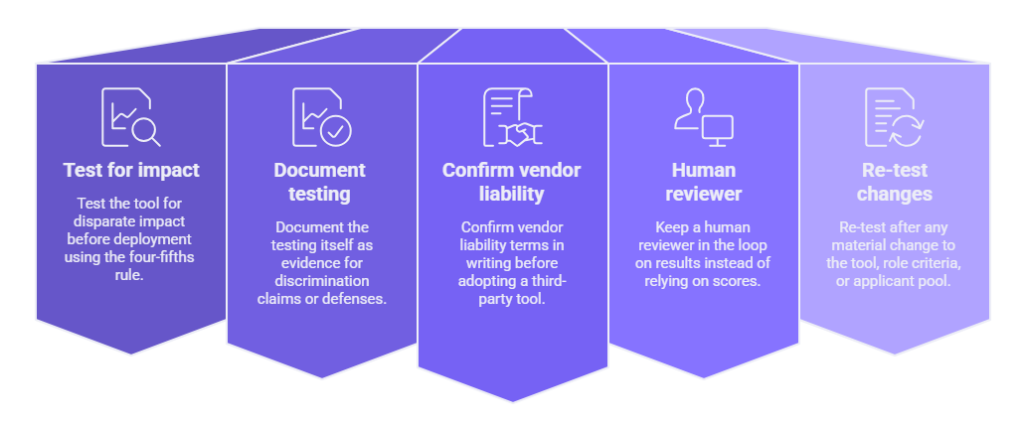
- Test the tool for disparate impact before deployment, using the four-fifths rule as a practical benchmark, not after it has already been used to screen candidates.
- Document the testing itself, since California’s regulations treat evidence of anti-bias testing, or its absence, as relevant to a discrimination claim or defense.
- Confirm vendor liability terms in writing before adopting a third-party tool, given that California’s regulations can extend liability to the vendor for a decision-making function the employer delegated to it.
- Keep a human reviewer in the loop on results, rather than letting a test score alone determine an outcome.
- Re-test after any material change to the tool, the role criteria, or the applicant pool, rather than treating a single pre-launch test as sufficient indefinitely.
Federal Enforcement Has Shifted, State Law Has Not
Separately, a 2025 executive order directed federal agencies, including the EEOC, to deprioritize enforcement of disparate impact liability generally. That shift affects federal enforcement priority specifically. It does not eliminate disparate impact as a live legal theory, since private plaintiffs can still bring these claims under Title VII, and state-level regulations, including California’s, continue to apply independently of federal enforcement posture. The EEOC’s own four-fifths rule, a standard under which a protected group’s selection rate falling below 80% of the highest-selected group’s rate is treated as a red flag for adverse impact, remains a widely used practical benchmark regardless of where federal enforcement priorities currently sit.
None of the steps above are unique to AI skills specifically. They are what already applies to any standardized assessment tool a hiring process relies on, extended here to a category of test that happens to be newer.
Why Disclosure Closes Part of the Loop for Free
The Finding
Twenty-nine percent of workers in the same survey said they would present themselves more honestly if employers disclosed verification scope upfront (PERCEPTION, n=1,500). This is the same dynamic GCheck’s Trust in Hiring Report documented for general resume embellishment: candidates calibrate what they are willing to claim based on what they believe will actually be checked, and that calibration shifts measurably once verification scope is stated plainly rather than left implicit.
Applied here, that means an employer does not need a testing product or a legal review to capture some of this benefit. Stating clearly, in a job posting or at the start of a screening process, that AI-related claims will be confirmed with prior employers costs nothing to add and reaches every candidate at the exact moment they are deciding how to describe their own experience. This is the lowest-cost, most immediately available response to the finding this piece opened with, and it requires none of the process or legal groundwork the rest of this piece covers.
Why Timing Determines Whether the Disclosure Actually Works
A candidate deciding how to phrase an AI-related bullet point on a resume is making that decision once, at the moment of writing it, not continuously throughout the hiring process. A disclosure that arrives too late reaches that decision after it has already been made and cannot change it.
| Disclosure timing | Where it typically appears | Effect on candidate behavior |
| Job posting, before application | Listed alongside role requirements | Reaches the candidate before they decide how to phrase their own claims |
| Application or intake form | Presented as a standard consent step | Reaches the candidate after the resume is already written, but before submission |
| Offer letter or post-interview email | Disclosed once a candidate has advanced | Reaches the candidate long after the relevant claims were already made |
The earliest row in that table is also the cheapest to implement, since stating in the job posting itself that AI-related claims will be confirmed with prior employers costs nothing to add and reaches every candidate at the exact point their own decision is still being made.
Fair Compliance and Transparent Compliance, Applied to a New Kind of Claim
Fair Compliance means applying the same verification standard to every candidate’s AI-skills claims, not scrutinizing some and waving others through based on how confidently they were stated. Transparent Compliance means telling candidates what that standard is before they apply, which is precisely what the 29% disclosure finding shows changes behavior. Both sit inside Compliance for Good™, the same operating standard this pipeline has applied to every prior finding drawn from GCheck’s own research.
Neither pillar requires an employer to have solved AI-skills verification perfectly. Confirming claims through employment verification and reference checks, applying the FCRA’s adverse action sequence consistently when a report-based finding affects a decision, and testing any direct assessment tool for disparate impact before deployment are all achievable steps that do not depend on a testing product that does not yet exist. What both pillars do require is applying whatever standard an organization lands on the same way for every candidate, and telling candidates plainly what that standard is.
Frequently Asked Questions
How common is it for candidates to exaggerate their AI skills?
GCheck’s Automation Anxiety Report 2026 found that 63% of full-time employed U.S. workers have exaggerated or lied about their AI skills to appear more capable, rising to 80% among workers under 30. The same research found that 64% of respondents say their employer has never attempted to verify the claim.
Is there a standard test for verifying someone’s actual AI skills?
Not as a standard part of most screening workflows today. Verification in practice generally means confirming a candidate’s claimed AI-related experience against independent sources, such as employment records and reference checks, rather than administering a direct competency test.
What should an employer do if employment verification reveals an AI-skills claim doesn’t match a candidate’s actual work history?
If the discrepancy comes from a consumer report and leads to declining the candidate or reversing an offer, that decision is an adverse action under the FCRA. It requires a pre-adverse action notice with a copy of the report and the Summary of Rights, a reasonable opportunity to respond, and a final adverse action notice if the employer proceeds, the same sequence that applies to any other consumer-report-based finding.
Should every AI-skills discrepancy be treated the same way?
No. The FCRA’s notice procedure applies the same way regardless of the specific discrepancy, but the substance of the decision should not. Extending EEOC’s individualized assessment principle by analogy, a reviewer should weigh how material the misrepresented skill is to the role and whether the gap reflects an overstated comfort level or an outright fabrication, rather than applying a blanket rule to every AI-skills mismatch.
Is it legal to build or buy a tool that tests candidates’ AI skills directly?
Yes, but it is a regulated activity in some jurisdictions. California’s Fair Employment and Housing Act regulations on automated-decision systems, effective October 2025, specifically name computer-based skills assessments as a covered category for employers with five or more employees, including at least one in California. Testing the tool for disparate impact before deployment, documenting that testing, and keeping a human reviewer involved in outcomes are all practical steps that reduce exposure.
Does the federal government still enforce discrimination claims related to AI hiring tools?
Federal enforcement priority shifted in 2025, when an executive order directed agencies including the EEOC to deprioritize disparate impact enforcement generally. This does not eliminate disparate impact as a legal theory. Private plaintiffs can still bring these claims, and state laws, including California’s automated-decision-system regulations, continue to apply regardless of federal enforcement posture.
Does telling candidates their AI skills will be verified actually change their behavior?
GCheck’s research found that 29% of workers say they would present themselves more honestly if employers disclosed verification scope upfront, consistent with a broader pattern the same research documents around resume claims generally: candidates calibrate what they claim based on what they expect will be checked.

ABOUT THE CREATOR
Charm Paz, CHRP
Recruiter & Editor
Charm Paz is an HR professional at GCheck, specializing in background screening, fair hiring, and regulatory compliance. She holds from the Professional Background Screening Association (PBSA) and helps organizations navigate employment regulations with clarity and confidence.
With a background in Industrial and Organizational Psychology, she translates policy into practice to build ethical, compliant, human-centered hiring systems that strengthen decision-making over time.