

Managing a toxic employee starts with an early, specific conversation about observable behavior, not a verdict on character. GCheck’s The Consequence Gap Report found that 61% of workers say managers addressing it early would most help keep toxic behavior from spreading. This playbook turns that ask into steps: check, talk, document, protect, close the loop.
Key Takeaways
- GCheck’s The Consequence Gap Report found that workers rank managers addressing toxic behavior early first among remedies (61%), ahead of real consequences regardless of performance (52%), protecting the good people (50%), and a safe way to raise concerns (46%).
- 65% of workers who have had a toxic coworker say one toxic person is enough to change a whole team’s tone; among those whose organization removed the coworker, the figure is 72%.
- In 47% of reported cases the toxic coworker was a peer and in 10% a manager or leader, so the playbook has to work on a problem that often sits inside the team, not above it.
- The report found that closeness, not time, moves adoption of the behavior, so the case for acting early rests on what workers ask for and on what a visible response teaches, not on a ticking clock.
- Before any coaching, check whether the conduct touches a protected characteristic or a complaint. If it does, the next call is to HR, not a coaching conversation.
What Workers Say Would Help
The Five Asks
GCheck’s The Consequence Gap Report asked all 1,500 workers what would most help keep toxic behavior from spreading at work, and let them pick more than one answer:
| What would most help | Share of workers |
| Managers addressing it early | 61% |
| Real consequences regardless of performance | 52% |
| Keeping and protecting the good people | 50% |
| A safe way to raise concerns | 46% |
| Leadership modeling better behavior | 41% |
Nothing on the list asks for a gentler workplace. Several of the five fall directly to managers, and the top-ranked one is simply timing: act while the behavior is still describable as a specific pattern instead of an accepted fact about someone. The report offered no monitoring option and endorses none, which is why this playbook contains none.
Why One Person Is Enough to Act On
Among workers who have had a toxic coworker, 65% say one toxic person is enough to change a whole team’s tone. The share rises to 72% among those whose organization removed the coworker, which suggests the people most convinced that a single person matters are the ones who watched intervention work. These are beliefs, not measurements of any one team. They are still useful to a manager, because they describe how a team is likely to read the situation: as something one person’s conduct can change, and a manager’s response can change back.
The same report cuts the other way too. Among workers who have had a toxic coworker, 49% reported no real change in the kind of employee they are. Not every teammate absorbs the behavior, so a manager shouldn’t assume the whole team is affected. Act on the pattern that can be described, not on a story about contagion.
What the Data Says About Timing
One finding cuts against the obvious reading of “stop it before it spreads.” The report found that how closely people worked with the coworker mattered for whether they picked up the behavior (7% among those with occasional contact, a smaller group the report labels directional; 14% with regular contact; 26% on the same team daily), while how long they endured it mattered much less. The case for acting early rests on what workers ask for and on the gap between outcomes: 36% of exposed workers began adopting the behavior where the coworker was rewarded or protected, against 14% where the coworker was removed. What a team sees the manager do matters. So does who sits closest to the behavior.
In practice, “early” means soon after the behavior can be described specifically, which may be after the second or third example, not the first.
Step 1: Check What You Are Looking At

Is It a Pattern?
Start with the definition the research used: a coworker whose behavior consistently made work life worse for the people around them. The word that matters is consistently. A sharp remark on a bad day isn’t a pattern, and treating it as one costs a manager credibility. The behaviors workers named most often were constant complaining and draining negativity (59%), escalating minor issues or weaponizing rules (51%), directing people without authority (50%), seeming friendly in person while undermining privately (49%), and taking credit (39%). Each can be described in terms of what someone said or did, which is what the rest of this playbook depends on. One caution: complaining about pay, hours, safety, or other working conditions, especially together with coworkers, can be legally protected, so a manager should separate interpersonal negativity from a workplace concern before treating either as a conduct issue.
Is It Something HR Should Handle?
The second check matters more. Some conduct that looks like a personality problem is unlawful harassment based on a protected characteristic, and the rules for handling it differ from coaching. According to the EEOC, an employer can be liable for harassment by non-supervisory employees if it knew or should have known about the harassment and failed to take prompt and appropriate corrective action, and employees are encouraged to report harassment to management early. Federal law prohibits harassment tied to characteristics such as race, sex, religion, age, disability, and national origin, and state and local laws also prohibit employment discrimination, so the details can differ by location. A manager shouldn’t try to decide alone which side of that line a situation falls on. Stop and involve HR, or an employment attorney where there is no HR function, before any coaching conversation if any of the following is present:
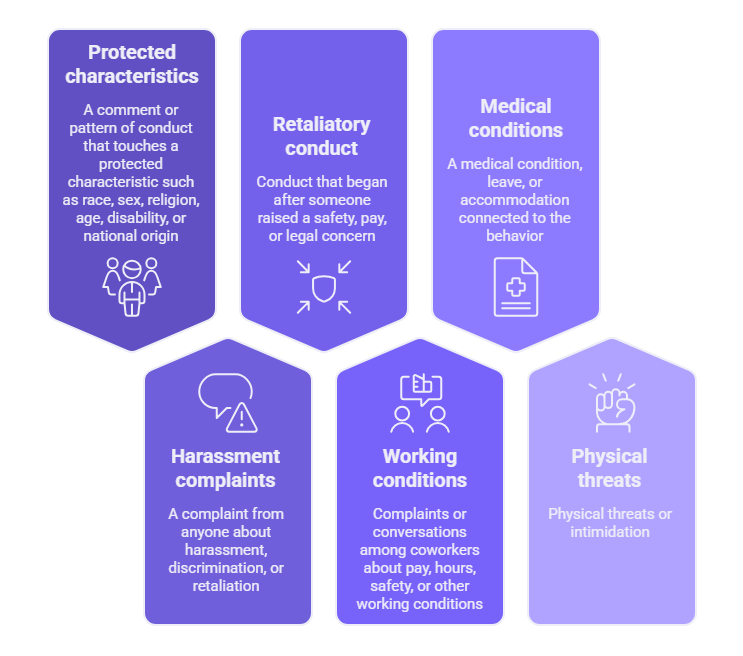
- A comment or pattern of conduct that touches a protected characteristic such as race, sex, religion, age, disability, or national origin
- A complaint from anyone about harassment, discrimination, or retaliation
- Conduct that began after someone raised a safety, pay, or legal concern
- Complaints or conversations among coworkers about pay, hours, safety, or other working conditions
- A medical condition, leave, or accommodation connected to the behavior (do not ask for medical details)
- Physical threats or intimidation
This is a practice guide, not legal advice. Employment rules vary by jurisdiction, by the facts of a case, and, where employees are represented by a union, by the collective bargaining agreement.
Step 2: Have the First Conversation Early and Specifically
What the Conversation Contains
Once the check is clear, hold the conversation soon after the pattern is evident, in private, and keep it short. Four elements do most of the work:
- The specific behavior, with one or two recent examples. “In Tuesday’s planning meeting you described Dana’s estimate as sloppy in front of the team” can be discussed. “You have a negative attitude” cannot.
- The effect on the work and the people. Name what happened to the team or the project, without speculating about motives.
- The expectation going forward. Say plainly what needs to change and what good looks like.
- A follow-up date. Put a specific check-in on the calendar.
Then stop talking and listen. The person may have context a manager lacks: a conflict that began elsewhere, a misunderstanding, or something unrelated to work. Hearing it doesn’t mean accepting it. If the person mentions a medical condition or a personal crisis, listen without asking for details and bring HR in.
What to Leave Out
Leave out character labels, guesses about intent, comparisons to coworkers, and promises about outcomes. A manager who says “this is the kind of person who…” has moved from describing conduct to judging the person, which makes defensiveness more likely and a fair review harder. The most useful thing a manager can offer someone whose behavior is hurting a team is a precise account of what happened and what is expected next, delivered the way it would be for anyone else.
If the person disputes an example, ask for their account, note it, and return to the expectation and the follow-up date.
Step 3: Document It the Same Way Every Time
Write down what happened soon after each relevant event: the date, what was seen or heard, who was present, what was said in any conversation, and what was agreed. Stick to facts a third person could verify. Phrases like “was rude” or “has a bad attitude” belong in a conversation about specifics, not in a record, while “interrupted two coworkers during the 10 a.m. standup and said their work wasn’t worth discussing” belongs in both. Keep records where HR can reach them and share them only with people who need them.
Consistency is the harder discipline. The record a manager would keep for a new hire who behaved this way should look the same as the record kept for the team’s top performer. Workers rank consequences that hold regardless of performance second among remedies (52%), and rank and results can quietly change what gets written down, which is where the consequence gap starts. A manager who documents junior staff carefully and senior staff loosely has built the pattern the research describes, even without intending to. An even record is also far easier to review fairly than one assembled after the fact.
A record is a means, not an outcome. One worker’s last straw was a coworker who “kept getting written up but not let go, and their behavior kept repeating.” Documentation that leads to no visible change can teach a team that the paperwork is the consequence, so connect each entry to the follow-up date and an honest next step if nothing improves.
Step 4: Protect the People Closest to It
Proximity Is the Dose
Because closeness drove adoption in The Consequence Gap Report, the people who sit nearest the behavior deserve the earliest attention: the teammate who shares a project, the person in the next seat, the new hire paired with the coworker. Ask them directly and privately how work is going, and treat what they say as information about the team, not as a complaint to be managed. The goal during this period is to reduce unnecessary daily contact without penalizing anyone for it. Adjustments to pairings, meeting formats, or review responsibilities can serve that goal. Moving the person who raised the concern, or loading them with extra work to keep the peace, cannot.
New hires deserve a specific look. Pairing a newcomer with the coworker whose behavior is under review puts the person with the least context in the closest contact, so choose a different buddy without explaining why.
Keep the Reporting Route Safe
Workers ranked a safe way to raise concerns fourth (46%), and the underlying problem is well documented. A 2016 report by the co-chairs of the EEOC’s Select Task Force found that roughly three in four people who experienced harassment never even talked to a supervisor, manager, or union representative about it, and that people hold back because they fear disbelief, inaction, blame, or retaliation. That figure concerns legally defined harassment, which is narrower than toxic behavior in general, but the reason it matters carries over. People are more likely to speak up when they expect to be heard and expect nothing bad to follow.
One worker’s account shows how fast that expectation can collapse: “She lied on me to a supervisor and the supervisor refused to hear me out and wrote me up. I left.” Hearing both sides before anyone is written up, and making clear that raising a concern will not be held against the person who raised it, is among the cheapest steps in this playbook and one of the most valuable.
When the Problem Is a Peer, Not a Report
The Consequence Gap Report found the toxic coworker was a peer in 47% of cases and a manager or leader above the worker in only 10%. That matters for how a manager sees the problem. Behavior that travels between teammates can happen in the gaps: in side conversations, in chat threads, on the way out of a meeting. A manager sampling the team’s day sees a fraction of it, and what looks like an isolated conflict may be a pattern for the people nearest. Regular, short one-on-ones with several teammates, not only with the person at the center, are one practical way to fill that gap.
Sometimes the person isn’t a direct report at all. When the behavior comes from someone on another team, the manager’s levers are narrower: describe the effect on the team in specific terms to that person’s manager and to HR, keep a factual record of what the team has experienced, and resist the temptation to coordinate informally with other peers about the person.
A teammate may already have tried a polite, direct request. One worker described that sequence: “The last straw for me was when a colleague started taking credit for my work in team meetings, especially after I’d already politely asked them to stop.” By the time the manager is involved, the direct ask may already have failed, and it belongs in the record as history, not as a sign the problem is minor.
Close the Loop, Then Escalate Consistently
Tell the Team What It Can Be Told
A team that never hears what happened may reasonably assume nothing did. The Consequence Gap Report’s comparison shows why that matters: among exposed workers, 42% said the experience changed them for the worse where the coworker was rewarded or protected, against 20% where the coworker was removed. A workplace that visibly resolves the problem appears to teach a different lesson than one that shrugs. A manager can say, in general terms and without personnel detail, that concerns were heard, that expectations were reset, and what the team can expect next. A line as plain as “I’ve heard the concerns, I’ve talked with the people involved, and I’ll check back with you on this by the end of the month” gives a team something to hold the manager to. Recovery is the norm once exposure ends: among the 630 workers whose exposure was behind them, 77% felt like themselves again within weeks.
When It Doesn’t Change
If the behavior continues after a clear conversation and a follow-up, involve HR to decide the next step, and make it the same step another employee in the same position would face. Consequences that hold regardless of performance are what 52% of workers ask for, and performance is where a plan can quietly stop.
Sometimes the obstacle isn’t the person but the people above the manager. One manager described the experience this way: “When I was asked to discipline a direct report and then the negative performance review was buried.” When a step gets reversed or neutralized from above, absorbing it quietly leaves the standard exactly where it was. The better move is to ask HR who owns the decision and whether the standard being applied here matches the one applied elsewhere. The outcome might be coaching, a role change, formal discipline, or an exit, and the right path depends on the facts, the policy, and local law, which is why HR and counsel belong in that conversation.
Preventing the Next One
Screening does necessary, effective work at the front door. A background check confirms what is on record at hire, and a reference check can ask former coworkers about conduct directly, using questions like those in GCheck’s guide to reference check questions. When a third-party provider assembles that report, the Fair Credit Reporting Act’s disclosure and written-authorization requirements can apply. Neither is built to follow a conduct pattern that develops on the job, which is a management question. The practical overlap is the first ninety days: how a new hire treats peers in that window is one place red flags can show early, and a short conversation then is easier than one after a pattern sets in.
What This Means for Compliance
Transparent Compliance, applied to managing behavior, means the person knows what is expected, why, and when it will be reviewed, and the team knows concerns are being addressed. A specific conversation, an evenly kept record, and a follow-up that actually happens are ordinary tools that make vague discomfort actionable.
Protective Compliance supplies the other half: protecting the teammates closest to the behavior and keeping the route for raising concerns safe. A manager doesn’t have to choose between fairness to the person and protection of the team: keep the focus on conduct, apply one standard to everyone, and send anything involving protected characteristics or complaints to the people trained to handle it.
Frequently Asked Questions
How do you manage a toxic employee?
Start by checking whether the conduct touches a protected characteristic or a complaint, and involve HR if it does. Otherwise, hold a private conversation soon after the pattern is clear, describe specific observable behavior and its effect, state the expectation, and set a follow-up date. Document each step the same way you would for anyone, and protect the teammates closest to the behavior.
When should a manager involve HR?
Before any coaching conversation if the conduct touches a protected characteristic, if anyone has complained about harassment, discrimination, or retaliation, if it began after someone raised a safety, pay, or legal concern, if it involves coworkers discussing pay, hours, or working conditions, or if a medical condition, leave, or accommodation is involved. HR should also be involved before any formal discipline or any step beyond a first conversation.
Is one toxic person really enough to affect a whole team?
Most workers who have had one think so. In GCheck’s research, 65% of workers who have had a toxic coworker said one toxic person is enough to change a whole team’s tone, rising to 72% among workers whose organization removed that coworker. These are perceptions, but they describe how teams are likely to read the situation.
What do workers say managers should do about toxic behavior?
Asked what would most help keep toxic behavior from spreading, 61% of workers named managers addressing it early, 52% named real consequences regardless of performance, 50% named protecting the good people, and 46% named a safe way to raise concerns. Nothing on the list asked for a gentler standard.
How do you handle a toxic employee who is also a top performer?
Apply the same conduct standard and the same documentation you would to anyone else, and involve HR early so the next step is consistent. Workers rank consequences that hold regardless of performance second among remedies (52%), and research on workplace accountability found protection rises with rank and results, which is the pattern a consistent standard exists to prevent.

ABOUT THE CREATOR
Charm Paz, CHRP
Recruiter & Editor
Charm Paz is an HR professional at GCheck, specializing in background screening, fair hiring, and regulatory compliance. She holds from the Professional Background Screening Association (PBSA) and helps organizations navigate employment regulations with clarity and confidence.
With a background in Industrial and Organizational Psychology, she translates policy into practice to build ethical, compliant, human-centered hiring systems that strengthen decision-making over time.