

Brand protection screening reviews a person’s publicly available online content against an organization’s own documented brand and conduct standards, not against legal-risk categories alone. It is typically applied at hiring and onboarding, for leadership and public-facing roles, and as an ongoing policy-enforcement tool across the employee lifecycle.
Key Takeaways
- Brand protection screening evaluates publicly available online content against an organization’s own brand and conduct standards. A background check verifies facts against official records, and general social media screening is usually scoped around legal-risk categories rather than a brand’s own values.
- The practice is limited to public content. It does not access private accounts, request passwords, or ask candidates to change privacy settings.
- Findings are organized by severity and measured against documented criteria, which is what allows the same standard to be applied to every case rather than to a reviewer’s personal judgment.
- Standardized severity criteria support consistency, but they do not replace an individualized, case-by-case relevance check before an adverse decision is made.
- Organizations typically use brand protection screening at three points: hiring and onboarding, leadership and public-facing role oversight, and ongoing enforcement across an existing workforce.
- Whether the Fair Credit Reporting Act applies turns on who compiles the findings and for what purpose, not on whether the underlying content happens to be public, and a one-time authorization does not automatically cover recurring, ongoing reports.
What Brand Protection Screening Is
If someone searches “brand protection” without the word “screening,” most of what comes back has nothing to do with hiring. It is trademark enforcement, anti-counterfeiting investigations, and intellectual property protection, a distinct field with its own job titles and its own legal toolkit. Brand protection screening, as an employment practice, is a different thing entirely. It has nothing to do with counterfeit goods or trademark infringement. It is the review of an individual’s publicly posted online content, matched against the standards an organization has written down for what it considers on-brand and off-brand conduct.
That distinction matters because the underlying question is different from the one a background check answers. A background check asks whether an official record exists: a conviction, a degree, a prior employer. Brand protection screening asks something else: does this person’s public conduct, as posted, align with or conflict with the values and standards this organization has committed to in writing. The answer does not come from a courthouse or a registrar. It comes from a documented internal standard, applied the same way every time.
Employer use of social platforms in hiring is not a fringe practice. SHRM member surveys found that 77 percent of companies used social networking sites to recruit candidates in 2013, up from 34 percent in 2008, a shift significant enough that the EEOC convened a public meeting that same year to examine what it meant for the laws the agency enforces (SHRM data, cited in EEOC, 2014). The people who typically commission brand-focused screening today are not exclusively HR. Brand and communications teams, risk management, and executive leadership all have a stake in it, because the risk being managed is reputational and organizational rather than purely legal. A criminal record search protects against negligent-hiring exposure. Brand protection screening protects against the narrower but very public problem of an employee’s own online conduct becoming associated with an employer’s name.
How Brand Protection Screening Differs From a Background Check and From General Social Media Screening
The three practices overlap in method, since all three might involve looking at what is publicly visible online, but they diverge sharply in what they are measuring against. A standard background check measures against official records. General social media screening, as most legal guidance frames it, is built around a narrower question: does this content create legal exposure, meaning does it reveal protected-class information the employer should not use, or does it show conduct like threats or harassment that would justify an adverse action regardless of where it was found.
Brand protection screening starts somewhere else. Its standard is not “what does the law require or forbid.” It is “what has this organization decided its brand and conduct expectations are.” Two companies could review the identical public post and reach different conclusions, because their documented brand standards differ, not because one applied the law correctly and the other did not. That is the core distinction a searcher trying to understand this term needs first.
| Background check | General social media screening | Brand protection screening | |
| What it measures against | Official government and institutional records | Legal-risk categories (protected-class exposure, threats, illegal conduct) | The organization’s own documented brand and conduct standards |
| Typical source | Courts, DMVs, schools, licensing boards | Public social platforms and forums | Public social platforms and public forums |
| Output | Verified facts | Flagged legal-risk content | Severity-categorized findings against a brand standard |
| Standard is set by | Law and official recordkeeping | Statute and case law | The employer, in a written policy |
None of the three substitutes for the others. An organization that only runs a criminal history search will miss a public post that conflicts with its own stated values but breaks no law, and an organization that only screens for legal risk will miss the same thing, since legal risk and brand risk are not the same category. Brand protection screening exists to close that specific gap, not replace the other two.
What Content Is Reviewed, and What Stays Off-Limits
The scope of a compliant brand protection screening program is narrower than the phrase might suggest. It covers content the person has made publicly visible: posts, comments, and profile information on platforms and forums that anyone can view without special access. It does not extend past that line.
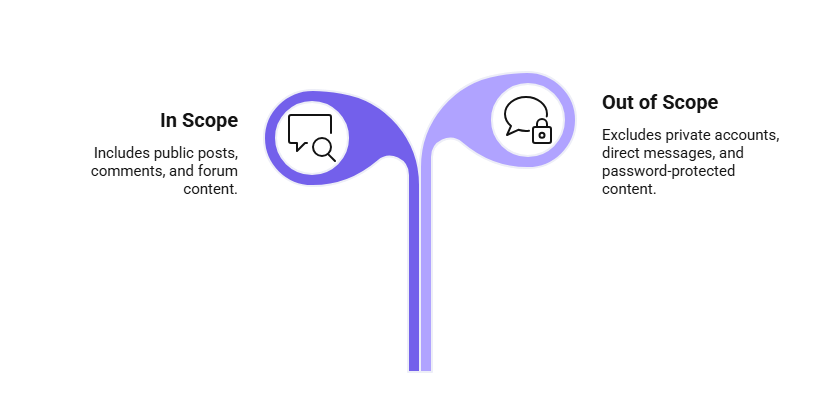
- In scope: public posts, public comments, public profile information, and content on forums that require no login or special access to view
- Out of scope: private accounts, password-protected content, direct messages, anything reached by requesting login credentials, and anything reached by asking a candidate to change their privacy settings so a reviewer can see more
That boundary is not incidental. Many states restrict employers from requesting social media passwords or requiring account access as a condition of employment, and a program that tries to reach past public content into private accounts runs directly into those restrictions, on top of creating the kind of privacy exposure that damages candidate and employee trust regardless of legality. A brand protection screening program built correctly treats “public only” as a hard boundary, not a preference, because the alternative creates legal exposure the program’s own value does not justify.
This is also where documentation earns its keep: a program that can show, case by case, that only public content was reviewed has a much easier time defending its methodology later than one that cannot demonstrate where information came from.
How Findings Are Evaluated: Documented Criteria and Severity Categorization
Why Standardized Criteria Matter Legally
The Equal Employment Opportunity Commission has held for over a decade that personal information gleaned from social media, including protected-class information a reviewer encounters incidentally, cannot be used to make employment decisions on prohibited bases such as race, gender, national origin, religion, age, or disability (EEOC, 2014). The agency’s own position stops there; it does not prescribe a specific review methodology. But the practical implication is straightforward: if a reviewer cannot show why one case was treated differently from another, an inconsistency the prohibited-bases rule was designed to catch becomes very hard to distinguish from an inconsistency that simply reflects poor process. Documented, written criteria, applied the same way to every case, is the practical mechanism that keeps that distinction visible.
What Severity Categorization Looks Like in Practice
A structured program does not simply flag content as a problem or not a problem. It sorts findings by severity, distinguishing content that is clearly material to brand and conduct standards from content that is borderline or plainly irrelevant to the standard being applied. That categorization does two things at once. It gives HR and risk teams a consistent basis for deciding what warrants escalation, and it creates a paper trail showing that similar findings were treated similarly across every person screened.
Standardized criteria and individualized assessment are not in tension. A documented severity tier tells a reviewer how seriously to treat a category of finding; it is not a substitute for asking, in each specific case, whether the finding is actually relevant to the role and the decision at hand. Treating a severity tier as an automatic trigger for adverse action, without that case-by-case relevance check, reintroduces the same blanket-rule risk that documented criteria are meant to avoid. At the EEOC’s 2014 public meeting on social media in the workplace, employment counsel briefing the Commission recommended using a third party or a designated reviewer who is not the hiring decision-maker, and limiting any review strictly to publicly available information, specifically to reduce the risk that protected-class information reaches the person making the decision (EEOC, 2014). A documented, severity-categorized report that separates the finding from the decision-maker is a practical way to build that separation into the process itself.
Where Brand Protection Screening Fits Across the Employee Lifecycle

Brand protection screening is not a single point-in-time check. It applies differently depending on where an individual sits in their relationship with the organization.
| Stage | Primary risk being managed | Typical trigger |
| Hiring and onboarding | Public content becomes associated with the brand at the moment employment is announced | Offer acceptance, before public announcement |
| Leadership and public-facing roles | Individual conduct disproportionately affects organizational reputation | Promotion, appointment, or ongoing tenure in a visible role |
| Ongoing policy enforcement | New public content emerges after employment has already begun | Scheduled review or a specific reported concern |
Hiring and Onboarding
The highest-leverage moment for brand protection screening is before a hire becomes public. Once someone’s employment is announced, whatever is already sitting in their public profile becomes retroactively associated with the employer, and there is no way to unwind that association after the fact. Screening before the announcement, rather than after, is what actually gives an organization the chance to evaluate and respond before the exposure exists. Any decision to withdraw an offer based on a brand protection screening finding still follows the same disclosure, authorization, and adverse action sequence described later in this guide. Screening earlier changes when the process starts, not whether it applies.
Leadership and Public-Facing Roles
Individual conduct does not carry equal weight across every role. A leader, spokesperson, or brand ambassador whose public profile conflicts with organizational standards creates disproportionate exposure compared to the same content posted by someone with no public visibility, simply because more people are watching and more of them will connect the content back to the organization. That is why leadership oversight warrants closer scrutiny than a standard new-hire check, not because leaders deserve less privacy, but because the stakes attached to their public conduct are objectively higher.
Ongoing Policy Enforcement
Reputational exposure does not stop accumulating after someone is hired. A policy-enforcement program applies the same documented criteria on a scheduled basis, or in response to a specific reported concern, so that brand standards are enforced consistently across the existing workforce rather than only at the point of hire. Consistency here matters for the same reason it matters at hiring: applying brand standards to some employees and not others, without a documented and repeatable process, is exactly the pattern that produces defensible-sounding decisions on paper and indefensible-looking ones in practice.
The Legal Framework: FCRA, Consumer Reports, and the Permissible-Purpose Test
When a Third Party Compiles the Report
The Fair Credit Reporting Act defines a consumer report as a communication by a consumer reporting agency that bears on a person’s character, general reputation, personal characteristics, or mode of living, and that is used or expected to be used as a factor in an employment decision (FCRA, 15 U.S.C. §1681a(d)). Employment purposes, in turn, covers evaluating a person for hiring, promotion, reassignment, or retention as an employee (FCRA, 15 U.S.C. §1681a(h)), which is why a report used to inform a decision to keep, discipline, or part ways with an existing employee triggers the same requirements as one used at the point of hire. The trigger for FCRA coverage is not whether the underlying content is public. Public social media posts, like public court records, are still public information. The trigger is whether a third party, meaning a business that assembles that information into a report and furnishes it to an employer for an employment decision, is the one compiling it (Federal Trade Commission, “Using Consumer Reports: What Employers Need to Know”). When a brand protection screening report is compiled by a third-party provider for a hiring, promotion, or retention decision, it functions as a consumer report, and the FCRA’s disclosure, authorization, and adverse action requirements apply.
Consent and Adverse Action Steps
Where that trigger is met, the sequence is the same one that governs any other FCRA-covered consumer report: a clear, standalone disclosure that the screening may occur, the individual’s written authorization, a pre-adverse action notice with a copy of the report if the findings could lead to an adverse decision, and a final adverse action notice once the decision is made (FCRA, 15 U.S.C. §1681b; 15 U.S.C. §1681m). Where brand protection screening is used on an ongoing basis rather than only at hiring, the authorization must say so clearly and conspicuously. A one-time authorization obtained at hiring does not automatically cover recurring reports pulled throughout someone’s employment (Federal Trade Commission, “Using Consumer Reports: What Employers Need to Know”). Treating a review as exempt from any of these steps because the content being reviewed happens to be public is a common and avoidable compliance failure.
Building a Compliant Brand Protection Screening Program
A program that holds up under scrutiny is built the same way regardless of company size, though the operational weight of each step grows as the workforce does.
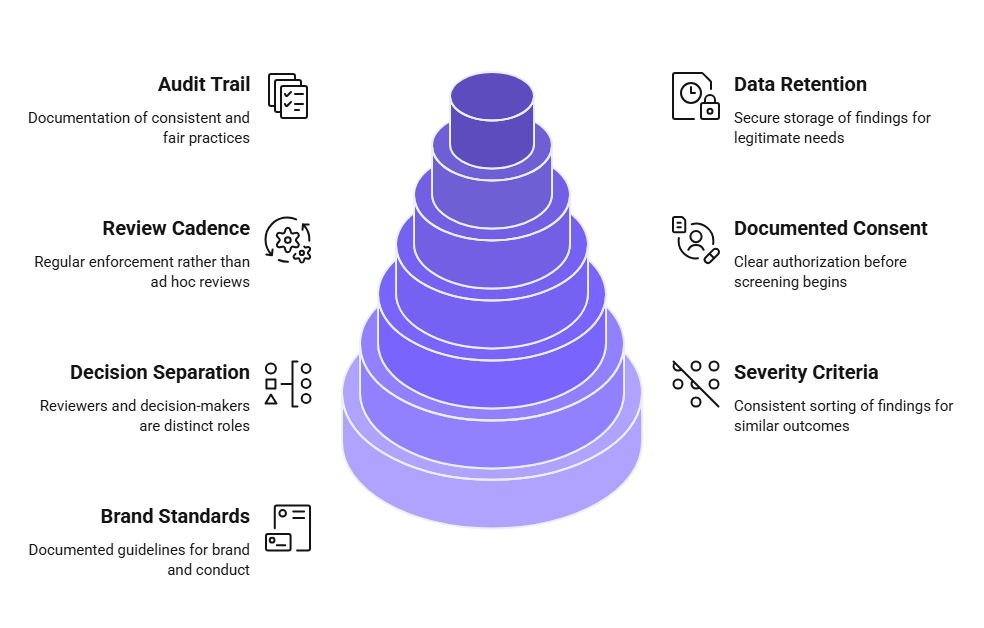
- Written brand and conduct standards, documented before any screening begins, not developed case by case as findings come in
- Severity categorization criteria that sort findings consistently, so similar content produces similar outcomes across every person screened, paired with an individualized relevance check before any adverse decision
- Separation between the person who reviews content and the person who makes the employment decision, so findings reach decision-makers as structured reports rather than as raw profiles
- Documented consent, obtained before screening starts, with clear disclosure of what will be reviewed and whether the authorization covers ongoing, recurring screening
- A defined review cadence for ongoing enforcement, rather than ad hoc reviews triggered only by informal complaints
- Defined data retention limits, so screening findings and source materials are kept only as long as a legitimate business or legal need requires, and are securely stored throughout
- An audit trail showing that public-only sourcing, documented criteria, and consistent application were followed in every case
Programs that skip the documentation step tend to look identical to compliant ones right up until a decision gets challenged. At that point, the difference between a written standard applied consistently and a judgment call made in the moment becomes the whole case. This is the kind of consistency GCheck’s Compliance for Good® framework is built around: Fair Compliance keeps the same documented standard, and the same individualized review, applied to every case, and Protective Compliance gives organizations the early visibility that lets them act before public association creates damage that cannot be undone.
Frequently asked questions
What is brand protection screening?
Brand protection screening is the review of an individual’s publicly available online content, evaluated against an organization’s own documented brand and conduct standards. It differs from a standard background check, which verifies facts against official records, and it is not related to trademark or counterfeit-related “brand protection” work, which is a separate field entirely.
Is brand protection screening the same as social media screening?
They overlap in method but not in standard. General social media screening is typically scoped around legal-risk categories, such as content revealing protected-class information or threats of violence. Brand protection screening measures content against an employer’s own written brand and conduct standards, which can be narrower or broader than legal-risk categories depending on what the organization has documented.
Does brand protection screening access private accounts?
No. A properly scoped program reviews only content that is publicly visible without special access. It does not request passwords, ask for account access, or require a candidate or employee to change privacy settings so more content becomes visible to a reviewer.
Does the Fair Credit Reporting Act apply to brand protection screening?
It depends on who compiles the findings and why, not on whether the content is public. When a third-party provider assembles publicly available content into a report and furnishes it to an employer for a hiring, promotion, or retention decision, that report functions as a consumer report under the FCRA, and the law’s disclosure, authorization, and adverse action requirements apply. If screening is meant to continue after hiring, the authorization needs to say so clearly.
Who uses brand protection screening?
HR leadership, brand and communications teams, risk management, and executive teams typically use it, most often for public-facing roles, leadership positions, and organizations where brand reputation carries significant business weight. It applies at hiring, at leadership appointment, and as an ongoing enforcement tool across an existing workforce.
How are findings evaluated?
Findings are measured against documented brand and conduct criteria and organized by severity, rather than left to a reviewer’s individual judgment, though severity categorization still requires an individualized check on relevance before any adverse decision. That structure is what allows an organization to demonstrate that similar content was treated consistently across every person screened, which matters most when a decision is later challenged.
Sources cited
- U.S. Equal Employment Opportunity Commission, “Social Media Is Part of Today’s Workplace but its Use May Raise Employment Discrimination Concerns,” Press Release, March 12, 2014
- Federal Trade Commission, “Using Consumer Reports: What Employers Need to Know” (business guidance)
- Fair Credit Reporting Act, 15 U.S.C. §1681a(d) (definition of consumer report)
- Fair Credit Reporting Act, 15 U.S.C. §1681a(h) (definition of employment purposes)
- Fair Credit Reporting Act, 15 U.S.C. §1681b (permissible purposes; disclosure and authorization)
- Fair Credit Reporting Act, 15 U.S.C. §1681m (adverse action requirements)
- Society for Human Resource Management member survey data, cited in EEOC, 2014 (social media use in recruiting, 2008 to 2013)

ABOUT THE CREATOR
Charm Paz, CHRP
Recruiter & Editor
Charm Paz is an HR professional at GCheck, specializing in background screening, fair hiring, and regulatory compliance. She holds from the Professional Background Screening Association (PBSA) and helps organizations navigate employment regulations with clarity and confidence.
With a background in Industrial and Organizational Psychology, she translates policy into practice to build ethical, compliant, human-centered hiring systems that strengthen decision-making over time.