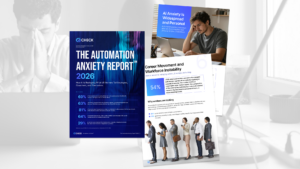
A national survey of 1,500 US workers from The Automation Anxiety Report 2026 finds the same workforce inflating its AI credentials is also quietly resisting AI adoption.
For many job applicants and employees, it’s easier to speak confidently about an AI tool they have barely used before than admit they are still learning how to use it. AI fluency has become such a ubiquitous marker of employability that not doing so risks losing a job offer or a promotion.
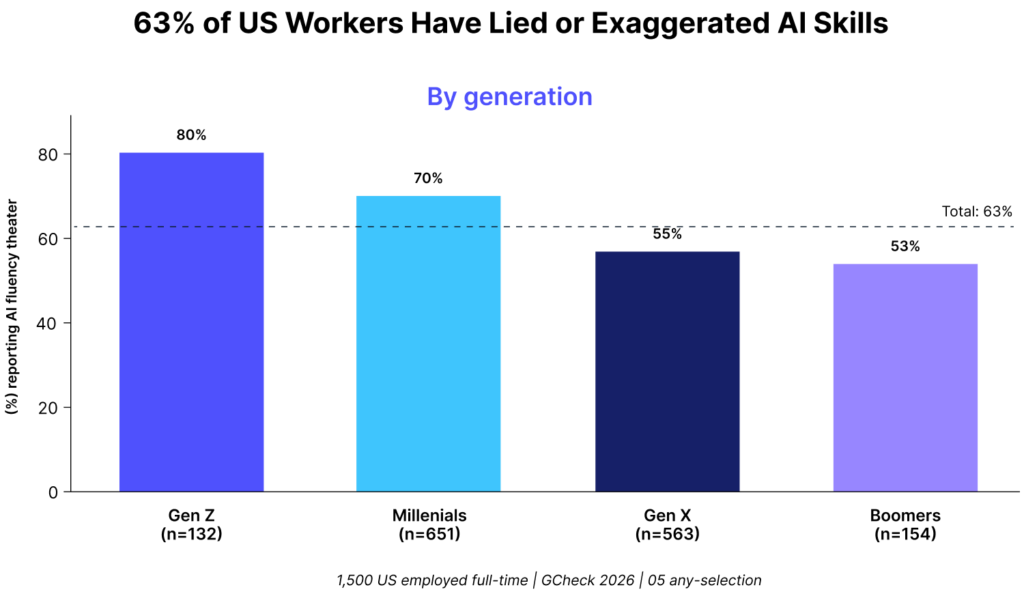
Across the United States, this has never been more true than now. The Automation Anxiety Report, a survey of 1,500 U.S. full-time employed adults fielded April 21-22, 2026, found that 63% have exaggerated or lied about their AI skills to appear more capable. That figure reaches 80% for workers under 30, while 64% say their employer has never actually attempted to verify their claims. The report calls this phenomenon, which is becoming more and more commonplace in every organization, the “AI Skills Bubble”: when workers’ claims about their AI skills outpace demonstrated ability.
GCheck broke down the findings from the Automated Anxiety Report to explain why and how often American workers are inflating their skills with AI tools.
Why the Bubble Inflated
The pressure to inflate AI fluency is real. Demand for AI skills in entry-level jobs has nearly tripled since fall 2025, according to the NACE Job Outlook 2026 Spring Update. Moreover, the International Monetary Fund found that 1 in 10 job postings in advanced economies now requires at least one new skill. In addition, postings with new skills tend to pay more in the U.S. and the U.K. Workers are aware of the trend and are responding by listing AI skills they have not fully acquired.
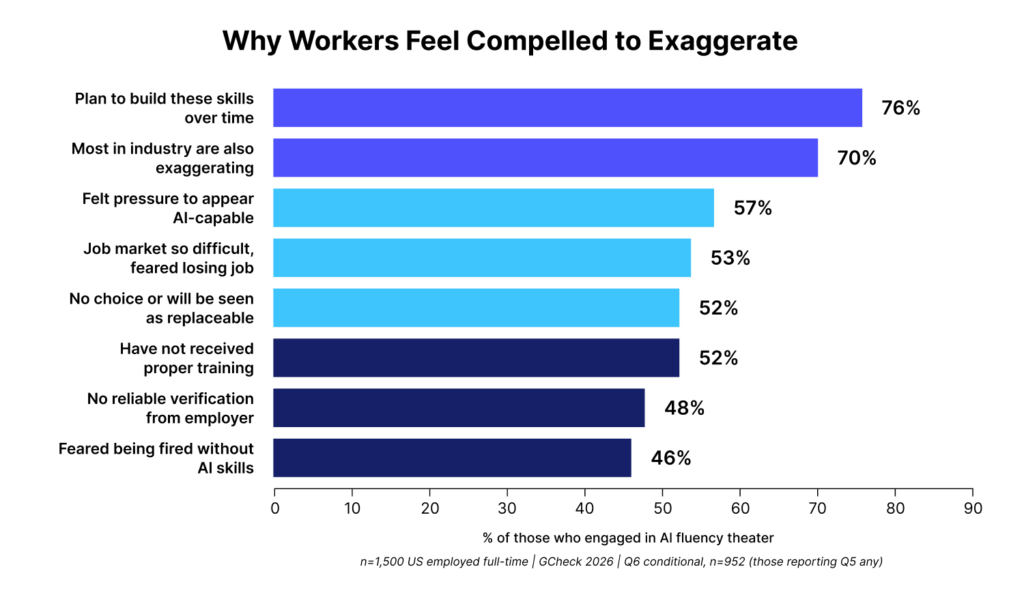
But why are workers inflating their abilities? Of those who were surveyed, 76% said they plan to build the skills eventually while 70% believe everyone around them is exaggerating like them. More than half said they have never received any formal AI training, and nearly half say that their employer has no way to verify their claim.
The Same Workers Are Quietly Resisting AI
The report also uncovered two activities going in opposite directions: The same workers exaggerating their AI credentials are working to slow down the rollout of AI in their workplaces. Eighty-one percent of those surveyed reported at least one behavior intended to discourage or limit AI use at work. Forty-five percent said they raised risk concerns about AI more loudly than they actually believed them. Meanwhile, over half of respondents said they intentionally stuck with manual approaches to avoid increasing their reliance on AI processes.
These motives are self-protective. Seventy-two percent of respondents admit they worry that widespread AI use will reduce job opportunities, while 71% said they do not completely trust the quality or accuracy of AI output. Additionally, 63% have fears that reliance on AI will erode their skills.
Employers are missing the contradiction because they estimate AI adoption by tracking usage, but they don’t see the behavior behind the numbers. Recruiting is the most common AI use case when it comes to human resources, according to SHRM’s State of AI in HR 2026. The research also found that gaps in workforce skills and governance are the main barriers to progress, even more so than technology. Aggregate usage data tends to hide the discrepancy between what workers claim and what they demonstrate.
Tatiana Teppoeva, Ph.D., a former Microsoft AI scientist and U.S. patent holder who now advises HR teams on the blind spots in automated screening, reads the pattern as a signal in itself.
“When hiring processes reward signals that can be measured and scored, candidates optimize for those signals,” Teppoeva said. “A workforce that inflates AI skills while resisting AI adoption is sending a clear signal that the measurement system isn’t capturing what actually predicts success.”
What Workers Are Actually Asking For
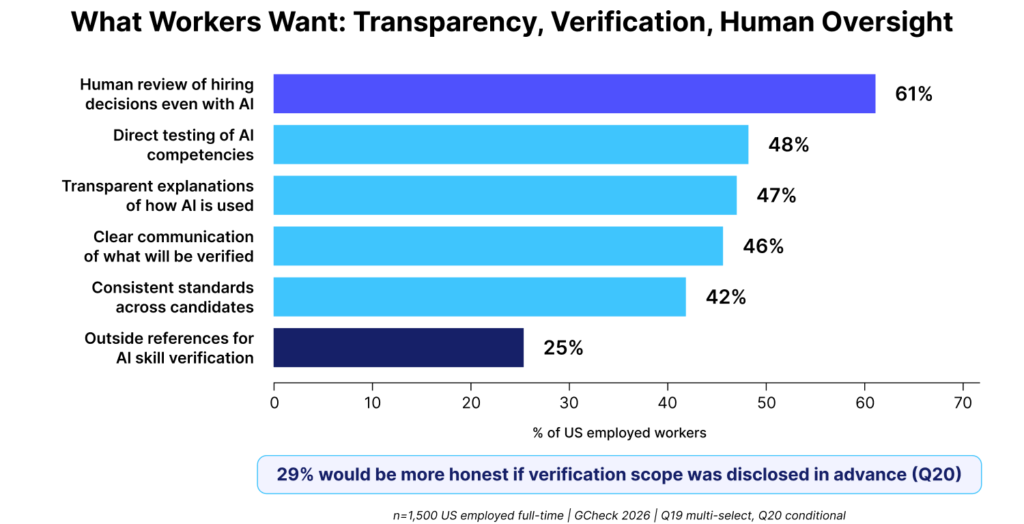
So what can change workers’ behavior? Among the survey respondents, 61% said they want a human to review hiring decisions even if AI tools are used. Forty-eight percent said they want their AI skills directly tested, and 42% said they want consistent standards applied for all candidates.
One finding from the survey was very particular. Twenty-nine percent said they would present themselves more honestly if employers told them up front what exactly would be verified. This preference aligns with current regulations. California’s 2025 AI employment regulations clarified how antidiscrimination laws apply to AI and automated decision systems in hiring and promotion.
A Human Response to an Anxious Moment
Inflation of AI skills and resistance to tool rollout are happening in the same population at the same time. Exaggeration is highest among the youngest workers who have the longest careers still ahead. The pressure is being driven by the market, and workers are looking for a more human response.
If employers give workers more clarity about what will be assessed, and if they guarantee a human will be in the loop and standards will be applied evenly, workers appear willing to be more candid about their actual level of AI fluency. This is a call for governance to catch up with aggressive AI tool adoption policies. Clearer rules promote honesty, and honesty can help bridge the growing gap between employers and the workforce.
Methodology: Findings are from The Automation Anxiety Report 2026, a national online survey of 1,500 full-time employed U.S. adults conducted via Pollfish and fielded April 21 – 22, 2026. All respondents passed an AI-familiarity screener. Margin of error: ±2.5 percentage points at the full-sample level.

ABOUT THE CREATOR
Houman Akhavan
Founder and CEO, GCheck
Houman Akhavan is the Founder and CEO of GCheck, a hire-to-retire screening platform built on the principle of Compliance for Good®. He is and serves on the boards of two NASDAQ-traded companies (POWW and CDON.ST), where he contributes to audit, compensation, and corporate governance.
With more than 25 years of experience building and scaling technology businesses, Houman brings a rare combination of operational discipline and compliance expertise to the background screening industry. Previously, as Chief Marketing Officer at CarParts.com (NASDAQ: PRTS), he directed $50M+ annual budgets and helped lead the company through a significant period of digital transformation and growth. He also served on Google's Retail Advisory Council.
Houman founded GCheck on a straightforward belief: background screening should be fast, fair, and transparent for both employers and candidates. He lives and works in the Los Angeles area.