
INDUSTRY GUIDES



MVR check lookback runs three to seven years under the FCRA, with separate state DMV rules and DOT annual review requirements for CDL drivers.
Created by

An MVR check typically pulls three to seven years of driving history. The Fair Credit Reporting Act (FCRA) caps most reported violations at seven years, but state DMV rules control what actually appears in the record, and separate U.S. Department of Transportation regulations govern the lookback for commercial drivers. Serious violations such as DUIs can stay on an MVR far longer, in some states permanently.
A motor vehicle record (MVR) is the driving history a state department of motor vehicles keeps for each licensed driver. When an employer runs an MVR check as part of a background screen, the report typically shows the driver’s license class, license status such as active, suspended, or revoked, endorsements and restrictions, moving violations, accidents, and vehicle-related criminal convictions such as DUI or reckless driving. Because each state’s DMV maintains its own records, an MVR pulled from one state generally will not show violations that occurred while the driver held a license in another state.
MVR checks are consumer reports under the Fair Credit Reporting Act when a consumer reporting agency (CRA) prepares them for an employer. The FCRA’s pre-authorization, disclosure, and adverse action rules apply here the same way they apply to any other background check (FTC, 2016). MVRs are also governed by the federal Driver’s Privacy Protection Act (18 U.S.C. §2721 et seq.), which limits access to state DMV records to a defined set of permissible purposes, including employment screening for driving-related roles.
Under the Fair Credit Reporting Act, a consumer reporting agency generally may not include adverse information older than seven years in a consumer report, including an MVR. The seven-year ceiling is set by 15 U.S.C. §1681c and covers items such as arrests, civil suits, and other adverse information other than criminal convictions. Criminal convictions themselves are not capped at seven years under the FCRA (Federal Trade Commission, 2016).
Two federal exceptions matter for MVR checks specifically:
The FCRA disclosure and consent rules apply to every MVR check performed through a CRA regardless of how far back the report reaches. The candidate must receive a standalone written disclosure and provide written authorization before the report is ordered (15 U.S.C. §1681b(b)(2)(A)).
Each state DMV sets its own rules for how long a violation stays on a driving record and how far back a driving record report reaches. The result is a patchwork: two candidates with identical driving histories can produce very different MVRs depending on the state that issued the license.
A few illustrative examples of state variation:
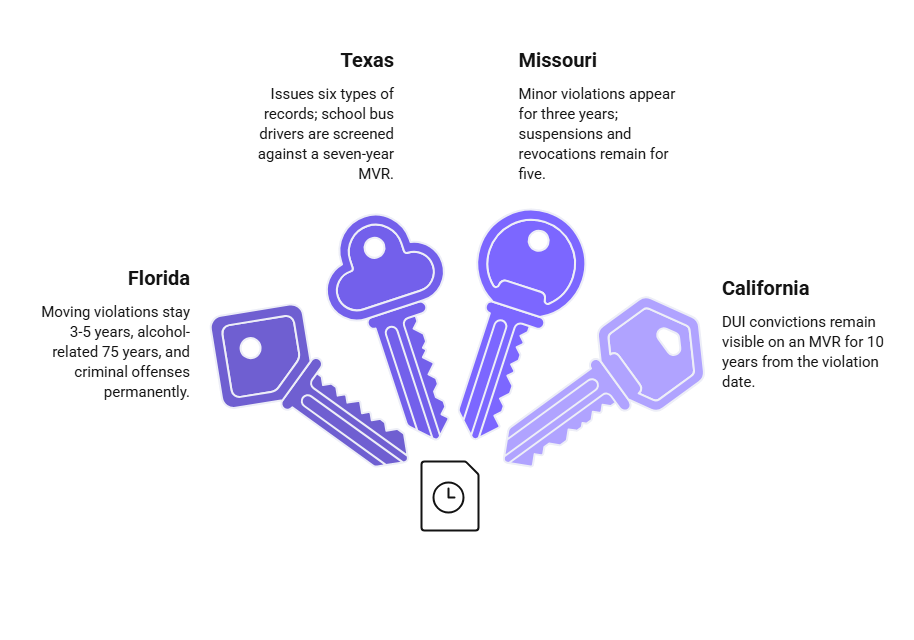
For employers hiring across multiple states, a single corporate lookback policy needs to accommodate different data availability rather than assume every state DMV will release the same window. A screening partner that pulls MVRs from every jurisdiction where the driver has held a license produces a more complete picture than a single-state check.

Commercial drivers regulated by the U.S. Department of Transportation are subject to a separate MVR regime. The DOT rules govern timing and scope; FCRA disclosure and consent obligations still apply when a CRA runs the report.
Two Federal Motor Carrier Safety Administration regulations set the pre-employment and ongoing MVR requirements for CDL drivers:
The pre-employment MVR under §391.23 does not satisfy the annual review requirement under §391.25. Both are independent obligations with their own documentation standards. For pre-employment screening beyond the MVR itself, the FMCSA Pre-Employment Screening Program (PSP) makes available a five-year window of crash data and three years of roadside inspection data drawn from the agency’s Motor Carrier Management Information System.
Serious traffic offenses behave differently than routine moving violations. State DMV rules generally treat DUI, reckless driving, vehicular manslaughter, felony hit-and-run, and other vehicle-related felonies as high-severity records with extended or permanent retention. Florida retains alcohol-related violations for 75 years and vehicle-related criminal offenses permanently. California retains DUI convictions for 10 years. Many states treat felony vehicle offenses as permanent record entries with no lookback ceiling.
The same MVR check on the same candidate can look substantially different depending on the mix of offenses on record and the state that maintains it. A candidate with a decade-old DUI in a state that retains the record permanently will surface information that a candidate with an identical DUI in a state that expires the record at 10 years may not.
The FCRA seven-year cap only applies when a CRA delivers the report. When a state DMV releases a driving record directly to an employer, whatever the DMV retains is what appears.
The lookback question sits at the intersection of what federal and state law allows, what the role actually requires, and what a defensible hiring process looks like. The law and the DMV set the ceiling on what can be reported. The role sets what a reasonable employer needs to see.
A useful frame:
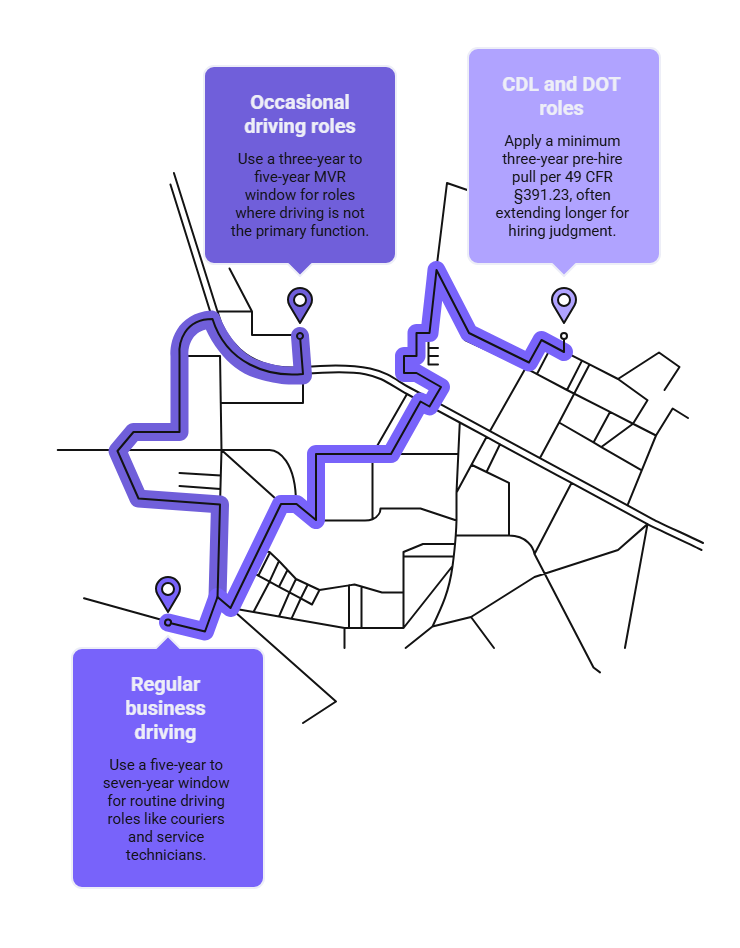
Applying the chosen window consistently across candidates for the same role is what a defensible process looks like under EEOC guidance and Title VII. Individualized assessment of what a driving record shows, rather than automatic rejection based on a single entry, aligns with the EEOC’s April 25, 2012 Enforcement Guidance on the Consideration of Arrest and Conviction Records in Employment Decisions Under Title VII.
Workers are asking employers to tell them, plainly, what is being verified and how. In the GCheck’s 2026 Trust in Hiring Report, 81% of workers said a clear explanation of what is being checked would make them more confident in the employer’s background check process (PERCEPTION, Q21, n=1,500). The same percentage said human review of findings, rather than fully automated decisions, would raise their confidence. And 77% said the same about the ability to review or dispute findings before an adverse decision is issued.
MVR checks are one of the easiest verification categories to explain to candidates, because the underlying facts are objective: a moving violation on a specific date, a license class, an expiration, a suspension window. Candidates who understand what the employer will look at, how far back the record will reach, and what the process is for disputing an entry participate in the process with less anxiety.
That is Transparent Compliance in practice. The MVR policy is documented. The lookback window is explained before the check runs. The candidate has a clear path to review the report and dispute any error before an adverse decision is issued. It is also Protective Compliance: an MVR program that surfaces a suspended license before a hired driver takes a company vehicle out of the lot prevents the kind of incident that ends up in the news and in a courtroom.
Compliance for Good™ is how GCheck runs MVR checks and every other verification category: transparent about what is checked, fair in how findings are reviewed, and protective of the people and organizations whose safety depends on the answer.
An MVR check for a non-commercial driver typically covers three to seven years, depending on the state DMV that maintains the record and any additional state employment law restrictions. Under the Fair Credit Reporting Act, adverse information older than seven years generally may not be reported by a consumer reporting agency, except for jobs paying $75,000 or more per year, which are exempt from the seven-year cap under 15 U.S.C. §1681c(b)(3).
For a driver holding a Commercial Driver’s License, 49 CFR §391.23 requires the motor carrier at the time of hire to obtain an MVR from every licensing authority where the driver held a CDL or permit during the preceding three years. After hire, 49 CFR §391.25 requires the carrier to obtain and review a new MVR at least once every 12 months for as long as the driver is employed. The two obligations are independent, and both must be documented in the driver qualification file.
DUI lookback varies sharply by state. California retains DUI convictions on the driver’s record for 10 years. Florida retains alcohol-related violations for 75 years. Some states retain vehicle-related criminal offenses permanently. When an employer pulls an MVR through a consumer reporting agency, the FCRA seven-year cap applies for most positions. When the state DMV releases the record directly, or when the position falls under the $75,000 salary exception, the state’s underlying retention rule controls what appears.
Accidents typically appear on an MVR when they result in a reportable violation or a conviction. State DMVs vary in how they treat at-fault versus not-at-fault accidents. Some states include all reportable crashes regardless of fault; others include only those tied to a citation or conviction.
Not directly. Each state DMV maintains its own record, so an MVR pulled from a single state generally reflects only the driving history that occurred while the driver held a license in that state. Employers who need a multi-state view typically ask their screening partner to pull MVRs from every state where the driver has held a license during the intended lookback window.
Recruiter & Editor
Charm Paz is an HR professional at GCheck, specializing in background screening, fair hiring, and regulatory compliance. She holds from the Professional Background Screening Association (PBSA) and helps organizations navigate employment regulations with clarity and confidence.
With a background in Industrial and Organizational Psychology, she translates policy into practice to build ethical, compliant, human-centered hiring systems that strengthen decision-making over time.

Contact us today for efficient, FCRA-compliant screening solutions
designed to keep your hiring process moving safely and smoothly.



LEGAL DISCLAIMER: The information provided in this article is for general informational and educational purposes only and should not be construed as legal advice or a substitute for consultation with qualified legal counsel. While we strive to ensure accuracy, employment screening laws and regulations—including but not limited to the Fair Credit Reporting Act (FCRA), Equal Employment Opportunity Commission (EEOC) guidelines, state and local ban-the-box laws, industry-specific requirements, and other applicable federal, state, and local statutes—are subject to frequent changes, varying interpretations, and jurisdiction-specific applications that may affect their implementation in your organization. Employers and screening decision-makers are solely responsible for ensuring their background check policies, procedures, and practices comply with all applicable laws and regulations relevant to their specific industry, location, and circumstances. We strongly recommend consulting with qualified employment law attorneys and compliance professionals before making hiring, tenant screening, or other decisions based on background check information.