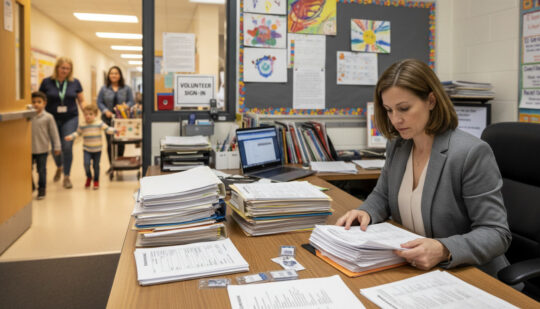

School volunteer programs carry the same child safety obligations as paid staff programs, but they are screened at a fraction of the depth. This guide covers the complete verification stack, how to tier checks by access level, what Florida, Pennsylvania, and California require by law, and what FCRA requires of any organization that uses a third-party screening provider.
Key Takeaways
- There is no single federal law mandating background checks for school volunteers. Requirements come from state law, district policy, and organizational risk posture.
- Effective March 1, 2025, Florida requires all school volunteers to complete a Level 2 background check, including fingerprinting and a comprehensive screening of state and federal criminal records, before working with students.
- Pennsylvania requires school volunteers to obtain three clearances: a PA Criminal History Record, a PA Child Abuse History Certification, and an FBI fingerprint check, with a 10-year residency waiver available.
- California’s AB 506 requires administrators, employees, and regular volunteers of youth service organizations to complete a fingerprint-based Live Scan background check. A regular volunteer is defined as an adult who volunteers 16 or more hours per month or 32 or more hours per year.
- Verification depth should scale with access level. A chaperoned classroom helper warrants a different stack than an unsupervised one-on-one tutor.
- FCRA applies to school volunteer background checks when a CRA conducts the check. Disclosure, authorization, and adverse action requirements apply regardless of whether the position is paid or unpaid.
- The sex offender registry check must cover all 50 states, territories, and D.C. A state-only registry search misses out-of-state registrations.
- The child abuse registry check is a separate product from a criminal check. Several states require it specifically, and most organizations do not know it exists as a distinct search.
Why School Volunteer Screening Deserves the Same Rigor as Employee Screening
School volunteers are the most consistently under-screened group in K-12 education. They serve in roles ranging from occasional classroom party helpers to weekly one-on-one tutors who work with individual students without a teacher present. The variation in engagement length and access level is one reason volunteer screening programs are often less systematically developed than the vetting policies that apply to teachers and administrators. Yet for many students, the volunteer in the room has as much direct contact with them as any paid staff member.
A school volunteer who harms a student creates the same legal, institutional, and human consequences as an employee who does. Many courts have applied negligent hiring and negligent supervision principles to organizations that place volunteers in roles involving access to children, and the absence of a state screening mandate does not eliminate that exposure. Consult qualified legal counsel regarding the liability framework applicable in your jurisdiction.
This guide covers what a complete school volunteer verification program includes, how to tier checks by access level, what state law requires in the highest-mandate jurisdictions, and what FCRA requires of any school district or education nonprofit that uses a third-party screening provider.
The Federal Framework: Why States Fill the Gap
There is no single federal law that mandates specific background check procedures for school volunteers. The Every Student Succeeds Act establishes broad student safety expectations but does not specify what checks schools must run, on whom, or how often. As a result, background check requirements for school volunteers are governed primarily by state law.
ESSA delegates the specifics to states, which produces a compliance patchwork: what is mandatory in Florida is recommended in Minnesota, and what requires fingerprinting in Pennsylvania may only require a name-based check in a neighboring state. Two federal frameworks apply regardless of state mandate, however.
The National Child Protection Act and the VECHS Program
The National Child Protection Act established the Volunteer and Employee Criminal History System, which gives qualified nonprofit and youth-serving organizations access to fingerprint-based FBI criminal history records for screening volunteers. Organizations do not need a state mandate to access FBI-level screening. They need VECHS qualified entity status. This pathway is how nonprofit tutoring programs, education nonprofits, and private schools without a state fingerprint mandate can access the same depth of search that Florida and Pennsylvania require by law.
FCRA
Whenever a school, district, or education nonprofit uses a consumer reporting agency to conduct background checks on volunteers, the Fair Credit Reporting Act applies. The paid or unpaid nature of the role does not create an exemption. This requirement is covered in detail in its own section below.
The Complete Verification Stack: What a Best-Practice Program Includes
A complete school volunteer verification program is not a single check. Instead, it is a layered set of searches, each accessing a different data source and serving a distinct screening purpose. Understanding what each component does, and what it cannot catch, is what separates a defensible program from a form-filing exercise.
The Core Verification Components
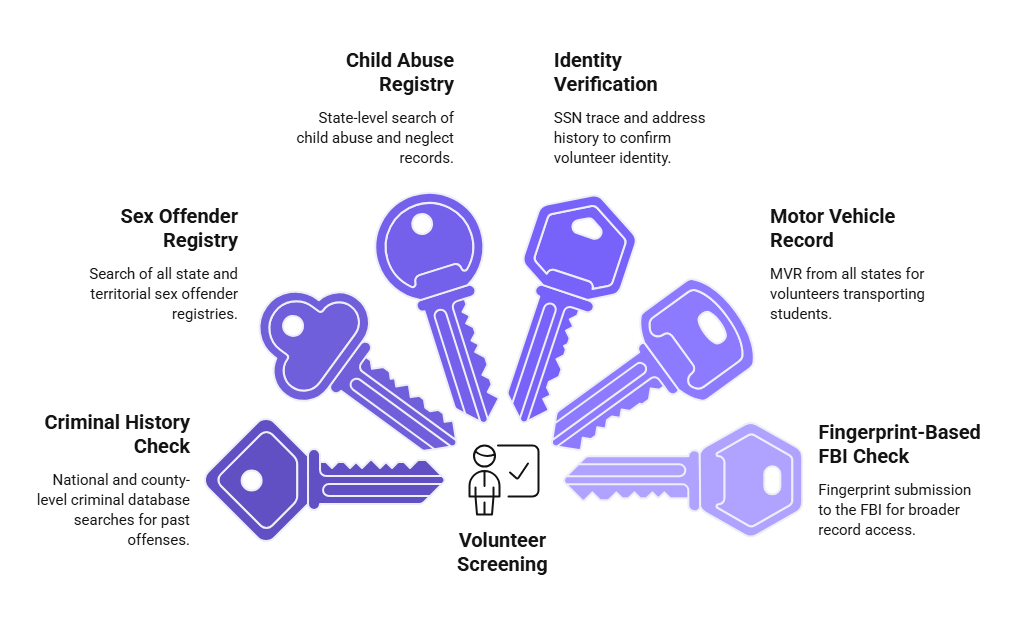
- Criminal history check through a CRA. A national criminal database search plus county-level verification at current and prior addresses. Approximately 40 percent of U.S. counties report to commercial databases, so a database-only search can miss recent local records. A state-only criminal check covers only the current state and will miss convictions from prior states of residence. For volunteers who have lived in multiple states, a multi-state search with county-level verification is essential.
- Sex offender registry search. A search of all public registries across all 50 states, territories, and D.C. A registrant who offended in one state and relocated to another appears on the originating state’s registry. A search limited to the current state misses them entirely. The National Sex Offender Public Website aggregates all state and territorial registries and serves as the appropriate baseline for CRA-ordered registry searches.
- Child abuse registry check. A search of the state’s child abuse and neglect registry, a separate database from criminal court records maintained by the state child welfare agency. Criminal checks do not surface child abuse registry listings. Pennsylvania mandates this check under Act 153. Organizations in other states should include it for any role involving one-on-one student contact.
- Identity verification. SSN trace and address history confirming the volunteer is who they say they are, run before any other check. Background check results are only as meaningful as the identity they are run against.
- Motor vehicle record check. For volunteers who will transport students, an MVR from every state where the volunteer has held a license in the past three years. The check should include DUI history and recent violations.
- Fingerprint-based FBI check. For states that require it, including Florida, Pennsylvania, and California, or for organizations that choose it through VECHS enrollment, a fingerprint submission to the FBI’s NGI system accesses a broader and more accurate record than any commercial database. This check surfaces records in jurisdictions that do not report to commercial databases.
Each component closes a gap the others cannot. Omitting any layer in a Tier 2 or Tier 3 program leaves a structural gap in coverage.
Role-Tiering: Matching Verification Depth to Access Level
Not all school volunteer roles carry the same risk profile. A parent who comes to the classroom twice a year for a holiday party, with a teacher present throughout, presents a fundamentally different access profile than a weekly one-on-one reading tutor who works with students individually in a separate room. The relevant variable is not the volunteer’s title or visit frequency. It is the access level: specifically, whether the volunteer will have unsupervised contact with students, and in what physical environment.
Tier 1: Supervised, Incidental, or Chaperoned Access
Tier 1 covers volunteers whose contact with students a teacher or staff member always observes. Examples include classroom party helpers, school event support staff with a teacher present throughout, supervised field trip chaperones, and library assistants working under staff oversight. The risk profile is limited: no unsupervised contact, no one-on-one student interaction, and a staff member accountable throughout.
The appropriate verification stack for Tier 1 includes identity verification (SSN trace), a national criminal database search, and a sex offender registry search across all states.
Tier 2: Regular Access With Some Student Interaction, Generally Supervised
Tier 2 covers volunteers with recurring access to students where a teacher or staff member is generally nearby but brief unsupervised interaction is possible. Examples include regular classroom volunteers, reading helpers with a teacher in the room, and school event organizers with ongoing student contact. Students at this tier typically know the volunteer by name, and brief unsupervised moments are possible.
For Tier 2, the appropriate stack adds county-level criminal verification and a child abuse registry check to the Tier 1 foundation: identity verification, criminal history through national database plus county-level verification, sex offender registry across all states, and child abuse registry check where available.
Tier 3: Unsupervised, One-on-One, or Extended Student Contact
Tier 3 covers the highest-risk volunteer roles: those involving unsupervised contact with individual students, private settings, or extended time periods. Examples include one-on-one tutors, mentors, reading program volunteers working individually with students, overnight trip chaperones, and regular transportation volunteers. For these roles, a teacher or staff member is not consistently present.
Consequently, Tier 3 requires the most comprehensive stack: full identity proofing, criminal history through national database plus county-level verification plus federal criminal search, sex offender registry across all states, child abuse registry check, fingerprint-based check (required in Florida, Pennsylvania, and California; recommended for all Tier 3 roles regardless of state), and MVR for transportation volunteers.
Tier Comparison
| Check Type | Tier 1: Supervised | Tier 2: Regular | Tier 3: Unsupervised |
| Identity verification | Yes | Yes | Yes (full proofing) |
| Criminal history: national database | Yes | Yes | Yes |
| Criminal history: county-level verification | No | Yes | Yes |
| Criminal history: federal search | No | No | Yes |
| Sex offender registry: all states | Yes | Yes | Yes |
| Child abuse registry check | No | Yes | Yes |
| Fingerprint-based FBI check | No | No | Yes (required FL, PA, CA; recommended all) |
| Motor vehicle record | No | No | Yes (transportation roles) |
This table reflects best-practice recommendations. State law may require specific components at specific tiers regardless of the framework above. Verify state requirements before finalizing program design.
State Law Requirements: Florida, Pennsylvania, California, and the Broader Patchwork
Florida, Pennsylvania, and California all require fingerprint-based background checks for school volunteers with student contact. Requirements vary by state, role, and whether the volunteer position is paid or unpaid. In states without a specific mandate, liability exposure for failing to screen volunteers remains substantial.
Florida
Effective March 1, 2025, Florida requires all school volunteers to complete a Level 2 background check before working with students. This requirement applies under Florida’s school volunteer statute and represents a significant shift from the prior framework, which required only a name-based Level 1 check for most volunteers. Level 2 includes fingerprinting and a comprehensive screening of both state and federal criminal records through FDLE. Clearance is valid for five years.
Importantly, this requirement is separate from Florida’s law under FS 943.0438 governing youth sports coaches, which carries its own effective date and population scope. The school volunteer statute and the youth sports coach statute are two distinct pieces of Florida law covering different roles. Organizations that operate both school volunteer programs and youth sports programs in Florida should confirm which statute applies to each role category.
Florida also distinguishes between chaperoned and unsupervised volunteers for implementation purposes. For chaperoned volunteers, districts typically conduct name-based criminal history checks through commercially available databases. Unsupervised volunteers, including tutors, mentors, and field trip chaperones with independent student contact, require Level 2 screening. The Level 2 check runs through FDLE’s VECHS program, and schools must apply for VECHS qualified entity status to access this pathway.
Pennsylvania
Pennsylvania requires school volunteers with regular, repeated contact with students to obtain three clearances under Act 153. Specifically, the three required clearances are:
- Pennsylvania Criminal History Record through PSP, available online through ePATCH at no cost for volunteers.
- Pennsylvania Child Abuse History Certification through DHS, certifying whether the volunteer appears in the statewide child abuse database.
- FBI Federal Criminal History Record through fingerprint, required for volunteers who have not been continuous residents of Pennsylvania for the entirety of the previous 10 years. Volunteers who meet the 10-year residency requirement may substitute a signed affidavit.
Child abuse history certifications obtained for volunteer purposes may only be used for other volunteer activities and cannot be reused for paid employment. Clearances are valid for five years and are transferable between organizations for volunteer purposes. Verify current validity periods and transfer rules against Pennsylvania Department of Education guidance before implementation.
California
California’s AB 506 requires administrators, employees, and regular volunteers of youth service organizations to complete a fingerprint-based Live Scan background check through the California Department of Justice. The regular volunteer threshold is 16 or more hours per month or 32 or more hours per year. Live Scan background checks are not transferable between organizations, so volunteers must complete the process separately for each organization they serve.
Beyond the background check itself, AB 506 also requires training in child abuse and neglect identification and reporting for covered volunteers. Organizations subject to AB 506 should therefore confirm both requirements are satisfied before a covered volunteer begins working with students.
The Broader Patchwork
As of late 2025, a significant number of states have background check laws for volunteers involved in youth activities, including school-adjacent programs. School-specific volunteer requirements in these states may differ from the general youth activity requirements. Always verify state education code alongside general youth activity statutes for each jurisdiction. Even where screening is not mandated, the standard of reasonable care in student-facing volunteer selection still applies.
State law is subject to change. Verify current requirements with your state’s department of education and qualified legal counsel before implementation. This section is informational and does not constitute legal advice.
FCRA Compliance: What Applies to School Volunteer Programs
FCRA applies to school volunteer background checks whenever a consumer reporting agency conducts the check, for any school, district, or education nonprofit, regardless of whether the volunteer position is paid or unpaid. FTC guidance has indicated that FCRA applies when a consumer reporting agency screens individuals for volunteer positions. Accordingly, organizations using a CRA for volunteer checks should apply the same FCRA framework they apply to employee checks.
Standalone Written Disclosure
Before ordering any background check on a volunteer through a CRA, the organization must provide a standalone written disclosure stating that a consumer report will be obtained. The disclosure must exist as a separate document and cannot be embedded in the volunteer application, handbook, or any multi-page onboarding packet. FTC guidance indicates that embedding a disclosure in other documents is unlikely to satisfy FCRA’s standalone disclosure requirement. Consult qualified legal counsel to confirm your disclosure document structure meets current standards.
Written Authorization
The volunteer must also provide separate written authorization before the check is ordered. The authorization is the volunteer’s signed consent; the disclosure is the organization’s notice that the check will occur. Both documents are required, and both must precede the order.
Adverse Action for Denied Volunteers
When a background check result leads to a decision not to approve a volunteer, for any reason related to the report, the organization must follow the two-step FCRA adverse action process: a pre-adverse notice with a copy of the report and the CFPB Summary of Rights, a reasonable opportunity for the individual to respond or dispute, then the final adverse action notice. This process applies whether the position is paid or unpaid. When an organization decides not to approve a volunteer based on information in a consumer report, FCRA adverse action procedures apply before that decision is communicated, regardless of who conducts the review.
FCRA compliance requires accurate implementation. Consult qualified legal counsel before establishing or modifying your volunteer screening program’s FCRA processes.
Common Gaps in School Volunteer Screening Programs
State-Only Criminal Checks
Pulling only the state repository check is the most common structural gap in school volunteer programs. A state police database covers the current state and will not return criminal records from other states. As a result, a volunteer convicted of a serious offense in one state who has since relocated will pass a destination-state-only check. A multi-state search through a CRA that includes county-level verification at current and prior addresses closes this gap. For any volunteer who has lived in more than one state, the state-only check is not an adequate foundation.
Missing the Child Abuse Registry Check
Most school administrators are aware of criminal background checks and sex offender registry searches. Far fewer know that child abuse and neglect registries are separate databases, maintained by state child welfare agencies, that criminal checks cannot access. A volunteer with a substantiated child abuse finding may have no criminal record at all. The finding exists in the CANR database, not in the criminal court system. Pennsylvania mandates this check under Act 153, and organizations in other states should include it in the Tier 2 and Tier 3 stacks regardless of whether their state requires it.
One-Time Checks Without a Renewal Policy
A background check run at onboarding reflects the volunteer’s record on that date only. A volunteer who clears an initial check and returns year after year without rescreening accumulates an ever-growing coverage gap. Florida’s Level 2 clearance is valid for five years, and Pennsylvania’s clearances are also valid for five years. Organizations without a state mandate, however, often have no renewal policy at all. The practical minimum for any program with recurring Tier 2 or Tier 3 volunteers is a defined renewal cycle, annual rescreening, or enrollment in continuous criminal monitoring.
How to Build a Documented School Volunteer Screening Program
A defensible volunteer screening program is defined by consistency, documentation, and proportionality to access level, not by complexity. The following checklist is structured for a district HR lead, school principal, or nonprofit program director.
Before the volunteer’s first day:
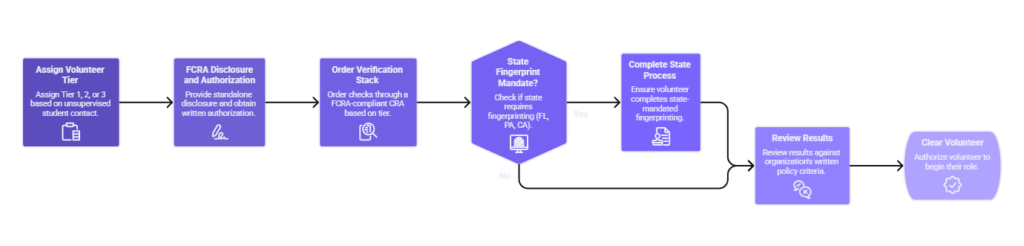
- Assign the volunteer role to a tier (Tier 1, 2, or 3) based on whether the volunteer will have unsupervised student contact.
- Provide a standalone FCRA disclosure and obtain written authorization before ordering any check.
- Order the verification stack appropriate to the assigned tier through a FCRA-compliant CRA.
- For states with fingerprint mandates (Florida, Pennsylvania, California), confirm the volunteer has completed the required state process in addition to any CRA-ordered checks.
- Review results against the organization’s written policy criteria before clearing the volunteer to begin.
When results require a decision:
- If a result leads to non-approval, follow the FCRA two-step adverse action process before communicating the decision.
- Document the review, the basis for the decision, and the date.
- Retain documentation for the duration of the volunteer relationship plus three years.
Ongoing:
- Build a renewal tracking system and flag clearance expiration dates 60 days in advance.
- Apply annual rescreening or continuous criminal monitoring enrollment for all Tier 2 and Tier 3 volunteers.
- Update the tier assignment any time a volunteer’s role or access level changes.
Conclusion
School volunteer programs carry the same child safety obligations as youth sports leagues and youth-serving nonprofits, but they operate with less consistent screening infrastructure and a more complex compliance environment. The verification stack is clear: criminal check, sex offender registry, child abuse registry, and fingerprinting where mandated or warranted by access level. The role-tiering framework makes the program defensible and proportionate, while the FCRA compliance layer makes it legally sound regardless of whether the people running it know the statute applies to volunteer programs.
The organizations that get this right are not the ones with the most complex programs. They are the ones with documented, consistent processes that scale from the occasional classroom helper to the weekly unsupervised tutor, with the right check depth at each tier.
Frequently Asked Questions
Are background checks required for school volunteers?
Requirements vary by state. Florida, Pennsylvania, and California have specific fingerprint-based requirements for volunteers with student contact. Many other states require criminal checks for volunteers with unsupervised access. Where no mandate exists, many courts have applied negligent hiring and negligent supervision principles to organizations placing volunteers in roles involving access to children. Consult qualified legal counsel regarding the liability framework applicable in your jurisdiction.
What background check does Florida require for school volunteers?
Effective March 1, 2025, Florida requires all school volunteers to complete a Level 2 background check before working with students. Level 2 includes fingerprinting and a comprehensive screening of state and federal criminal records through FDLE. Clearance is valid for five years. This requirement is separate from Florida’s youth sports coach requirements under FS 943.0438.
What clearances do Pennsylvania school volunteers need?
Pennsylvania school volunteers with regular student contact must obtain three clearances under Act 153: a Pennsylvania Criminal History Record through PSP, a Pennsylvania Child Abuse History Certification through DHS, and an FBI Federal Criminal History Record through fingerprint. Volunteers who have been continuous Pennsylvania residents for the past 10 years may substitute a signed affidavit for the FBI fingerprint requirement. Verify current requirements against Pennsylvania Department of Education guidance before implementation.
Does FCRA apply to background checks on school volunteers?
Yes, when a consumer reporting agency conducts the check. FCRA requires a standalone written disclosure and written authorization before any check is ordered, and the full two-step adverse action process when check results influence a decision not to approve a volunteer. This applies to schools and education nonprofits regardless of whether the volunteer position is paid or unpaid.
What disqualifies someone from volunteering at a school?
Disqualifying offenses vary by state. Florida’s Level 2 check disqualifies for a list of serious offenses defined under Florida statute; verify current disqualifying offenses against applicable Florida statutes and FDLE guidance before implementation. Pennsylvania disqualifies for specific enumerated offenses under Pennsylvania’s Child Protective Services Law and Act 153. Sex offender registry listings are treated as disqualifying under most school volunteer screening policies, though specific rules vary by state and program. Criminal history outside mandatory disqualifiers should be evaluated through individualized assessment.
How long is a school volunteer background check valid?
Validity periods vary by state. Florida Level 2 clearances are valid for five years, and Pennsylvania clearances under Act 153 are valid for five years and are transferable between organizations for volunteer purposes. California Live Scan checks are not transferable and must be completed separately for each organization. For states without a mandate, annual rescreening is the recognized best practice for recurring volunteers.
Do school volunteers need fingerprint checks?
In Florida, Pennsylvania, and California, fingerprint-based checks are required for volunteers with regular student contact. Florida requires Level 2 FDLE fingerprinting for all school volunteers under the March 2025 law. Pennsylvania requires FBI fingerprinting for volunteers who have not been continuous state residents for the past 10 years. California requires Live Scan fingerprinting for regular volunteers meeting the AB 506 threshold.
Additional Resources
- Every Student Succeeds Act (ESSA) — U.S. Department of Education
https://www.ed.gov/essa - National Sex Offender Public Website (NSOPW)
https://www.nsopw.gov - Background Checks: What Employers Need to Know (FTC / EEOC Joint Guidance)
https://www.ftc.gov/tips-advice/business-center/guidance/background-checks-what-employers-need-know

ABOUT THE CREATOR
Charm Paz, CHRP
Recruiter & Editor
Charm Paz is an HR professional at GCheck, specializing in background screening, fair hiring, and regulatory compliance. She holds from the Professional Background Screening Association (PBSA) and helps organizations navigate employment regulations with clarity and confidence.
With a background in Industrial and Organizational Psychology, she translates policy into practice to build ethical, compliant, human-centered hiring systems that strengthen decision-making over time.