


A hotel background check program for summer hiring should include a role-tiered verification framework that matches check depth to staff access level, a same-day initiation workflow triggered at conditional offer acceptance, FCRA-compliant disclosure and authorization for every seasonal and part-time hire, and a platform-managed adverse action process that holds up under volume. Screening speed is a workflow design problem, not a check-length problem.
Key Takeaways
- Summer hotel hiring creates a volume and timeline compression that single-hire screening workflows cannot absorb. A process built for two hires per month will create a queue when volume spikes to 30 in a single week.
- Role-tiered verification matches check depth to access level rather than applying a uniform package to every hire. This reduces turnaround time for low-access roles without reducing depth for high-access ones.
- FCRA obligations apply to seasonal and part-time hotel employees identically to permanent staff. The summer hiring timeline creates no FCRA accommodation.
- In ban-the-box jurisdictions, including major hotel markets such as New York City, Los Angeles, Chicago, and Seattle, the conditional offer must precede the background check. Initiating checks before extending an offer creates legal exposure on top of the operational problem.
- Turnaround time is primarily a workflow design problem, not a check-length problem. The single most common cause of screening bottlenecks is delay between offer acceptance and check initiation.
- A documented screening process is the negligent hiring defense and the FCRA audit record simultaneously.
Why Summer Hotel Hiring Breaks Standard Background Check Programs
Most hotel background check programs suit steady-state hiring. They handle one or two positions per month, process each candidate individually, and rely on a manual workflow that holds together at low volume. Summer hiring breaks this design in three specific ways.
Volume Compression
A hotel hiring two or three people per month may onboard 25 to 40 seasonal staff in a four-week window before Memorial Day. A process built for the former creates a queue that delays start dates and costs candidates who accept faster offers elsewhere.
Role Diversity
Summer hotel hiring spans roles with very different access profiles: guest-facing front desk staff, housekeeping with master key access, kitchen and food and beverage staff, and parking and valet. A uniform screening package applied to every role either over-screens low-access positions, slowing the process, or under-screens high-access ones, creating liability.
Conditional Offer Sequencing
In states and municipalities with ban-the-box laws, hotels that start background checks before extending a conditional offer create legal exposure before screening even begins. As a result, the hotels losing candidates to slow checks are not losing them because screening takes too long. They are losing them because their workflow was built for one hire at a time.
What Background Checks Do Hotels Need to Run on Summer Employees?
Role title is a poor proxy for risk in hotel hiring. The real variable is access level. A housekeeper and a parking attendant both hold seasonal positions, but their access profiles are categorically different. The framework below organizes verification by access tier, not job title.
Tier 1: Limited or Supervised Access
Roles with no guest room access, no master key, and no financial system contact. Examples include parking attendants, exterior maintenance, and supervised kitchen prep staff. This tier requires:
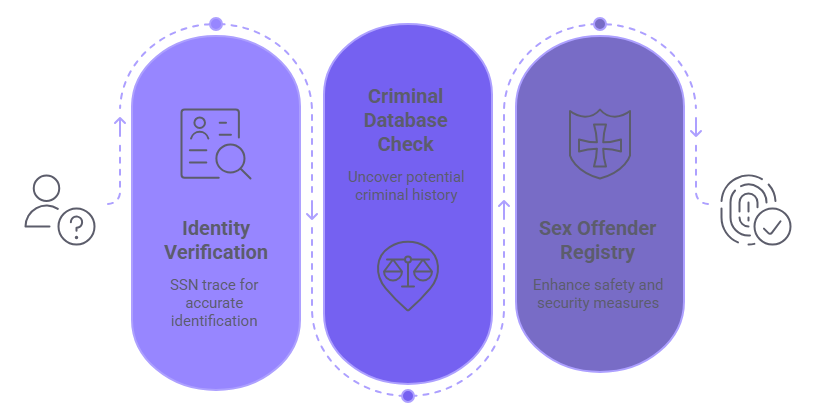
- Identity verification plus SSN trace.
- National criminal database check.
- Sex offender registry check.
Tier 2: Guest-Facing or Common Area Access
Roles with guest contact in common areas but without master key or financial system access. Examples include front desk, concierge, guest services, and restaurant floor staff. This tier requires:
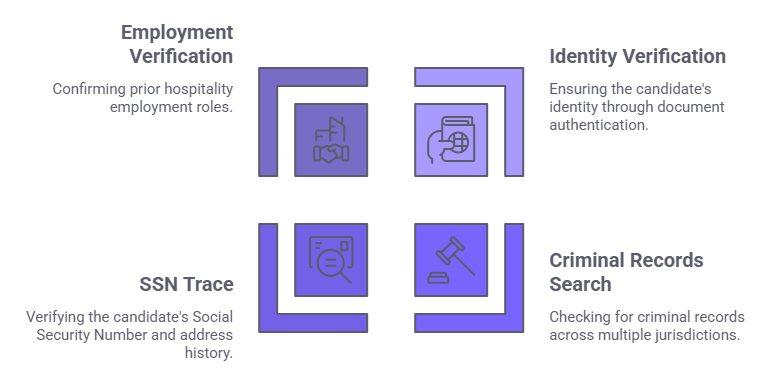
- Identity verification with document authentication.
- Multi-jurisdiction county and state criminal records search.
- SSN trace and address history.
- Employment verification for prior hospitality roles.
Tier 3: Unsupervised Access to Guest Rooms, Master Key, Financial Systems, or Personal Guest Information
Roles with the highest access profiles. Examples include housekeeping, room service, security, accounting, and property management. This tier requires:
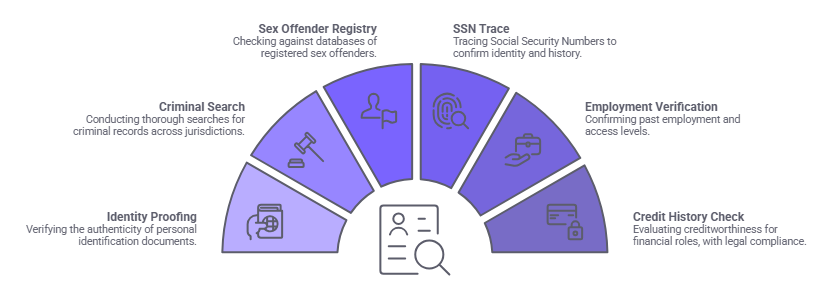
- Full identity proofing.
- Federal and multi-jurisdiction county criminal search.
- Sex offender registry search.
- SSN trace and full address history.
- Employment verification with specific reference to prior access-level roles.
- Credit history check for roles with financial system access, where applicable, FCRA-compliant, and permitted under applicable state law. Several states restrict or prohibit employer use of credit history in hiring decisions. Hotels in California, Illinois, and other restrictive states should confirm applicability with qualified legal counsel before including this check in the Tier 3 stack.
| Verification Component | Tier 1 | Tier 2 | Tier 3 |
| Identity verification and SSN trace | Yes | Yes, with document authentication | Yes, full identity proofing |
| National criminal database check | Yes | Yes | Yes |
| Multi-jurisdiction county criminal search | No | Yes | Yes, including federal |
| Sex offender registry | Yes | Yes | Yes |
| Address history | No | Yes | Yes, full history |
| Employment verification | No | Prior hospitality roles | Access-level roles specifically |
| Credit history check | No | No | Yes, where applicable, FCRA-compliant, and state-law-permitted |
Hotels should document the tier-to-role mapping in their hiring policy and share it with hiring managers before the season begins. Every position with unsupervised guest room access should sit in Tier 3 regardless of its organizational classification.
“Fast hiring should never come at the expense of thoughtful hiring.” One of the things that I have learned about the hospitality industry is that the best way to see whether or not a company is prepared is to look at them during their busy season. For example, when hotels need to ramp up for the summer months, it is not only important that they hire quickly, but also that they do so efficiently and within compliance regulations. The most successful teams will be those who can build processes around speed yet still maintain efficiency. �
FCRA Compliance for Seasonal Hotel Hiring: What Does Not Change When the Timeline Is Compressed
FCRA applies to seasonal and part-time hotel employees identically to permanent staff. Summer timeline pressure creates no FCRA accommodation. Three requirements draw the most skipped steps under volume pressure.
Standalone Disclosure and Written Authorization
Before ordering any background check through a consumer reporting agency, the hotel must give the candidate a standalone written FCRA disclosure and collect written authorization. The disclosure must be a separate document. It cannot sit inside the employment application or the offer letter. Under volume pressure, hotels often bundle the disclosure with onboarding paperwork and start the check before authorization arrives. Each instance is a separate FCRA violation.
Conditional Offer Sequencing in Ban-the-Box Jurisdictions
In jurisdictions with conditional offer requirements, the background check cannot start until after a conditional offer has gone out. New York City, Los Angeles, Chicago, and Seattle are among the major hotel markets with these requirements. However, this list is illustrative rather than exhaustive. Therefore, multi-market hotel operators must map ban-the-box and conditional offer requirements to each property location before summer hiring begins.
The Two-Step Adverse Action Process
When a background check result leads to a hiring decision reversal, the FCRA two-step adverse action process applies. First, the hotel must send a pre-adverse action notice with a copy of the consumer report and the Summary of Rights Under the FCRA. Next, the candidate gets a waiting period of generally at least five business days per CFPB and FTC guidance before the final adverse action notice goes out. The most common failure under volume pressure is issuing adverse action decisions in batch without giving each candidate their individual pre-adverse notice and waiting period. Batch adverse action is not FCRA-compliant. Moreover, the final adverse action notice must identify the CRA by name, address, and telephone number, state that the CRA did not make the adverse action decision, and tell the candidate about their right to a free copy of the report within 60 days and their right to dispute it.
FCRA requirements and applicable state and local laws vary by jurisdiction. This section is informational only and does not constitute legal advice. Consult qualified legal counsel for your specific market before implementing or modifying your screening program.
Workflow Design: How to Screen 30 People in Two Weeks Without Creating a Bottleneck
Hotels that run summer hiring efficiently do not cut corners on what they screen for. Instead, they design their screening workflow for volume before the season starts. Five principles separate programs that scale from programs that queue. An effectively designed process ensures that recruitment teams can work fast without compromising quality, compliance, and candidate experience. With an efficient process in place from the beginning, hotels are able to cope with peak seasons without generating any delays on their end or the candidates’.
Principle 1: Initiate Checks at Conditional Offer
The single most common bottleneck cause is delay between offer acceptance and check initiation. Building the FCRA disclosure and authorization into the offer acceptance workflow eliminates this gap for most markets. In ban-the-box jurisdictions, however, disclosure timing relative to the conditional offer may face additional local requirements. Hotels operating across multiple markets should confirm sequencing requirements for each location with qualified legal counsel before standardizing the workflow.
Principle 2: Batch by Role Tier, Not by Hire Date
Rather than processing candidates in application order, hotels should batch Tier 1 and Tier 2 checks together for faster turnaround while Tier 3 checks run in parallel. A Tier 1 parking attendant check should not wait in queue behind a Tier 3 management hire.
Principle 3: Use a CRA With Direct County Court Access
County-level criminal record turnaround is the most variable timeline element. For major hotel markets, direct court access can reduce county record turnaround from five to seven days down to 24 to 48 hours. Before summer hiring begins, hotels should confirm whether their CRA has direct access to county courts in their primary hiring markets.
Principle 4: Set Role-Appropriate Turnaround Expectations
Front desk and housekeeping hires do not need the same check depth as management or accounting hires. Documenting turnaround expectations by role tier in the hiring manager guide allows conditional start dates to be set realistically.
Principle 5: Build Adverse Action Into the Platform
Manual adverse action tracking breaks down under volume. A platform that automatically generates pre-adverse notices, tracks waiting periods by candidate, and triggers final adverse action notices removes the human failure point from the process. Implementing all five principles before Memorial Day hiring begins is the difference between a workflow that scales and one that queues.
Negligent Hiring Exposure in Hotel Operations: What the Checks Are Actually Protecting Against
Background checks in hotel hiring address three specific categories of foreseeable harm. Each maps directly to a verification component in the role-tiered framework.
Guest Room Access
A hotel that places a housekeeper or room service employee with an undisclosed theft or assault conviction in unsupervised access to occupied guest rooms faces negligent hiring liability if an incident occurs and the hotel failed to conduct reasonable due diligence. However, a prior conviction does not automatically disqualify a candidate. Hotels must conduct an individualized assessment that considers the nature and gravity of the offense, the time elapsed, and the direct relationship between the offense and the access requirements of the role. This assessment must happen before any adverse action decision based on criminal history. Courts examine whether the harm was foreseeable given what a reasonable due diligence process would have revealed.
Financial System Access
Accounting, front desk, and management roles with access to guest payment information and hotel financial systems create theft and fraud exposure. Credit history checks and employment verification directly address this risk. Additionally, one of the most consistent findings in hospitality misconduct cases is that individuals with prior incidents move between properties in the same market, often without disclosure to the new employer. Employment verification focused on prior access-level roles, combined with a multi-jurisdiction criminal search, addresses this pattern directly.
The Documented Process as the Defense
A documented, proportionate screening process is the negligent hiring defense regardless of outcome. If a check returns clean and an incident later occurs, that documented process shows the hotel exercised reasonable care.
Multi-Property and Franchise Considerations: Screening Consistency Across a Hotel Portfolio
For regional HR leads and hotel management companies, summer hiring adds a third compliance layer: consistency across properties. Three challenges apply specifically to multi-property operators.
Screening Consistency and Disparate Impact
Inconsistent screening programs across properties may create disparate impact exposure under federal anti-discrimination law. A candidate rejected at one property for a finding that another property would have cleared creates exactly the kind of inconsistency that can form the basis of a disparate impact claim. Accordingly, individualized assessment criteria and adverse action documentation must stay consistent across the portfolio. Hotel management companies should confirm the current operative individualized assessment framework with qualified legal counsel, as EEOC guidance on criminal history has been subject to formal administrative revision.
State and Local Law Variability
Major hotel markets span jurisdictions with materially different ban-the-box, lookback period, and adverse action requirements. A policy built for a Florida property may be non-compliant for a New York City property in the same portfolio. Furthermore, franchisor background check requirements in hotel franchise agreements must be treated as contractual obligations satisfied within the FCRA framework, not as substitutes for it. Both sets of requirements apply independently and must both be met.
Conclusion
Hotels that scale summer hiring without slowing it do so because they designed their screening workflow for volume before the season started, not because they reduced what they screen for. Role-tiered verification ensures check depth matches access level. Same-day initiation at conditional offer acceptance eliminates the most common bottleneck. A platform-managed adverse action workflow prevents the manual tracking failures that create FCRA exposure under volume pressure. These three design decisions separate hotels that lose candidates to slow background checks from those that do not.
Frequently Asked Questions
What background checks do hotels need to run on employees?
Hotels should use a role-tiered framework based on access level. Limited-access roles require identity verification, a national criminal check, and a sex offender registry search. Guest-facing roles add multi-jurisdiction county criminal records and employment verification. High-access roles including housekeeping and accounting require the full Tier 3 stack, including federal criminal records and, where applicable and state-law-permitted, credit history.
Does FCRA apply to seasonal hotel employees?
Yes. FCRA applies to seasonal and part-time hotel employees identically to permanent staff. Standalone written disclosure and authorization are required before any check is initiated. The two-step adverse action process applies to every candidate whose offer is reversed based on a background check result, regardless of whether the position is seasonal.
How long does a hotel background check take?
Tier 1 and Tier 2 checks typically clear within 24 to 72 hours when a CRA has direct county court access. Tier 3 checks typically take two to five business days. Delay between offer acceptance and check initiation, not check processing time, is the most common cause of extended timelines.
Can a hotel rescind a job offer based on a background check result?
Yes, but the rescission must follow the FCRA two-step adverse action process. The hotel must provide a pre-adverse action notice, allow a waiting period of generally at least five business days, and then issue a final adverse action notice. In ban-the-box jurisdictions, individualized assessment requirements apply before a rescission decision based on criminal history is made.
What background check is required for hotel housekeeping staff?
Housekeeping staff fall in the Tier 3 access category and require full identity proofing, a federal and multi-jurisdiction county criminal search, a sex offender registry search, a full address history and SSN trace, and employment verification with specific reference to prior access-level roles. Any adverse action based on criminal history requires individualized assessment before a final decision is made.

ABOUT THE CREATOR
Charm Paz, CHRP
Recruiter & Editor
Charm Paz is an HR professional at GCheck, specializing in background screening, fair hiring, and regulatory compliance. She holds from the Professional Background Screening Association (PBSA) and helps organizations navigate employment regulations with clarity and confidence.
With a background in Industrial and Organizational Psychology, she translates policy into practice to build ethical, compliant, human-centered hiring systems that strengthen decision-making over time.