


A standard MVR and a commercial CDLIS MVR are not interchangeable. A standard MVR is a state driving record available for any licensed driver. A commercial CDLIS MVR adds CDL class and endorsements, medical certification status, and multi-state violation history transmitted through the Commercial Driver’s License Information System. For CDL hires under FMCSA jurisdiction, the standard MVR is the wrong report.
Key Takeaways
- A standard MVR is a state-level driving record. A commercial CDLIS MVR adds CDL-specific data that FMCSA requires carriers to verify before a driver operates a CMV.
- The most consequential operational difference is the CDLIS five-year multi-state violation lookback versus a standard MVR’s current-state-only view. A driver can have a clean current-state MVR and a disqualifying violation from a prior state that only the commercial MVR surfaces.
- The CDLIS check must come before the MVR pull. It identifies which states to pull by returning all states where the driver held a CDL in the past five years, bypassing reliance on driver self-disclosure.
- FMCSA has been transitioning medical certification for CDL and CLP holders to electronic transmission through the CDLIS MVR. The paper Medical Examiner’s Certificate is being phased out as primary proof of medical qualification, though implementation varies by state. Carriers should confirm current requirements with their CRA and FMCSA before modifying their medical documentation practices.
- Non-CDL CMV drivers must still carry a paper Medical Examiner’s Certificate. The electronic transmission system applies only to CDL and CLP holders.
- State implementation of electronic medical transmission is not uniform. Carriers should confirm with their CRA whether each state is transmitting medical data electronically before relying solely on the MVR for medical status verification.
- FMCSA requires a commercial MVR pull before a driver operates any CMV and an updated commercial MVR at least every 12 months thereafter for active drivers.
- All MVRs must be retained in the Driver Qualification File for three years after employment ends.
What Is a Commercial MVR and How Does It Differ From a Standard Driving Record?
When a fleet HR manager orders an MVR for a CDL hire, they may be ordering a standard driving record. That is the wrong report for a CDL hire and it misses several categories of information FMCSA requires carriers to verify. The distinction is not a formatting difference. It is a data scope difference with direct compliance consequences.
What a Standard MVR Contains
A standard MVR is the state DMV driving record available for any licensed driver. It contains the driver’s name, license number, date of birth, and address, along with current license class and status, traffic violations and convictions within the state’s reportable period, DUI and DWI convictions, at-fault accidents were reported to the DMV, and license suspensions, revocations, and reinstatement history. For non-CDL employees driving company vehicles, the standard MVR is the appropriate report.
A standard MVR does not include the following:
- CDL class and endorsements or restriction codes.
- Medical certification status for CMV operation.
- Driving history transmitted from other states through CDLIS.
- Violations from jurisdictions that did not transmit data back to the issuing state.
- FMCSA roadside inspection violations, which appear only in the PSP report.
For CDL drivers operating CMVs under FMCSA jurisdiction, the standard MVR will miss CDL-specific data that carriers must verify.
What a Commercial MVR Adds
A CDLIS MVR is a commercial driving record that combines the standard state MVR with data from the Commercial Driver’s License Information System, maintained by AAMVA, not FMCSA directly. It adds CDL class and current status, all active endorsements with their letter codes and descriptions, all active restriction codes, and the driver’s self-certification category for medical qualification. Additionally, it adds CDLIS-transmitted violation history from all CDL numbers held across all states for the past five years, which a standard state MVR does not capture.
What a CDLIS MVR Adds Beyond the Standard Record
A CDLIS MVR is the federal commercial driving record that combines state DMV data with CDL-specific information from AAMVA’s national Commercial Driver’s License Information System. It includes endorsements, restrictions, medical certification status, and multi-state violation history that state-only MVRs do not capture.
Medical Certification Status and the Electronic Transmission Transition
FMCSA has been phasing in electronic medical certificate transmission for CDL and CLP holders over a multi-year transition period. Under the intended system, medical examiners transmit exam results to FMCSA by the next business day following a DOT physical. FMCSA then forwards those results to the state DMV, and the state posts them to the driver’s CDLIS MVR.
As the system matures, the commercial MVR is intended to become the primary record of medical qualification for CDL and CLP holders. However, state implementation is not uniform across all jurisdictions. FMCSA has issued a series of waivers allowing carriers to continue using paper MECs during the transition. Carriers should therefore confirm the current waiver status directly with FMCSA before modifying their paper MEC collection practices. Until the transition is complete in each hiring state, carriers should maintain existing paper MEC collection practices unless their CRA confirms electronic transmission is active for that state and current FMCSA guidance confirms paper MECs are no longer required.
One important carve-out applies regardless of transition status: drivers who operate CMVs that do not require a CDL must still carry a paper Medical Examiner’s Certificate. Carriers should also confirm with their CRA whether each state in their hiring footprint is transmitting medical certification data before relying solely on the commercial MVR for medical status verification.
CDLIS Multi-State Violation History
The CDLIS MVR includes violation data from all CDL numbers held in any state for the past five years. By contrast, a standard state MVR includes only data from the CDL currently issued by that state. Violations from a prior state of licensure transmitted through CDLIS appear on the commercial MVR and may not appear on a standard state MVR at all. This gap is the most consequential operational difference between the two report types and the most common source of compliance failures in carrier MVR programs.
“How many hiring decisions are made confidently while still relying on incomplete information?” One thing I have learned is that in compliance-driven industries, small differences in process can carry very big consequences. The process involving MVR and commercial CDLIS MVR might look alike; however, the amount of information involved in each one of them is entirely different. To me, strong hiring leadership is not just about moving quickly, but about making sure the systems behind every decision are built on the right level of visibility and accountability. �
The CDLIS Check: Why It Comes Before the MVR Pull
Most carriers know they need multi-state MVR pulls for CDL hires. However, most cannot answer which states to pull from without first running the CDLIS check. The CDLIS check answers that question and should always precede the MVR pull. When ordering a CDLIS check or commercial MVR through a consumer reporting agency for employment purposes, carriers must provide the driver with a standalone FCRA disclosure and obtain written authorization before the check is conducted. These requirements apply regardless of whether the check returns any adverse information.
The CDLIS check returns the following:
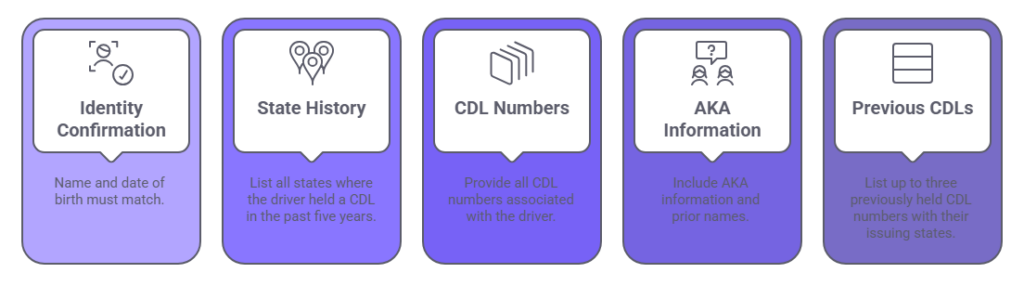
- Driver identity confirmation including name and date of birth matching.
- All states where the driver held a CDL in the past five years.
- All CDL numbers associated with the driver.
- AKA information and prior names.
- Up to three previously held CDL numbers with their issuing states.
Access to CDLIS data requires a permissible purpose and appropriate authorization. The CDLIS check returns factual licensing history directly from the AAMVA system, which means carriers do not need to rely on driver self-disclosure to identify prior states of licensure. Drivers must still authorize any CDLIS check conducted through a consumer reporting agency under FCRA requirements. The CDLIS result supplements, rather than replaces, the carrier’s authorization and disclosure obligations. Carriers should confirm FCRA compliance requirements for their specific MVR ordering arrangement with qualified legal counsel.
Side-by-Side Comparison: Standard MVR vs. Commercial CDLIS MVR
The distinction between these two report types is about data scope, not report format. Specifically, the CDLIS layer adds federal CDL-specific information that state-only MVRs do not capture.
| Feature | Standard MVR | Commercial CDLIS MVR |
| Traffic violations and convictions | Yes, current state only | Yes, multi-state via CDLIS (5-year lookback) |
| DUI and DWI convictions | Yes, current state only | Yes, multi-state via CDLIS |
| License suspensions and revocations | Yes, current state only | Yes, current state plus CDLIS-transmitted |
| CDL class and status | No | Yes |
| CDL endorsements and restrictions | No | Yes, with letter codes |
| Medical certification status | No | Yes, where state electronic transmission is active |
| CDLIS multi-state violation history | No | Yes, all CDL numbers past 5 years |
| Prior CDL numbers and alias check | No | Yes, up to 3 prior CDL numbers |
| Required for FMCSA-regulated CDL hiring | No | Yes |
| Appropriate for non-CDL employees | Yes | Yes, but not required |
FMCSA MVR Requirements: What the Regulation Actually Mandates
FMCSA imposes three distinct MVR pull obligations on motor carriers, each with its own timing requirement and documentation standard. When commercial MVRs are ordered through a consumer reporting agency, FCRA requires a standalone written disclosure and written authorization from the driver before any MVR is obtained. This requirement applies to each state MVR ordered through a CRA and is separate from the FMCSA regulatory requirement to pull the report. Carriers should confirm their CRA’s FCRA compliance workflow before initiating pre-employment MVR pulls.
Pre-Employment Pull
Before a driver operates any CMV, the carrier must obtain a commercial CDLIS MVR from every state where the driver held a CDL or permit in the past three years. This must be a commercial CDLIS MVR, not a standard driving record. It must also show current medical certification status where electronic transmission is active in that state. The CDLIS check must be completed before ordering state MVRs to ensure all required states are identified.
Annual Review
Under FMCSA driver qualification file regulations, the carrier must pull an updated commercial MVR for every active CDL driver at least once every 12 months. A qualified person must then review and document that the driver still meets FMCSA qualification requirements. That review must be signed, dated, and retained in the Driver Qualification File.
Medical Certification Update
When a CDL driver completes a new DOT physical, the carrier must obtain an updated MVR within 15 days to confirm new medical certification status is correctly posted through the electronic transmission system where applicable. All MVRs must be retained in the Driver Qualification File for three years after employment ends. The 12-month annual review cycle also creates a gap during which new violations, suspensions, or medical certification changes will go undetected until the next scheduled pull. Continuous MVR monitoring programs generate real-time alerts that close this gap without replacing the required annual review.
The Medical Certificate Electronic Transmission Transition: What It Means for MVR Pulls
The electronic medical certificate transmission system represents one of the most operationally significant ongoing changes to CDL driver qualification workflows. This regulatory transition is not yet fully reflected in most competitor MVR content. Understanding the system architecture helps carriers prepare, even where full implementation is still in progress.
How the Transmission Chain Works
The intended transmission chain works as follows. The medical examiner submits exam results to FMCSA by the next business day after the DOT physical. FMCSA then forwards the results to the driver’s state DMV. The state posts the certification status, expiration date, and any applicable medical variances or exemptions to the driver’s CDLIS MVR. As implementation becomes complete in each jurisdiction, the commercial MVR is intended to serve as the primary record of medical qualification for CDL and CLP holders.
Non-CDL Carve-Out and Interim Documentation
The non-CDL CMV driver carve-out remains in effect regardless of transition status. Drivers who operate CMVs that do not require a CDL must still carry a paper Medical Examiner’s Certificate, as this group is not covered by the electronic transmission system. In states where electronic transmission has not yet been fully implemented, a paper Medical Examiner’s Certificate may serve as interim documentation of medical qualification while the state’s system is brought current. Carriers should confirm interim documentation standards with their CRA and qualified legal counsel. Additionally, carriers should confirm with their CRA whether each state in their hiring footprint is transmitting medical certification data before relying solely on the commercial MVR for medical status verification.
Ordering the Right MVR: Practical Workflow
Pre-Employment Checklist
Before a CDL driver operates any CMV, the carrier should complete the following steps in order.
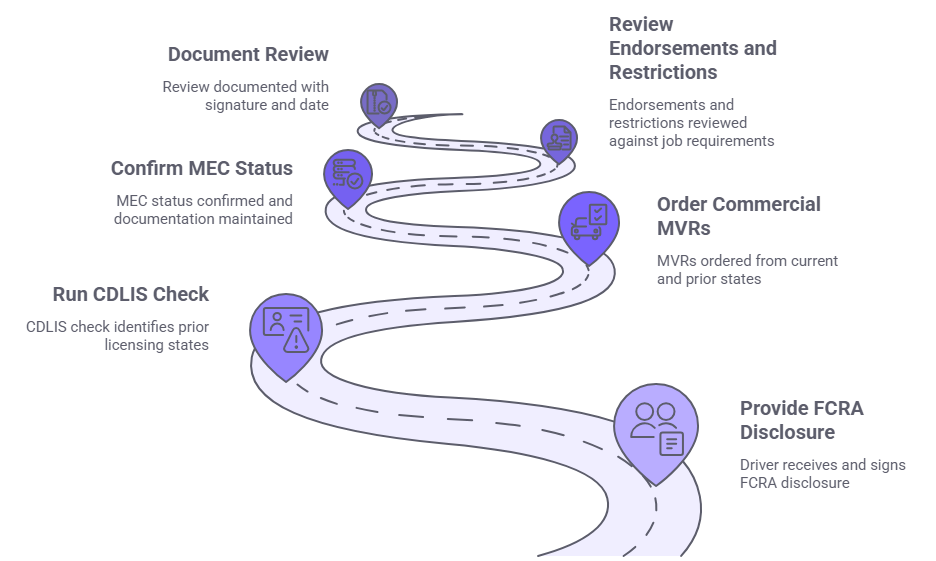
- Provide the driver with a standalone FCRA disclosure and obtain written authorization before ordering any check through a consumer reporting agency.
- Run the CDLIS check to identify all states where the driver held a CDL in the past five years.
- Order a commercial CDLIS MVR from the driver’s current state and every additional state the CDLIS check identifies as a prior licensing state within the past three years.
- Confirm whether the commercial MVR includes electronic medical certification status for each state, and maintain paper MEC documentation where electronic transmission is not yet confirmed active.
- Review endorsements and restrictions against the job requirements before making a hiring decision.
- Document the review with a qualified reviewer signature and date in the Driver Qualification File.
Annual Review Checklist
At least once every 12 months for every active CDL driver, the carrier should complete the following steps.
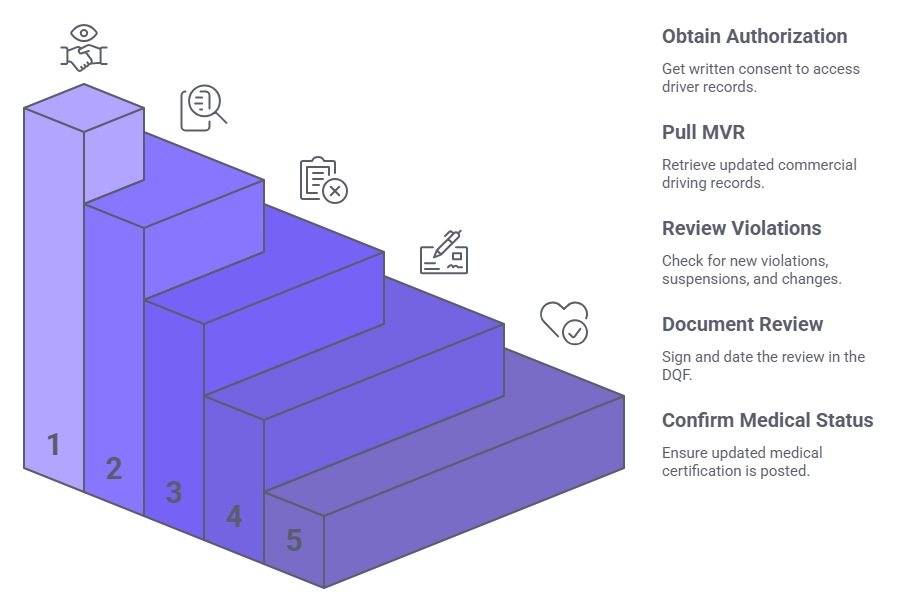
- Provide an updated FCRA disclosure and obtain written authorization before ordering the updated MVR through a CRA.
- Pull an updated commercial CDLIS MVR from the driver’s current state of licensure.
- Review for new violations, suspensions, endorsement changes, and medical certification status updates.
- Document the review with a qualified reviewer signature and date in the DQF.
- If the driver’s medical certification has changed or is approaching expiration, obtain an updated MVR within 15 days of the new DOT physical to confirm updated status is posted where electronic transmission is active.
Conclusion
The commercial CDLIS MVR and the standard driving record are not interchangeable for CDL hiring. The commercial MVR adds CDL-specific data that FMCSA requires carriers to verify: endorsements, restrictions, medical certification status where electronic transmission is active, and five years of multi-state violation history transmitted through AAMVA’s CDLIS system. The CDLIS check is the prerequisite that tells the carrier which states to pull from, and FCRA disclosure and authorization requirements apply to every check ordered through a consumer reporting agency. The medical certificate electronic transmission transition is an ongoing regulatory development that carriers should monitor and confirm with their CRA as implementation progresses by state. Carriers who have not reviewed their MVR ordering workflow and DQF medical documentation practices in light of this transition may be maintaining programs that do not reflect current FMCSA requirements.
Frequently Asked Questions
The identification of the difference between the two types of MVRs – one used for normal purposes and the other employed by business establishments for CDLIS – is not easy because of the constantly changing rules formulated by the FMCSA. Even the slightest deviation from the process could lead to omission of significant details, non-conformity, and even driver ineligibility. Below are the responses to common inquiries about CDLIS MVRs.
What is the difference between a standard MVR and a commercial MVR?
A standard MVR is a state driving record available for any licensed driver. A commercial CDLIS MVR adds CDL class and endorsements, medical certification status where electronic transmission is active, and five years of multi-state violation history transmitted through AAMVA’s CDLIS system. For CDL hires under FMCSA jurisdiction, the commercial CDLIS MVR is required. The standard MVR misses CDL-specific data carriers must verify.
What is a CDLIS check and do I need one before pulling an MVR?
A CDLIS check returns all states where a driver held a CDL in the past five years, all associated CDL numbers, and prior names or aliases. Carriers need it before pulling MVRs because it identifies which states to pull from without relying on driver self-disclosure. When ordered through a CRA, FCRA disclosure and authorization requirements apply before the check is conducted.
Do CDL drivers still need a paper medical card?
It depends on the state and current FMCSA waiver status. FMCSA has been transitioning medical certification to electronic transmission through the CDLIS MVR, but implementation varies by state and waiver extensions have been issued during the transition. Non-CDL CMV drivers must still carry a paper Medical Examiner’s Certificate. Carriers should confirm current requirements with their CRA and FMCSA directly.
How often must employers pull MVRs for CDL drivers?
FMCSA requires a commercial MVR before any CDL driver operates a CMV, and an updated commercial MVR at least once every 12 months for every active driver. An additional MVR pull is required within 15 days of a new DOT physical to confirm updated medical certification status is posted. All MVRs must be retained in the Driver Qualification File.
Can a clean current-state MVR miss violations from prior states?
Yes. A standard state MVR includes only data from the CDL currently issued by that state. Violations from a prior state may not appear unless transmitted through CDLIS. The commercial CDLIS MVR includes five years of violation history across all states where the driver held a CDL. Without the CDLIS check and commercial MVR, prior-state violations may be invisible.
Additional Resources
- AAMVA: Commercial Driver’s License Information System (CDLIS)
https://www.aamva.org/technology/systems/cdlis - FMCSA: Medical Examiner Handbook and Electronic Reporting
https://www.fmcsa.dot.gov/medical/driver-medical-requirements/medical-examiner-handbook - Title 49 CFR: Federal Motor Carrier Safety Regulations (eCFR)
https://www.ecfr.gov/current/title-49 - FMCSA: Driver Qualification File Requirements
https://www.fmcsa.dot.gov/regulations/driver-qualification-files - FMCSA: Commercial Driver’s License Program Overview
https://www.fmcsa.dot.gov/registration/commercial-drivers-license - FTC: Using Consumer Reports for Employment Purposes
https://www.ftc.gov/business-guidance/resources/using-consumer-reports-employment-purposes

ABOUT THE CREATOR
Charm Paz, CHRP
Recruiter & Editor
Charm Paz is an HR professional at GCheck, specializing in background screening, fair hiring, and regulatory compliance. She holds from the Professional Background Screening Association (PBSA) and helps organizations navigate employment regulations with clarity and confidence.
With a background in Industrial and Organizational Psychology, she translates policy into practice to build ethical, compliant, human-centered hiring systems that strengthen decision-making over time.