

Global watchlist screening checks a candidate’s or employee’s identity against government sanctions lists, international law enforcement notices, and industry exclusion databases to confirm they are not a prohibited or restricted party. It matters most for finance, healthcare, government contracting, and any role touching international operations. Sanctions lists change without a fixed schedule, which is why a one-time check and an ongoing one produce very different levels of protection.
Key Takeaways
- Global watchlist screening searches three distinct categories of lists: sanctions lists, law enforcement notices, and industry exclusion databases, and each category answers a different compliance question.
- OFAC updates its Specially Designated Nationals List on no predetermined schedule, so a screening program built around a fixed annual or monthly cycle will miss designations added in between.
- A name match on a watchlist is a lead to verify, not a conclusion. Most hits are false positives caused by shared names, similar birthdates, or transliteration differences in international names.
- When a watchlist match surfaces through a consumer report from a background check provider, the FCRA’s pre-adverse and adverse action notice requirements apply before an employer can act on it.
- The underlying prohibition on transacting with a sanctioned party comes from the International Emergency Economic Powers Act, not the USA PATRIOT Act, and it applies to U.S. persons and businesses generally, not only to financial institutions. What varies by industry is the additional, more prescriptive screening rules layered on top of that baseline.
What Global Watchlist Screening Actually Checks
Global watchlist screening is the practice of comparing a candidate’s or employee’s identifying information against databases maintained by governments, international bodies, and regulators to confirm they don’t appear as a sanctioned, restricted, or excluded party. It is broader than a standard criminal background check, which searches county, state, or federal court records for convictions and pending charges within the United States. It is also broader than a domestic-only watchlist check, which stops at U.S. government databases and doesn’t reach the international sanctions and enforcement lists that a global search covers.
The distinction matters in practice. A candidate can clear a county and federal criminal search with no record at all and still appear on an international sanctions list, because sanctions designations aren’t criminal convictions. They’re administrative actions tied to national security, foreign policy, or regulatory enforcement, and they can attach to someone who has never been charged with a crime in any court.
Employers in finance, healthcare, government contracting, and international operations rely on this broader search because their regulatory exposure isn’t limited to domestic criminal history. A payments company, a hospital system, and a federal contractor each have a different reason to run this search, but the underlying question is the same: is this person legally permitted to hold this role, handle these funds, or work with this population.
The Three Categories of Lists Involved
Global watchlist screening pulls from three distinct categories, and knowing which is which helps explain why a match on one list means something different from a match on another.
Sanctions Lists
Sanctions lists identify individuals and entities subject to economic or trade restrictions tied to national security or foreign policy. In the United States, the primary sanctions list is the Treasury Department’s Specially Designated Nationals and Blocked Persons List, maintained by the Office of Foreign Assets Control (OFAC). Other governments and international bodies maintain their own versions: the UN Security Council Consolidated List, the EU’s Consolidated List of Persons, Groups, and Entities Subject to Financial Sanctions, the UK Sanctions List, and Australia’s DFAT Consolidated List. A sanctions match restricts who a business or individual can transact with; it is not, by itself, a criminal record.
Law Enforcement Notices
This category includes domestic and international “most wanted” designations tied to suspected or confirmed serious crimes: the FBI’s Most Wanted and Most Wanted Terrorists lists, INTERPOL Red Notices, and the ICE Most Wanted List. These identify fugitives and individuals sought in connection with terrorism, trafficking, or major fraud, and they carry a different weight than a sanctions listing because they typically involve an active criminal proceeding somewhere in the world.
Industry Exclusion and Debarment Lists
These lists bar individuals from specific kinds of work rather than from doing business generally. The HHS Office of Inspector General’s List of Excluded Individuals and Entities governs eligibility to bill Medicare and Medicaid. SAM.gov exclusions govern eligibility for federal contracts and grants. The Commerce Department’s Bureau of Industry and Security maintains Denied Persons and Entity Lists that restrict access to export-controlled goods and technology. A person can appear on one of these lists without ever appearing on a sanctions list or a law enforcement notice, because the underlying issue is licensing or program eligibility, not a security threat.
| List category | What it flags | Example sources | Practical effect |
| Sanctions lists | Economic or trade restrictions tied to national security or foreign policy | OFAC SDN List, UN Security Council Consolidated List, EU Consolidated List, UK Sanctions List | Restricts who can be transacted with |
| Law enforcement notices | Suspected or confirmed involvement in serious crimes | FBI Most Wanted, INTERPOL Red Notices, ICE Most Wanted | Signals an active criminal matter somewhere globally |
| Industry exclusion lists | Program or licensing eligibility | HHS OIG LEIE, SAM.gov exclusions, BIS Denied Persons and Entity Lists | Bars specific kinds of work or funding eligibility |
A fourth category worth naming separately: politically exposed persons (PEP) and adverse media flags. A PEP designation identifies someone in a position where bribery or undue influence risk is elevated, such as a government official or their close associate. It is not a legal bar to employment and shouldn’t be treated with the same weight as a confirmed sanctions or exclusion match.
Why a Match Is a Lead to Verify, Not a Conclusion
Watchlist screening runs on name and identifier matching, and name matching produces false positives more often than most employers expect. OFAC’s own guidance on handling a potential match tells the party running the check to compare the details rather than treat a name match as conclusive: if the individual’s location or other identifying details don’t align with the listed entry, it may be what OFAC calls a “false hit,” and OFAC directs parties to its compliance hotline for verification when the similarities are substantial enough to warrant a closer look. That guidance, coming directly from the agency that maintains the list, is the clearest statement available that a name match is the start of a verification step, not the end of the screening process.
International names raise the false-positive rate further. Transliteration differences, shared given names common across regions, and inconsistent date-of-birth formatting all increase the odds that two different people share enough surface-level detail to trigger a match. This is where the difference between a screening program that stops at “flagged” and one that verifies identity before anyone acts on the result becomes an operational necessity, not a courtesy.
Standardized reporting matters here for a second reason beyond speed. A report that clearly distinguishes a confirmed match from an unresolved one prevents the wrong signal from reaching a hiring manager who isn’t positioned to interpret a raw database hit. Clear, audit-ready documentation of how a match was investigated and resolved is also what an employer needs on hand if a regulator later asks how a screening decision was made.
The Laws That Govern Watchlist Screening and What Follows a Confirmed Match
Two separate legal frameworks apply here, and they’re often blended together in ways that overstate what either one actually requires.
The Sanctions Obligation Comes From IEEPA, Not the PATRIOT Act
The prohibition on transacting with a party on OFAC’s sanctions lists traces to the International Emergency Economic Powers Act and related executive orders, not the USA PATRIOT Act. The PATRIOT Act’s most relevant provision, Section 326, requires financial institutions specifically to verify customer identity when opening accounts; it does not itself impose a screening-process mandate on every U.S. employer. That distinction is about which law requires an affirmative screening process, not about who is subject to the underlying prohibition: IEEPA’s bar on transacting with a sanctioned party applies to U.S. persons and businesses generally, so the absence of a PATRIOT Act mandate does not mean the absence of legal exposure. OFAC’s own regulations set the maximum civil penalty for an IEEPA violation at the greater of $377,700 or twice the value of the underlying transaction, per violation, adjusted annually for inflation. Financial institutions, exporters, and businesses handling international transactions carry the clearest, most frequent exposure under this framework because of transaction volume and regulatory overlays like BSA/AML; a general employer’s exposure is lower in practice but not zero, particularly if the employer does business internationally or handles regulated funds.
FCRA Governs What Happens When a Background Check Provider Surfaces the Match
When an employer relies on a consumer report from a background screening company to make an employment decision, the Fair Credit Reporting Act requires a written, stand-alone disclosure and the applicant’s written authorization before the report is obtained. If the employer intends to take an adverse action, such as declining to hire, based on what the report shows, the employer must first give the applicant a pre-adverse action notice that includes a copy of the report and a copy of the Summary of Rights Under the FCRA, and after the decision is finalized, a second adverse action notice identifying the reporting company and the applicant’s rights to dispute the information. This sequence applies to a confirmed watchlist match delivered through a consumer report the same way it applies to a criminal record.
EEOC’s Individualized-Assessment Principle Is Instructive, Not Directly Controlling
EEOC’s guidance on criminal records under Title VII describes an individualized assessment as giving the affected person notice of what triggered an exclusion, a chance to explain their circumstances, and real consideration of whether that explanation changes the outcome. That guidance addresses arrest and conviction records specifically, and it does not govern sanctions or watchlist matches by its own terms. The underlying discipline it describes, confirming that a flag actually belongs to the person in front of you before treating it as disqualifying, is the same discipline a well-run watchlist match verification step performs, even though the legal basis is different.
Which Industries Carry the Highest Exposure
Regulatory exposure for skipping or under-scoping watchlist screening isn’t evenly distributed across industries.
| Industry | Primary exposure | Why it applies |
| Financial services | OFAC/IEEPA, BSA/AML obligations | Direct handling of funds and counterparty relationships subject to sanctions law |
| Healthcare | HHS OIG exclusion (LEIE) | Employing or contracting with an excluded individual can jeopardize Medicare/Medicaid billing |
| Government contracting | SAM.gov exclusion | Excluded individuals or entities are ineligible for federal contracts and grants |
| Technology and export-controlled industries | BIS Denied Persons and Entity Lists | Access to export-controlled technology or goods can be restricted |
| Transportation and aviation | Public-safety-driven screening standards | Direct responsibility for passenger and public safety |
| Public sector and education | Program and funding eligibility requirements | Government agencies and schools face eligibility and funding conditions tied to screening |
Multinational employers and any organization hiring foreign nationals face a compounding version of this exposure, since a single hire can touch several of these categories at once depending on the role and the countries involved.
Why Ongoing List Refresh Changes the Calculation
A background check is a snapshot. Sanctions lists are not static, and that mismatch is where a one-time screening program quietly loses its value over time. OFAC has told institutions that rely on a periodic download schedule for its sanctions lists to periodically reevaluate that schedule, noting that its lists are updated at an increasing pace and that a schedule built for yesterday’s rate of change may no longer serve as an effective risk mitigation tool. OFAC’s own FAQ describes the SDN List as frequently updated with no predetermined timetable, with names added or removed as necessary and appropriate rather than on a fixed release date.
That has a direct, practical implication for an Enterprise HR team building or evaluating a screening program: a watchlist check run once at the point of hire tells you the person’s status on that specific day. It says nothing about whether that person is added to a list six months into their tenure, particularly in a role with ongoing access to funds, sensitive data, or vulnerable populations. Organizations that need to hold that assurance past the hiring moment are the ones for whom a recurring or continuously refreshed screening cadence, rather than a single check, actually matches the risk they’re managing.
What a Compliant Watchlist Screening Program Looks Like End to End
A defensible global watchlist screening program follows a consistent sequence regardless of which provider or internal process runs it.
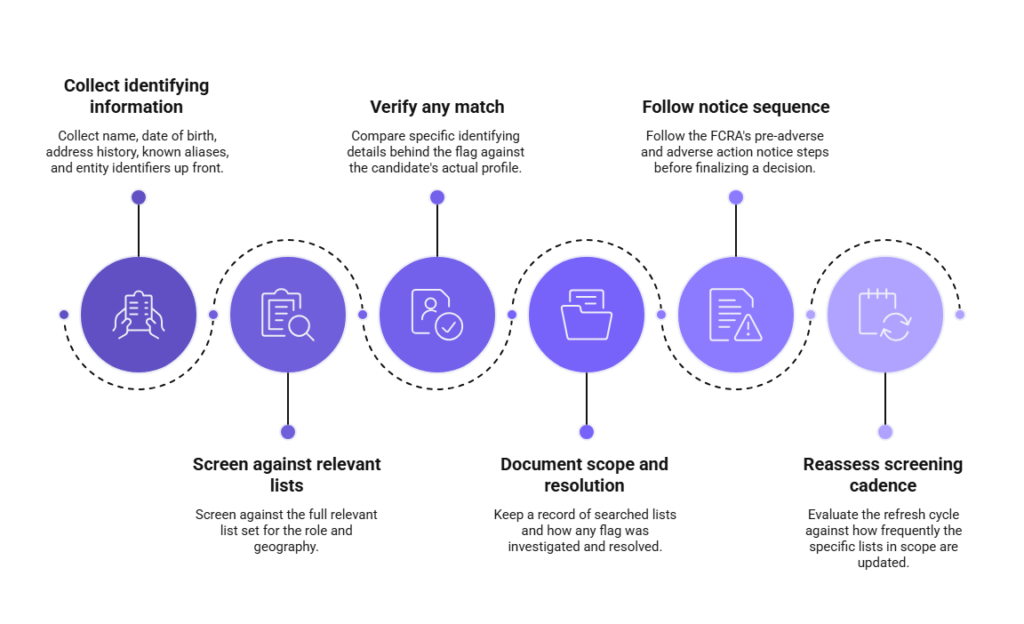
- Collect complete identifying information up front: name, date of birth, address history, known aliases, and entity identifiers where applicable. Incomplete identifying information is one of the most common causes of both missed matches and false positives, since a thin identity profile gives the matching process less to work with in either direction.
- Screen against the full relevant list set for the role and geography. Not every role needs every list category. A domestic-only retail hire has a different relevant list set than an internationally facing finance role, and scoping the search to what the role actually requires keeps the program efficient without leaving a real gap.
- Verify any match before treating it as confirmed. Compare the specific identifying details behind the flag against the candidate’s actual profile before escalating it as a finding. This step is what separates a defensible program from one that generates noise its own hiring managers learn to ignore.
- Document the screening scope and the resolution of any match. A record of which lists were searched, when, and how any flag was investigated and resolved is what supports a screening decision if it’s ever reviewed by a regulator, an auditor, or in litigation.
- Follow the applicable notice sequence before acting on a confirmed match. Where the match came through a consumer report and will inform an adverse action, that means the FCRA’s pre-adverse and adverse action notice steps, in that order, before the decision is finalized.
- Reassess the screening cadence against how the underlying lists actually change. A fixed annual or monthly refresh cycle should be evaluated against how frequently the specific lists in scope are updated, not set once and left alone.
Enterprise HR teams that document this sequence consistently, and can show it applied the same way across every candidate in a given role category, are the ones positioned to defend a screening decision months or years after it was made, which is precisely when the question tends to get asked.
This is where Transparent Compliance and Protective Compliance work together rather than as separate checklist items. Transparent Compliance is the discipline of knowing exactly which lists were searched, what a match confidence level means, and how a flag was resolved, in language an auditor or a hiring manager can actually follow. Protective Compliance is what that discipline is in service of: keeping a regulated organization, and the people it serves, out of a relationship with a genuinely restricted party, without treating every name collision as a verdict against the candidate in front of you.
Frequently Asked Questions
What is a global watchlist search?
A global watchlist search checks a candidate’s or employee’s identity against sanctions lists, international law enforcement notices, and industry exclusion databases maintained by governments and regulators around the world. It’s broader than a domestic criminal background check because it reaches international sanctions bodies like the UN and EU in addition to U.S. sources.
What’s the difference between a global watchlist search and a domestic watchlist search?
A domestic watchlist search stops at U.S. government databases, such as the OFAC SDN List and the FBI’s watchlists. A global watchlist search adds international sources, including the UN Security Council Consolidated List, the EU Consolidated List, and the UK Sanctions List, which matters most for employers with international operations or foreign national candidates.
How often are sanctions lists updated?
OFAC updates its Specially Designated Nationals List on no fixed schedule, adding or removing names as needed rather than on a set release date. A screening program built around a fixed monthly or annual refresh cycle can miss designations added in between cycles.
What happens if a background check turns up a watchlist match?
The match should be verified against the candidate’s actual identifying details before it’s treated as confirmed, since name-based matching produces a meaningful rate of false positives. If the match is confirmed and came through a consumer report that will inform an adverse action, the employer must follow the FCRA’s pre-adverse and adverse action notice sequence before finalizing the decision.
Do all employers need to screen against sanctions lists?
Yes, in the sense that the underlying prohibition on transacting with a sanctioned party under IEEPA applies to U.S. persons and businesses generally, not only to a specific industry. What varies by industry is the additional, more prescriptive screening and monitoring rules layered on top of that baseline, such as OIG exclusion requirements for healthcare or SAM.gov exclusion checks for federal contractors. Because the specific requirements that apply depend on industry, jurisdiction, and role, employers should confirm their own obligations with legal counsel rather than relying on general guidance like this article.
What is a PEP, and is it the same as a sanctions match?
A politically exposed person (PEP) is someone in a role, such as a senior government position, where bribery or undue-influence risk is considered elevated. A PEP flag is not a legal bar to employment and is not the same as a confirmed sanctions or exclusion match; it’s a risk indicator that warrants closer review, not an automatic disqualifier.
Sources cited
- Office of Foreign Assets Control, U.S. Department of the Treasury, “Specially Designated Nationals (SDNs) and the SDN List,” FAQs 20 and 23, ofac.treasury.gov/faqs/topic/1631
- Office of Foreign Assets Control, U.S. Department of the Treasury, FAQ 88, ofac.treasury.gov/faqs/88
- eCFR, Title 31, Appendix A to Part 501, “Economic Sanctions Enforcement Guidelines,” ecfr.gov
- Federal Trade Commission, “Using Consumer Reports: What Employers Need to Know,” ftc.gov/business-guidance/resources/using-consumer-reports-what-employers-need-know
- U.S. Equal Employment Opportunity Commission, “Enforcement Guidance on the Consideration of Arrest and Conviction Records in Employment Decisions Under Title VII,” eeoc.gov
- U.S. Department of Health and Human Services, Office of Inspector General, “Background Information & Exclusion Authorities” and List of Excluded Individuals/Entities (LEIE), oig.hhs.gov/exclusions/background-information-exclusion-authorities/
- System for Award Management, sam.gov

ABOUT THE CREATOR
Charm Paz, CHRP
Recruiter & Editor
Charm Paz is an HR professional at GCheck, specializing in background screening, fair hiring, and regulatory compliance. She holds from the Professional Background Screening Association (PBSA) and helps organizations navigate employment regulations with clarity and confidence.
With a background in Industrial and Organizational Psychology, she translates policy into practice to build ethical, compliant, human-centered hiring systems that strengthen decision-making over time.