

A federal criminal search checks the records of the 94 U.S. federal judicial district courts for offenses prosecuted under federal law, using PACER, the same electronic system the courts themselves rely on. It surfaces crimes such as interstate fraud, drug trafficking across state lines, and immigration violations, none of which appear in a standard state or county criminal check. It does not replace one.
Key takeaways
- A federal criminal search only surfaces offenses prosecuted in U.S. District Court. It does not include state or county convictions.
- The search draws on PACER, the federal courts’ own electronic filing system, and must be run district by district because no single federal criminal index exists.
- Federal criminal convictions can be reported with no time limit. Most other adverse federal court information is capped at seven years under the Fair Credit Reporting Act (FCRA).
- A federal criminal search is not the same as a national criminal database search, which draws from a proprietary, aggregated multi-source list rather than court dockets directly.
- Employers extending an offer above $75,000 in annual salary are exempt from the FCRA’s federal seven-year lookback limit on non-conviction information (15 U.S.C. § 1681c(b)(3)), though several states, including California, New York, and Massachusetts, impose their own stricter or absolute limits that override this federal exception.
- Roles with financial authority, executive responsibility, or government-adjacent duties are the ones most likely to warrant a federal criminal search alongside standard county-level screening.
What a federal criminal search actually checks
A federal criminal search is a records check that looks specifically for criminal cases prosecuted in U.S. District Court, the trial-level court where the federal government brings charges for violations of federal law. This is a narrower and different search than the county or state criminal checks that make up most employment screening programs, which cover offenses charged and adjudicated by state or local prosecutors under state law.
Cases land in federal court, rather than state court, for a specific set of reasons: the offense violated a federal statute, crossed state lines, occurred on federal property, targeted a federal official or agency, or involved a federally regulated system such as the banking network or the mail. Common categories include financial crimes like fraud, embezzlement, and money laundering; drug trafficking that spans multiple states; immigration violations; weapons trafficking; tax evasion; and cybercrime directed at federal systems or federally insured institutions. A candidate can have a completely clean county record and still carry a federal conviction, and the reverse is just as true: a federal search alone will miss the great majority of criminal convictions in the United States, since most crime is prosecuted at the state and county level.
This distinction matters for how the search fits into a broader screening program. A federal criminal search is not designed to stand in for a county or state check, and it is not designed to be replaced by one either. The two answer different questions: one asks whether a candidate has a record with a specific state or county, and the other asks whether they have a record with the federal government itself. An employer relying on only one of the two has a real gap in coverage, not a smaller version of the same picture.
How PACER and the 94 federal district courts work
PACER, short for Public Access to Court Electronic Records, is the system operated by the Administrative Office of the U.S. Courts that gives access to federal court filings, including criminal case dockets. It is the authoritative source a federal criminal search draws from, and it is the same system federal courts, prosecutors, and attorneys use to manage and review case records.
What PACER does not offer is a single, unified national search. The federal court system is organized into 94 judicial districts, with at least one district per state and larger states divided into as many as four. Each district maintains its own docket independently, so a federal criminal search has to be run district by district rather than through one national query. In practice, a thorough search targets the district or districts where the candidate has lived, worked, or been known to reside, since that is where a federal case against them would most plausibly have been filed.
This is the detail most candidates, and more than a few employers, do not realize going in: there is no button that queries “all federal criminal records” at once. Each district’s docket has to be searched on its own terms, which is part of why federal criminal searches are handled through a consumer reporting agency with the infrastructure to run and reconcile multiple district queries rather than through a single ad hoc search. A search that only covers one district when a candidate has lived across several is technically a federal criminal search, but it is not a complete one, and the gap is easy to miss unless the search’s scope was made clear from the start.
Why identifiers matter more in a federal search
Federal case files historically carry fewer identifying details than state and county records, which increases the risk of a false match, a real record wrongly attributed to the wrong person, or a missed match, a real record overlooked because the identifiers didn’t line up. A full legal name, date of birth, and prior addresses meaningfully reduce that risk, and reviewing the underlying case file rather than relying on a name match alone is standard practice for confirming whether a record actually belongs to the candidate before it is reported.
What shows up in a federal criminal search, and what doesn’t
A federal criminal search will typically surface convictions and case information in categories including:
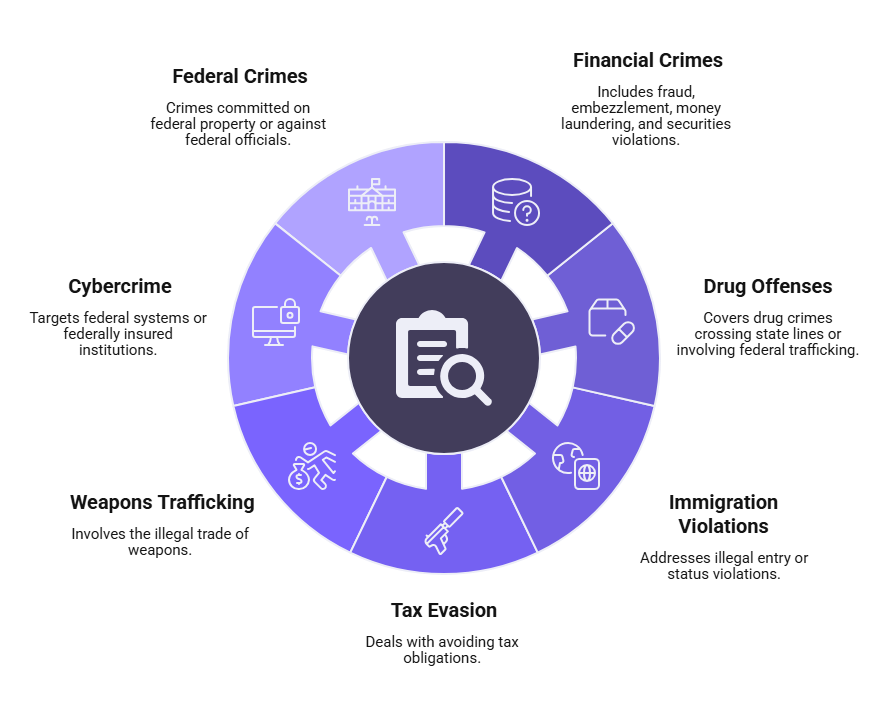
- Financial crimes: fraud, embezzlement, money laundering, securities violations
- Drug offenses that cross state lines or involve federal trafficking statutes
- Immigration violations
- Weapons trafficking
- Tax evasion
- Cybercrime targeting federal systems or federally insured institutions
- Crimes committed on federal property or against federal officials
What it will not surface is anything prosecuted purely at the state or county level: the large majority of assault, theft, burglary, and DUI convictions in the United States, for instance, since those are state offenses tried in state court, not federal ones. As with any criminal record check, sealed and expunged records are generally excluded from what is reportable, with narrow exceptions for certain national-security or government-adjacent roles that may require broader disclosure.
Federal criminal search vs. national and state or county criminal searches
The three search types are often confused because they sound similar, but they pull from fundamentally different sources and answer different questions. A federal criminal search is a direct query of federal court dockets through PACER. A national criminal database search is a query of a proprietary, aggregated index built from a mix of county, state, and other public records, which is broad but not exhaustive and is not a substitute for a court-level check. A state or county criminal search is a direct query of a specific state’s or county’s own court or repository records.
| Search type | Source of records | Typical scope | Common limitation |
| Federal criminal search | PACER, queried district by district | Offenses prosecuted in U.S. District Court | Must be run per district; does not include state or county convictions |
| National criminal database search | Aggregated, proprietary multi-source index | Broad, cross-jurisdictional coverage of state and county records | Coverage depends on what the underlying sources report; not a full substitute for a direct court check |
| State or county criminal search | A specific state or county’s own court or repository records | Offenses prosecuted at the state or county level | Limited to the jurisdiction searched; misses out-of-jurisdiction history |
None of the three searches is a complete picture on its own. A federal criminal search paired with county-level or national-database screening gives a fuller view than any single search alone, which is why most thorough screening programs combine more than one search type rather than treating any one of them as sufficient.
The confusion between a federal search and a national database search in particular is worth clearing up directly, since the names sound almost interchangeable. A national criminal database search is fast and broad because it queries a pre-built index rather than live court dockets, but that index is only as current and complete as the sources that feed it, and it is generally understood in the industry as a lead-generation tool that flags where a more direct court-level search should follow, not as a final answer on its own. A federal criminal search, by contrast, goes to the federal court records directly, which is slower but does not depend on how recently or completely a third-party index was updated.
How employers request a federal criminal search
Most employers do not query PACER directly for employment screening the way an individual might for a personal case lookup. Instead, most work with a consumer reporting agency that has the infrastructure to search across the relevant federal districts, review the resulting case files against the candidate’s identifiers, and deliver a consolidated report rather than a stack of raw docket entries.
Before any search begins, the candidate must give written authorization, a requirement under the FCRA that applies to a federal criminal search the same way it applies to any other type of background check pulled by a consumer reporting agency. That authorization must be presented in a document consisting solely of the disclosure, separate from the job application or any liability waiver; courts have repeatedly invalidated disclosures bundled with other terms, so keeping the two apart is a compliance requirement, not a formatting preference. The employer typically supplies the candidate’s full legal name and any additional identifiers on hand, such as date of birth or prior addresses, since those details are what allow a federal case file to be confirmed or ruled out as a match. From there, the districts searched are usually the ones tied to where the candidate has lived or worked, unless the employer has a specific reason to expand the scope further.
Fees and turnaround depend on how many districts are searched and how much manual case-file review is required to confirm a match, since federal records, as noted above, tend to carry fewer identifying details than state records and often need a closer look before they can be reliably attributed to the right person.
How a federal criminal search fits FCRA compliance
The lookback rule for federal records
The Fair Credit Reporting Act sets limits on how far back certain information in a consumer report can go. Under 15 U.S.C. § 1681c(a)(2), civil suits, civil judgments, and records of arrest that do not result in conviction are limited to seven years from the date of entry. Criminal convictions are treated differently: since a 1998 amendment removed them from that restriction, a conviction, federal or otherwise, can be reported with no time limit under federal law. A federal criminal search follows the same rule as any other criminal record search on this point: an old federal conviction remains reportable, while an old federal arrest that did not lead to conviction generally is not, once it passes the seven-year mark.
There is one notable exception. Under 15 U.S.C. § 1681c(b)(3), the seven-year limit on non-conviction information does not apply when the consumer report will be used for employment at an annual salary of $75,000 or more. For roles above that threshold, a consumer reporting agency can report older non-conviction information that would otherwise be excluded. State laws can impose their own, stricter limits on top of the federal floor, so the applicable rule in a given search depends on both federal law and the law of the relevant state.
The adverse action sequence
If a federal criminal search result factors into a decision not to hire, the FCRA’s adverse action process applies the same way it does for any other background check finding. Before the decision is finalized, the candidate is entitled to a pre-adverse action notice, a copy of the consumer report itself, and a summary of their rights under the FCRA, along with a reasonable window to respond or dispute the information before a final adverse action notice is sent. This is also where individualized assessment matters most: a federal record, like any record, should be considered in the context of the specific role and how directly the offense relates to its duties, rather than triggering an automatic disqualification.
Who typically needs a federal criminal search
Not every role calls for a federal criminal search on top of standard screening. It tends to be most relevant for positions where a federal-level offense, particularly a financial crime, would otherwise go undetected by county or national-database screening alone:
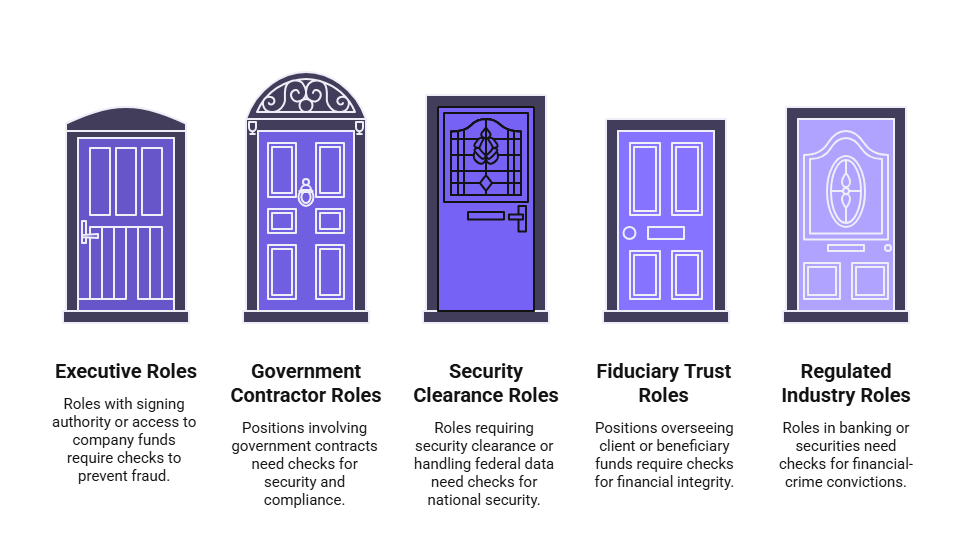
- Executive, finance, and accounting roles with signing authority or access to company funds
- Government contractor and government-adjacent positions
- Roles requiring a security clearance or handling of federally regulated data
- Positions of significant fiduciary trust, such as those overseeing client or beneficiary funds
- Roles in regulated industries, such as banking or securities, where a federal financial-crime conviction would be directly relevant to the job
A useful way to think about the decision is to ask what a federal-level offense would actually mean for the role in question. A wire fraud conviction is directly relevant to someone who will be moving company funds. It is a different question entirely for a role with no financial authority, no government exposure, and no access to sensitive systems. For most roles in that second category, a federal criminal search is one layer among several, not the entire screening strategy. Employers weighing whether to add it should look at the actual risk profile of the role rather than defaulting to it as a blanket practice, which keeps the screening program both defensible and proportionate to the job at hand.
Frequently asked questions
How long does a federal criminal search take?
Turnaround varies by district and by how many districts need to be searched, since each of the 94 federal district courts maintains its own docket. A search covering one or two districts where the candidate has lived is typically faster than one covering several, and case files that require manual review to confirm a match can add time beyond an initial PACER query.
Does a federal criminal search show arrests that didn’t lead to a conviction?
Generally, only within the FCRA’s seven-year federal lookback window, and not at all once that window has passed, unless the role qualifies for the $75,000 salary exception under 15 U.S.C. § 1681c(b)(3). Convictions are not subject to that same limit and can be reported regardless of age. Several states, including California, New York, and Massachusetts, impose their own stricter or absolute limits on non-conviction records that override the federal salary exception, so the applicable rule depends on the state as well as federal law.
Is a national criminal database search the same as a federal criminal search?
No. A national criminal database search draws on an aggregated index built from state and county sources, while a federal criminal search queries PACER and federal district court dockets directly. The two surface different things, and neither one is a full substitute for the other.
Can a federal criminal search show sealed or expunged records?
No, with narrow exceptions for certain national-security or government-adjacent roles that may require broader disclosure. As with other criminal record checks, sealed and expunged records are generally excluded from what a consumer reporting agency can report.
Do all employers need to run a federal criminal search?
No. It is most relevant for roles carrying financial authority, government-adjacent responsibilities, or a security clearance requirement. For most positions, a federal criminal search is one component of a layered screening program rather than a standalone requirement.
Sources cited
- Federal Trade Commission. (2023). Fair Credit Reporting Act, 15 U.S.C. § 1681 et seq. https://www.ftc.gov/system/files/ftc_gov/pdf/fcra-may2023-508.pdf
- Office of the Law Revision Counsel, U.S. House of Representatives. (n.d.). 15 U.S.C. § 1681c: Requirements relating to information contained in consumer reports. https://uscode.house.gov/view.xhtml?req=%28title%3A15+section%3A1681c+edition%3Aprelim%29
- Administrative Office of the U.S. Courts. (n.d.). PACER: Public Access to Court Electronic Records. https://pacer.uscourts.gov/

ABOUT THE CREATOR
Charm Paz, CHRP
Recruiter & Editor
Charm Paz is an HR professional at GCheck, specializing in background screening, fair hiring, and regulatory compliance. She holds from the Professional Background Screening Association (PBSA) and helps organizations navigate employment regulations with clarity and confidence.
With a background in Industrial and Organizational Psychology, she translates policy into practice to build ethical, compliant, human-centered hiring systems that strengthen decision-making over time.