

A domestic background check searches records inside the United States: state and county courts, national criminal databases, and U.S.-based employers and schools. An international background check searches the same categories of records in a foreign country, where access, timing, and legal requirements are set by that country’s own laws rather than U.S. rules alone.
Key takeaways
- International checks typically take two to six weeks for criminal history, three to eight weeks for employment verification, and four to ten weeks for education verification, per country, compared to 24 to 72 hours for standard domestic screening.
- Record availability varies by country. Some criminal, employment, and education records are electronic and centralized; others require manual retrieval through courts or government offices.
- The Fair Credit Reporting Act (FCRA) still applies whenever a U.S. employer obtains a check through a consumer reporting agency, even when the candidate or the records are located abroad.
- Countries covered by the General Data Protection Regulation (GDPR) and similar laws add legal-basis and data-handling requirements on top of FCRA, not instead of it.
- Cost increases internationally mainly because of local sourcing, translation, and manual record retrieval, not because the underlying search is more thorough.
- Credit checks, common domestically, are restricted or effectively unavailable for employment purposes in many other countries.
What makes a background check domestic or international
A background check is domestic when every record source, the candidate’s residence, work history, and education, sits inside the United States. County courts, the Social Security Administration, state driving records, and U.S. employers are all reachable through established, standardized channels that most consumer reporting agencies (CRAs) already have direct or near-direct access to.
A background check becomes international the moment any part of a candidate’s history sits outside the U.S., whether that’s a prior conviction in another country, a degree from a foreign university, or three years of employment at a company with no U.S. presence. The check itself still aims to answer the same questions domestic screening answers: has this person done what they say, and is there anything in their history that matters to this hire. What changes is how those answers get sourced.
Domestic vs. international background checks at a glance
The table below summarizes the four dimensions employers most often ask about when they add international screening to an existing domestic program.
| Dimension | Domestic background check | International background check |
| Turnaround time | 24 to 72 hours for standard screening; 1 to 3 business days for county criminal searches | 2 to 6 weeks for criminal history, 3 to 8 weeks for employment verification, 4 to 10 weeks for education verification, per country |
| Governing law | FCRA, plus applicable state and local screening laws | FCRA, plus the destination country’s data protection and labor law (GDPR in the EU, similar regimes elsewhere) |
| Consent and authorization | Standalone written disclosure and authorization under FCRA | FCRA authorization, plus a valid legal basis and, in many countries, additional local consent or notice requirements |
| Criminal record access | Centralized, largely electronic access through county, state, and federal systems | Ranges from electronic police certificates to manual court or police-office retrieval, depending on the country |
| Employment and education verification | Direct contact with U.S. employers and registrars, usually within days | Direct contact with foreign employers and universities, often slower due to language, time zone, and local verification norms |
| Credit checks | Common and well established for roles with financial responsibility | Restricted or unavailable for employment purposes in many countries |
| Typical cost driver | Standard vendor pricing for domestic database access | Local vendor sourcing, translation, and manual retrieval in countries without electronic access |
| Watchlist and sanctions screening | Typically limited to regulated industries (finance, defense, government contracting) | Often standard practice for any cross-border hire, given the added exposure of international financial and trade relationships |
This table sets the baseline; the sections below explain why each difference exists.
Turnaround time: why international checks take longer
Domestic criminal checks are fast because most U.S. jurisdictions have digitized and centralized their court and criminal records, and CRAs have built direct data connections to them. Standard domestic employment screening typically returns in 24 to 72 hours, with county-level criminal searches often clearing in one to three business days.
International turnaround times stretch out because that same digitization and centralization does not exist everywhere. GCheck’s own published guidance on background check timelines puts international criminal history verification at two to six weeks per country, employment verification at three to eight weeks per country, and education verification at four to ten weeks per country, with the exact figure depending on how centralized that country’s record systems are. A country with an electronic national police certificate system can return a result close to domestic speed. A country where criminal records are held at the local courthouse level, with no central index, requires a manual request routed through a local contact who understands that specific system.
What actually drives the gap
Three factors explain most of the variance: whether the destination country’s criminal records are centralized or held locally, whether the check type requires document translation and authentication, and whether local law imposes a waiting period or notice requirement before records can be released. A criminal check in a country with a national electronic registry and no mandatory waiting period can return in under two weeks. A criminal check in a country where records live at the municipal court level, and where the candidate must first request the record in person, can take the full six weeks or longer.
Setting expectations with hiring managers and candidates
Because the variance is country-specific, the most useful thing an HR team can do is set a realistic timeline before the requisition opens, not after. Telling a hiring manager “international checks take longer” without a country-specific estimate invites frustration and pressure to skip steps. Telling a candidate up front that their specific country’s check typically takes three to four weeks, and why, keeps the process transparent and avoids the candidate feeling like a delay is a sign of suspicion rather than a routine part of cross-border verification.
Record availability: what domestic screening covers that international doesn’t automatically
Domestic screening benefits from standardized record types across nearly every U.S. jurisdiction: county and state criminal records, a well-established employment and education verification process, and, where relevant to the role, a credit report. International record availability is uneven, and it varies by both country and record type rather than by country alone.
Criminal records
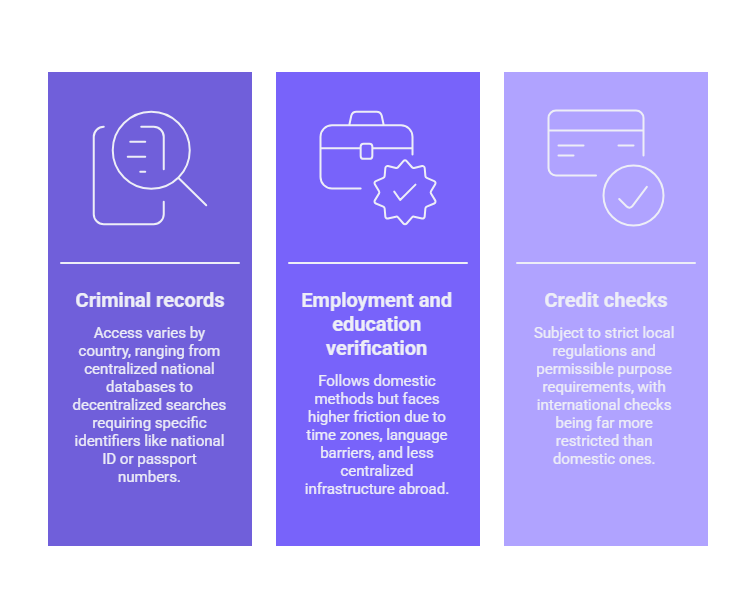
Some countries maintain a single national criminal database accessible through an official police certificate, which a local provider can request and receive electronically or through a short in-person process. Other countries have no centralized system at all, and a criminal record search means checking with individual courts or regional police offices, which is slower and depends heavily on correct identifiers like full legal name, date of birth, and, in many countries, a national ID or passport number.
Domestic retrieval is technically standardized, but use is not: ban-the-box and fair-chance laws restrict when an employer may ask about criminal history, and lookback and arrest-versus-conviction rules differ by state and city. Retrieval and permitted use are two different questions, and a domestic program needs the same jurisdiction-by-jurisdiction review.
Employment and education verification
Verifying foreign employment and education claims follows the same basic method as domestic verification, contacting the employer or the registrar directly, but the practical friction is higher. Time zone differences, language barriers, and unfamiliarity with U.S.-style verification requests all slow the process down. Some countries also have less centralized infrastructure for catching credential misrepresentation than the U.S. does, which is exactly why skipping international verification on a candidate with significant foreign work or education history leaves a meaningful gap that a domestic-only check would never catch.
Credit checks
Domestically, credit checks are available for roles with financial responsibility, subject to FCRA’s permissible purpose requirement, but a growing number of states and cities (including California, Colorado, Illinois, and New York City) restrict or prohibit using credit history in hiring at all, regardless of role, so this needs a location check before it goes into a domestic requisition. Internationally, credit checks for employment purposes are far more restricted. In Germany, credit information can generally only be requested where a role’s specific financial responsibilities make it necessary, and a blanket credit check run on every candidate is considered disproportionate under the country’s federal data protection law. In the UK, the Information Commissioner’s Office is explicit that employers must not run credit reference checks routinely or without justification, and must be able to show why the information is necessary for the specific role. Employers used to ordering credit checks by default domestically need to treat that step as the exception internationally, not the norm.
Consent and authorization: FCRA vs. GDPR and local data protection law
Every background check ordered by a U.S. employer through a consumer reporting agency, domestic or international, is governed by the FCRA. Under FCRA §604(a)(3), the employer must have a permissible purpose, and under §1681b(b)(2), the employer must provide a standalone written disclosure and obtain the candidate’s written authorization before ordering the report, regardless of where that candidate lives or where the records originate. Adding a country to the search does not remove any FCRA obligation; it adds obligations on top of it.
For candidates located in the European Union, the GDPR (Regulation (EU) 2016/679) introduces a separate requirement: the employer needs a valid legal basis under Article 6 for processing the candidate’s personal data. Criminal history sits in its own category under Article 10, which restricts processing of criminal-conviction data to situations under the control of an official authority or specifically authorized by EU or member state law, on top of the Article 6 basis. FCRA authorization satisfies the U.S. requirement; it does not by itself satisfy the GDPR requirement, which is why a check that is fully FCRA-compliant can still be non-compliant under EU law if the legal-basis and data-handling steps aren’t addressed separately. Other regions have their own equivalents. Canada’s PIPEDA, for instance, imposes its own consent and data-handling framework that operates alongside, not in place of, FCRA.
The practical difference for an HR team is that domestic consent is largely a single-document exercise: the FCRA disclosure and authorization form. International consent is a layered exercise: the FCRA form, plus whatever the destination country’s data protection law requires, which can include specific notice language, a documented legal basis, and, in some countries, more explicit candidate consent than U.S. law demands on its own.
Cost differences and what drives them
| Cost driver | Present domestically | Present internationally |
| Standard database access | Yes, standard vendor pricing | Rarely; most countries lack equivalent centralized databases |
| Local vendor or correspondent sourcing | Not applicable | Common; many countries require a local partner with in-country access |
| Document translation and authentication | Rarely needed | Frequently needed for foreign-language records |
| Manual retrieval (in-person or courthouse-level requests) | Uncommon | Common in countries without electronic record systems |
International background checks cost more than domestic ones primarily because the underlying infrastructure is different, not because the search itself is more comprehensive. A domestic criminal check draws on a database the CRA already has standing access to. An international check in a country without that infrastructure requires a local provider, sometimes a translator, and in some cases a person physically requesting a document from a courthouse or government office. Each of those steps adds cost that has nothing to do with how thorough the check is and everything to do with how the record system in that country works.
This is worth explaining plainly to finance and hiring stakeholders who compare a domestic invoice to an international one and assume the international check is somehow “more” when it is, in most cases, doing the same job under a harder set of conditions.
Watchlist and sanctions screening: a step with a different baseline internationally
Domestically, watchlist and sanctions screening (checking a candidate against government sanctions lists, denied party lists, and similar watchlists) is common mainly in regulated industries: banking, defense contracting, and roles with government access. Most domestic hires outside those industries never touch this step.
Internationally, the calculation shifts. A candidate with employment history in multiple countries, or a role that involves cross-border financial transactions, trade relationships, or supply-chain access, carries exposure that a domestic-only hire typically doesn’t. Many employers treat watchlist and sanctions screening as a standard part of international background checks even for roles that wouldn’t trigger it domestically, precisely because the cross-border element itself introduces the kind of risk this screening is designed to catch. This is not a judgment about the candidate; it reflects the reality that cross-border roles interact with more regulatory systems than a purely domestic one does.
What changes operationally when you add international screening

Adding international checks to a domestic program is less about a different kind of check and more about three operational habits: how identifiers are collected, how timelines are planned, and how consent is documented.
Collecting the right identifiers up front
Domestic checks usually succeed with a full legal name, date of birth, and Social Security number. International searches fail far more often on identifier mismatches, since many countries have no SSN equivalent and instead rely on a national ID number, a passport number, or a specific local address history format. Collecting the correct identifier for the destination country before the search begins, rather than after a first attempt bounces back, is the single biggest lever an HR team has over how smoothly an international check runs.
Building country-specific timeline expectations
A one-size-fits-all “background check takes a week” expectation does not transfer internationally. Country-specific timeline estimates belong in the requisition and offer process itself, so a hiring manager expecting a UK check in ten days and a Philippines check in four weeks isn’t caught off guard by either outcome. Setting this expectation early keeps the process transparent for both sides.
Treating consent as a two-part requirement
For any candidate located outside the U.S., consent has two parts rather than one: the FCRA disclosure and authorization that applies to every check a U.S. employer runs, and whatever legal basis, notice, or additional consent the destination country’s data protection law requires on top of it. Treating these as a single combined form, rather than two distinct legal requirements that happen to be collected together, is one of the more common gaps in international screening programs that otherwise handle FCRA compliance correctly.
None of this changes the goal of screening. It changes the process needed to reach the same standard of verification the U.S. system already provides for domestic hires, applied fairly to candidates whose history happens to sit across a border. Telling candidates and hiring managers plainly what changes, and why, is the operating standard behind GCheck’s Compliance for Good® framework, and specifically its Transparent Compliance pillar.
Frequently asked questions
How much longer does an international background check take than a domestic one?
Domestic criminal checks often return in 24 to 72 hours. International checks typically take two to six weeks for criminal history, three to eight weeks for employment verification, and four to ten weeks for education verification, per country. Countries with centralized, electronic record systems return results faster than countries where records must be retrieved manually from local courts, police offices, or institutions.
Does the FCRA apply to international background checks?
Yes, when the check is obtained through a consumer reporting agency. The FCRA applies regardless of where the candidate lives or where the records originate. Employers must still establish a permissible purpose, provide standalone disclosure, obtain written authorization, and follow the adverse action process if the check affects a hiring decision.
Do international candidates need to give consent the same way domestic candidates do?
They need FCRA authorization at minimum, the same as any domestic candidate. Candidates in the EU and other regions with their own data protection laws may also require a documented legal basis or additional notice under that country’s law, layered on top of the FCRA requirement rather than replacing it.
Why do international background checks cost more than domestic checks?
Cost increases mainly because of infrastructure differences, not thoroughness. Many countries lack the centralized, electronic record systems U.S. providers can access directly, which means local vendor sourcing, document translation, or manual courthouse retrieval, each adding cost that reflects how the records system works in that country.
Can I run a credit check on a candidate living outside the U.S.?
In most cases, not routinely. Many countries restrict credit checks for employment purposes to roles where financial responsibility is directly relevant to the job, and a growing number of U.S. states and cities restrict or prohibit them domestically too, so this is a location check on both sides of the comparison. In Germany, a blanket credit check is considered disproportionate under federal data protection law unless the role specifically requires it. In the UK, the Information Commissioner’s Office requires employers to justify credit reference checks rather than run them by default.
What records are hardest to verify internationally?
Criminal records in countries without a centralized national database are typically the slowest and most identifier-sensitive to verify, since they require locating the correct local court or police office. Education and employment verification can also slow down in countries where employers and registrars are unfamiliar with U.S.-style verification requests.
Sources cited
- Fair Credit Reporting Act, 15 U.S.C. §1681 et seq., including §1681b(a)(3) / FCRA §604(a)(3) (permissible purpose) and §1681b(b)(2) (disclosure and authorization for employment purposes).
- Regulation (EU) 2016/679 (General Data Protection Regulation), Articles 6 and 10.
- Personal Information Protection and Electronic Documents Act (PIPEDA), Canada.
- Information Commissioner’s Office (UK), “Pre-employment vetting of candidates,” ico.org.uk.
- GCheck, “How Long Does a Background Check Take? A Complete Guide,” gcheck.com/blog/how-long-does-a-background-check-take, citing Professional Background Screening Association (PBSA) data on employer screening adoption and turnaround as a selection factor.

ABOUT THE CREATOR
Charm Paz, CHRP
Recruiter & Editor
Charm Paz is an HR professional at GCheck, specializing in background screening, fair hiring, and regulatory compliance. She holds from the Professional Background Screening Association (PBSA) and helps organizations navigate employment regulations with clarity and confidence.
With a background in Industrial and Organizational Psychology, she translates policy into practice to build ethical, compliant, human-centered hiring systems that strengthen decision-making over time.