

Standard executive background checks verify criminal history, employment, education, and identity, but stop short of reputation risk. Many organizations pair that check with separate reputation intelligence before finalizing a board or C-suite appointment.
Key Takeaways
- A standard executive background check verifies facts against official records: criminal filings, employment history, education, and professional licenses.
- Executive reputation intelligence is a separate practice that reviews public information, including news coverage, court filings, regulatory actions, and professional network mentions, then assesses that information for governance risk.
- A clean criminal record does not rule out reputational exposure, and a history of negative press does not necessarily indicate a legal problem. Boards that rely on only one type of check get an incomplete picture.
- Whether the FCRA applies to reputation intelligence depends on who compiles the information and why, not on whether the information is public.
- Executive and officer appointments clearly fall within the FCRA’s employment-purposes definition; non-employee board directorships sit in less settled territory, and the safer practice is to apply FCRA disclosure and authorization procedures regardless.
What a Standard Executive Background Check Verifies
A background check confirms facts that already exist in a record somewhere: a criminal filing, a degree conferred, a job held. For executive candidates, this typically includes criminal history searches at the county, state, and federal level, employment verification going back further than a typical entry-level check, and education and professional license verification. Some organizations add a credit history review where the role carries fiduciary responsibility and state law permits it.
None of this is unique to executives in kind. What changes is scope and depth: a standard employee check might verify the last two employers, while an executive check might verify the last decade, across multiple countries, because a false credential carries more consequence in a C-suite hire. Executive-level screening is widely recognized as more comprehensive than standard employee screening for this reason (SHRM, 2023).
The broader geographic and time scope also reflects how executive careers actually move. Senior leaders are more likely to have worked across state lines or internationally, and a check that stops at one state’s court records or one country’s employment history will miss exactly the gaps a fabricated résumé is designed to hide.
| Component | What it verifies | Typical scope for executives |
| Criminal history | County, state, and federal filings | Multi-state and often international |
| Employment verification | Dates, titles, and employers | Ten years or more |
| Education and licensing | Degrees and professional licenses | Full career history |
| Credit history | Financial responsibility | Roles with fiduciary duty, where legally permitted |
Why Standard Checks Stop Short of Reputation Risk
A criminal record search answers a narrow question: has this person been charged with or convicted of something. It does not answer whether this person was named in a shareholder lawsuit that never became a criminal matter, was the subject of sustained negative press, or has a pattern of professional controversies that never resulted in a conviction but still shaped how peers and regulators view them.
This is the structural limit of a standard background check. It verifies facts against official records; it does not assess how a person’s public conduct might affect an organization’s standing. For most hires, that limit is fine. Reputation exposure at the individual-contributor level rarely threatens the organization as a whole. At the executive and board level, it can.
Consider a candidate whose departure from a previous employer followed a public dispute that was resolved privately and never entered a court docket. A standard background check will not surface that dispute, because there is no filing to find. Reputation intelligence, which reviews news coverage and public discussion rather than court records alone, is built to surface exactly this kind of gap.
What Executive Reputation Intelligence Adds
Executive reputation intelligence is a practice that reviews public information tied to a leader’s professional conduct, then assesses those signals for credibility, severity, and governance implications. Rather than asking whether an official record exists, it asks what the public record says about how a person has conducted themselves, and whether that creates risk for the organization.
The two practices draw from different source types:
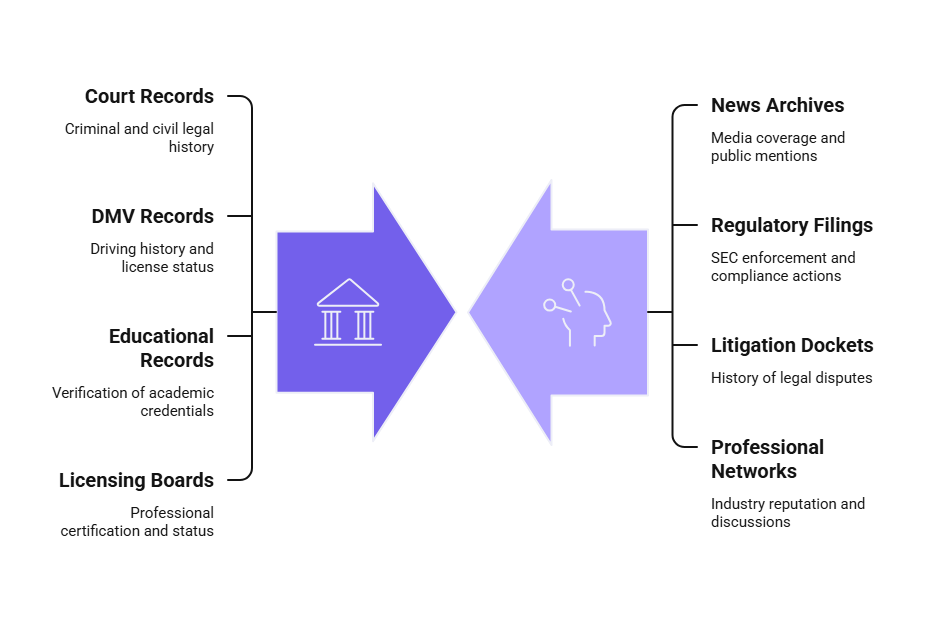
- Standard background checks pull from official government and institutional records: courts, DMVs, schools, and licensing boards.
- Reputation intelligence pulls from public information sources: news archives, regulatory filings such as SEC enforcement actions, litigation dockets, professional licensing disciplinary records, and professional network discussion.
Both are legitimate parts of executive due diligence, and neither substitutes for the other. A board that only runs a standard check may clear a candidate whose public conduct history would have raised questions; a board that only reviews reputation signals may miss a straightforward criminal filing a standard check would have caught.
A regulatory filing is a useful illustration of why source type matters. An SEC enforcement action or a professional licensing board’s disciplinary record is public, but it rarely surfaces in a standard criminal or employment check, since neither is designed to search regulatory dockets. Reputation intelligence treats that filing as a core source category, which is why the two practices produce different findings even when run on the same person at the same time.
| Standard background check | Executive reputation intelligence | |
| Question asked | Does an official record exist | What does the public record say, and what risk does it create |
| Source types | Courts, DMVs, schools, licensing boards | News, regulatory filings, litigation dockets, professional network activity |
| Output | Verified facts | Risk-assessed signals with severity and governance context |
| Typical use | Point-of-hire verification | Point-of-appointment and ongoing oversight |
When This Information Becomes a Consumer Report Under the FCRA
This is the point where organizations most often get the compliance question wrong, and it turns on a specific, narrow test rather than on whether the information is public.
The Permissible Purpose Test
Under the Fair Credit Reporting Act, a consumer report is any communication by a consumer reporting agency bearing on a person’s character, general reputation, personal characteristics, or mode of living, used or expected to be used as a factor in an employment decision (FCRA, 15 U.S.C. §1681a(d)). Employment purposes means evaluating a person for hiring, promotion, reassignment, or retention as an employee (FCRA, 15 U.S.C. §1681a(h)). The trigger is not whether the underlying information is public. Court records, news coverage, and social media posts are all public. The trigger is whether a consumer reporting agency, meaning a third party that assembles or evaluates the information for the purpose of furnishing it to others, compiles that information into a report for an employment purpose.
Practically, that means an organization’s own staff pulling up news articles and public filings directly generally falls outside the FCRA’s consumer-reporting requirements, though fairness and non-discrimination obligations still apply. A third-party provider compiling that same information into a report for a hiring, promotion, reassignment, or retention decision creates a consumer report, and the FCRA’s disclosure, authorization, and adverse action requirements apply the same way they would for a criminal background check. The CFPB confirmed this reading in 2024: background dossiers compiled from public records and used for employment decisions are often governed by the FCRA, regardless of the technology or method used to compile them (CFPB, Circular 2024-06).
Board Appointments and the “As an Employee” Question
The FCRA’s employment-purposes definition is tied specifically to evaluating someone “as an employee,” which creates a genuine distinction worth tracking. An appointment that makes someone an employee, such as a C-suite officer role, clearly falls within employment purposes. A purely non-employee board directorship sits in less settled territory, since independent directors are typically not employees of the organizations they oversee, and the statute’s text does not squarely address board service that carries no employee relationship.
In practice, many board appointments involve someone who is, or is being evaluated for, an executive role, or who has a prior employment relationship with the organization, which brings the appointment within employment purposes regardless of title. Organizations should not assume a board seat is automatically exempt, but the safer practice is to apply FCRA disclosure and authorization procedures whenever a third party compiles reputation intelligence for a governance decision, since the cost of following the process is low and the cost of wrongly skipping it is not.
| Who compiles the information | Purpose | FCRA consumer report? |
| Organization’s own staff | Internal review | Generally no |
| Third-party provider | Executive or officer appointment decision | Yes |
| Third-party provider | Non-employee board directorship | Less settled; often treated as covered out of prudent practice |
| Third-party provider | Non-employment business purpose | Depends on the specific permissible purpose claimed |
State Privacy Law Considerations
The FCRA sets a federal floor, not a ceiling. Several states layer additional disclosure or data-handling requirements on top of the federal standard, some specific to social media or online information gathered during screening. Organizations operating across multiple states should confirm whether the states where their executives or board candidates reside add further requirements before relying on reputation intelligence in a decision.
The multi-state, multi-year scope described earlier refers to how far a check can search, not how far back a CRA may report certain findings. The FCRA caps some negative information at seven years for civil judgments and ten years for bankruptcies, with no federal cap on criminal convictions, and several states impose their own, often shorter, limits on criminal history reporting. A broader search does not mean every item found is reportable or usable in every jurisdiction.
How Consent and Adverse Action Apply
Where reputation intelligence is compiled by a third party and used for an employment or appointment decision, the same sequence applies as it would to any consumer report:
- A clear, standalone disclosure that the check may be conducted
- The individual’s written authorization
- A pre-adverse action notice and a copy of the report, if the findings could lead to an adverse decision
- A summary of rights and a final adverse action notice once the decision is made
(FCRA, 15 U.S.C. §1681b; 15 U.S.C. §1681m)
Skipping any of these steps because the underlying information happens to be public is a common, avoidable compliance failure. This is also where confidential, consent-based diligence differs most from open-ended surveillance. Reputation intelligence, done properly, reviews what is already public and does so with the subject’s knowledge and consent.
Confidentiality matters as much as the notice sequence itself. Findings should reach only board members and governance personnel with a legitimate oversight need, not circulate broadly across an organization. Organizations that keep that boundary clear, public information only, consent obtained, findings handled confidentially, hold up better under later scrutiny.
Who Uses Reputation Intelligence, and Why Standard Checks Aren’t Enough for This Purpose
Boards of directors, audit and nomination committees, and governance officers are the primary users, typically at two points: before finalizing a C-suite or board appointment, and on an ongoing basis throughout an executive’s tenure. The reasoning is straightforward. A one-time check at the point of hire cannot surface problems that emerge later, and boards carry oversight responsibilities that a hiring manager’s background check was never designed to satisfy.
Common users include:
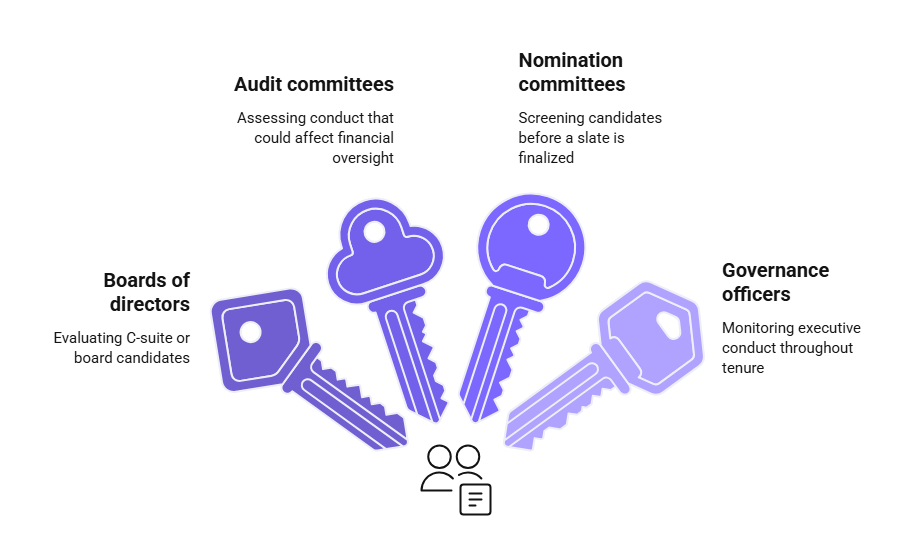
- Boards of directors evaluating C-suite or board candidates
- Audit committees assessing conduct that could affect financial oversight
- Nomination committees screening candidates before a slate is finalized
- Governance officers monitoring executive conduct throughout tenure
Executive-level screening exists because the consequences of an incomplete picture scale with the role. A verified degree and a clean criminal record tell a board very little about whether a candidate’s past conduct will become a governance problem after the appointment is finalized, when options for addressing it are far more limited than earlier. Ongoing reviews, run on a set schedule or triggered by an event such as new litigation, extend that awareness across an executive’s full tenure.
Some boards schedule an annual reputation review alongside routine governance reporting; others trigger a review when a specific event occurs, such as new litigation naming the executive. Either approach is more protective than relying on the appointment-stage check alone.
Common Mistakes Organizations Make
The most frequent error is treating public availability as automatic exemption from the FCRA. The exemption depends on who compiles the information, not whether it is public, and organizations that skip disclosure and authorization on that assumption expose themselves to liability regardless of intent.
A second mistake is bundling reputation intelligence authorization into a standard background check authorization without describing what will be reviewed. A disclosure that only describes criminal and employment checks does not cover a reputation intelligence review conducted alongside it; the two require their own notice.
A third mistake is distributing reputation findings too broadly. Reports built for board oversight should reach the committee or governance personnel with a legitimate need, not circulate informally, since wider distribution increases privacy exposure and the risk that findings are used beyond the purpose they were authorized for.
What a Compliant Program Looks Like End to End
A compliant program follows a consistent sequence regardless of whether it is running at the point of appointment or on an ongoing basis. Each step maps to a specific compliance requirement, not just a procedural convenience.
| Step | What happens | Compliance requirement |
| Identify executive profiles | Confirm identity, affiliations, and public presence | Accurate name-matching to avoid misattributed records |
| Collect public signals | Review news, court filings, regulatory actions, and professional network activity | Public sources only, no private account access |
| Assess risk severity | Evaluate credibility, severity, and governance implications | Documented evaluation criteria |
| Deliver intelligence report | Provide governance recommendations to authorized personnel | Consent obtained; distribution limited to those with a legitimate governance need |
This distinction, between verifying facts and assessing risk, is the kind of precision GCheck’s Compliance for Good® framework is built around: Protective Compliance safeguards the organizations and executives involved, and Transparent Compliance keeps everyone clear on what is checked and how findings are handled. Organizations that run this sequence consistently are better positioned to demonstrate the reasonable inquiry that governance and fiduciary duties expect.
Reputation Risk as a Governance, Not Just an HR, Responsibility
Undisclosed executive misconduct is rarely only a hiring mistake. When it surfaces after an appointment, boards face questions about whether reasonable inquiry would have caught it earlier, questions that fall squarely within a board’s fiduciary and oversight duties rather than within HR’s traditional scope. That is why reputation intelligence sits alongside board packets and audit committee reports, not inside a standard new-hire file.
Section 5 of the FTC Act prohibits unfair or deceptive practices that mislead consumers or stakeholders, and material omissions can fall within that prohibition even without intent to deceive (FTC Act, 15 U.S.C. §45). That principle targets commercial practices, not executive vetting, but the logic still applies by analogy: undisclosed executive conduct that later surfaces publicly raises similar questions about what an organization knew and when, which is part of why boards increasingly treat reputation review as a standing governance practice.
Framed this way, reputation intelligence is not designed to expose or embarrass executives. It is a governance practice that gives boards the information reasonable oversight requires, weighed through individualized assessment of relevance, severity, and recency rather than automatic disqualification, and delivered with the same consent and confidentiality standards that apply to any other form of executive due diligence.
Frequently Asked Questions
What does an executive background check include?
A standard executive background check includes criminal history searches, employment verification, education and professional license verification, and in some cases a credit history review. It typically covers a longer lookback period and a broader geographic scope than an entry-level check, often extending across multiple states or countries.
Is a reputation or social media check covered by the FCRA?
It depends on who compiles it and why, not on whether the information is public. If a third-party provider assembles news, court, or social media findings into a report and furnishes it to an organization for an employment or appointment decision, that report is a consumer report subject to the FCRA’s disclosure, authorization, and adverse action requirements (FCRA, 15 U.S.C. §1681b).
Does a board appointment require FCRA compliance?
It depends on whether the appointment makes the person an employee. Executive or officer appointments clearly fall within the FCRA’s employment-purposes definition, which covers evaluating a person for hiring, promotion, reassignment, or retention as an employee. Purely non-employee board directorships are less clearly covered by the statute’s text, so the safer practice is to apply the same disclosure and authorization procedures regardless of the exact title.
Is consent required for executive reputation intelligence?
Yes, where the information is compiled by a third party for an employment or appointment purpose. The individual must receive a clear disclosure and provide written authorization before the check is conducted, the same requirement that applies to any FCRA-covered consumer report.
Does executive reputation intelligence monitor private accounts?
No. A properly scoped program reviews only publicly available information: news coverage, court filings, regulatory actions, and public professional network activity. It does not access private accounts or restricted content.
Can reputation intelligence support ongoing monitoring, not just pre-appointment screening?
Yes. Because reputation risk can emerge after an appointment is finalized, many boards use continuous reputation monitoring throughout an executive’s tenure rather than a single check at hire. This mirrors the broader shift toward continuous monitoring in employment screening, where a one-time check at hire misses risk that develops later.
Sources cited
- Fair Credit Reporting Act, 15 U.S.C. §1681a(d) (definition of consumer report)
- Fair Credit Reporting Act, 15 U.S.C. §1681a(h) (definition of employment purposes)
- Fair Credit Reporting Act, 15 U.S.C. §1681b (permissible purposes; disclosure and authorization)
- Fair Credit Reporting Act, 15 U.S.C. §1681m (adverse action requirements)
- Consumer Financial Protection Bureau, Circular 2024-06 (background dossiers and employment decisions)
- SHRM, “Executives Warrant More Thorough Background Screens,” 2023
- FTC Act, Section 5, 15 U.S.C. §45 (unfair or deceptive practices)

ABOUT THE CREATOR
Charm Paz, CHRP
Recruiter & Editor
Charm Paz is an HR professional at GCheck, specializing in background screening, fair hiring, and regulatory compliance. She holds from the Professional Background Screening Association (PBSA) and helps organizations navigate employment regulations with clarity and confidence.
With a background in Industrial and Organizational Psychology, she translates policy into practice to build ethical, compliant, human-centered hiring systems that strengthen decision-making over time.