
Professional license verification is the process of confirming that a job candidate or employee holds a valid, active license or credential for their role, obtained directly from the issuing licensing authority or its official database. It confirms license status, expiration date, any disciplinary actions on record, and whether restrictions apply. It does not confirm criminal history, employment history, or financial background.
Key Takeaways
- A professional license verification confirms the type of license, the issuing authority, the license number, its current status (active, expired, suspended, and similar), and often the dates of issuance and expiration.
- A verification report typically includes license details such as issuance date, expiration date, and current status, as well as disciplinary history covering all publicly available administrative actions or disciplinary findings associated with the license.
- Professional license verification covers the licensing record only. It does not cover criminal history, employment history, financial background, or anything outside the licensing authority’s records.
- License checks can function as a key piece of a comprehensive employment background check program that includes additional reports such as criminal background checks, driving record checks, and employment verification.
- Pre-hire verification answers one question: is this person licensed today? Post-hire monitoring answers the ongoing question: are they still licensed, and have any disciplinary actions, suspensions, or revocations occurred since they joined?
- Primary source verification, meaning obtaining data directly from the issuing authority rather than relying on secondary documents or candidate-provided copies, is the recognized standard for high-stakes hiring.
- FCRA applies when a CRA conducts the verification. Written disclosure, authorization, and adverse action requirements apply regardless of whether license verification is run standalone or bundled in a background check package.
- According to a reported incident cited in industry research, fake nursing diplomas from Southern Florida nursing schools resulted in over 2,000 uncertified nurses entering the field, illustrating the stakes of skipping primary source verification.
For most employers, a candidate’s claim to hold a professional license is one of the easier things to verify, and one of the most frequently skipped. Visual inspection of a license document is not verification. Simply inspecting a candidate’s license instead of confirming status with the issuing authority may create liability exposure. Primary source verification closes that gap.
Professional license verification is the process of confirming license status directly with the issuing authority. Understanding what it actually returns, which roles require it, how it integrates with the rest of a background check program, and what happens to license status after hire is where most employer guidance falls short. This article covers all four.
What Professional License Verification Is, and What It Isn’t
Professional license verification is the process of confirming that an individual holds a valid, current license or credential by contacting the issuing licensing authority or querying its official database. It is distinct from a background check. It covers the licensing record, not criminal history or employment history.
A professional license verification involves contacting the governing board or agency that issued the applicant’s credentials, as well as the jurisdictions they have recently lived in. The goal is to confirm that the license the candidate claims to hold is real, current, and free of restrictions or disciplinary actions that would affect their ability to perform the role.
A professional license verification confirms the type of license, the issuing authority, the license number, its current status, and often the dates of issuance and expiration. It does not search court records, does not verify employment history, and does not check financial background. An HR manager who runs a license verification and considers the background screening complete has confirmed the candidate is licensed, but has not confirmed the candidate has no criminal history, has not misrepresented their employment history, or has not been subject to sanctions in a database the licensing board does not maintain. Those elements require separate checks run alongside the license verification, not as substitutes for it.
What a Professional License Verification Typically Returns
A verification report typically includes license details such as issuance date, expiration date, and current status (Active, Inactive, or Expired), as well as disciplinary history covering all publicly available administrative actions or disciplinary findings associated with the license. The table below maps what a license verification does and does not return.
| Element | Returned by License Verification | Notes |
| License status (active, inactive, expired, suspended) | Yes | Primary return element |
| License number | Yes | Confirms specific credential |
| Issuing authority | Yes | State board, DOI, federal agency, or professional body |
| Issuance date | Yes | When the license was first issued |
| Expiration date | Yes | When renewal is required |
| Disciplinary actions and sanctions | Yes | Publicly reported administrative actions |
| License restrictions | Yes | Limitations on scope of practice where reported |
| Criminal history | No | Requires a separate criminal background check |
| Employment history | No | Requires employment verification |
| Financial or credit history | No | Requires employment credit check |
| Education or degree details | No | Requires education verification |
| Drug test results | No | Requires separate drug screening |
What “disciplinary actions” means in practice.
Disciplinary actions recorded by a licensing authority typically include administrative sanctions, such as probation, reprimand, suspension, or revocation, that resulted from formal proceedings. They do not include informal complaints resolved without a formal finding or actions not reported to the public database. What licensing boards publicly report varies by profession and state. Where applicable by law, sanctions and revocations will be disclosed. That qualifier is operationally significant: the disciplinary history returned by a verification is bounded by what the issuing authority makes publicly available.
A note on data currency.
Primary source verification involves obtaining data directly from the issuing authority rather than relying on secondary documents or candidate-provided copies. Some CRAs verify against a live primary source query; others use aggregated databases updated periodically. For high-stakes roles, primary source verification is the appropriate standard.
Which Roles and Industries Require Professional License Verification

Two categories of roles warrant professional license verification: those where a license is legally required to perform the work, and those where verification is a best-practice risk management step even without a statutory mandate. While licenses are often required by law for safety-sensitive positions or roles requiring extensive training, compliance is not the only reason employers run license verification.
| Industry | Common Roles | Licensing Authority | Legally Required | Monitoring Standard |
| Healthcare | RNs, LPNs, physicians, pharmacists, therapists, dentists | State licensing boards | Yes | Monthly (OIG) plus license monitoring |
| Legal | Attorneys, paralegals where licensed | State bar associations | Yes | Annual plus monitoring |
| Financial services | CPAs, financial advisors, securities brokers | State boards, FINRA | Varies by role | Annual plus monitoring |
| Insurance | Producers, agents, brokers, adjusters | State Departments of Insurance | Yes | License monitoring |
| Education | Teachers, school counselors, administrators | State education departments | Yes | Annual plus monitoring |
| Construction and trades | Electricians, plumbers, contractors, engineers | State licensing boards | Yes, varies by state | License monitoring |
| Transportation | CDL holders, pilots, commercial operators | State DMVs, FAA, FMCSA | Yes | MVR monitoring |
| Real estate | Agents, brokers, appraisers | State real estate commissions | Yes | License monitoring |
| Mental health | Psychologists, counselors, social workers | State licensing boards | Yes | License monitoring |
The legally required vs. best-practice distinction.
For regulated professions in the table above, placing an unlicensed individual in a licensed role creates meaningful compliance and liability risk. The professional may not be permitted to lawfully perform the work, and the employer may face consequences for allowing unlicensed practice depending on applicable state law. For other roles, including certain contractors and consultants with professional designations, verification is a risk management decision rather than a statutory mandate. Negligent hiring exposure applies when a credential claim turns out to be false, regardless of whether the role is formally regulated.
Insurance producers: a multi-state verification requirement.
Insurance producers, including agents, brokers, and adjusters, are licensed by state Departments of Insurance and must hold an active license in each state where they transact business. For carriers and agencies appointing producers, verifying current license status across all applicable states is a standard step in the appointment process. A producer whose license has lapsed, been suspended, or been revoked in a state of appointment is generally not permitted to lawfully transact insurance in that state. Because producers frequently hold licenses in multiple states, multi-state verification scope is the norm rather than the exception in insurance. The employer must verify not just that a license exists in the home state, but that it is active and in good standing in every state of appointment.
How Professional License Verification Fits Into the Broader Screening Stack
Professional license verification is a component of a complete background check program, not a substitute for other components. License checks function as a key piece of a comprehensive employment background check program that includes criminal background checks, driving record checks, and employment verification. The components relate to one another as follows:
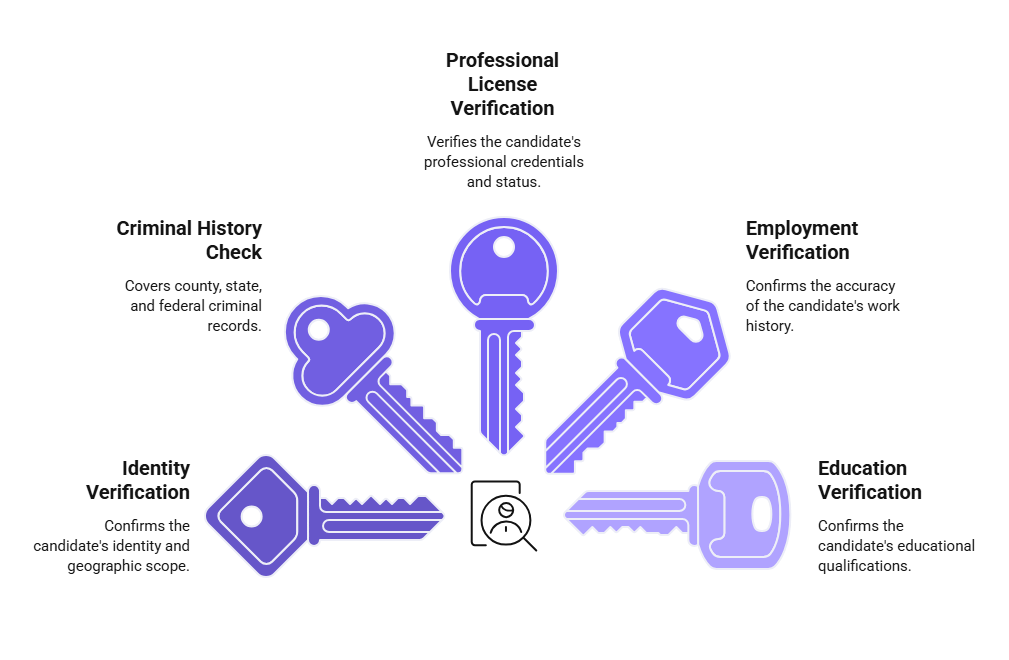
- Identity verification confirms the candidate is who they claim to be. It anchors the geographic scope of the criminal search and runs before or alongside all other components.
- Criminal history check covers county, state, and federal criminal records, addressing what the license check does not: arrests, convictions, and pending charges.
- Professional license verification confirms the specific credential the role requires. It covers what the criminal check does not: licensing status, disciplinary actions taken by the licensing authority, and restrictions on practice.
- Employment verification confirms prior employment history, addressing what neither the criminal check nor the license check covers: whether the candidate’s claimed work history is accurate.
- Education verification confirms the degree or credential that underpins the license. It is particularly relevant for healthcare and legal roles where the educational pathway is a regulatory requirement.
Running a license verification without running a criminal check, or the reverse, leaves predictable gaps. For regulated roles, the complete stack is the defensible program.
When to add a sanctions check.
For healthcare roles, license verification should be paired with an OIG/LEIE exclusion check. A licensing board clearance does not confirm the individual is not on a federal exclusion list, and the two checks cover different sources. For insurance producers, license verification works alongside the criminal history check, as neither covers what the other does.
Pre-Hire Verification vs. Post-Hire Monitoring: The Distinction That Matters
Pre-hire license verification answers one question: is this person licensed as of today? Post-hire license monitoring answers the ongoing question: are they still licensed, and has anything changed since hire? Verification is a point-in-time check. Monitoring is a persistent watch that alerts employers when license status changes after a cleared employee is already in the role.
A license that is active and in good standing on a hire date can be suspended, revoked, placed on probation, or allowed to expire at any point afterward. For organizations with licensed professionals on staff, the hire-date verification is the beginning of the credential management obligation, not the end. Regulations do not pause at the hire date. A license revocation that occurs between verification cycles is invisible to an organization without a monitoring program.
What post-hire license monitoring does.
Post-hire monitoring enrolls licensed employees in an ongoing watch against their licensing authority’s records. When a status change occurs, whether suspension, revocation, probation, new disciplinary action, or expiration, the employer receives an alert, typically within days of the board recording the change.
Which roles warrant monitoring:
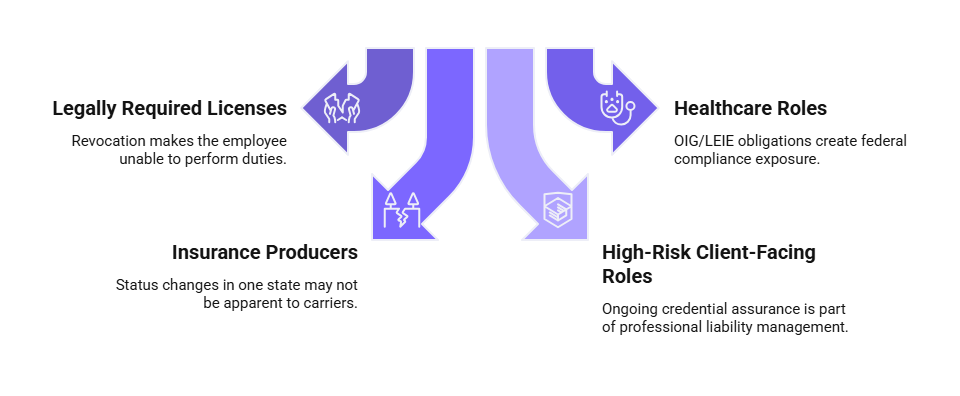
- Any role where a license is legally required to perform the work. A revocation makes the employee legally unable to continue performing their duties.
- Healthcare roles with OIG/LEIE obligations, where an exclusion or sanction after hire creates direct federal compliance exposure.
- Insurance producers appointed across multiple states, where a status change in one state may not be immediately apparent to the carrier or agency.
- High-risk client-facing roles, where ongoing credential assurance is part of professional liability management.
Verification and monitoring solve different problems. Running verification without monitoring provides point-in-time assurance. Running both provides ongoing assurance. For regulated industries where license status directly determines whether an employee can legally perform their role, both are appropriate program components.
How to Run a Professional License Verification
Employers run professional license verifications through three primary methods, each with different tradeoffs on speed, depth, and scalability.
Direct primary source query.
The employer or HR team contacts the licensing board directly, by phone, online portal, or written request. This approach is free or low-cost but time-intensive. It relies on the employer knowing which board to contact, navigating each board’s individual process, and managing turnaround times that vary by jurisdiction. In some states, receiving information directly from the board can take several weeks.
CRA-based primary source verification.
A consumer reporting agency contacts the issuing licensing authority on the employer’s behalf. Primary source verification involves obtaining data directly from the issuing authority rather than relying on secondary documents or candidate-provided copies. This is the recognized standard for high-stakes hiring. Most licenses are verified within one to two business days through this method, though those requiring direct board confirmation may take longer.
Database-based verification.
Some CRAs query aggregated license databases rather than contacting the issuing authority directly. These are faster but may not reflect recent status changes. For regulated healthcare, insurance, and legal roles, primary source verification is the more defensible approach.
A Practical Note on FCRA
When an employer uses a consumer reporting agency to conduct professional license verification, whether for a nurse, an attorney, an insurance producer, or a contractor, the Fair Credit Reporting Act applies. This includes license verification as a standalone check, not just as part of a broader background check package. Two requirements are most commonly missed in license verification programs.
Standalone written disclosure and authorization.
Before ordering a CRA-based license verification, the employer must provide a standalone written disclosure, separate from the employment application and offer letter, and obtain written authorization. This applies to license verification specifically, not just to the criminal history component of a background check.
Adverse action when results affect a hiring decision.
If a license verification result, whether an expired license, an active disciplinary action, or a suspension, leads to a decision not to hire or to rescind an offer, FCRA’s two-step adverse action process applies. The process requires a pre-adverse action notice with a copy of the report and the CFPB Summary of Rights, a reasonable opportunity for the candidate to respond or dispute, typically interpreted as at least five business days, before the final decision is made, and a final adverse action notice if the employer proceeds.
This section is informational only and does not constitute legal advice. Consult qualified employment counsel for FCRA compliance guidance specific to your screening program.
Conclusion
Professional license verification is the component of the employment screening stack that answers one specific question: does this person hold the credential they claim, in good standing, as of today? That is a narrow but critical question for any employer placing a licensed professional in a role where the license is legally required or practically material, whether that professional is a nurse, an attorney, an insurance producer, or a licensed contractor.
The answer has a shelf life. A license that clears verification on a hire date can change status afterward, and only a monitoring program catches that change before it creates a compliance or safety gap. The complete credential management program uses both: verification to confirm status at hire, and monitoring to maintain assurance throughout employment.
Frequently Asked Questions
What is professional license verification?
Professional license verification is the process of confirming that a job candidate or employee holds a valid, active license for their role by contacting the issuing licensing authority or querying its official database. It confirms license status, expiration date, disciplinary actions, and restrictions. It does not cover criminal history or employment history.
What does professional license verification show?
A professional license verification typically returns the license number, issuing authority, issuance date, expiration date, current status, and any publicly reported disciplinary actions or restrictions. It does not show criminal history, employment history, or financial background. Those require separate components of a background check program.
Which jobs require professional license verification?
Roles where a license is legally required to perform the work, including nurses, physicians, attorneys, teachers, CPAs, insurance producers, electricians, CDL drivers, and real estate agents, require verification. Organizations hiring for other roles may also run license verification as a risk management step when candidates claim specific credentials relevant to the position.
Do insurance agents need professional license verification?
Yes. Insurance producers must hold an active license in each state where they transact business, issued by the state Department of Insurance. Carriers and agencies verify license status across all applicable states as a standard step in the appointment process. Multi-state producers require verification in each state of appointment.
What is the difference between license verification and license monitoring?
License verification is a point-in-time check run at hire confirming current license status. License monitoring is an ongoing watch that alerts employers when a licensed employee’s status changes after hire, including suspension, revocation, new disciplinary action, or expiration. Verification answers “are they licensed today?” Monitoring answers “are they still licensed?”
Is professional license verification part of a background check?
License verification is a component that can be included in a background check package or run as a standalone check. It is not a substitute for criminal history, employment verification, or other background check components. A complete screening program for licensed roles typically includes both a criminal check and a license verification.
Does FCRA apply to professional license verification?
Yes. When an employer uses a consumer reporting agency to run a professional license verification, FCRA applies. This includes the standalone disclosure and authorization requirement before the check is ordered and the adverse action process if verification results influence a hiring decision. It applies to all industries, including healthcare, insurance, and legal.
Additional Resources
- Background Checks: What Employers Need to Know (FTC / EEOC Joint Guidance)
https://www.ftc.gov/tips-advice/business-center/guidance/background-checks-what-employers-need-know - EEOC Enforcement Guidance: Consideration of Arrest and Conviction Records in Employment Decisions
https://www.eeoc.gov/laws/guidance/enforcement-guidance-consideration-arrest-and-conviction-records-employment-decisions - OIG List of Excluded Individuals and Entities (LEIE)
https://exclusions.oig.hhs.gov - NAIC Producer Licensing Resource
https://content.naic.org/cipr-topics/producer-licensing - FINRA BrokerCheck
https://brokercheck.finra.org

ABOUT THE CREATOR
Charm Paz, CHRP
Recruiter & Editor
Charm Paz is an HR professional at GCheck, specializing in background screening, fair hiring, and regulatory compliance. She holds from the Professional Background Screening Association (PBSA) and helps organizations navigate employment regulations with clarity and confidence.
With a background in Industrial and Organizational Psychology, she translates policy into practice to build ethical, compliant, human-centered hiring systems that strengthen decision-making over time.