

Driver monitoring is legally required for some employers, effectively required by insurance carriers for others, and a genuine voluntary decision for the rest. Which category applies depends on what your drivers are licensed to operate, which state you operate in, and what your insurance policy actually says in writing.
Key Takeaways
- Federal DOT and FMCSA rules require an annual driving record review for covered commercial drivers, but the federal rule itself does not mandate continuous or ongoing monitoring.
- California is a documented example of a state going further than federal law: its Vehicle Code requires certain employers to enroll specific driver categories in a state monitoring program, not merely permits it.
- Most other states offer employer notification systems that satisfy the federal annual-review requirement, but enrollment in those systems is voluntary, not state-mandated.
- Commercial auto insurance carriers can make monitoring a practical necessity through coverage conditions or pricing, even where no statute requires it.
- Organizations without DOT-covered drivers, without a carrier requirement, and without a prior incident may reasonably choose a lighter-touch approach instead of a full continuous monitoring program.
- Whichever category applies, driver notification and consent obligations apply the same way; the decision affects whether monitoring happens, not whether the driver gets to know about it.
When Driver Monitoring Is Legally Required
Legal requirements for driver monitoring come from two different sources that operate independently of each other: federal rules tied to the vehicle and license type, and state rules that can go further than federal law within that state’s own borders.
Federal DOT and FMCSA Coverage
Federal Motor Carrier Safety Administration regulations require motor carriers to review the driving record of each commercial motor vehicle driver at least once every twelve months. This requirement applies to drivers operating vehicles that meet specific federal thresholds, generally commercial vehicles requiring a CDL, and it is a floor, not a ceiling: it establishes a minimum review frequency without dictating how an employer collects that information.
Employers can satisfy this requirement through a manual annual pull, a state-run notification system, or a private monitoring service, and FMCSA guidance has confirmed that enrollment in a qualifying state system covers the requirement. What the federal rule does not do is require continuous or automated monitoring specifically. An employer that manually pulls each covered driver’s record once a year, on schedule, is technically compliant with the federal minimum, even though many employers choose more frequent monitoring for reasons covered later in this article.
Coverage under this federal rule generally turns on the vehicle itself meeting the federal definition of a “commercial motor vehicle,” a broader and lower threshold than many employers assume, and one that does not by itself require the driver to hold a CDL:
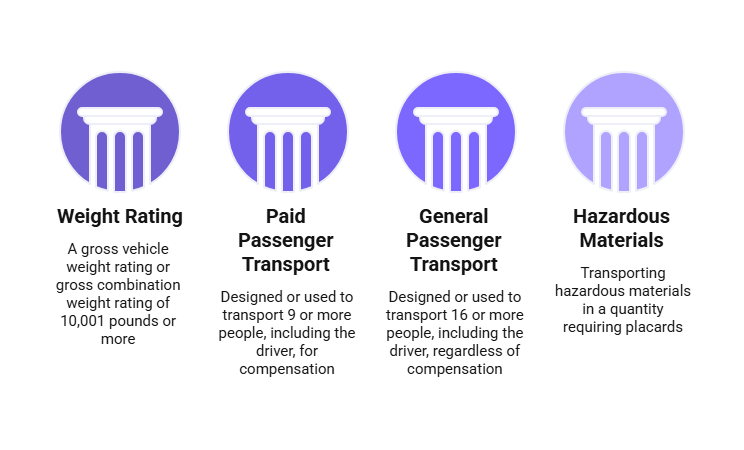
- A gross vehicle weight rating or gross combination weight rating of 10,001 pounds or more
- Designed or used to transport 9 or more people, including the driver, for compensation
- Designed or used to transport 16 or more people, including the driver, regardless of compensation
- Transporting hazardous materials in a quantity requiring placards
A CDL itself is a separate, higher threshold (generally 26,001 pounds or more, or the same passenger and hazmat triggers at a stricter level), so a driver operating a mid-size box truck can fall under the annual-review requirement without needing a CDL at all. Employers should confirm the vehicle definition applies before assuming CDL status is the deciding factor.
California’s Mandatory Enrollment Statute
California is the clearest documented example of a state law that goes beyond the federal floor. Under California Vehicle Code Section 1808.1, employers must enroll any driver employed to operate a vehicle in the state’s Employer Pull Notice program if that driver is required to hold a Class A or Class B commercial license, certain Class C endorsements such as hazardous materials or passenger transport, or operates a for-compensation passenger vehicle seating ten or fewer people. This is not a voluntary tool an employer may choose to use; it is a statutory obligation tied to the driver’s license classification.
The California Highway Patrol can verify EPN compliance during terminal inspections, and failing to enroll even one driver who meets the statutory criteria can affect a carrier’s safety rating. An employer operating in California should treat this threshold as a compliance question to resolve directly, not a best practice to consider, since the obligation exists regardless of company size or fleet count.
The statutory categories that trigger mandatory enrollment include:
- Drivers required to hold a Class A or Class B commercial license
- Drivers required to hold a Class C license with specific endorsements, such as hazardous materials or passenger transport certificates
- Drivers operating passenger vehicles seating ten or fewer people, including the driver, for compensation by a charter-party carrier
Other States’ Employer Notification Systems
A number of other states, including Oklahoma and Indiana, operate their own employer notification systems that automatically alert enrolled employers to license or status changes. The distinction that matters here is enrollment: in these states, an employer may subscribe to satisfy the federal annual-review requirement conveniently, but the state does not require enrollment the way California does for its statutorily defined driver categories.
| State Program | Enrollment Basis | Purpose |
| California EPN | Mandatory for statutorily defined driver categories | State law compliance, exceeds federal floor |
| Oklahoma Driver Status Notification System | Voluntary subscription | Satisfies federal annual-review requirement |
| Indiana Driver Employer Link (IDEL) | Voluntary subscription, CDL/CMV drivers only | Satisfies federal annual-review requirement |
Confirming which category your operating state falls into is a one-time research task worth doing directly against that state’s own DMV or licensing agency documentation, since the difference between “available” and “mandatory” changes what an employer is actually required to do, and that distinction rarely comes through clearly in general industry summaries.
When It’s Effectively Required by Insurance
Even where no statute mandates monitoring, a commercial auto insurance carrier can make it a practical necessity. Carriers routinely condition coverage terms, premium pricing, or claim handling on the policyholder maintaining some form of ongoing driver oversight, and that condition operates independently of whatever the law requires.
How Carriers Condition Coverage
This distinction matters because it changes where an employer should look for the actual requirement. A carrier’s underwriting requirements are contractual, not statutory, which means they can be stricter than the law, narrower in scope, or tied to specific coverage types the law does not touch at all. An employer whose policy conditions coverage on monthly monitoring is bound by that condition regardless of what a neighboring, unmonitored competitor is legally permitted to do.
Underwriting conditions like this typically surface in one of a few forms: a flat requirement to run monitoring at a specified frequency as a condition of binding coverage, a premium discount tied to demonstrated monitoring practices, or a reservation of the carrier’s right to review monitoring records when evaluating a claim. Each of these functions differently in practice. A binding condition is closest to a true requirement; a premium discount is closer to the voluntary category described later, just with a financial incentive attached.
Why Policy Language Is the Real Requirement
The practical takeaway is straightforward: reviewing the actual policy language, not assumptions about what “insurance probably requires,” is the only reliable way to know whether this category applies. Two employers with similar fleets and the same carrier can end up with different obligations depending on the specific policy terms they negotiated or the coverage tier they selected.
GCheck’s existing coverage of continuous MVR monitoring goes into the liability doctrine behind this in more depth, including how monitoring practices factor into negligent entrustment defenses and how courts have evaluated what counts as reasonable diligence when a carrier dispute or a lawsuit turns on whether an employer was watching its drivers closely enough.
When It’s a Voluntary Risk Decision
Outside of DOT coverage, state mandates, and insurance conditions, driver monitoring becomes a genuine business judgment call rather than a compliance obligation. This is the largest category by employer count, and it is also the one competitor content tends to skip past entirely in favor of asserting universal necessity.
Organizations in this category typically have employees who drive occasionally for work, using personal or company vehicles, without a CDL requirement, a state mandate, or a carrier condition in play. The relevant question here is not “am I required to,” but “does my actual risk exposure justify the cost,” which depends on factors like how many employees drive for work, how often, what they’re driving, and whether the organization has had a driving-related incident before.
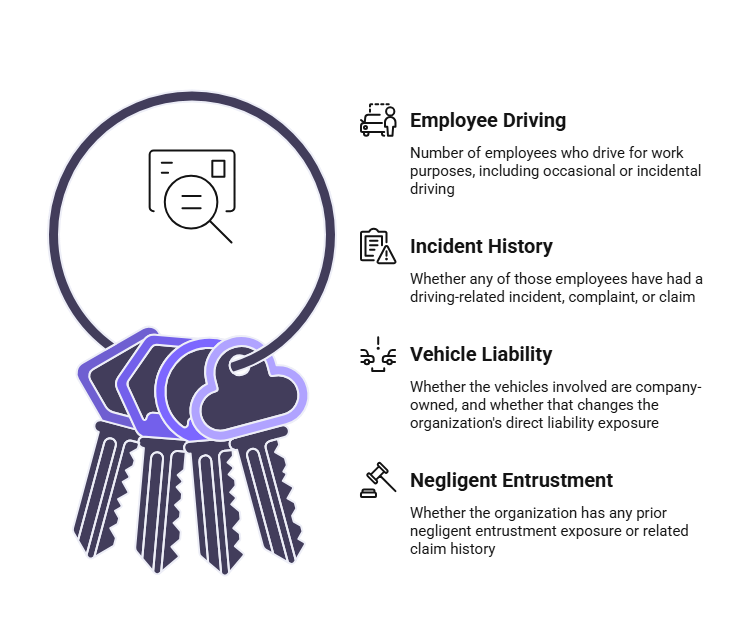
- Number of employees who drive for work purposes, including occasional or incidental driving
- Whether any of those employees have had a driving-related incident, complaint, or claim
- Whether the vehicles involved are company-owned, and whether that changes the organization’s direct liability exposure
- Whether the organization has any prior negligent entrustment exposure or related claim history
This category covers a wider range of organizations than the “driver monitoring” label usually suggests. A field sales team using personal vehicles for client visits, a home health agency whose staff drive between patient homes, and a small office that occasionally sends someone on an airport run all fall here, none of them CDL-covered, state-mandated, or carrier-conditioned, yet all of them technically employing people who drive on the organization’s behalf.
None of these factors are legal requirements in themselves. They are the practical inputs to a genuine cost-benefit decision, and a reasonable answer for one organization can be entirely different for another with a similar headcount.
A Simple Framework to Decide
Rather than treating “do we need this” as a single yes-or-no question, it helps to work through it as a short sequence, since each answer changes what the right next step actually is.
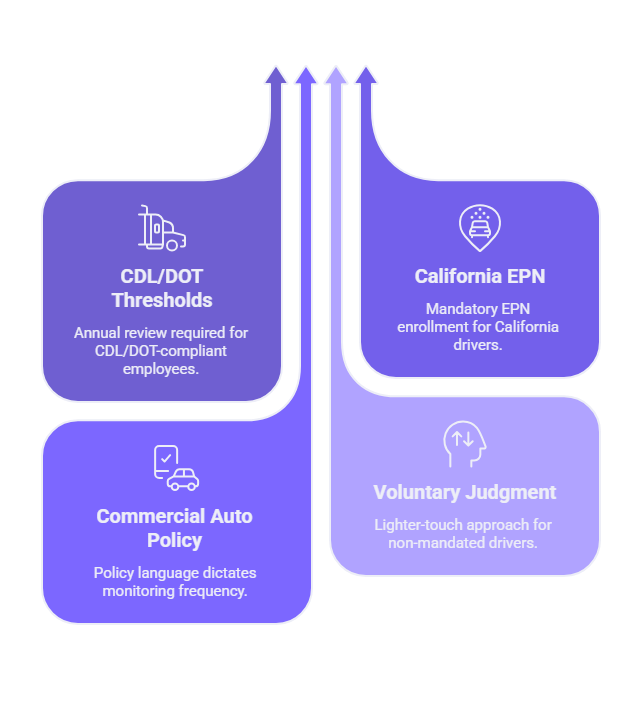
- Do any employees hold a CDL or operate a vehicle meeting federal DOT thresholds? If yes, the annual review requirement applies at minimum, regardless of company size.
- Does the organization operate in California with drivers meeting the Vehicle Code’s mandatory-enrollment categories? If yes, EPN enrollment is a statutory obligation, not a choice.
- Does the commercial auto policy condition coverage or pricing on monitoring frequency? If yes, that policy language sets the actual requirement, independent of any law.
- Do employees drive for work without any of the above applying? This is where the voluntary judgment call in the previous section applies, and the honest answer for many organizations is that a lighter-touch approach is enough for now.
Working through these in order avoids the two most common mistakes: assuming a full continuous monitoring program is legally required when it is not, and assuming no obligation exists at all when a state statute or policy condition already applies.
| Category | What Applies | Where to Confirm It |
| Federally covered drivers | Annual review minimum, method flexible | 49 CFR 391.25 |
| California statutory categories | Mandatory EPN enrollment | CVC Section 1808.1 |
| Insurance-conditioned | Policy-specific monitoring requirement | Your carrier’s underwriting terms |
| Everyone else | Voluntary risk decision | Your own incident history and exposure |
Why This Gets Confused with Continuous MVR Monitoring
Part of why “is this required” is hard to answer is that the word “monitoring” gets used for two different things in this space, and articles about one are often mistaken for guidance on the other. Continuous MVR monitoring, covered in depth elsewhere on this site, refers to the technical practice of checking a driver’s record more frequently than an annual pull, regardless of whether any law requires it. This article is answering a different question: whether some form of ongoing record-checking is required at all, and if so, by what authority.
An employer can be in the legally-required category described above and still choose a lighter monitoring frequency than continuous monitoring, so long as it meets the applicable minimum, whether that minimum is the federal annual review or California’s EPN enrollment terms. Conversely, an employer with no legal or contractual obligation at all can still choose to run continuous monitoring voluntarily, simply because the cost-benefit analysis favors it once fleet size or risk exposure grows. The requirement question and the frequency question are related but genuinely separate decisions, and conflating them is a common source of over-buying or under-buying relative to what an organization actually needs.
A concrete illustration: a small regional distributor with five CDL drivers is legally required to review each driver’s record annually under federal rules, full stop. Whether that distributor satisfies the requirement with a once-a-year manual pull or upgrades to a monthly continuous monitoring service is a separate, voluntary decision layered on top of the legal floor, driven by the same cost-benefit factors described in the voluntary-category section above, not by any additional legal requirement to monitor more frequently than annually.
What “You Probably Don’t Need One Yet” Looks Like
For organizations that land in the voluntary category with no prior incidents and a small number of occasional drivers, a formal continuous monitoring program is not always the right first step. A periodic manual MVR check, timed to coincide with an annual review or a role change, is a reasonable starting point for an organization at this stage, though the right cadence for a specific organization depends on its own risk profile and is worth confirming with legal or insurance counsel rather than treating as a fixed rule.
The honest signal to revisit that decision is a change in the underlying facts, not a fixed calendar date:
- A new insurance policy with different monitoring terms
- A driving-related incident, complaint, or claim involving any employee
- A shift toward higher-mileage or higher-risk driving roles
- Meaningful growth in the number of employees who drive regularly for work
Any of these changes the inputs from the previous section’s framework, and it’s worth re-running the same four questions rather than assuming the original answer still holds.
This is also where the difference between “voluntary” and “unimportant” matters. An organization that reasonably decides it doesn’t need a formal program yet still has employees driving on its behalf, and it is worth having a simple, written point of view on what would trigger a reassessment, rather than defaulting to no plan at all.
The Same Obligations Apply Either Way
Whichever category an organization falls into, the underlying legal obligations around notifying and authorizing the driver do not change. A driver enrolled under a state-mandated program, an insurance-driven program, or a voluntary internal decision is entitled to the same clarity about what is being checked and why, and that clarity has specific legal shape rather than being a matter of general courtesy: accessing a driver’s motor vehicle record at all requires a permissible purpose under the Driver’s Privacy Protection Act, and when that record is procured through a consumer reporting agency for employment purposes, the FCRA requires a standalone written disclosure and the driver’s written authorization before the report is obtained.
This matters because monitoring decisions are sometimes framed purely as a liability question, with the driver treated as a line item in that calculation rather than a person entitled to a straightforward explanation and the specific legal protections described above. Whatever category applies to an organization, the driver being enrolled is entitled to more than an informal heads-up, and GCheck’s coverage of how driver monitoring actually works goes into the mechanics an organization can point to when meeting that obligation.
Frequently Asked Questions
Is driver monitoring legally required for all employers with driving employees?
No. It is legally required for employers with CDL or federally covered commercial drivers, and in California, for employers with drivers meeting the state’s statutory mandatory-enrollment categories. Outside of those situations, it is either insurance-driven or a voluntary risk decision.
Does the federal annual MVR review requirement mean I need continuous monitoring?
No. The federal requirement sets a minimum review frequency of once every twelve months for covered commercial drivers. It does not require continuous or automated monitoring specifically; an employer can satisfy it with a manual annual pull.
What makes California different from other states?
California’s Vehicle Code requires certain employers to enroll specific driver categories, including CDL holders and certain passenger or hazmat endorsements, in the state’s Employer Pull Notice program. Most other states offer similar notification systems on a voluntary subscription basis rather than a statutory mandate.
Can my insurance policy require driver monitoring even if no law does?
Yes. Commercial auto insurance carriers can condition coverage terms or pricing on maintaining driver monitoring, and that contractual requirement applies independently of whatever state or federal law requires.
How do I know if I’m in the voluntary category?
If no employees hold a CDL or operate a federally covered vehicle, your state has no mandatory-enrollment statute that applies to your drivers, and your insurance policy does not condition coverage on monitoring, the decision is a voluntary risk-management judgment call based on your actual driver exposure and incident history.
What should an organization do if it decides it doesn’t need a formal program yet?
A periodic manual MVR check tied to hire or role changes is a reasonable starting point for a small, low-risk driver population, though the right approach depends on the organization’s specific risk profile. The decision should be revisited if the insurance policy changes, an incident occurs, or the number or role of driving employees grows.
Sources cited
- California Department of Motor Vehicles, Employer Pull Notice (EPN) Program, https://www.dmv.ca.gov/portal/vehicle-industry-services/motor-carrier-services-mcs/employer-pull-notice-epn-program/
- California Vehicle Code Section 1808.1, official text via California Legislative Information, https://leginfo.legislature.ca.gov/faces/codes_displaySection.xhtml?lawCode=VEH§ionNum=1808.1
- Federal Motor Carrier Safety Administration, 49 CFR 391.25, Annual Inquiry and Review of Driving Record, https://www.fmcsa.dot.gov/regulations/title49/section/391.25
- 49 CFR 390.5, Definitions (commercial motor vehicle thresholds), https://www.ecfr.gov/current/title-49/subtitle-B/chapter-III/subchapter-B/part-390/subpart-A/section-390.5
- Federal Register, Driver Qualifications: Regulatory Guidance Concerning the Use of Computerized Employer Notification Systems, https://www.federalregister.gov/documents/2015/03/12/2015-05645/driver-qualifications-regulatory-guidance-concerning-the-use-of-computerized-employer-notification
- Oklahoma Administrative Code, Title 260, Chapter 135, Driver Status Notification System, https://regulations.justia.com/states/oklahoma/title-260/chapter-135/subchapter-5/part-35/section-260-135-5-217
- Indiana Bureau of Motor Vehicles, Employer Notification System FAQs, https://www.in.gov/bmv/ens/faqs/

ABOUT THE CREATOR
Charm Paz, CHRP
Recruiter & Editor
Charm Paz is an HR professional at GCheck, specializing in background screening, fair hiring, and regulatory compliance. She holds from the Professional Background Screening Association (PBSA) and helps organizations navigate employment regulations with clarity and confidence.
With a background in Industrial and Organizational Psychology, she translates policy into practice to build ethical, compliant, human-centered hiring systems that strengthen decision-making over time.