

Driver monitoring works by connecting an enrolled driver’s state DMV record to an employer’s alert system, so a suspension, conviction, or new violation is reported after it appears in state records rather than at the next scheduled check. The speed of that alert depends on how the state delivers the update, not on the software running the monitoring program.
Key Takeaways
- Driver monitoring is not real time. It reflects state DMV processing speed plus how that state delivers updates: automatic push, daily batch file, or scheduled pull.
- States use one of three delivery models: formal push notification programs, batch file transfers processed on a fixed daily schedule, or periodic pull requests on a set cadence.
- How quickly a violation posts at all depends heavily on how digitized the reporting state’s own court and DMV systems are, independent of any monitoring provider.
- Out-of-state violations take longer to appear because they depend on two separate interstate agreements: the Driver License Compact and the Nonresident Violator Compact.
- Identity validation confirms a record change belongs to the enrolled driver before an alert is sent, protecting the driver from clerical mismatches as much as it protects the employer.
- The FMCSA Drug and Alcohol Clearinghouse is a separate federal system from state MVR monitoring. It tracks drug and alcohol program violations only; it does not track license suspensions or moving violations.
- The commonly cited “24 to 72 hour” detection window describes state processing and delivery speed. No monitoring technology can compress a delay that originates at the courthouse or DMV counter.
- Driver monitoring is not GPS tracking or vehicle telematics. It checks official state records that already exist; it does not observe a driver’s location or behavior in the vehicle.
What Actually Triggers a Record Change
A driver’s motor vehicle record does not update the moment an officer writes a citation. It updates only after that citation moves through a chain of administrative steps, and each step in that chain runs on its own timeline, set by the relevant court or agency rather than by any monitoring provider.
The Citation-to-Conviction Chain
A traffic stop produces a citation. That citation then gets adjudicated, either through a court appearance, a plea, or a default judgment if the driver never responds, and each of those paths takes a different amount of time depending on court scheduling and whether the driver contests the charge. Once adjudicated, the court transmits the conviction to the state DMV.
The DMV then processes that conviction and posts it to the driver’s official record. Only after that posting does any monitoring system, state-run or private, have anything to detect. A citation that sits in a backlogged court docket for weeks will not reach a driver’s record any faster because a monitoring program is watching for it.
Events That Skip the Court Step
Some events bypass most of this chain entirely. A DUI arrest that triggers an administrative license suspension is often processed directly by the DMV through administrative license suspension procedures, which run separately from and faster than the criminal case, rather than waiting on a full court disposition. This is one reason DUI-related suspensions tend to post faster than a contested moving violation working through a crowded docket.
Medical certificate expirations for commercial drivers follow a different track still. The DMV administers those directly, with no court step involved, so they post on a predictable, calendar-driven schedule rather than an unpredictable one tied to how quickly a court clears its cases.
| Event Type | Typical Path | Relative Speed |
| DUI / administrative suspension | Often processed directly by DMV | Faster |
| Contested moving violation | Court adjudication, then DMV posting | Slower, docket-dependent |
| Medical certificate expiration (CDL) | Administered directly by DMV | Predictable, scheduled |
| Out-of-state violation | Compact reporting, then home-state posting | Slowest |
This table matters because “driver monitoring” is frequently described as though it happens in real time. It does not. It happens as fast as the underlying state record is updated, and no monitoring technology, however advanced, can outrun that.
Why the Same Violation Posts at Different Speeds in Different States
Two drivers can commit an identical violation on the same day in two different states and have that violation appear on their MVR weeks apart. The reason has little to do with the offense itself and much to do with how digitized each state’s reporting infrastructure is.
Some states run fully electronic court-to-DMV transmission, where a conviction posts to the driver record within days of adjudication. Others still rely on courts transmitting paper records or batch data files to the DMV on a less frequent schedule, which adds a layer of delay before the record even exists in a form any monitoring program, state-run or private, can detect. This variation is a known characteristic of state traffic-records systems generally, not a defect specific to any single monitoring approach.
For an employer operating drivers across multiple states, this means the same monitoring program can appear highly responsive in one state and noticeably slower in another, purely as a function of that state’s own back-end infrastructure. No amount of provider-side technology changes what a state has already decided to build.
How the Record Reaches an Employer
Once a state posts a change to a driver’s record, that information has to travel from the DMV’s database to the employer who needs to see it. States handle this delivery in one of three structurally different ways, and knowing which one applies to a given state explains most of the variation in how fast a monitoring program appears to be.
Push-Based Notification Programs
A number of states run formal employer notification programs that push updates to enrolled accounts as events occur, rather than waiting for the employer to ask. California’s Employer Pull Notice (EPN) program is a documented example: employers enroll specific drivers under a requester code, and the state then delivers a report automatically whenever an enrolled driver has a new conviction, suspension, or collision on record, in addition to an automatic annual report for every enrolled driver.
New York runs a comparable system called the License Event Notification Service (LENS), and New Jersey’s Motor Vehicle Commission operates a similar program under its Customer Abstract Information Retrieval system. In each case, the trigger for notification is the underlying event itself, not a calendar date, which is what distinguishes a push-based program from a periodic one.
Batch File Transfer
Even within a push-based program, the technical delivery mechanism is often a scheduled batch job rather than a live feed. California’s EPN system, for example, documents that its secure file transfer server processes inbound and outbound files once per day. If a provider submits more than one file with the same name in a single day, the second submission overwrites the first rather than queuing behind it.
That single daily processing window is a concrete, technical reason “real time” is the wrong way to describe most driver monitoring. “Same day to a few days” is the accurate description, and it holds even for states with the most automated notification programs.
Periodic Pull Requests
States that do not run a formal push notification program require the employer, or a monitoring provider acting on the employer’s behalf, to request the record on a set schedule: monthly, quarterly, or whatever cadence the program is built around. This is functionally closer to running repeated point-in-time checks than to monitoring in the continuous sense, even when it is marketed as continuous monitoring.
The frequency of the pull, not any underlying technology, determines how quickly a violation is caught under this model. A monthly pull schedule and a quarterly pull schedule produce meaningfully different detection windows even when both use identical software.
| Delivery Model | How It Works | Typical Detection Window |
| Push notification | State reports automatically when a qualifying event posts | Same day to a few days |
| Batch file transfer | Updates processed on a fixed daily schedule | One to two business days |
| Periodic pull | Provider requests the record on a set cadence | Determined by cadence (weekly, monthly, quarterly) |
Why Interstate Violations Take Longer
A driver’s home-state record does not automatically reflect a violation committed in another state. That connection depends on two separate interstate agreements, and not every state belongs to both, which is a detail that changes how completely a monitoring program can see a driver’s out-of-state activity.
The Driver License Compact
The Driver License Compact governs how a conviction, particularly serious offenses like DUI and reckless driving, gets reported from the state where it occurred back to the driver’s home state, under the shared principle of “one driver, one license, one record.” Member states agree to treat a qualifying out-of-state conviction as though it happened at home, applying home-state penalties once the record arrives.
Not every state participates, and the compact generally does not cover minor, non-moving offenses. A driver’s home state only acts on what the compact actually transmits, which means the compact’s scope, not the monitoring program’s capability, sets the outer limit of what can be detected this way.
The Nonresident Violator Compact
The Nonresident Violator Compact operates alongside the Driver License Compact and covers a broader range of moving violations and unpaid tickets, including citations a driver might otherwise ignore simply by leaving the state where it was issued. Because these are two distinct compacts with different member rosters, a violation covered promptly under one may not be covered by the other.
Each hop across this chain adds processing time on top of the citation-to-conviction delay already described. A speeding ticket received during a business trip in another state has to clear that state’s own court and DMV processing, then cross the applicable compact reporting channel to the home state, then post to the home-state record, before any home-state monitoring program has anything to detect.
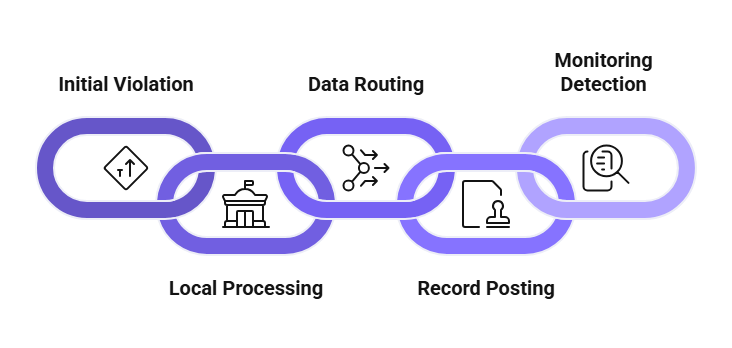
- A violation occurs in a non-home state.
- That state’s court and DMV process the violation locally first.
- The violation routes to the home state through the Driver License Compact, the Nonresident Violator Compact, or both, depending on offense type and state membership.
- The home state posts the violation to the driver’s official record.
- Only then can any monitoring program, push or pull, detect the change.
This chain is one of the more common reasons a monitoring program appears to have “missed” something. In most cases, the violation had simply not yet reached the record the program was watching.
What Identity Validation Actually Checks
An alert is only useful if it belongs to the right driver. Before a monitoring program notifies an employer, a validation step confirms that a record change matches the specific enrolled individual rather than someone with a similar name or an overlapping license number.
This step exists as much for the driver as for the employer. State driver records span decades-deep databases maintained across county courts, DMV field offices, and multiple reporting systems, and clerical mismatches happen: a transposed digit in a license number, a shared name paired with a near-matching date of birth, or an out-of-state record attributed to the wrong placeholder identifier used for non-resident license holders. A monitoring program that skips this step and reports raw record changes risks flagging a driver for a violation that was never theirs, which can trigger an unwarranted suspension review or an adverse action process built on a data error rather than a real event.
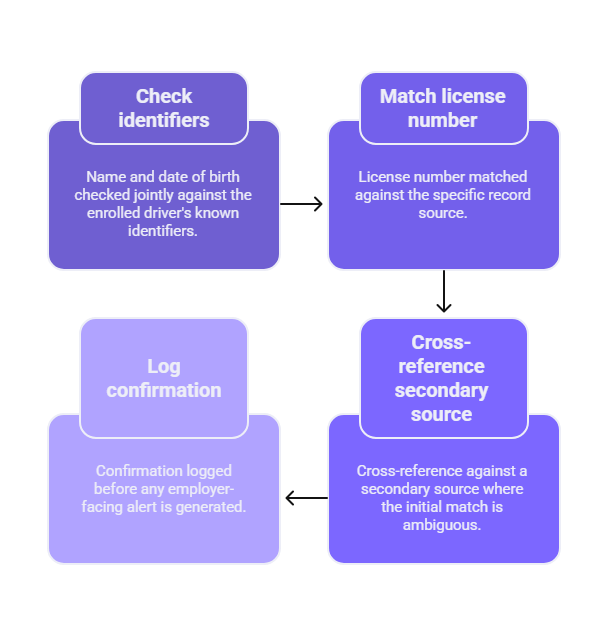
- Name and date of birth checked jointly against the enrolled driver’s known identifiers
- License number matched against the specific record source
- Cross-reference against a secondary source where the initial match is ambiguous
- Confirmation logged before any employer-facing alert is generated
Validating identity before alerting reduces the risk of exactly the outcome described above, not only for the employer acting on bad information, but for the driver as well. It is a deliberate pause built into the pipeline, not a delay caused by inefficiency. It is also worth being clear about what an alert is not: an alert is the start of an internal review, not an adverse decision on its own, and any adverse action that follows still must go through the FCRA’s required pre-adverse and final adverse action notice sequence.
How CDL Monitoring Differs: The FMCSA Clearinghouse
Commercial drivers subject to FMCSA drug and alcohol testing rules sit inside a separate, federally run system that works differently from state MVR monitoring, and the two are frequently confused. The FMCSA Drug and Alcohol Clearinghouse is a single federal database of drug and alcohol program violations for CDL holders, and employers query it, with driver consent, before hire and at least annually thereafter.
Since March 2023, FMCSA has also notified an employer if a driver they previously queried has new information, such as a new violation, an updated return-to-duty status, or a removed violation, recorded within twelve months of that query. Completing that follow-on query resets the twelve-month clock. This is closer to an alert model than state MVR checks traditionally were, but its scope is narrow: it only covers drug and alcohol program violations, not license suspensions, moving violations, or accidents.
| System | What It Tracks | Notification Trigger |
| FMCSA Clearinghouse | Drug and alcohol program violations (CDL holders) | Query-based, plus 12-month follow-up notice |
| State MVR monitoring | License status, moving violations, accidents | Push, batch, or periodic pull, depending on state |
A CDL driver’s full risk picture requires both systems running in parallel. Neither one substitutes for the other, and a program built on only one leaves a real gap in what an employer can actually see.
What “24 to 72 Hours” Actually Means
Vendor descriptions of driver monitoring often cite a detection window like 24 to 72 hours without explaining what that figure represents. Given the mechanics above, that window is the combination of state DMV processing speed after adjudication, plus the delivery model that state runs, whether push notification, daily batch file, or scheduled pull.
It is not a measure of how quickly a provider’s software reacts to a road event, because no provider has visibility into a road event until the state has already posted a record of it. Faster technology cannot compress a delay that originates at the courthouse or the DMV counter, which is why even the fastest monitoring program still runs on a same-day-to-several-day cycle rather than a genuinely instantaneous one.
Driver Monitoring Is Not Vehicle Telematics
It is worth stating plainly: driver monitoring in this sense checks official state driving records after the fact. It has nothing to do with GPS tracking, dash cameras, or in-vehicle telematics that observe how a driver operates a vehicle in the moment. The data source here is a public record maintained by a government agency, not a live feed of the driver’s location or behavior behind the wheel. Access to that record is governed by the Driver’s Privacy Protection Act’s permissible-purpose framework, and, when the record is obtained through a consumer reporting agency for employment screening, by the FCRA’s separate disclosure and authorization requirements. The two frameworks are related but distinct, and neither one applies to GPS or telematics data at all.
Conflating the two is a common source of confusion, and it is worth separating clearly, since the compliance obligations, consent requirements, and privacy considerations for each are entirely different.
Frequently Asked Questions
Is driver monitoring real time?
No. Detection speed depends on how quickly a state posts a record after adjudication and whether that state pushes updates, delivers them in a daily batch, or requires a periodic pull. Most programs operate on a same-day-to-several-day cycle, not an instant one.
How does an employer actually receive a driver monitoring alert?
Through one of three models: a state-run push notification program that reports automatically when an enrolled driver’s record changes, a batch file transfer that a monitoring provider processes on a scheduled basis, or a periodic pull request the provider submits to the state on the employer’s behalf.
Why do out-of-state violations take longer to show up?
Because they depend on the Driver License Compact and the Nonresident Violator Compact to route the violation from the state where it occurred back to the driver’s home-state record. Not every state belongs to both compacts, and each hop adds processing time.
What does identity validation check before an alert is sent?
It confirms the record change matches the enrolled driver’s name, date of birth, and license number, protecting against DMV clerical errors or near-identical identities being attributed to the wrong person before any action is taken.
How is the FMCSA Clearinghouse different from state MVR monitoring?
The Clearinghouse tracks drug and alcohol program violations for CDL holders under a federal query-and-notification system. State MVR monitoring tracks license status, moving violations, and accidents. A complete picture for a commercial driver requires both.
Is driver monitoring the same as GPS or telematics tracking?
No. Driver monitoring checks official state driving records that already exist. It does not involve tracking a vehicle’s location or observing driving behavior in real time.
Sources cited
- California Department of Motor Vehicles, Employer Pull Notice (EPN) Program, https://www.dmv.ca.gov/portal/vehicle-industry-services/motor-carrier-services-mcs/employer-pull-notice-epn-program/
- California Department of Motor Vehicles, Secure File Transfer Frequently Asked Questions, https://www.dmv.ca.gov/portal/dmv?1dmy=&urile=wcm%3Apath%3A%2Fdmv_content_en%2Fdmv%2Fotherser%2Fcra%2Fsft_faq
- New York State Department of Motor Vehicles, License Event Notification Service (LENS), https://dmv.ny.gov/records/license-event-notification-service-lens
- New Jersey Motor Vehicle Commission, Customer Abstract Information Retrieval (CAIR) Program, https://www.nj.gov/mvc/business/cair.htm
- Council of State Governments, National Center for Interstate Compacts, Driver License Compact, https://compacts.csg.org/compact/driver-license-compact/
- American Association of Motor Vehicle Administrators, Driver License Compact / Non-Resident Violator Compact, https://www.aamva.org/topics/driver-license-compact
- Federal Motor Carrier Safety Administration, Drug and Alcohol Clearinghouse, Queries and Consent Requests FAQ, https://clearinghouse.fmcsa.dot.gov/FAQ/Topics/Queries-Consent-Requests
- National Highway Traffic Safety Administration, State Traffic Safety Information, https://www.nhtsa.gov/state-traffic-safety-information

ABOUT THE CREATOR
Charm Paz, CHRP
Recruiter & Editor
Charm Paz is an HR professional at GCheck, specializing in background screening, fair hiring, and regulatory compliance. She holds from the Professional Background Screening Association (PBSA) and helps organizations navigate employment regulations with clarity and confidence.
With a background in Industrial and Organizational Psychology, she translates policy into practice to build ethical, compliant, human-centered hiring systems that strengthen decision-making over time.