

Continuous monitoring for retail employees is an automated, consented background-screening service that rescans criminal, driving, or sanctions records for specific employees after hire and alerts the employer when a new record appears. It is not activity surveillance or performance tracking software. For retail, it fits asset protection, cash handling, and management roles, not the sales floor broadly.
Key Takeaways
- Continuous monitoring is a compliance service, not workplace surveillance. It rescans public records for consented employees; it does not track what anyone does on shift.
- A pre-hire background check is a snapshot. The value of that snapshot erodes the longer an employee stays, which is the entire reason ongoing monitoring exists.
- Retail’s case for continuous monitoring is role-specific: asset protection, cash-handling, and management positions carry a stronger justification than entry-level sales or seasonal floor roles.
- The FCRA allows a single “evergreen” consent to cover monitoring throughout employment, but only if the disclosure says so clearly. Some states add their own requirements on top of that, so multi-state programs should never rely on one national form without checking state law.
- An alert is a lead, not a verdict. Any employment action based on one still requires the same pre-adverse and adverse action steps as a pre-hire check, plus an individualized look at the underlying record.
What Continuous Monitoring for Retail Employees Is, and What It Isn’t
Continuous monitoring is a post-hire screening service that automatically rescans criminal, motor vehicle, or sanctions databases for a specific, consented employee at defined intervals, and sends an alert when a new record surfaces. It differs from a one-time pre-employment background check in one way: timing. A pre-hire check captures a candidate’s record on a single day. Continuous monitoring keeps watching that same category of record for as long as the employee is enrolled.
It is worth naming clearly what continuous monitoring is not, because the search results for this exact phrase are split between two unrelated topics. One is background-screening compliance, the subject of this article. The other is workplace activity monitoring: point-of-sale transaction tracking, camera systems, and software that logs what an employee does during a shift. Those tools solve a different problem and carry different legal and workplace-trust considerations. Continuous criminal monitoring only touches the same categories of public record an employer already had permission to check at hire. It does not watch behavior on the clock.
The distinction matters because framing this as surveillance would misrepresent what the service actually does and would undercut the reason retailers use it: protecting coworkers, customers, and company assets, not watching individual workers with suspicion. This is Protective Compliance in practice: safeguarding the people and assets at stake in a retail environment while keeping human judgment over any automated flag.
Why a Point-in-Time Check Isn’t Enough
A background check answers one question: what did the public record show on the day it was pulled. It says nothing about what happens afterward. An employee hired with a clean record can pick up a new arrest eighteen months into the job, and a one-time check will never reflect that unless the employer re-checks.
Think of a background check’s usefulness as something that erodes with time rather than something that holds steady. The report gets less representative of a person’s current status the further you get from the date it was run. GCheck’s Shadow Workforce research frames this erosion conceptually as a verification half-life: the value of any single verification decays the longer it sits unrefreshed. Retail hiring is a useful case study for this because turnover is high, tenure varies widely by role, and the roles with the most financial exposure, store managers, cash-office staff, loss prevention, often stay in place the longest, which is exactly when a stale check does the most harm.
Continuous monitoring and periodic rescreening are the two tools that address this decay. GCheck has covered the mechanical differences between them in detail elsewhere; the short version is that continuous monitoring watches in near real time between scheduled checks, while rescreening repeats a full check on a set calendar. The question retail employers actually need answered is which roles justify either one, addressed next.
Which Retail Roles Justify Continuous Monitoring
Not every retail position carries the same post-hire risk profile, and treating continuous monitoring as a blanket policy across an entire workforce is both an unnecessary cost and a framing problem. The stronger, more defensible position scopes monitoring to roles where ongoing access to cash, inventory, or sensitive systems creates real exposure.
| Role category | Post-hire risk profile | Recommended approach |
| Asset protection and loss prevention | Ongoing access to surveillance systems, incident data, and investigation authority | Continuous criminal monitoring |
| Store manager, assistant manager, cash-office staff | Unsupervised access to safes, deposits, and point-of-sale overrides | Continuous criminal monitoring |
| District and regional management | Oversight across multiple locations and financial reporting | Continuous criminal monitoring |
| Delivery driver, fleet-adjacent roles | Vehicle operation and public road exposure | Continuous MVR monitoring |
| Entry-level sales associate, seasonal stock or merchandising | Limited financial or systems access, short average tenure | Periodic rescreening or pre-hire check alone |
This scoping does two things at once. It puts continuous monitoring where the risk actually sits, and it avoids the appearance of monitoring an entire hourly workforce by default, which would run against a worker-as-protagonist stance and would read as surveillance rather than protection. A retailer rolling out a program should document the role-based criteria in writing, both for consistency across locations and because a documented, job-related rationale is exactly what supports the program if it is ever challenged.
A useful test when deciding whether a role belongs on the monitoring list: does the position carry standing, ongoing access to cash, inventory, or systems where a new criminal record would materially change how much that access should be trusted. A cash-office lead with signature authority on deposits meets that test. A seasonal associate stocking shelves for eight weeks generally does not.
What the FCRA Requires Before Monitoring Starts
The Fair Credit Reporting Act treats a report obtained during employment the same way it treats a pre-hire report: as a consumer report subject to disclosure, consent, and adverse action rules. The Federal Trade Commission’s own guidance for employers is direct on this point. Before an employer can obtain any consumer report, it must give the applicant or employee a standalone written disclosure and get written permission, and if the employer wants that permission to extend to reports obtained throughout the person’s employment, the notice needs to say so clearly (FTC, Using Consumer Reports: What Employers Need to Know, 15 U.S.C. § 1681b(b)).
Employers must also certify to the consumer reporting agency, before obtaining any report, that they gave proper notice and got permission, that they will comply with FCRA requirements, and that they will not misuse the information in a way that violates federal or state equal opportunity law (FTC, Using Consumer Reports: What Employers Need to Know). This certification applies to a continuous monitoring report the same way it applies to a pre-hire report.
In practice, this means a consent form written only for a pre-employment check does not automatically stretch to cover ongoing monitoring. Retail employers rolling out a continuous monitoring program for the first time should either build “throughout employment” language into new-hire disclosures going forward, or issue a fresh disclosure and authorization to any current employees being enrolled. A monitoring program built on top of old, narrowly worded consent forms is a compliance gap waiting to surface, not a technicality.
What Happens When an Alert Surfaces a New Record
An alert is information, not a decision. The same two-step adverse action process that applies to a pre-hire check applies here: before any employment action, the employer must give the employee a copy of the report and the FCRA Summary of Rights, and after taking the action, must notify the employee of the reporting company’s contact information and the right to dispute the report (FTC, Using Consumer Reports: What Employers Need to Know, 15 U.S.C. § 1681m(a)).
There is a second layer worth building into the process alongside the FCRA steps: an individualized look at what the new record actually means for the role. The EEOC’s enforcement guidance on arrest and conviction records, while written primarily for hiring decisions, lays out a framework that applies by extension to a post-hire alert: consider the nature of the offense, how much time has passed, and the nature of the job, then give the employee a chance to respond before treating a screen result as final (EEOC, Enforcement Guidance No. 915.002, Consideration of Arrest and Conviction Records in Employment Decisions Under Title VII, April 25, 2012). A booking record and a conviction are not the same thing, and a new charge unrelated to the employee’s duties calls for a different response than one that goes directly to cash-handling trust. Retail employers should build this individualized review into the workflow before the first alert ever arrives, not while responding to one under time pressure.
A Sample Alert Walkthrough
Consider a store manager enrolled in continuous monitoring because the role carries deposit and safe access. A new arrest surfaces through the monitoring alert: a traffic-related charge unconnected to any financial or workplace conduct. Under the FCRA steps above, the employer provides a copy of the report and the Summary of Rights before considering any action, and gives the manager a reasonable window to respond. Under the individualized-assessment layer, HR or compliance, not the store’s direct supervisor, weighs whether a traffic charge unrelated to cash handling has any real bearing on the specific duties of the role.
In this scenario, the charge alone would rarely justify termination or reassignment, since it has no apparent connection to the job’s core risk of financial trust. Compare that with an alert surfacing a new theft or fraud charge for the same role: the nature of that offense bears directly on the responsibilities the position carries, which changes the weight it deserves in the assessment. The point of walking through both is not to prescribe an outcome for every case, but to show why the same alert type can call for different responses depending on what the underlying record actually says and how closely it relates to the role, which is exactly what an individualized assessment is meant to capture.
State Rules That Change the Picture
Federal rules set the floor, not the ceiling. A number of states layer additional consumer-report requirements on top of the FCRA, covering things like extra disclosures, stricter consent language, or narrower permissible uses, and those requirements do not disappear just because an employer has a national policy in place. California is commonly cited as one of the stricter states in this area, through its own consumer reporting statute (Cal. Civ. Code § 1786 et seq.), but it is an example, not an exhaustive list, and multi-state retailers should treat any state with its own consumer-reporting law as a variable to check rather than assume a single federal-standard consent form covers every location.
The safest approach for a retailer operating in several states is to build state-specific review into the monitoring rollout itself: confirm with counsel, before enrollment begins, which states require anything beyond the FCRA’s disclosure and consent standard, and adjust consent language location by location rather than defaulting to one national form.
Multi-state retailers should also check whether ban-the-box or fair-chance laws in a given state impose their own individualized-assessment or timing requirements that extend past the point of hire. GCheck’s guide to ban-the-box compliance covers that territory in more depth, and the same principle applies here that applies throughout this piece: a program that assumes uniformity across states is the program most likely to have a gap somewhere.
Building a Continuous Monitoring Program Across Multiple Retail Locations
Retail operations rarely run continuous monitoring out of a single, centralized HR function. Store-level managers and regional HR teams often initiate hiring and, without a structured program, could end up applying inconsistent standards for who gets enrolled in ongoing monitoring and who doesn’t. A workable program starts with the role-based criteria described earlier, written down and applied the same way at every location, not left to individual manager discretion.
From there, several operational pieces matter. Enrollment and disclosure need to happen at a defined point, either at hire for roles identified in advance, or at the moment an employee moves into a qualifying role through promotion or transfer. Monitoring data is still a consumer report under the FCRA, not a general HR record, so it should be stored, accessed, and disposed of with the same care and limited access as a pre-hire background check report. Alert review needs a designated owner, typically a compliance or HR contact rather than the store manager who works alongside the employee day to day, so that the individualized assessment step happens with some distance from the situation.
None of this requires abandoning transparency with employees. Telling enrolled staff plainly that certain roles carry ongoing screening, and why, is consistent with treating the program as protective rather than as something to obscure. This is where Transparent Compliance and Protective Compliance work together: employees understand what is being monitored and why, and the program still puts human review ahead of any automated alert rather than letting a flag make the decision on its own. A program built on disclosed, consented, role-specific criteria is also simply easier to defend if it is ever questioned than one applied informally or inconsistently.
Where Enrollment Fits in an ATS-Integrated Hiring Workflow
Many retailers already route hiring through an applicant tracking system, and GCheck integrates with several platforms common in retail hiring, including Fountain, Rippling, Cadient, ADP, and Dayforce. Where that integration exists, enrollment in continuous monitoring can be tied directly to role designation in the ATS, so a candidate hired into a qualifying role is flagged for enrollment automatically rather than relying on someone remembering to add them manually.
This matters most at the promotion and transfer point, which is where manual processes tend to break down. An employee moving from an entry-level role into a cash-office or management position should trigger both the enrollment step and the fresh consent step described earlier, and an ATS-integrated workflow can prompt for both at the moment the role change is recorded rather than leaving it to catch up later.
What a Documented Continuous Monitoring Policy Should Include
A continuous monitoring program is easiest to defend, and easiest to run consistently across locations, when its criteria live in a written policy rather than in the judgment of whoever happens to be hiring at a given store on a given day. The policy doesn’t need to be long, but it does need to answer the same questions the same way every time, regardless of location or which manager is involved.
A documented policy should specify:
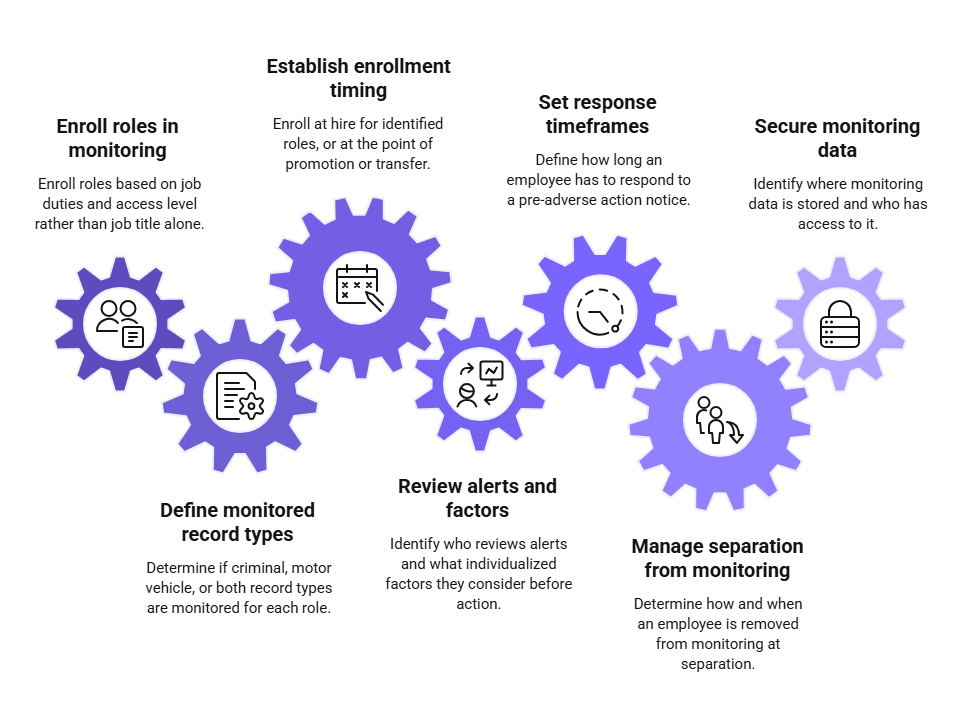
- Which roles are enrolled in continuous monitoring, described by job duties and access level rather than job title alone, since titles vary across banners and regions
- What record types are monitored for each enrolled role, whether criminal, motor vehicle, or both
- When enrollment happens: at hire for roles identified in advance, or at the point of promotion or transfer into a qualifying role
- Who reviews an alert, and what individualized factors that reviewer considers before any employment action
- How long an employee has to respond to a pre-adverse action notice before a final decision is made
- How and when an employee is removed from monitoring at separation
- Where monitoring data is stored and who has access to it
Putting these answers in writing does more than support a legal defense if the program is ever questioned. It also gives every store, regardless of size or region, the same starting point, which is the difference between a program that scales consistently and one that quietly drifts store by store.
Frequently Asked Questions
Is continuous monitoring the same as workplace surveillance?
No. Continuous monitoring rescans public criminal, driving, or sanctions records for a specific consented employee and alerts the employer when something new appears. It does not track behavior on the job, and it is a different service entirely from activity-tracking or camera-based monitoring software.
Which retail employees should be enrolled in continuous monitoring?
Roles with ongoing access to cash, inventory, or financial systems carry the strongest case: asset protection and loss prevention staff, store and cash-office managers, and district or regional management. Entry-level sales and seasonal floor roles are typically better served by a solid pre-hire check and periodic rescreening rather than continuous monitoring.
Do we need new consent to add continuous monitoring for current employees?
In most cases, yes, unless your original hiring disclosure already stated clearly that authorization covered reports throughout employment. If it didn’t, issue a fresh standalone disclosure and get written consent before enrolling current employees.
What has to happen if continuous monitoring flags a new record?
Treat it as a lead, not a decision. Give the employee a copy of the report and the FCRA Summary of Rights before taking any action, allow a reasonable window to respond, and consider the nature of the offense, how much time has passed, and its relevance to the role before making a final decision.
Do state laws change how continuous monitoring works?
Yes, in some states. A number of states add their own consumer-reporting requirements beyond the FCRA, and California is often cited as one of the stricter examples, though not the only one. Multi-state retailers should confirm state-specific requirements with counsel before rolling out a program rather than relying on a single national consent form.
How is continuous monitoring different from annual rescreening?
Rescreening repeats a full background check on a set schedule, such as annually. Continuous monitoring watches designated record types on an ongoing basis between those scheduled checks, so a new record can surface closer to when it actually occurred rather than waiting for the next calendar-based check.

ABOUT THE CREATOR
Charm Paz, CHRP
Recruiter & Editor
Charm Paz is an HR professional at GCheck, specializing in background screening, fair hiring, and regulatory compliance. She holds from the Professional Background Screening Association (PBSA) and helps organizations navigate employment regulations with clarity and confidence.
With a background in Industrial and Organizational Psychology, she translates policy into practice to build ethical, compliant, human-centered hiring systems that strengthen decision-making over time.