

Federal contractors face a compliance environment that most applicant tracking systems were never built for, and the ATS they choose directly affects whether their hiring process holds up under FCRA, FAR, OFCCP, and CMMC scrutiny. We evaluated 10 widely used platforms and scored them across screening integration depth, adverse-action workflow support, E-Verify readiness, OFCCP reporting, and audit trail completeness. The gap between ATS platforms built for regulated federal contractor hiring and those designed primarily for speed or cost savings is wide enough to create real contract risk.
Key Takeaways:
- Federal contractor hiring sits inside a regulatory perimeter that includes FCRA, FAR E-Verify mandates, OFCCP audit requirements, the federal Fair Chance Act, and CMMC cybersecurity obligations. The ATS an organization chooses either supports that perimeter or creates gaps in it.
- Background screening integration comes in three models: native partner integrations, custom API connections, and manual portal processes. Native integrations are the only model that reliably maintains adverse-action timing, consent documentation, and audit trails at scale.
- DCSA reported in January 2026 that foreign intelligence entities are targeting the cleared industrial base through ordinary hiring activities, with resume submissions accounting for 28% of collection attempts. That makes embedded screening controls a national security concern, not just an HR workflow issue.
- Not every popular ATS is built for regulated hiring. Several widely adopted platforms lack OFCCP compliance reporting, E-Verify support, and FCRA adverse-action sequencing, which means federal contractors using them would need significant workarounds to stay audit-ready.
- When evaluating an ATS, federal contractors should weight background screening integration as heavily as candidate experience or AI capabilities. The seven-point framework we outline covers integration models, adverse-action workflows, consent management, E-Verify readiness, OFCCP reporting, ban-the-box configurability, and audit trail completeness.
Federal contractors hiring face a compliance environment that most applicant tracking systems were never designed to handle. Between FCRA adverse-action requirements, FAR-mandated E-Verify enrollment, the federal Fair Chance Act, OFCCP reporting obligations, and CMMC cybersecurity requirements, the ATS an organization uses directly shapes how fast it can hire and how defensible that process is under audit. The best-performing applicant tracking systems for federal contractors are those with mature background screening integrations, built-in compliance workflows, and audit-ready documentation trails.
This article evaluates 10 widely used applicant tracking systems through the lens of background screening integration and compliance readiness for federal contractors.
Why Background Screening Integration Is the Most Underrated ATS Feature for Federal Contractors
Most ATS comparison guides rank platforms on job posting distribution, AI resume parsing, and candidate experience. Those features matter. But for organizations inside the federal contracting compliance stack, the background screening integration model determines whether hiring stays on schedule or stalls.
Federal contractor hiring sits inside a regulatory perimeter that includes FCRA disclosure and adverse-action procedures, E-Verify enrollment within 30 days of contract award under FAR 52.222-54, state and local ban-the-box timing rules, and OFCCP audit documentation. When screening is disconnected from the ATS, compliance gaps multiply. Consent forms get misrouted. Adverse-action steps get skipped. Audit trails fragment across systems. For defense industrial base employers, work-authorization errors on covered contracts can create False Claims Act exposure, not just administrative headaches.
The distinction that separates effective ATS platforms in this space comes down to how background screening is integrated:
- Native marketplace or partner integration: The ATS has a certified connector with screening providers. Orders, consent, status updates, and results flow automatically. This is the gold standard for compliance-heavy environments.
- API and webhook custom integration: The ATS exposes an open API, and the screening provider maintains a custom connection. This works for organizations with technical resources but requires ongoing maintenance.
- Manual export or portal process: The recruiter copies candidate data into a separate screening portal, then manually updates the ATS. This is the riskiest model for federal contractors because it introduces errors into adverse-action timing and consent tracking.
The 10 Applicant Tracking Systems
1. UKG Pro
UKG Pro is an enterprise-grade human capital management suite deployed across large organizations in regulated industries and government contracting. Its recruiting module handles requisition management, candidate tracking, and onboarding within the platform that manages payroll, benefits, and time tracking.
Background screening features: UKG Pro supports native integrations with multiple background screening providers through its marketplace. Screening can be initiated from the candidate record, and results flow back into the system. The platform supports configurable adverse-action workflows and consent management, which is critical for FCRA compliance.
Other relevant features for federal contractors:
- OFCCP and EEO reporting capabilities built into the platform
- E-Verify integration support for FAR-covered contracts
- Role-based access controls for managing sensitive candidate data
- Configurable workflows that can enforce pre-adverse and final adverse-action sequencing
2. Zoho Recruit
Zoho Recruit is a budget-friendly ATS used by staffing agencies and small to mid-sized corporate HR teams, with a free tier and paid plans starting at $25 per user per month.
Background screening features: Zoho Recruit integrates with a limited set of screening providers, including Checkr, through its marketplace. The integrations support initiating checks and receiving basic status updates, but the platform does not offer built-in adverse-action workflow management or robust consent-tracking.
Other relevant features: AI-powered candidate matching through its Zia engine, integration with the broader Zoho ecosystem, customizable hiring pipelines, and multi-channel job posting across 25+ boards.
Limitations for federal contractors: Zoho Recruit lacks OFCCP compliance reporting, E-Verify workflow support, and configurability around federal contractor hiring documentation requirements.
3. NEOGOV
NEOGOV is the market leader in public sector hiring software, serving more than 13,000 government and educational organizations. Its Insight ATS is purpose-built for compliance-intensive workflows in government and government-adjacent hiring.
Background screening features: NEOGOV supports integrations with background screening providers geared toward public sector needs. Screening orders can be triggered from within the hiring workflow, and the platform maintains audit-ready candidate records throughout. Its compliance architecture accounts for layered approval workflows, documentation requirements, and regulatory checkpoints that commercial ATS platforms rarely address.
Other relevant features for federal contractors:
- Built-in EEO and OFCCP compliance reporting
- Supplemental question logic for role-specific qualification screening
- GovernmentJobs.com job board reaching over 20 million public sector job seekers
- Custom approval workflows that mirror government procurement and hiring processes
4. Ashby
Ashby is a fast-growing, analytics-forward ATS popular with venture-backed tech companies, combining applicant tracking, CRM, scheduling, and deep reporting into a single platform with roughly 1,900 customers.
Background screening features: Ashby integrates with Checkr, Sterling, and Certn for background checks. Checks can be triggered from within the interview pipeline, and status updates sync back to the candidate record. Its API-first architecture supports custom integrations with additional providers.
Other relevant features: Industry-leading recruiting analytics, AI-powered workflow automation, built-in scheduling and CRM, and a bias audit partnership with FairNow for AI screening compliance.
Limitations for federal contractors: Ashby does not include OFCCP compliance reporting, E-Verify workflow tools, or multi-layered approval structures. Its screening partner ecosystem is narrower than platforms built for regulated industries.
5. Dayforce
Dayforce (formerly Ceridian) is an enterprise HCM platform running HR, payroll, benefits, workforce management, and talent acquisition on a single database. Its compliance automation makes it a strong fit for organizations operating across multiple jurisdictions.
Background screening features: Dayforce supports native integrations with background screening providers, allowing checks to be ordered and tracked within the talent acquisition workflow. Its compliance engine automatically applies jurisdiction-specific rules for state and local ban-the-box laws. Adverse-action documentation and consent tracking are built into the workflow rather than bolted on.
Other relevant features for federal contractors:
- Real-time payroll and compliance calculations across jurisdictions
- Automated overtime, break, and tax-shift compliance
- Configurable onboarding workflows that connect hiring to I-9 and E-Verify processes
- Continuous compliance monitoring for evolving labor regulations
6. Breezy HR
Breezy HR is a visually oriented ATS designed for mid-sized businesses, offering a free tier and paid plans with drag-and-drop pipeline management, automation, and team collaboration features.
Background screening features: Breezy HR supports basic background check integrations through third-party connectors but does not offer native adverse-action management or compliance workflow tools. Screening is treated as an add-on step rather than an embedded compliance process.
Other relevant features: Touchless candidate screening on paid plans, customizable career pages, automated workflow actions between pipeline stages, and collaborative hiring with scorecards.
Limitations for federal contractors: Breezy HR does not support OFCCP reporting, E-Verify integration, or configurable adverse-action sequencing, creating audit risk in regulated hiring environments.
7. ClearCompany
ClearCompany is a talent management platform that unifies recruiting, onboarding, performance management, employee engagement, and workforce analytics. It has served thousands of organizations since 2004 and is strong in compliance-oriented hiring.
Background screening features: ClearCompany offers native integrations with a broad ecosystem of background screening providers. Screening orders, consent collection, and results are managed within the ATS, creating a continuous audit trail from application through onboarding. The platform supports configurable adverse-action workflows that enforce the pre-adverse notice, waiting period, and final adverse-action steps required under FCRA.
Other relevant features for federal contractors:
- OFCCP and EEO compliance reporting built into the platform
- Configurable ban-the-box and fair-chance timing controls
- Integrated onboarding with I-9 and document management
- AI-powered automation tools for workflow efficiency and candidate screening
8. Manatal
Manatal is an AI-powered ATS popular for its affordability (starting at $15 per user per month) and ease of use, serving organizations across more than 135 countries.
Background screening features: Manatal offers limited screening integrations, primarily through Zapier-based connections or its open API. The platform does not include built-in adverse-action management, consent tracking, or compliance workflow tools specific to U.S. employment law.
Other relevant features: AI candidate scoring, LinkedIn and social media profile enrichment, customizable pipeline automation, and multi-language support.
Limitations for federal contractors: Manatal lacks OFCCP reporting, E-Verify workflow support, and structured adverse-action processes. Organizations in the defense industrial base would face significant compliance gaps without substantial workarounds.
9. SAP SuccessFactors
SAP SuccessFactors is one of the largest enterprise HCM suites globally, used extensively by major defense contractors. Its recruiting module is part of a platform covering the full employee lifecycle, and SAP’s 2025 acquisition of SmartRecruiters further expanded its talent acquisition capabilities.
Background screening features: SAP SuccessFactors supports integrations with enterprise background screening providers through its Integration Suite and partner marketplace. The platform’s compliance architecture is built for organizations operating across multiple countries and regulatory environments. Screening workflows, adverse-action management, and consent documentation can be configured to meet jurisdiction-specific requirements.
Other relevant features for federal contractors:
- OFCCP compliance and affirmative action reporting
- Global talent sourcing across 200+ countries with 46 supported languages
- Role-based access controls aligned with enterprise security requirements
- Integration with SAP’s broader ERP ecosystem for procurement and contract management
10. Teamtailor
Teamtailor is a user-friendly ATS used by more than 10,000 companies globally, known for its clean candidate experience, branded career sites, and 400+ integrations.
Background screening features: Teamtailor offers integrations with select screening providers, but its ecosystem is narrower than enterprise platforms. Background checks are managed as a pipeline stage rather than a deeply integrated compliance workflow, and the platform lacks built-in adverse-action sequencing or FCRA-specific tools.
Other relevant features: Award-winning career site builder, automated candidate nurturing, collaborative team evaluation features, and strong pipeline analytics.
Limitations for federal contractors: Teamtailor does not offer OFCCP compliance reporting, E-Verify integration, or structured compliance workflows for regulated hiring environments.
How to Choose an ATS With Strong Background Screening Features
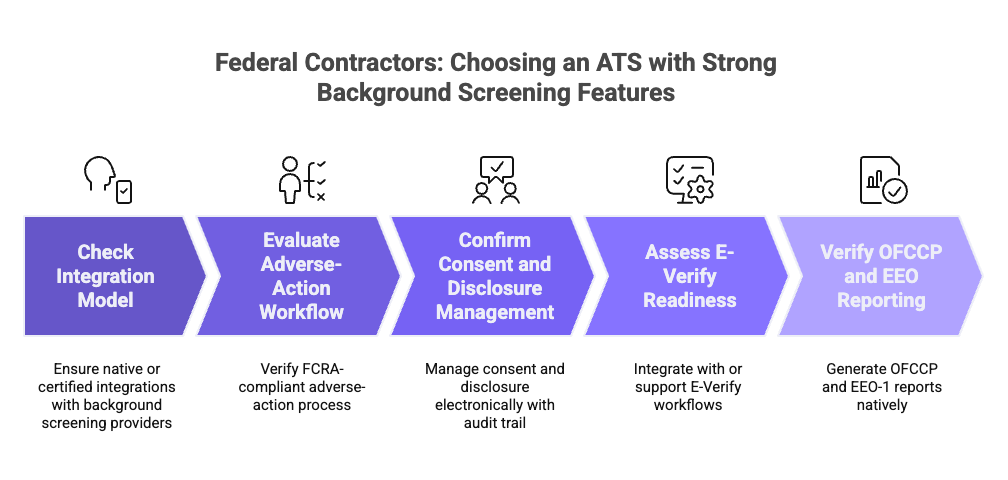
For federal contractors evaluating applicant tracking systems, background screening integration should be weighted as heavily as candidate experience or AI features. Because requirements vary by contract type, jurisdiction, and role sensitivity, the right ATS needs to accommodate that variation rather than force a one-size-fits-all workflow. Here is a framework for evaluating screening readiness:
- Check the integration model. Ask whether the ATS offers native, certified integrations with your preferred background screening provider, or whether you will need a custom API build or manual workaround. Native integrations reduce compliance risk.
- Evaluate adverse-action workflow support. The ATS should enforce FCRA-compliant sequencing: pre-adverse notice accompanied by a copy of the consumer report and a summary of rights, a reasonable waiting period, and a final adverse-action notice. If this process is manual, errors will happen at scale.
- Confirm consent and disclosure management. The platform should manage standalone disclosure delivery and written authorization collection electronically, with a clear audit trail.
- Assess E-Verify readiness. For FAR-covered contracts, the ATS should integrate with or support E-Verify workflows, including tracking which employees are assigned to covered contracts.
- Verify OFCCP and EEO reporting. Federal contractors with 50+ employees and contracts of $50,000+ need affirmative action plans and EEO-1 filing support. The ATS should generate this reporting natively.
- Look for ban-the-box configurability. The federal Fair Chance Act and dozens of state and local laws restrict when criminal history inquiries can occur. The ATS should allow timing controls that adapt to jurisdiction and role, and should support individualized assessment workflows rather than blanket disqualification rules.
- Test audit trail completeness. Every screening-related action (order placed, consent received, report delivered, adverse action initiated) should be time-stamped and retained in a format that can be produced during a compliance audit.
Which ATS Deliver the Strongest Background Screening Ecosystems?
Not all 10 platforms evaluated here are equal when it comes to background screening integration and federal contractor compliance. The scoring below uses a five-point scale across five categories that matter most in regulated hiring.
| Category | UKG Pro | NEOGOV | ClearCompany | Dayforce | SAP SF | Zoho | Breezy | Ashby | Manatal | Teamtailor |
| Screening integration depth | 5 | 4 | 5 | 5 | 5 | 3 | 2 | 3 | 2 | 2 |
| Adverse-action workflow | 5 | 4 | 5 | 5 | 4 | 2 | 2 | 2 | 1 | 2 |
| OFCCP/EEO reporting | 5 | 5 | 5 | 4 | 5 | 1 | 1 | 1 | 1 | 1 |
| E-Verify/I-9 readiness | 4 | 4 | 4 | 5 | 4 | 1 | 1 | 1 | 1 | 1 |
| Audit trail completeness | 5 | 5 | 5 | 5 | 5 | 2 | 2 | 3 | 2 | 2 |
| Total (out of 25) | 24 | 22 | 24 | 24 | 23 | 9 | 8 | 10 | 7 | 8 |
The platforms that score highest share a common trait: background screening is woven into the hiring workflow through native provider integrations, automated compliance sequencing, and documentation that holds up under audit.
UKG Pro, ClearCompany, and Dayforce each deliver broad screening provider ecosystems with built-in adverse-action enforcement and strong OFCCP reporting. NEOGOV brings unmatched public sector compliance architecture. SAP SuccessFactors provides the enterprise scale that large defense primes require.
Ashby and Zoho Recruit are strong where speed and analytics (Ashby) or cost efficiency (Zoho) are the priority. But federal contractors operating inside FCRA, FAR, OFCCP, and CMMC obligations will find those platforms require significant workarounds.
The Compliance Layer Federal Contractors Cannot Afford to Get Wrong
Background screening in the defense industrial base extends well beyond criminal checks. The compliance perimeter now includes E-Verify timing for contract-triggered hires, FCRA adverse-action procedures, federal Fair Chance Act timing restrictions, OFCCP audit documentation, and continuous monitoring for roles involving classified or controlled unclassified information.
DCSA reported in January 2026 that foreign intelligence entities are targeting the cleared industrial base through ordinary business activities, with resume submissions accounting for 28% of reported collection attempts. That finding sharpens the case for embedded screening controls over bolt-on solutions.
Choosing an ATS that treats background screening as a core compliance function is not a preference for federal contractors. It is a contract-readiness decision.
Additional Resources
- SHRM: Federal Contractors Face February 25 Deadline for EEO-1 Release (https://www.shrm.org/topics-tools/employment-law-compliance/federal-contractors-face-february-25-deadline-eeo-1-release)
- FTC: Using Consumer Reports for Employment Decisions (https://www.ftc.gov/business-guidance/resources/using-consumer-reports-what-employers-need-know)
- Acquisition.gov: FAR 52.222-54 E-Verify Requirements (https://www.acquisition.gov/far/52.222-54)
- Federal Register: Federal Fair Chance Act Final Rule (https://www.federalregister.gov/documents/2024/04/29/2024-08981/fair-chance-rule)
- Federal Register: CMMC DFARS Final Rule (https://www.federalregister.gov/documents/2024/10/15/2024-22905/cybersecurity-maturity-model-certification-cmmc-program)
- Mitratech: OFCCP Compliance 101 for Federal Contractors (https://mitratech.com/resource-hub/blog/ofccp-compliance-101-the-ultimate-guide-for-federal-contractors/)
- DOL OFCCP: Federal Contractor Compliance (https://www.dol.gov/agencies/ofccp)

ABOUT THE CREATOR
Charm Paz, CHRP
Recruiter & Editor
Charm Paz is an HR professional at GCheck, specializing in background screening, fair hiring, and regulatory compliance. She holds from the Professional Background Screening Association (PBSA) and helps organizations navigate employment regulations with clarity and confidence.
With a background in Industrial and Organizational Psychology, she translates policy into practice to build ethical, compliant, human-centered hiring systems that strengthen decision-making over time.