

Airport hiring breaks most applicant tracking systems because the real bottleneck is not finding candidates. It is moving them through a post-offer compliance pipeline that includes employer background checks, airport badging, fingerprinting, security clearances, training, and badge issuance before they can legally start work. We ranked 10 ATS platforms on screening ecosystem depth, real-time status visibility, and compliance automation to show which ones are built for this kind of regulated, high-volume hiring and which ones will leave your team manually stitching together workflows that should be seamless.
Key Takeaways:
- The average organization loses roughly 13 days between extending a job offer and completing background screening, and a significant portion of that delay comes from disconnected systems. For airport employers filling ramp, concession, and ground-handling roles during peak travel seasons, those lost days translate directly into unfilled shifts.
- Not all ATS platforms treat background screening as core infrastructure. Several widely adopted platforms score well on recruiting features but rely on manual data transfers, middleware, or custom API work to connect with screening providers, which creates real compliance risk in regulated airport environments.
- The FCRA adverse action process is a multi-step legal obligation that includes pre-adverse notice, a copy of the report, a summary of rights, and a final notice. An ATS that automates these steps with proper timing reduces exposure, but automation supports employer obligations rather than replacing them.
- Federal aviation security rules include mandatory disqualifiers for certain airport-access functions, but that does not override an employer’s responsibility to follow state and local fair-chance laws or EEOC guidance on individualized assessment for employer-side hiring decisions.
- The single most predictive factor when evaluating an ATS for airport hiring is the screening integration pattern. Native marketplace integrations with real-time status syncing outperform manual export workflows by a wide margin, particularly when hiring teams are coordinating background checks, badge readiness, and training completion at the same time.
Airport employers face a hiring problem that no standard applicant tracking system was built to solve. A conditional offer is not a start date. Between the offer and a worker’s first shift on the ramp or near a secured area, the hiring team must coordinate employer-side background checks, airport badging applications, fingerprinting, security threat assessments, SIDA training, and badge issuance. The ATS that handles this best is the one with a screening ecosystem deep enough to keep regulated workflows moving without forcing recruiters to shuttle data across disconnected systems.
This ranking evaluates 10 applicant tracking systems based on how well their screening integrations support compliance-heavy, high-volume airport hiring. Five platforms stand out for mature screening partner networks, automated adverse action workflows, and real-time status visibility. The other five, while popular recruiting tools, fall short in the screening infrastructure that airport-regulated employers need.
Why Background Screening Integration Is the Bottleneck in Airport Hiring
Airport hiring is not slow because recruiters cannot find candidates. It is slow because the post-offer compliance pipeline is fragmented. A ramp agent or concession worker who needs unescorted access to a SIDA zone must clear an employer-ordered FCRA background check, a federally mandated Criminal History Records Check, a Security Threat Assessment, training, and badge issuance before working a single shift. The Philadelphia Department of Aviation noted in 2025 that hiring for airport roles is more demanding than comparable city positions specifically because of the background check and badging process.
Industry data suggests the average organization loses roughly 13 days between extending an offer and completing background screening, with a significant portion of that delay caused by disconnected systems. For airport employers competing for hourly talent while TSA screened a record 904 million passengers in 2024, those lost days translate directly into unfilled shifts.
The applicant tracking systems that perform best in this environment share three characteristics:
- Native or marketplace-level background screening integrations that trigger checks automatically when candidates reach a defined pipeline stage
- Real-time status syncing so recruiters see screening progress without leaving the ATS
- Built-in compliance automation for FCRA adverse action notices (including pre-adverse notice, report copy, summary of rights, and final notice), consent capture, and audit-ready documentation
The 10 Applicant Tracking Systems, Ranked
1. Tenstreet
Best for: Airlines, ground-handling companies, and transportation employers with DOT-regulated roles.
Tenstreet was purpose-built for transportation hiring and operates one of the deepest screening ecosystems in the industry. Its Xpress dashboard lets recruiters order background checks, DOT employment verifications, drug tests, and MVR reports without leaving the platform. The Xchange network returns employment verifications in under one day on average.
- Background screening partners integrated directly into the dashboard
- Electronic chain of custody for drug and physical testing through Pulse MD
- DOT-compliant verification tracking with automated good-faith attempt documentation
- Over 300 total integrations across the platform
Aviation relevance: Airline ground operations, cargo handlers, fuelers, and employers managing DOT-regulated safety-sensitive roles will find Tenstreet’s compliance infrastructure far ahead of generalist platforms.
2. Zoho Recruit
Best for: Small to mid-sized teams that want an affordable, full-featured ATS within the Zoho ecosystem.
Zoho Recruit offers strong general recruiting capabilities, including AI resume parsing, multi-language support, and integration with the broader Zoho product suite. Its free tier makes it accessible to budget-conscious hiring teams. However, its background screening ecosystem is limited. Organizations typically need to build custom integrations using Zoho’s REST API or rely on middleware, and status updates do not automatically sync back to candidate records.
- AI-powered resume screening and candidate matching
- Supports 26 languages with global job board distribution
- Limited native background screening partner marketplace
- Manual export and import often required for screening data
Aviation relevance: Airport employers with regulated screening requirements may find the lack of real-time screening synchronization creates compliance gaps when managing FCRA adverse action timelines across high-volume pipelines.
3. Fountain
Best for: High-volume frontline hiring at airport concessions, ground services, and vendor operations.
Fountain was designed for organizations hiring hundreds or thousands of hourly workers. Its mobile-first platform reduces application drop-off rates, and its workflow automation triggers background checks, I-9 verification, and onboarding steps as candidates move through configurable pipeline stages. Companies using Fountain report time-to-hire reductions of 58% or more.
- Automated background screening triggers at configurable pipeline stages
- I-9 and compliance verification built into onboarding workflows
- Connects to more than 40 systems across HR, scheduling, compliance, and screening
- Mobile-optimized candidate experience with SOC 2 compliance
Aviation relevance: Airport concessionaires, wheelchair service vendors, cleaning contractors, and ground-handling companies hiring at scale can use Fountain’s automated compliance workflows to reduce the gap between conditional offer and badge-readiness.
4. Teamtailor
Best for: Organizations focused on employer branding and candidate experience.
Teamtailor has grown rapidly as a career-site-first ATS with strong visual branding tools. It appeals to companies that want to stand out through polished candidate experiences. Its core strength is attraction and engagement rather than post-offer compliance workflows.
- Drag-and-drop career site builder with strong employer branding
- Basic background check integration capabilities
- Limited compliance automation for adverse action and consent management
Aviation relevance: While Teamtailor supports the attraction side of airport recruiting, hiring teams managing SIDA-environment workflows or multi-step badge-readiness pipelines may need supplemental tools for post-offer screening coordination.
5. NEOGOV
Best for: Airport authorities, port authorities, and public-sector airport operators.
NEOGOV dominates the public-sector hiring space, serving more than 7,000 government organizations. Its Insight ATS is built around civil-service compliance, including configurable approval workflows, EEO reporting, records retention, and audit trails. Its Vetted module handles background investigations for public-sector employers.
- Purpose-built for government and public-sector hiring compliance
- Vetted module for streamlined background investigations
- GovernmentJobs.com reaches more than 20 million public-sector job seekers
- CJIS, SOC 2 Type II, and StateRAMP certified
Aviation relevance: Municipal and county airport authorities that manage badging offices and security programs often operate under civil-service hiring rules. NEOGOV’s compliance architecture aligns directly with the governance requirements of public airport operators.
6. Manatal
Best for: Small recruiting teams and agencies that prioritize AI-powered candidate sourcing on a budget.
Manatal offers AI candidate matching, access to over 600 million profiles, and posting to more than 2,500 job boards, all starting at $15 per user per month. It has gained popularity among recruitment agencies and lean in-house teams. Its screening integration ecosystem, however, relies on manual processes or custom API development.
- AI-driven candidate matching and resume enrichment
- Affordable and transparent pricing
- Minimal native background screening integrations
- No built-in compliance automation for FCRA adverse action
Aviation relevance: The absence of automated screening workflows and compliance tooling makes Manatal a difficult fit for airport hiring where FCRA, EEOC, and badging requirements demand auditable processes.
7. TalentReef
Best for: Multi-location airport vendors, concessionaires, and franchise operators hiring hourly workers.
TalentReef, now part of Mitratech’s HR compliance platform, was built for high-volume hourly hiring across decentralized operations. It serves more than 100,000 locations and integrates with Mitratech’s background screening, I-9 compliance, and E-Verify tools. Its text-to-apply and conversational AI chatbot features reduce friction for hourly applicants.
- Integrated background screening through Mitratech’s compliance platform
- I-9, E-Verify, and WOTC integrations built into onboarding
- 87% application completion rate reported by customers using Fast Apply
- Compliance automation across the candidate lifecycle
Aviation relevance: Airport concession operators, janitorial contractors, retail vendors, and food-service employers operating across multiple airport locations can leverage TalentReef’s unified screening and compliance pipeline to standardize post-offer workflows.
8. Breezy HR
Best for: Startups and small businesses that want a free or low-cost ATS with visual pipeline management.
Breezy HR offers a genuinely useful free tier, an intuitive Kanban-style pipeline, and video assessment features. It is an excellent entry point for small teams. Its background screening workflow, however, relies on manual processes where recruiters copy candidate information into screening vendor portals and manually update records.
- Free Bootstrap plan with core ATS features
- Visual drag-and-drop candidate pipeline
- Background check integrations require manual data transfer
- No real-time screening status synchronization
Aviation relevance: Airport employers managing security-sensitive hiring will find the manual screening workflow a liability. Without automated consent capture and adverse action timing, Breezy HR creates compliance exposure in regulated environments.
9. Avionté
Best for: Staffing agencies placing temporary and contract workers into airport ground-handling, ramp, and cargo roles.
Avionté is an all-in-one staffing platform handling ATS, CRM, payroll, billing, and compliance from a single system of record. Its integration with background screening providers and drug testing services is purpose-built for the staffing workflow, where the agency manages candidate screening and placement. Some implementations handle 5,000 or more applications weekly.
- Background screening and drug testing provider integrations within the staffing workflow
- DOT compliance tracking and workers’ compensation coordination
- Single system of record across front-office recruiting and back-office payroll
- Over 25,000 users across 1,000 staffing clients
Aviation relevance: Ground-handling companies, temporary staffing firms placing ramp agents and cargo workers, and airport service contractors operating through staffing models will find Avionté’s compliance and screening integration directly relevant.
10. Monday.com
Best for: Teams already using Monday.com for project management that want basic hiring tracking without switching platforms.
Monday.com has expanded from project management into HR with templates that can function as a lightweight ATS. Its visual boards and automations make it flexible for teams that want to track candidates alongside other workflows. It was not designed for recruiting, and its background screening capabilities are minimal to nonexistent.
- Familiar interface for existing Monday.com users
- No native background screening integrations or marketplace
- No compliance automation for FCRA, adverse action, or consent management
Aviation relevance: Airport employers managing regulated hiring workflows should not rely on Monday.com as their primary ATS. The platform lacks the screening infrastructure and audit capabilities that airport environments demand.
Scoring: Which ATS Ecosystems Actually Support Airport Screening Workflows?
Each platform was scored across four dimensions critical to airport-regulated hiring. Scores use a 1 to 10 scale per category, with 40 as the maximum total.
| ATS | Screening Partner Ecosystem (10) | Real-Time Status Sync (10) | Compliance Automation (10) | Airport/Regulated Fit (10) | Total (40) |
| Tenstreet | 9 | 9 | 9 | 10 | 37 |
| NEOGOV | 8 | 8 | 9 | 9 | 34 |
| Avionté | 8 | 8 | 8 | 9 | 33 |
| Fountain | 8 | 8 | 8 | 8 | 32 |
| TalentReef | 8 | 7 | 8 | 8 | 31 |
| Zoho Recruit | 4 | 3 | 3 | 3 | 13 |
| Teamtailor | 4 | 4 | 3 | 3 | 14 |
| Manatal | 3 | 3 | 2 | 2 | 10 |
| Breezy HR | 3 | 2 | 2 | 2 | 9 |
| Monday.com | 1 | 1 | 1 | 1 | 4 |
The gap between the top five and bottom five is stark. Platforms scoring above 30 share dedicated screening partner marketplaces, automated pipeline triggers for background checks, real-time result syncing, and compliance workflows for FCRA notices, consent capture, and audit documentation.
Platforms scoring below 15 are capable recruiting tools for posting jobs and managing candidates. But they were not designed for environments where a missed adverse action deadline or an invisible screening delay can stall operations or create legal exposure. For airport hiring teams, screening ecosystem depth should be weighted more heavily than general ATS features.
How to Choose an ATS With Strong Background Screening for Airport Hiring
The screening integration model determines whether your post-offer pipeline runs smoothly or stalls. Here is what to evaluate:
Identify the integration pattern.
- Native marketplace or partner integration: The ATS has pre-built connections to multiple background screening providers. Screening triggers automatically when candidates reach a defined stage. Results sync back in real time. This is the gold standard for regulated hiring.
- API and webhook custom integration: The ATS supports building custom connections to screening providers. This offers flexibility but requires development resources and ongoing maintenance.
- Manual export and portal process: The ATS has no direct screening connection. Recruiters copy candidate data into a separate screening portal and manually update records. This is the riskiest model for compliance-heavy environments.
Evaluate compliance automation depth.
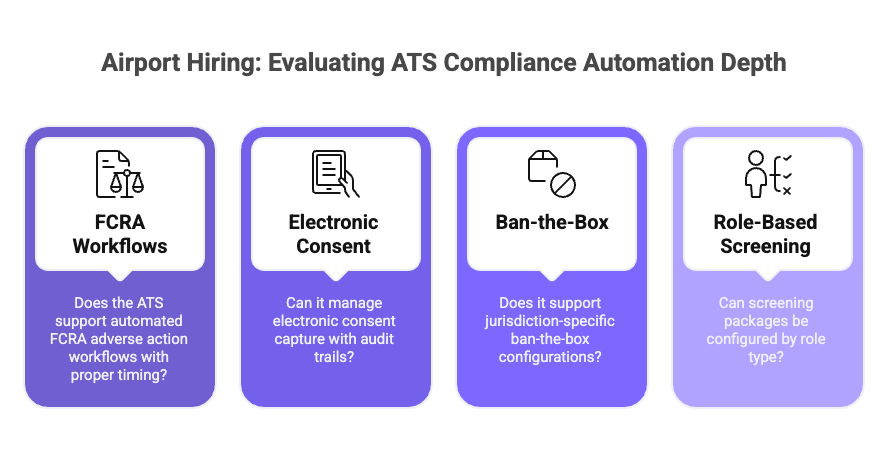
- Does the ATS support automated FCRA adverse action workflows with proper timing?
- Can it manage electronic consent capture with audit trails?
- Does it support jurisdiction-specific ban-the-box configurations?
- Can screening packages be configured by role type?
Keep in mind that while certain airport-access functions carry federally mandated disqualifiers, employer-side hiring decisions must still comply with applicable state and local fair-chance laws, and EEOC guidance calls for individualized assessment when using criminal history in employment decisions. ATS compliance automation supports these obligations but does not replace employer legal responsibility.
Assess real-time status visibility.
Airport hiring teams track multiple parallel compliance gates: employer screening, badge application, fingerprinting, CHRC and STA clearance, training, and badge issuance. If the ATS cannot surface screening status in real time, recruiters are left checking external portals manually.
Test the screening provider network.
Not every CRA specializes in regulated workforce screening. Ask whether the ATS integrates with providers experienced in DOT compliance, transportation screening, or high-volume hourly workforce checks. A long list of integrations is less valuable than a relevant list.
Factor in the full airport compliance stack.
The best ATS for airport hiring supports the complete compliance pipeline: I-9 and E-Verify, drug and alcohol testing (particularly for DOT/FAA safety-sensitive roles), employment and education verification, motor vehicle records, and onboarding document management.
The Bigger Picture: Screening Is Infrastructure, Not a Feature
The aviation sector is under simultaneous pressure from record passenger volumes, workforce shortages in ground-handling and ramp operations, intensifying insider-threat scrutiny from federal oversight bodies, and unresolved legal questions around aviation worker physical screening. The line between a candidate who is “hired” and a worker who can legally enter a secured airport area is a compliance pipeline, not a single background check.
An ATS that treats screening as a checkbox is not built for this reality. The platforms that score highest in this ranking treat screening as operational infrastructure: integrated, automated, auditable, and fast enough to keep pace with the hiring velocity that airport operations demand.
Additional Resources
- eCFR, 49 CFR 1542.209 (Airport Operator CHRC Requirements): https://www.ecfr.gov/current/title-49/subtitle-B/chapter-XII/subchapter-C/part-1542
- Philadelphia Department of Aviation, Airports Fill Key Staffing Roles (2025): https://www.phl.org/newsroom/new-staff
- Reuters, TSA Screened Record 3.13 Million Passengers (November 2025): https://www.reuters.com/world/us/
- Airlines for America, Winter Holiday Travel Forecast (2025): https://www.airlines.org/
- Bureau of Transportation Statistics, Airline Employment Data (2025): https://www.bts.gov/
- ACI-NA, Airport Workforce Accreditation: https://airportscouncil.org/
- GAO, Aviation Insider Threat Program Reports: https://www.gao.gov/
- Federal Register, TSA 2025 Technical Amendments: https://www.federalregister.gov/
- FTC, Background Checks and Employment (FCRA Employer Obligations): https://www.ftc.gov/tips-advice/business-center/guidance/background-checks-what-employers-need-know
- EEOC, Consideration of Arrest and Conviction Records in Employment: https://www.eeoc.gov/laws/guidance/enforcement-guidance-consideration-arrest-and-conviction-records-employment-decisions
- Air Cargo Week, Labour and Skills Shortage in Aviation (2025): https://aircargoweek.com/labour-and-skills-shortage-the-silent-airfreight-constraint-heading-into-2026/
- The Hill, TSA Staffing Challenges (2026): https://thehill.com/policy/transportation/5802043-tsa-staffing-airports-shutdown/
- ScienceDirect, Airport Ground Workforce Dilemma (2024): https://www.sciencedirect.com/science/article/pii/S2941198X24000046

ABOUT THE CREATOR
Charm Paz, CHRP
Recruiter & Editor
Charm Paz is an HR professional at GCheck, specializing in background screening, fair hiring, and regulatory compliance. She holds from the Professional Background Screening Association (PBSA) and helps organizations navigate employment regulations with clarity and confidence.
With a background in Industrial and Organizational Psychology, she translates policy into practice to build ethical, compliant, human-centered hiring systems that strengthen decision-making over time.