

Social media screening in healthcare hiring is the review of a candidate’s public posts, photos, and comments to identify conduct risks that traditional background checks don’t reach, including threats, discrimination, and disclosures that put patient privacy at risk. For healthcare employers, it only works as a defensible tool when it runs on the same documented, consistent criteria and the same FCRA and EEOC discipline that governs every other consumer report.
Key Takeaways
- Social media screening surfaces public conduct risk that criminal records, license checks, and abuse registries don’t capture, but it isn’t a substitute for any of them.
- When a third-party vendor conducts the screen, the Fair Credit Reporting Act applies in full: written disclosure, consent, and a pre- and post-adverse action process.
- The Equal Employment Opportunity Commission has long held that information gleaned from social media, such as race, religion, or age, can’t be used to make hiring decisions, regardless of how it was discovered.
- Healthcare carries a risk category most other industries don’t: public posts that disclose identifiable patient information, images, or treatment details.
- Most states now restrict what employers can ask candidates to hand over from personal accounts, though the specifics vary and change often.
- A defensible program treats social media screening as one input among several, reviewed against documented policy criteria rather than individual judgment.
What Social Media Screening Covers in Healthcare Hiring
Social media screening is the structured review of a candidate’s publicly available posts, photos, videos, and comments against a documented set of conduct criteria, typically covering violence, discrimination, illegal activity, and policy violations. In healthcare hiring specifically, the review is scoped to conduct that has a direct bearing on patient safety and organizational risk, not a general character assessment. The table below breaks down the standard categories and where healthcare adds its own.
| Risk Category | Example Public Conduct | Healthcare-Specific Note |
| Violence or threats | Explicit threats directed at coworkers or the public | Weighed more heavily for roles with direct, unsupervised patient contact |
| Discriminatory conduct | Public posts using discriminatory language toward a protected group | Ties to equal-treatment obligations toward both patients and coworkers |
| Illegal activity | Public admissions of illegal conduct | Evaluated against the same documented criteria used in any other industry |
| Policy violations | Conduct that violates a written employer or professional-body policy | Often overlaps with conduct standards set by nursing or medical licensing boards |
| Patient-privacy disclosure | Posts or photos that identify a patient or disclose treatment details | Unique to healthcare; connects directly to the HIPAA-adjacent risk covered next |
Traditional healthcare background checks are built to surface what already went through a formal process: a criminal conviction, a licensing board action, a substantiated abuse registry finding. Those checks are thorough within their scope, but the scope is narrow by design. They surface conduct that already produced a record. Social media screening surfaces a different kind of signal: conduct that a candidate has made public but that never generated an arrest, a board complaint, or a lawsuit. A pattern of threats toward coworkers, an anti-patient rant, or a photo that discloses a patient’s identity can sit entirely outside the criminal justice and licensing systems while still telling an employer something real about risk.
That distinction matters for how the two tools relate to each other. Social media screening doesn’t replace a criminal background check, license verification, or abuse registry screen. It fills a specific gap next to them: visibility into public conduct that formal records don’t track.
Why Healthcare Carries Distinct Risk
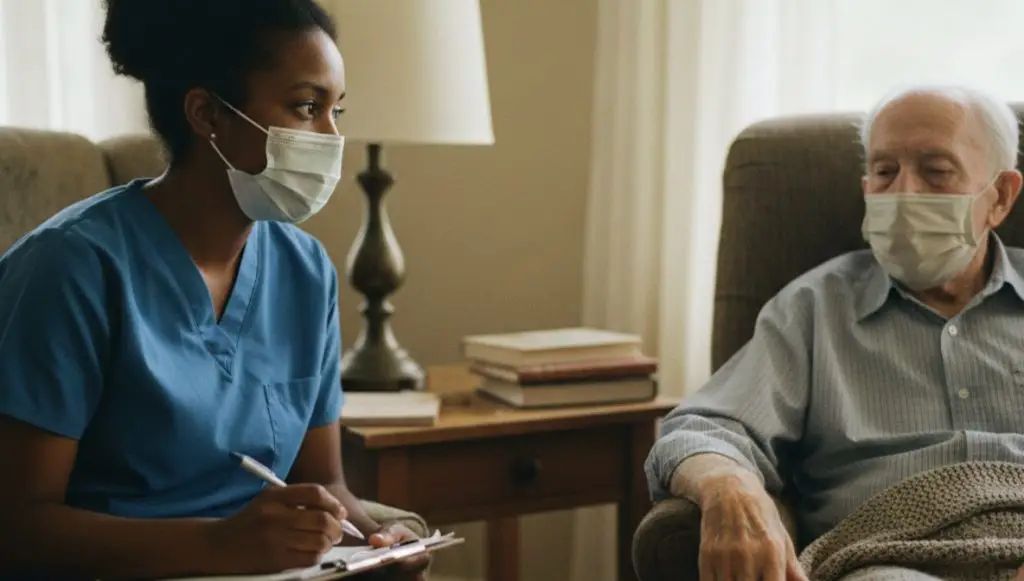
Healthcare hiring shares the general conduct-risk categories every industry screens for, but it carries two categories other verticals don’t face with the same weight: direct exposure to vulnerable patients, and the disclosure risk built into clinical work itself. This is where Protective Compliance, GCheck’s framework for verification that safeguards vulnerable populations and reduces organizational risk, carries most of the weight in a healthcare screening program: the goal isn’t broader surveillance of staff, it’s keeping the people in an organization’s care safe.
Patient Safety and Conduct Risk
Roles with direct patient contact carry a different risk calculus than a typical office job. A candidate’s public posts showing harassment, discriminatory language, or a documented history of aggression matter more when the person will be alone with a sedated patient, an elderly resident, or a child than when they’ll be answering phones in a call center. This is the same logic that already drives abuse registry screening and continuous criminal monitoring in healthcare: the population being protected can’t always advocate for itself, so the screening bar sits higher.
The HIPAA-Adjacent Disclosure Risk
Healthcare hiring also carries a risk category that doesn’t apply to most other industries at all: public disclosure of protected health information. A staff photo with a patient’s chart visible in the background, a “funny patient story” post, or an image that identifies a patient without consent isn’t just an etiquette problem. It’s the kind of disclosure that, once someone is hired and handling real patients, becomes a genuine HIPAA exposure for the employer, not just the individual.
It’s worth being precise about where this fits. HIPAA itself doesn’t govern the act of screening a candidate’s social media; that’s FCRA and EEOC territory, covered in the next two sections. What HIPAA does is explain why this particular risk category exists in healthcare and nowhere else. A documented pattern of casual disclosure involving patient-adjacent information, whether from a prior clinical role, a nursing program, or a ride-along, is a legitimate signal about judgment before someone ever handles a real patient chart. And because a candidate can’t have violated HIPAA at an employer they haven’t worked for yet, this category matters as much or more after hire as before it, which is where continuous social media monitoring picks up where pre-hire screening leaves off.
What’s Legally In Bounds and Out of Bounds
What Public Content Is Fair Game
The starting boundary is simple: only content that’s genuinely public is fair game. Reviews limited to posts, photos, comments, and profile information visible to anyone, without friending, following, or bypassing a privacy setting, stay on the right side of the line. Anything that requires a password, an accepted connection request, or deceptive access to view crosses it, and more than half the states now have laws that make requesting that kind of access illegal outright, on top of the ethical and evidentiary problems it creates.
What Can’t Be Used, Even If It’s Visible
The harder boundary is about what can be used, not just what can be seen. Most public profiles reveal, directly or by inference, a person’s race, approximate age, religion, national origin, or other protected characteristics. The Equal Employment Opportunity Commission has taken a consistent position on this for over a decade: personal information gleaned from social media, including race, gender, national origin, color, religion, age, disability, or genetic information, cannot be used to make employment decisions on a prohibited basis, regardless of how visible that information was or how it was discovered. As the EEOC has put it, the anti-discrimination laws don’t specifically permit or prohibit any particular screening technology; the question that matters is how the tool is used.
That single distinction, between what’s visible and what’s usable, is why documented criteria matter more here than in almost any other type of screening. A reviewer scanning a profile without a defined rubric is exposed to protected-characteristic information whether they’re looking for it or not. A screening process built on documented conduct criteria, evaluated the same way for every candidate, gives an employer a defensible answer to the question a discrimination claim will eventually ask: what were you actually looking for, and did everyone get evaluated against the same standard. This is Fair Compliance in practice: individualized, bias-minimizing assessment applied to a consistent standard, with a clear path for a candidate to review or dispute what was found. A healthcare employer that can show every candidate for a role was screened against the same written criteria, with the same review process, is in a fundamentally different legal position than one relying on whatever a hiring manager happened to notice.
How FCRA Applies to Healthcare Social Media Screening
FCRA, the Fair Credit Reporting Act, is the federal law governing background checks, known formally as consumer reports, when a third party compiles them for employment purposes. Whether FCRA applies to a social media screen turns entirely on who’s doing the looking, which the table below breaks down across the two paths.
| Third-party vendor screen | Direct employer review | |
| FCRA applies | Yes | No |
| Consent required | Yes, written, stand-alone disclosure | Not under FCRA, though disclosure is good practice |
| Pre-adverse action step | Required: notice plus a copy of the report | Not required under FCRA |
| Post-adverse action step | Required: notice of the report source and dispute rights | Not required under FCRA |
| EEOC exposure | Applies regardless | Applies regardless, often with less structural protection |
| Dispute rights for the candidate | Built into the process | Not automatic |
| Reasonable time before finalizing adverse action | Required in practice: the pre-adverse notice has to give the candidate a real chance to review and respond before the decision is finalized, not a same-day formality | Not applicable under FCRA, though the same fairness logic still applies |
| Disposal after use | Required: the report and any information gathered from it must be securely disposed of once it’s no longer needed | Good practice, though not an FCRA disposal obligation since no consumer report was generated |
| State law overlay | May add its own notice or restriction requirements on top of FCRA | May independently restrict what an employer can even request, such as passwords or forced account access |
When a vendor compiles the report, the employer’s obligations run in a specific sequence. Before requesting the report, the employer must give the candidate a stand-alone written disclosure that a consumer report may be used for employment decisions, and get written permission. If that authorization is meant to cover continuous, post-hire monitoring rather than a single pre-hire check, the disclosure has to say so clearly and conspicuously; a one-time hiring disclosure doesn’t automatically extend to ongoing review unless it’s written to. Before taking an adverse action based on what’s in the report, the employer has to provide the candidate a copy of the report and a summary of their FCRA rights, giving them the chance to review it and flag anything inaccurate. After the adverse action, a final notice identifying the reporting company and confirming the candidate’s dispute rights closes the loop.
Direct employer review, where a hiring manager or recruiter looks at a candidate’s public profile without a vendor, sits outside this framework entirely. That doesn’t make it lower-risk. It removes the disclosure, consent, and dispute-rights structure that gives a candidate any visibility into what was found or any path to correct it, while leaving the full weight of anti-discrimination law in place. Ad hoc, undocumented review by whoever happens to be conducting the interview is, in practice, the riskiest version of social media screening a healthcare employer can run, not the safest one.
How Social Media Screening Fits Into a Healthcare Compliance Program
A healthcare screening program is a stack, and social media screening is one layer in it, not a replacement for any of the others. The table below lines up each layer against its data source, when it runs, and what it actually covers.
| Screening Layer | Data Source | When It Runs | What It Covers |
| Credentialing and license verification | Primary-source licensing boards and issuing institutions | Pre-hire, and again at license renewal | Confirms real credentials and current license status; a LinkedIn profile can claim “board certified,” only primary-source verification confirms it |
| OIG and FACIS® sanctions monitoring | Federal exclusion lists and state Medicaid sanction databases | Pre-hire, and ongoing | Program-eligibility risk, including federal exclusions and state sanctions that make someone ineligible to bill Medicare or Medicaid |
| Abuse registry screening | State-maintained abuse and neglect registries | Pre-hire, and as required by state law | Substantiated findings of abuse or neglect, a distinct data source from both criminal records and public social content |
| Continuous criminal and license monitoring | Court records, criminal databases, licensing boards | Post-hire, ongoing | New arrests, convictions, or license actions that occur after someone is already on staff |
| Social media screening | The candidate’s own public posts, photos, and profiles | Pre-hire, and post-hire if run continuously | Public conduct risk: threats, discrimination, illegal activity, and disclosures that put patient privacy at risk |
Read across the table, the gap each layer fills becomes clear: none of the other four rows touch public conduct that never generated a record, and social media screening touches nothing that the other four rows are built to verify. Treated this way, social media screening answers a narrow question: is there public conduct that formal records don’t capture and that a healthcare employer has a legitimate reason to know about. It’s one input into a hiring or retention decision, weighed alongside everything else in the stack, not a stand-alone verdict.
Building a Defensible Healthcare Social Media Screening Program
A program that holds up under scrutiny, whether from a rejected candidate’s attorney or a Joint Commission surveyor, tends to share the same four structural features.
| Program Element | What It Requires | Why It Matters |
| Documented criteria | Written, specific criteria for what warrants closer review, covering violence and threats, discriminatory conduct, illegal activity, and, for healthcare specifically, disclosure of identifiable patient information, established before any profile is reviewed | Turns “I didn’t like what I saw” into a standard that applies the same way to every candidate; a documented category is a trigger for individualized review, not an automatic disqualification, since a finding still has to be weighed on its own facts, including how recent and how job-related it is, before it factors into any employment decision |
| Consistent application | Every candidate for a given role screened against the same criteria, using the same process, with no exceptions | Selective screening, or letting a reviewer’s personal read override the documented standard, is exactly the pattern that turns a legitimate program into a discrimination claim |
| Independent review | A third party, or a designated reviewer who isn’t the hiring decision-maker, conducts the screen | Reduces the chance that protected-characteristic information seen incidentally, while looking for something else, quietly influences a decision; this is the practice employment counsel recommended to the EEOC over a decade ago and it remains the standard today |
| Documentation | A record of what was reviewed, against what criteria, with what outcome | Turns a defensible process into a provable one when a decision is challenged, and is what a surveyor or auditor will actually ask to see, not a description of the policy but evidence it was followed |
None of this treats candidates as suspects. A healthcare worker’s public conduct, evaluated against a fair standard applied consistently, with a documented path to dispute a finding, is a very different experience than being watched, judged informally, and never told why. The first is Compliance for Good®: verification that protects patients and staff without treating the person being screened as the threat. The second is the version every healthcare employer should be trying to avoid.
Frequently Asked Questions
Is social media screening legal for healthcare employers?
Yes. Reviewing a candidate’s publicly available social media content is legal for healthcare employers, provided the review sticks to public content, follows documented criteria, and doesn’t factor in protected characteristics like race, religion, or age. Using a third-party vendor to conduct the screen brings the process under FCRA, which adds consent and adverse-action requirements on top of the underlying anti-discrimination protections.
Do healthcare employers need candidate consent to screen social media?
Consent requirements depend on who’s doing the screening. A third-party vendor conducting the review triggers FCRA, which requires a stand-alone written disclosure and written consent before the report is obtained. Direct review by hiring staff doesn’t require consent under FCRA, though disclosing the practice to candidates is good practice regardless, and some state laws impose their own notice requirements.
Can social media screening find a HIPAA problem before someone is hired?
Not directly. A candidate can’t have violated HIPAA at an employer they haven’t worked for yet. What pre-hire screening can surface is a pattern of casual disclosure involving patient-adjacent content from a prior role or clinical program, which is a legitimate signal about judgment. The bigger opportunity to surface HIPAA-relevant disclosure comes after hire, through ongoing social media monitoring rather than a one-time pre-hire check.
How is social media screening different from continuous monitoring?
Social media screening, run once at the pre-hire stage, is a snapshot of a candidate’s public conduct at a single point in time. Continuous monitoring extends that same review across employment, surfacing new posts, patterns, or disclosures that emerge after someone is already on staff, the same way continuous criminal monitoring surfaces a new arrest that a one-time background check never would.
Which states restrict what employers can ask about a candidate’s personal social media?
Most states now have laws limiting what employers can request from a candidate’s personal social media accounts, typically prohibiting requests for passwords, required account access, or forced friending. The specifics, including which conduct is covered and what exceptions apply, vary by state and change often enough that healthcare employers operating across multiple states should verify current requirements in each jurisdiction rather than rely on a general count.
Sources cited
- U.S. Equal Employment Opportunity Commission. (2014, March 12). Social Media Is Part of Today’s Workplace but its Use May Raise Employment Discrimination Concerns [Press release]. https://www.eeoc.gov/newsroom/social-media-part-todays-workplace-its-use-may-raise-employment-discrimination-concerns
- Federal Trade Commission. (2016, October). Using Consumer Reports: What Employers Need to Know. https://www.ftc.gov/business-guidance/resources/using-consumer-reports-what-employers-need-know
- Fair Credit Reporting Act, 15 U.S.C. Section 1681 et seq. (Sections 604(b), 606, 615(a))
- HIPAA Privacy Rule, 45 C.F.R. Parts 160 and 164 (general disclosure and covered-entity/workforce-member liability standard; described at a conceptual level, no secondary aggregator cited)
- State law reference generalized to “most states” / “more than half the states” throughout, standardized during fact-check against two independent state counts (27/50 and 28/50); no single count cited, per standing sourcing discipline

ABOUT THE CREATOR
Charm Paz, CHRP
Recruiter & Editor
Charm Paz is an HR professional at GCheck, specializing in background screening, fair hiring, and regulatory compliance. She holds from the Professional Background Screening Association (PBSA) and helps organizations navigate employment regulations with clarity and confidence.
With a background in Industrial and Organizational Psychology, she translates policy into practice to build ethical, compliant, human-centered hiring systems that strengthen decision-making over time.