

Most employment background checks are completed within a few business days, though the exact timing depends on which checks are included and the jurisdictions involved. Some searches return in hours, while others take longer when county court records, past-employer verifications, or international sources are part of the package. This guide explains what is realistic and what actually drives speed.
Key Takeaways
- A background check is not one lookup but a bundle of separate searches, so the report is only as fast as its slowest component. Most are completed within a few business days.
- Turnaround depends on what is in the package and where records live: automated searches such as identity and database checks return fastest, while anything routed through a court, a former employer, a school, or a licensing board runs at that third party’s pace.
- The most controllable driver of speed is complete, accurate candidate information at intake. Mismatched or missing details force re-work that restarts the clock on that search.
- The biggest delays are structural and outside anyone’s control: manual-retrieval county courts, backlogs, international records, and legally required dispute windows. The right response is to plan around them, not to promise to eliminate them.
- The fastest possible check is often a database-only search that skips source-level confirmation, which is exactly where a record can be missed or attached to the wrong person. Speed bought by cutting verification is a false economy.
- Speeding up a check does not shorten the FCRA adverse action steps: the reasonable waiting period, which FTC guidance generally treats as about five business days at minimum, runs on its own schedule regardless of how fast the check ran.
- Transparency during the wait is what workers say builds their confidence: 81% want a clear explanation of what is being checked, and 74% want transparency about how AI is used in screening (GCheck, 2026).
How long does an employment background check take?
A typical employment background check completes within a few business days, but that headline hides a wide spread. A single-source identity or database check can return in minutes, while a package that reaches into rural county courthouses or verifies a degree earned overseas can take a week or more. The honest answer to “how long does it take” is that turnaround depends almost entirely on what is inside the package and where the underlying records live.
The reason a single average is misleading is that a background check is not one lookup. It is a bundle of separate searches, each pulling from a different source at a different speed. The fastest components can finish while you are still reading the candidate’s resume; the slowest are gated by an outside party you do not control. Timing is therefore best understood check by check, not as one figure.
Typical turnaround by check type
Turnaround is best read as a relative-speed picture rather than a fixed clock, because each component runs on its own source. Automated searches resolve quickly, while any search that depends on a court, a former employer, or a school runs at that third party’s pace. The table below shows the pattern.
| Check type | Relative speed | What sets the pace |
|---|---|---|
| Identity verification | Fastest | Automated matching against authoritative data |
| Criminal database (multi-jurisdiction) search | Fast, but preliminary | Near-instant, yet a starting point that still needs source-level confirmation |
| County criminal record search | Variable | Court digitization; manual-retrieval counties are slower |
| Employment verification | Depends on a third party | Responsiveness of past employers and their records vendors |
| Education verification | Depends on a third party | Registrar responsiveness; international records take longer |
| Motor vehicle record (MVR) | Usually fast | State DMV access, quicker where digitized |
| Professional license verification | Depends on a third party | Licensing-board or portal responsiveness |
| Drug testing | Multi-step | Collection scheduling plus lab processing and review |
The practical takeaway is that a package built entirely from automated searches clears quickly, while a single manual-retrieval component sets the pace for the whole report.
Why do background check turnaround times vary so much?
Background check turnaround varies because a check is not a single action but a bundle of independent searches, each pulling from a separate source with its own speed and its own bottlenecks. The final report can only be as fast as its slowest component. When one search reaches into a county that still retrieves records by hand, the whole package waits on that one court, no matter how quickly every other search returned. Four variables explain most of the spread.
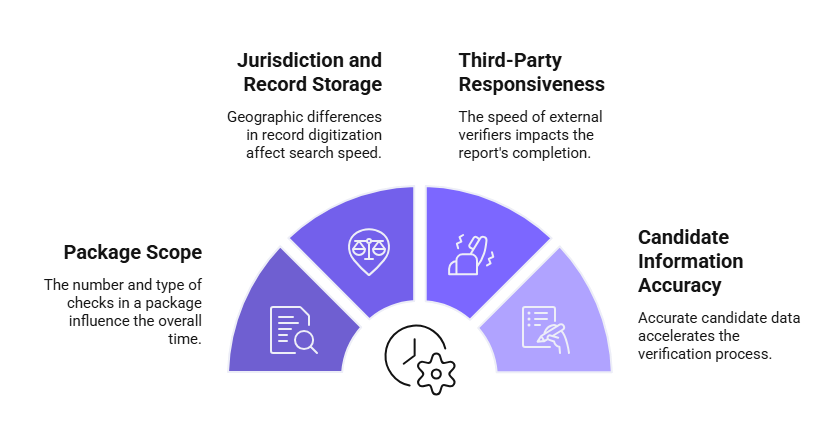
The number and type of checks in the package
The more searches a package contains, and the more of them that depend on human retrieval, the longer the report takes overall. A lean, role-matched package of automated searches can clear quickly. A broad package that adds county-level criminal searches across several jurisdictions, multi-employer verifications, and an international credential will run to the pace of its slowest element. Scope drives timing more than almost anything else the employer controls.
Jurisdiction and how records are stored
Turnaround varies by geography because record access is not uniform. Many courts provide digitized records that can be searched electronically in near real time. Others still require a researcher to retrieve files in person or submit a request that a clerk fulfills on the court’s own schedule. Two otherwise identical candidates can have very different timelines simply because their records sit in counties with different levels of digitization.
Third-party responsiveness
Verifications depend on people outside the process answering a request. Employment verification waits on a former employer or the vendor that handles its records; education verification waits on a registrar; license verification waits on a board. None of these parties is on the employer’s clock. A responsive past employer can confirm dates in a day; an unresponsive one, or a business that has closed, can add several days while alternate documentation is gathered.
Candidate information accuracy and completeness
The single most controllable driver of speed is the quality of the information the candidate provides at the start. Accurate names, dates, addresses, and identifiers let each search resolve on the first attempt. A misspelled former employer, a wrong graduation year, or a missing middle name forces re-work: a search comes back inconclusive, the candidate is re-contacted, and the clock restarts on that component. Complete, accurate intake data is the closest thing there is to a turnaround accelerator.
What actually drives background check speed?
The biggest controllable factors in background check speed are the completeness of the candidate’s information, the provider’s process and degree of automation, and how records are retrieved. The biggest uncontrollable factors are court backlogs, manual-retrieval jurisdictions, international records, and mandated waiting or dispute windows. Understanding which is which tells you where effort pays off and where patience is the only realistic option.
Factors employers and candidates can control
Several levers genuinely move turnaround, and they sit with the employer and candidate rather than with any court. Complete and accurate candidate data at intake lets searches resolve without re-work. Clear consent and disclosure, collected correctly up front, prevent the report from stalling on missing paperwork. Integration between the screening process and the applicant tracking system removes manual re-entry, which is both a speed gain and an error-reduction step. Responsive verification contacts, sometimes as simple as the candidate confirming a former manager’s current details, shorten the wait on the slowest verifications. These are the areas where attention reliably produces a faster, cleaner result.
Factors no one controls
Some delays are structural, and treating them as failures only creates false expectations. Court closures, holidays, and clerk backlogs set the pace in manual-retrieval jurisdictions. International records move at the speed of foreign institutions and their own privacy rules. Dispute and reinvestigation windows exist by law to protect candidates and cannot be compressed. A capable process plans around these realities rather than promising to eliminate them. The right posture is to control the controllables tightly and communicate honestly about the rest.
What slows a background check down?
The most common causes of a slow background check are manual court access and county backlogs, incomplete or mismatched candidate information, international education or employment history, and the extra care required when a candidate shares a common name. Most delays trace back to one of these four, and most are visible early enough to manage expectations rather than be surprised by them.
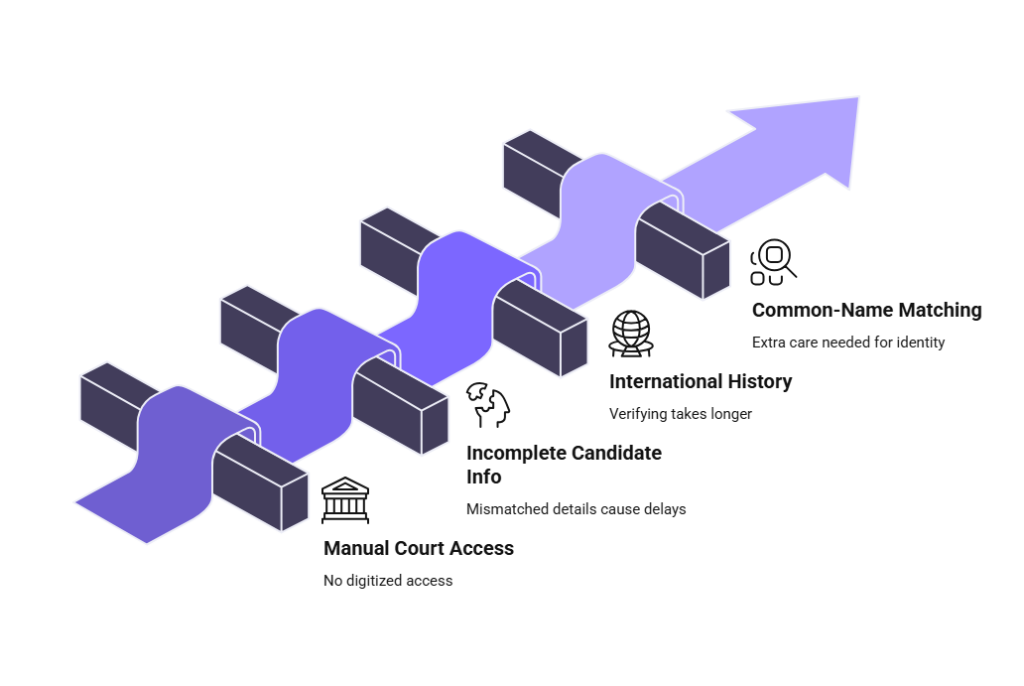
Manual court access and county backlogs
The frequent culprit behind a slow criminal record search is a court that does not offer digitized access. In these counties, a record has to be retrieved by a researcher on site or fulfilled by court staff on their own schedule, and no amount of employer urgency changes the court’s pace. Backlogs after closures or holidays compound the wait. When a report seems stuck, a manual-retrieval county is often the reason.
Incomplete or mismatched candidate information
Missing or inconsistent details are a leading and highly preventable source of delay. When the name, date, employer, or school on the application does not match the source record, the search returns inconclusive and the candidate has to be re-contacted for clarification. Each round trip adds days. This is why careful, complete intake is the single most effective thing anyone can do to keep a check moving.
International education or employment history
Verifying a degree earned or a job held outside the country adds time because the request depends on foreign institutions, time-zone gaps, language differences, and local privacy rules that govern how records are released. These verifications are entirely legitimate and routinely completed; they simply run on a longer clock than a domestic equivalent. Building that reality into the timeline prevents an international candidate’s report from looking like a problem when it is only a longer path.
Common-name matching
When a candidate shares a name with many other people, the process takes extra care to confirm that every record belongs to the right person and that no one else’s record is attached by mistake. This is a data-matching challenge, not a mark against the candidate. The additional verification protects the candidate from being confused with a stranger, which is exactly the kind of error a careful process is designed to prevent. The short delay it can add is the cost of getting the identity right, and it is a cost worth paying.
Is the fastest background check always the best choice?
No. A background check optimized only for speed can quietly trade away the accuracy, fairness, and compliance that make the result usable in the first place. The fastest possible check is often a single database search that skips county-level confirmation, and that shortcut is precisely where a record can be missed or a record belonging to someone else can be attached to the wrong candidate. Speed is a real value, but speed purchased by cutting verification is a false economy, because a result you cannot rely on is not actually finished.
At GCheck, this is where the brand’s standard applies. Compliance for Good™ holds three commitments together rather than trading one for another: Transparent Compliance means the candidate and the employer both understand what is being checked and why; Fair Compliance means the same careful standard is applied to every candidate, including the extra care that common-name matching requires; and Protective Compliance means the process is built to protect good-faith workers and fair employers from the specific harms that a rushed, inaccurate result creates. Speed matters inside that standard, not instead of it.
The cost of a rushed or inaccurate result
A result that arrives fast but wrong is more expensive than a result that takes an extra day and is right. A record attached to the wrong person, a county quietly skipped, or a mismatch that has to be re-run erases whatever time the shortcut saved, and it can expose the employer to a bad decision or a dispute. The time “saved” by cutting verification is usually borrowed, and it is repaid with interest when the error surfaces.
Speed and compliance are not in tension
Running a check quickly does not shorten the compliance steps that follow, so there is no real trade-off to make. If an employer decides not to hire based in whole or in part on the results, the FCRA requires a two-step adverse action process: a pre-adverse action notice that includes a copy of the report and a summary of the candidate’s rights, a reasonable period for the candidate to review and respond, and then a final adverse action notice (Fair Credit Reporting Act, 1970; Federal Trade Commission, n.d.). The statute does not fix a number of days; FTC guidance is widely applied as treating about five business days as a reasonable minimum, and some state and local laws require longer. That window exists to give the candidate time to respond, and how fast the underlying check ran does not change it. A faster check simply reaches this stage sooner; it does not compress the candidate’s right to respond. See our overview of the FCRA adverse action process for how that sequence works.
The standard to hold: fast, accurate, and defensible together
The right benchmark is not “how fast” but “how fast while still accurate, fair, and defensible.” A check that returns quickly, confirms records at the source, applies the same standard to every candidate, and produces a result that would hold up under scrutiny is the one worth having. Speed is one attribute of a good check, not the definition of one.
How can employers speed up background checks without cutting corners?
Employers can shorten turnaround honestly by improving the inputs and the workflow rather than by removing verification steps. Five practices consistently reduce delay while keeping the result accurate and compliant: collect complete information at intake, get consent and disclosure right the first time, integrate screening with the ATS, scope packages to the role, and keep candidates informed. None of these trades accuracy for speed; each removes a source of avoidable delay.
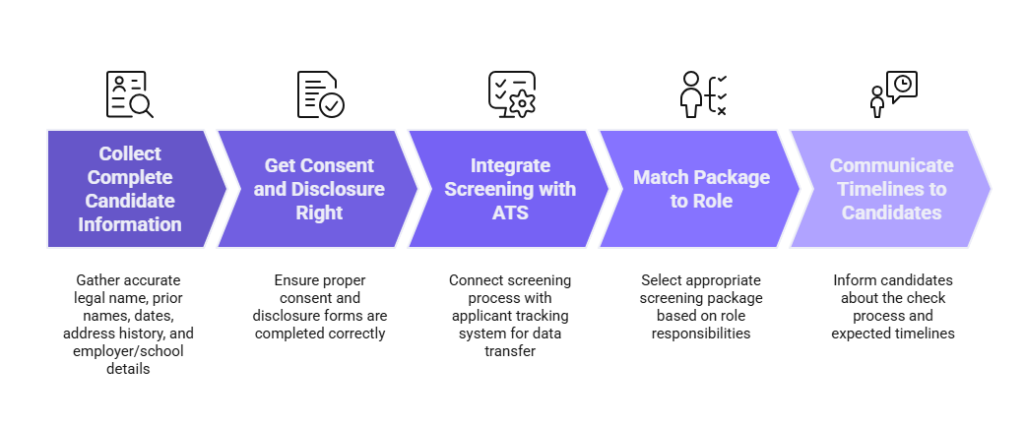
Collect complete, accurate candidate information at the start
The fastest checks begin with the cleanest data. Capturing full legal name, prior names where relevant, accurate dates, complete address history, and correct employer and school details up front lets each search resolve on the first pass. A short intake step that validates this information prevents the inconclusive results and re-contacts that quietly add days.
Get consent and disclosure right the first time
A background check cannot proceed until consent and disclosure are properly in place, so paperwork errors are a common and invisible source of delay. Using a clear, compliant standalone disclosure and capturing authorization correctly at the start means nothing stalls waiting on a signature or a corrected form. Our guide to running a compliant employment background check covers the disclosure and authorization steps in detail.
Integrate screening with your ATS
Manual re-entry between systems is both slow and error-prone, and every re-typed field is a chance for the mismatch that triggers a re-run. Integrating screening with your applicant tracking system passes candidate data through cleanly, removes handoff delays, and reduces the data errors that cause the slowest kind of rework.
Match the package to the role
Over-scoping every hire with the broadest possible package adds time and cost without adding relevant assurance. Matching the checks to the role’s actual responsibilities and risk profile keeps each report as lean as it can responsibly be, which naturally shortens turnaround. Right-sizing is not corner-cutting; it is scoping the check to the decision it supports.
Communicate timelines to candidates
The wait itself is easier to manage when the candidate knows what to expect. Telling candidates what is being checked, roughly how long it should take, and what might extend it turns an anxious silence into a predictable process. Clear communication does not make a check literally faster, but it removes the friction, the status-check emails, and the uncertainty that make a normal timeline feel like a delay.
What is the candidate’s experience during the wait?
For many candidates, the turnaround window is the most anxious part of hiring, and transparency during it is what turns a black box into a fair, human process. The candidate has usually accepted an offer and is waiting on a result they cannot see or influence, which is an uncomfortable position to sit in. What changes the experience is not a faster clock but a clearer one: knowing what is being checked, why, and how any technology is used.
Research bears this out. Among US workers surveyed, 81% said a clear explanation of what is being checked would make them more confident in an employer’s verification process, and 74% said the same about transparency in how automation or AI is used in screening (GCheck, 2026). Both figures measure what workers say would build their confidence, a stated preference rather than a record of behavior, and both point the same way: the wait is easier to bear when the candidate understands what is happening and is treated as a participant rather than a subject. Transparency is not a courtesy layered on top of the process; for the candidate, it is a large part of what makes the process feel fair.
How does turnaround affect adverse action and start dates?
Turnaround affects when an employer can finalize an offer or set a start date, but it does not shorten the adverse action steps the FCRA requires if the employer decides not to hire based on the results. A faster check lets the employer reach a go or no-go point sooner, which can protect a start date. It does not, however, compress the candidate’s rights on the other side of a negative result.
If the decision is not to hire based in whole or in part on the report, the FCRA requires a pre-adverse action notice that includes a copy of the report and the summary of rights, a reasonable period for the candidate to respond, and then a final adverse action notice (Fair Credit Reporting Act, 1970; Federal Trade Commission, n.d.). The FCRA does not set a specific number of days; FTC guidance is generally applied as treating roughly five business days as a reasonable minimum, and some state and local laws require longer. The practical takeaway for anyone worried that timing creates legal exposure: speeding up the check is fine and useful, but the adverse action clock runs on its own schedule regardless, and it should never be shortened to hit a start date. Our adverse action overview walks through the required sequence and timing.
Frequently asked questions
How long does a background check take for employment?
Most employment background checks are completed within a few business days, though the real answer depends on the package. Automated searches such as identity and database checks can return the same day, while county court records, past-employer verifications, and international sources take longer. The final report moves at the speed of its slowest component.
What is the fastest a background check can be completed?
A single automated search, such as an identity or multi-jurisdiction database check, can return in minutes to a few hours. That speed reflects a narrow, database-only lookup, not a full check. A complete, accurate report that confirms records at the source, including county-level searches, generally takes longer, because source confirmation is what makes the result reliable.
Why is my background check taking so long?
The usual reasons are a county court that retrieves records manually, information on the application that did not match the source record, an international school or employer, or the extra care taken to confirm identity when a name is very common. Most of these are normal parts of a thorough process rather than signs that anything is wrong.
What can delay a background check?
Common delays include manual-retrieval courts and county backlogs, incomplete or mismatched candidate information, unresponsive past employers or schools, international records, and dispute or reinvestigation windows that exist by law. The most preventable of these is mismatched information at intake, which is also the one candidates and employers can most easily fix by providing complete, accurate details up front.
Can employers speed up a background check?
Yes, honestly and without cutting corners. The most effective steps are collecting complete, accurate candidate information at the start, getting consent and disclosure right the first time, integrating screening with the applicant tracking system to remove manual re-entry, and scoping the package to the role. These improve the inputs and the workflow rather than removing verification.
Does a faster background check mean a less accurate one?
Not necessarily, but speed achieved by skipping verification does reduce accuracy. The fastest checks are often database-only searches that omit county-level confirmation, which is where a record can be missed or misattributed. A well-run process can be both quick and accurate, but accuracy comes from confirming records at the source, not from returning a result as fast as possible.
How long do continuous or post-hire checks take?
Continuous or post-hire monitoring works differently from a one-time pre-hire check: rather than a single turnaround, it runs on an ongoing basis and surfaces new, relevant records as they appear, so there is no single “how long” to report. See our overview of continuous and post-hire monitoring for how ongoing screening works.
The bottom line
The fastest background check worth having is the one that is also transparent, accurate, and defensible. Turnaround is real and worth managing, and most of the delay that frustrates employers is preventable through cleaner intake, correct paperwork, ATS integration, and honest communication with candidates. The delays that remain are usually structural, and the right response is to plan around them rather than to cut the verification that makes a result trustworthy. Speed is worth pursuing inside that standard, which is the whole idea behind Compliance for Good: a check that is fast because the process is well built, not fast because the process was shortened.
For the full framework, see the parent guide, How to Run Employment Background Checks.
References
- Fair Credit Reporting Act, 15 U.S.C. § 1681 (1970).
- Federal Trade Commission. (n.d.). Background checks: What employers need to know. https://www.ftc.gov/business-guidance/resources/background-checks-what-employers-need-know
- GCheck. (2026). The 2026 trust in hiring report. GCheck.

ABOUT THE CREATOR
Charm Paz, CHRP
Recruiter & Editor
Charm Paz is an HR professional at GCheck, specializing in background screening, fair hiring, and regulatory compliance. She holds from the Professional Background Screening Association (PBSA) and helps organizations navigate employment regulations with clarity and confidence.
With a background in Industrial and Organizational Psychology, she translates policy into practice to build ethical, compliant, human-centered hiring systems that strengthen decision-making over time.