

An abuse registry background check searches a state-maintained database of substantiated abuse, neglect, or exploitation findings, and it is a separate search from a criminal background check. Behavioral health employers, across both outpatient and residential programs, serve exactly the populations these registries exist to protect, so understanding what each check covers is not optional.
Key Takeaways
- An abuse registry background check and a criminal background check search different records, built on different standards of proof, and one clearing does not mean the other clears too.
- Adult abuse and neglect registries exist in many states but not all, and some states route adult findings through a separate system entirely, such as an employee misconduct registry.
- Child abuse and neglect central registries are more consistently available across states, though the application process, required forms, and what counts as a reportable finding still vary.
- Residential behavioral health programs, where staff have unsupervised contact with residents, generally carry the clearest case for running both adult and child abuse registry checks, regardless of role title.
- A registry listing reflects an administrative finding, not a criminal conviction, and when it arrives through a background screening company’s report, it still triggers the FCRA adverse action process before finalizing a decision not to hire.
What an abuse registry background check is and how it differs from a criminal background check
An abuse registry background check queries a state agency’s database of individuals with a substantiated finding of abuse, neglect, or exploitation against a vulnerable adult or a child. This is a different record set than a criminal background check, which draws from court and law enforcement records of arrests and convictions, and it is different again from the sex offender registry, which lists only individuals convicted of a qualifying sex offense.
The gap between these searches matters because the standard of proof is not the same. A criminal conviction requires proof beyond a reasonable doubt in a court proceeding. A substantiated abuse finding is typically an administrative determination made by a state protective services agency, based on a preponderance of the evidence, meaning the agency found it more likely than not that the abuse, neglect, or exploitation occurred (Arizona Department of Economic Security, APS Registry). A candidate can clear a criminal background check entirely and still appear on an abuse registry, and the reverse is true too.
| Check type | What it searches | Standard of proof | Typically maintained by |
| Criminal background check | Arrests and convictions | Beyond a reasonable doubt | Courts and law enforcement agencies |
| Sex offender registry | Individuals convicted of a qualifying sex offense | Criminal conviction | State and federal justice agencies |
| Abuse and neglect registry | Substantiated findings of abuse, neglect, or exploitation | Preponderance of the evidence (administrative) | State health and human services agencies |
Behavioral health settings raise the stakes on this gap more than most healthcare sub-sectors. A residential program may house minors alongside staff working overnight shifts with limited supervision, while an outpatient program may send case managers into a client’s home unaccompanied. Both scenarios sit inside the population an abuse registry exists to protect, which is why the registry search is not interchangeable with a criminal check.
Adult abuse and neglect registries: what behavioral health employers should know
An adult abuse registry lists individuals with a substantiated finding of abuse, neglect, or exploitation against a vulnerable adult, and it is not universal. Some states require specific categories of employers to check it before hiring. Arizona law requires residential care institutions, nursing care institutions, and home health agencies to check the APS Registry and bars them from hiring anyone listed on it (Arizona Revised Statutes §36-411). Outside these three institution types, Arizona’s general guidance leaves the hiring decision to the individual employer, so the mandatory exclusion is specific, not statewide. Delaware requires all long-term care facilities to check its Adult Abuse Registry before hiring, and notably, only active listings are reportable; a past or expired listing does not appear in a search result (Delaware Department of Health and Social Services, Division of Health Care Quality).
Not every state runs this the same way. Texas does not include findings of adult abuse, neglect, or exploitation in the central registry maintained by its Department of Family and Protective Services. Employers there instead need the separate Employee Misconduct Registry to capture that information (Texas Department of Family and Protective Services). A behavioral health organization that assumes one registry search covers adult findings nationwide will miss this exact kind of state-specific gap, and a residential SUD treatment program or adult psychiatric facility operating in Texas needs to know the difference before it builds a screening checklist.
Child abuse and neglect registry checks: what behavioral health employers should know

A child abuse and neglect registry lists individuals with a substantiated finding involving a minor, typically the result of a state child protective services investigation. Kansas operates its Child Abuse and Neglect Central Registry through the Department for Children and Families, and a search there requires the applicant’s written permission, submitted on the agency’s own release-of-information form (Kansas Department for Children and Families, Child Abuse and Neglect Central Registry). Texas maintains a similar system: its Central Registry includes cases where a Child Protective Services investigation resulted in a disposition of “reason to believe” (Texas Department of Family and Protective Services).
Child abuse and neglect registries are more consistently available across states than adult abuse registries, since nearly every state child welfare agency maintains one in some form. That consistency does not mean the process is uniform. Required consent forms, turnaround time, and what qualifies as a reportable finding differ by state, which is the same operational challenge behavioral health employers face with adult registries, just with a wider footprint. A residential youth behavioral health program operating in three states will likely be filling out three different forms, sent to three different agencies, on three different timelines.
Which behavioral health roles need an abuse registry check
Role, not job title, determines whether an abuse registry check belongs in a behavioral health hiring workflow. The relevant question is whether the position involves direct, and often unsupervised, contact with residents, clients, or patients who fall into a protected category under state law.
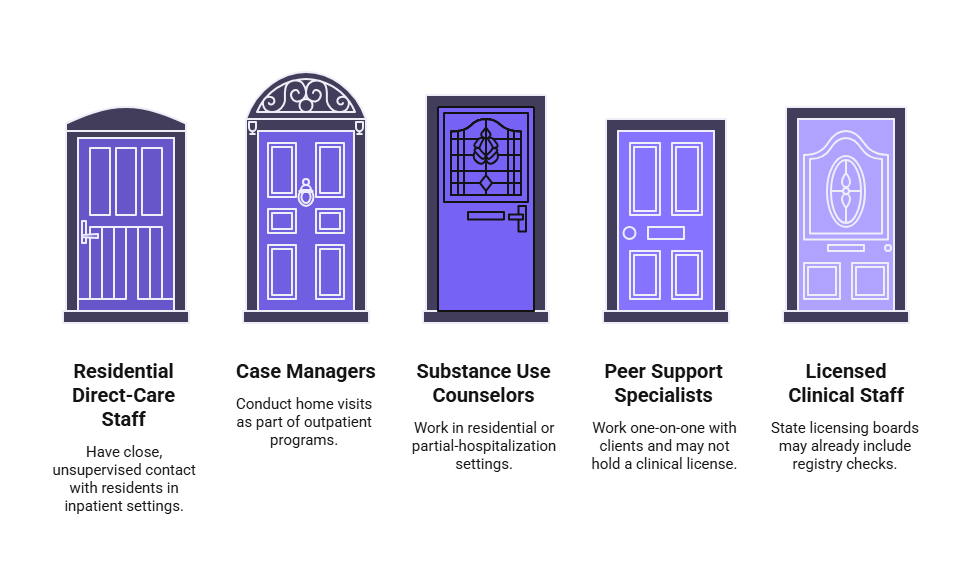
- Residential direct-care staff and behavioral health technicians, who typically have the closest and most unsupervised contact with residents in inpatient or residential settings
- Case managers and outreach staff who conduct home visits as part of an outpatient program
- Substance use disorder counselors working in residential or partial-hospitalization settings
- Peer support specialists, who often work one-on-one with clients and may not hold a state clinical license
- Licensed clinical staff, such as licensed clinical social workers, licensed professional counselors, and psychiatric nurse practitioners, whose state licensing board process may already include some version of a registry check as part of licensure
Support and unlicensed roles deserve particular attention here. A licensed clinician’s credentialing process often builds in some background screening already, but a behavioral health technician or peer support specialist hired without a state license may not go through that same gate, which is exactly the coverage gap an employer-run abuse registry check is meant to close.
Setting changes the exposure even when the job title stays the same. A behavioral health technician in a residential program typically has extended, overnight, and less-supervised contact with residents, the pattern abuse registries were built to screen against. The same title in an outpatient day program may see clients only during scheduled sessions with other staff present. Neither setting should skip the check outright, since state law rather than program type usually decides whether a search is required, but residential programs generally carry the more urgent case for building the check into every covered role.
What a substantiated finding means, and what happens after a match
What “substantiated” means, and the due process behind it
A substantiated finding means a state agency investigated an allegation and determined, under its own evidentiary standard, that abuse, neglect, or exploitation occurred. This is not an arrest, and it is not a pending accusation. Arizona’s process illustrates the due process built into most systems: after APS concludes an investigation, the agency sends the alleged perpetrator a letter explaining the outcome, and if APS intends to substantiate the finding and add the person to the registry, that letter includes a form the person can use to request an administrative hearing before the listing becomes final (Arizona Department of Economic Security).
Individualized assessment and the FCRA adverse action process
Because a registry listing has already been through an administrative determination process, a behavioral health employer’s response to a match is a hiring decision, not a fact-finding exercise. The Equal Employment Opportunity Commission’s guidance on individualized assessment, developed in the context of criminal history, reflects a broader principle that reasonably extends here: consider the nature of the finding, its relevance to the specific role, and any evidence of rehabilitation, rather than applying an automatic, blanket exclusion (EEOC Enforcement Guidance on the Consideration of Arrest and Conviction Records in Employment Decisions Under Title VII). Some states remove that discretion for specific employer categories, such as Arizona’s prohibition on hiring anyone listed on the APS Registry into a covered role, so employers should confirm what their state actually requires rather than assuming an individualized review applies everywhere.
State law and federal law operate on separate tracks here, and both apply. When an abuse registry finding arrives as part of a report prepared by a background screening company, that company is a consumer reporting agency under the Fair Credit Reporting Act, and the report is a consumer report. Before finalizing a decision not to hire, the employer generally must complete the FCRA adverse action process: a pre-adverse action notice with a copy of the report and a summary of rights (FCRA §604(b)(3), 15 U.S.C. §1681b(b)(3)), a reasonable response period, then a final adverse action notice if the employer proceeds (FCRA §615, 15 U.S.C. §1681m). This applies even in a state like Arizona, where the underlying exclusion is mandatory: state law can require the outcome while federal law still governs the notice process used to reach it.
Documenting the decision
Whatever the outcome, document it. A behavioral health employer should keep a record of which registries were searched, on what date, and what decision followed a match, separate from the general personnel file given the sensitivity of the underlying finding. That documentation is what turns an abuse registry check from a one-time hiring step into evidence of a consistent, defensible program if a licensing surveyor or a state auditor ever asks how a specific hiring decision was made.
Why state variation matters for multi-state behavioral health organizations
A behavioral health organization running programs in more than one state cannot build a single abuse registry screening checklist and apply it everywhere. The registry that exists, the employer categories required to check it, and the process for requesting a search all shift at the state line.
| State | Registry | Who must check | Notable feature |
| Arizona | APS Registry | Residential care institutions, nursing care institutions, home health agencies (mandatory under A.R.S. §36-411) | General employer access is discretionary; hiring is legally barred only for the three covered institution types |
| Delaware | Adult Abuse Registry | All long-term care facilities, before hiring | Only active listings are reportable; expired listings do not appear |
| Texas | Central Registry (child) and Employee Misconduct Registry (adult) | Employers checking for child abuse/neglect use the Central Registry; adult findings require the separate EMR | No single combined adult-and-child registry |
| Kansas | Child Abuse and Neglect Central Registry, and a separate Adult Abuse, Neglect and Exploitation Central Registry | Both operated by the Department for Children and Families | Written applicant permission is required for either search |
| Washington | State registry of long-term care workers with substantiated findings | Certain long-term care providers and individual providers | A fingerprint-based check may be waived for continuously employed providers who have not left the state since their last check |
A residential program expanding from one state into a neighboring one should treat the abuse registry requirement as a fresh research question, not an assumption carried over from the first state’s checklist.
Building abuse registry checks into a defensible behavioral health hiring program
Compliance for Good® is GCheck’s operating standard for turning screening into a source of trust rather than a source of fear, and abuse registry checks are a clear example of where that standard applies in practice.
Transparent Compliance: telling candidates what is being checked and why
Transparent Compliance means telling candidates plainly that an abuse registry check is part of the process and why, rather than treating it as a hidden gate they discover only if something goes wrong. Most candidates applying to work in behavioral health already expect some form of screening given the population served, so naming the specific checks upfront, including which registries apply to the role and the state, tends to build confidence in the process rather than anxiety about it.
This matters operationally too. A candidate who understands in advance that a state requires written consent for a registry search, and that the search may take longer than a standard criminal check, is less likely to treat a delayed start date as a red flag on the employer’s end. Clear communication about timeline expectations is part of what makes the process feel fair rather than opaque.
Protective Compliance: layering the safeguard correctly
Protective Compliance is the more direct fit for this specific check. Behavioral health programs, whether outpatient or residential, exist to serve people who may be minors, elderly, disabled, or otherwise vulnerable, and an abuse registry search closes a gap a criminal background check alone leaves open. Layering the two searches together, rather than treating either as sufficient on its own, is the more complete safeguard.
Residential programs in particular should revisit registry checks periodically rather than only at the point of hire, given the extended, often unsupervised contact those roles involve over time. Registry match data is sensitive by nature, so it should be stored, shared, and retained under the same confidentiality discipline an organization applies to any other protected background check finding, with access limited to the people who actually need it to make or document a hiring decision.
Frequently asked questions
What’s the difference between an abuse registry check and a criminal background check?
A criminal background check searches court and law enforcement records for arrests and convictions, decided under a criminal standard of proof. An abuse registry check searches a state health or human services agency’s records of substantiated abuse, neglect, or exploitation findings, decided under an administrative standard. A candidate can clear one and still appear on the other, so behavioral health employers generally need both.
Do all states have an adult abuse registry?
No. Adult abuse and neglect registries exist in many states, but the details vary widely, and some states do not maintain one at all. Texas, for example, does not include adult abuse or neglect findings in its Central Registry and instead uses a separate Employee Misconduct Registry for that information (Texas Department of Family and Protective Services). Employers should confirm what exists in each state where they operate rather than assuming a consistent national system.
Does a behavioral health worker need both a child and an adult abuse registry check?
It depends on the population the program serves and the state’s requirements. A program serving only adults, such as an adult residential SUD treatment facility, may only need an adult abuse registry check where one exists. A program serving both, such as a family-focused behavioral health center, likely needs both searches, since the two registries track separate populations and are maintained separately in most states.
Can a candidate be denied a job based on an abuse registry listing alone?
In some states, yes, by law: Arizona, for instance, prohibits certain employer categories from hiring anyone listed on its APS Registry. Where state law does not mandate exclusion, an individualized assessment weighing the finding’s nature and its relevance to the role is the more defensible approach. Either way, if the finding came through a background screening company’s report, the Fair Credit Reporting Act’s adverse action process, including a pre-adverse notice, a copy of the report, a summary of rights, and a final notice, generally applies before the employer finalizes the decision.
How long does an abuse registry check take?
Turnaround varies significantly by state and by the agency’s own process. Some registries are searchable online with a same-day result, while others require a mailed or faxed application processed manually by agency staff, which extends the timeline considerably. Behavioral health employers building a hiring timeline around abuse registry checks should confirm the expected turnaround with each relevant state agency directly, since it is not standardized nationally, and should build that lead time into the offer process rather than treating it as an afterthought.
Do residential programs need abuse registry checks more often than outpatient programs?
Residential programs typically involve more sustained and less supervised contact between staff and residents, which is the exact risk profile abuse registries exist to address. That does not mean outpatient programs are exempt, particularly where staff conduct home visits or work one-on-one with clients. Both program types should assess their specific roles against their state’s registry requirements rather than assuming setting alone determines the answer.
Sources cited
- Arizona Department of Economic Security. APS Registry. https://des.az.gov/APSRegistry
- Arizona Revised Statutes §36-411. https://www.azleg.gov/ars/36/00411.htm
- Delaware Department of Health and Social Services, Division of Health Care Quality. Adult Abuse Registry. https://dhss.delaware.gov/dhcq/adult-abuse-registry/
- Texas Department of Family and Protective Services. Central Registry Background Checks, FAQ. https://www.dfps.texas.gov/background_checks/faq/faq_abuse_registry.asp
- Kansas Department for Children and Families. Adult Abuse Registry. https://www.dcf.ks.gov/Agency/Operations/pages/adult-abuse-registry.aspx
- Kansas Department for Children and Families. Child Abuse and Neglect Central Registry. https://www.dcf.ks.gov/services/PPS/pages/child-abuse-and-neglect-central-registry.aspx
- Washington State Legislature. RCW 74.39A.056. https://app.leg.wa.gov/rcw/default.aspx?cite=74.39a.056
- U.S. Equal Employment Opportunity Commission. Enforcement Guidance on the Consideration of Arrest and Conviction Records in Employment Decisions Under Title VII of the Civil Rights Act of 1964, April 25, 2012.
- Fair Credit Reporting Act, 15 U.S.C. §1681b(b)(3) (FCRA §604(b)(3)) and 15 U.S.C. §1681m (FCRA §615).

ABOUT THE CREATOR
Charm Paz, CHRP
Recruiter & Editor
Charm Paz is an HR professional at GCheck, specializing in background screening, fair hiring, and regulatory compliance. She holds from the Professional Background Screening Association (PBSA) and helps organizations navigate employment regulations with clarity and confidence.
With a background in Industrial and Organizational Psychology, she translates policy into practice to build ethical, compliant, human-centered hiring systems that strengthen decision-making over time.