

A board does not need to believe its executive director is irreplaceable to protect them. It only needs replacing them to look expensive, slow, and risky enough that keeping them feels safer. In a sector where most organizations run on a small staff and a tight budget, that calculation happens constantly, and it quietly decides who gets held accountable and who does not.
Key Takeaways
- Outside the hospital- and university-dominated parts of the nonprofit sector, most nonprofit establishments run small, BLS data puts the combined average at 13 employees for the mission-driven categories most people associate with “a nonprofit,” a genuinely thin bench to absorb the loss of a senior leader.
- GCheck’s The Consequence Gap Report found that coworkers seen as more valuable to an organization are rewarded or protected at a higher rate, and removed at roughly half the rate, of coworkers seen as easier to replace.
- Board members and executive leadership frequently sit outside standard screening and oversight structures entirely, despite holding the most organizational influence.
- The people with the most daily visibility into a toxic executive’s conduct, the staff, are structurally the ones with the least formal power to act on it. The people with that power, the board, are structurally the ones with the least day-to-day visibility.
- Workers exposed to a coworker who was rewarded instead of addressed leave the job before that coworker did at roughly four times the rate seen when the organization actually acted, a pattern with obvious stakes for a nonprofit that already runs lean.
Why This Is a Familiar Story With an Unfamiliar Name
The trade-off underneath all of this is rarely as deliberate as it sounds. A specific set of constraints, budget, bench depth, and donor relationships that feel personal rather than institutional, pushes otherwise well-intentioned people toward the same decision over and over, without anyone ever framing it as a trade-off at all.
Every organization has some version of the coworker whose behavior consistently makes the job harder for everyone around them. This article looks at two roles where that problem plays out with particular force in a nonprofit: the executive director who built the organization’s reputation and relationships, and the major gifts officer or development director whose name is attached to the biggest checks coming in. Those two roles aren’t the only place this happens, but they’re where the trade-off described below is sharpest, since both carry relationships and institutional knowledge a board is reluctant to jeopardize. When either one is also difficult to work for, boards and senior staff face a specific, recurring trade-off: address the behavior and risk destabilizing the fundraising relationships or institutional knowledge that behavior is tangled up with, or leave it alone and let the staff underneath absorb the cost.
That trade-off rarely gets named out loud in a board meeting. It can instead show up as a pattern of small deferrals, the kind that are easy to imagine even without a specific case in hand:
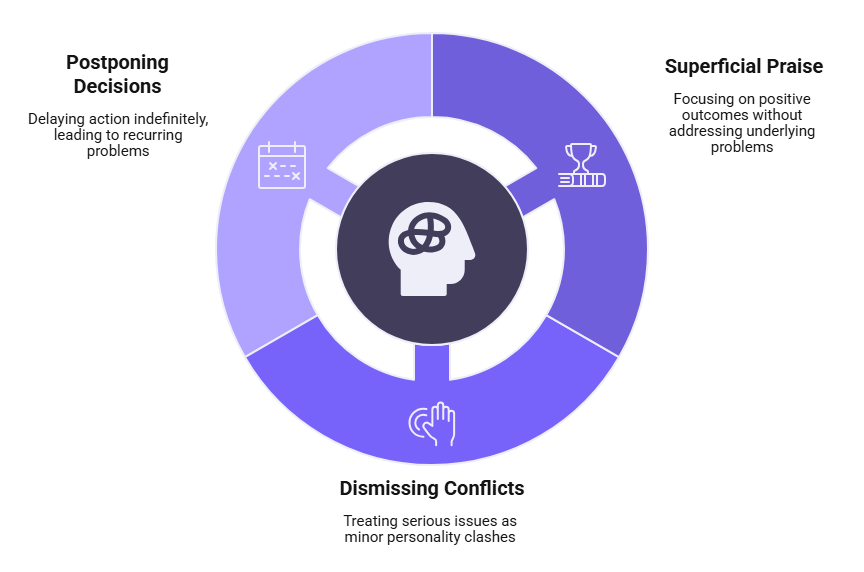
- A performance review that praises the fundraising numbers and doesn’t dig into complaints from program staff
- A board chair who hears about a conflict secondhand and treats it as a personality clash rather than a pattern
- A decision to address something “after the campaign wraps up” that keeps getting pushed to the next campaign
No single decision like that is made with bad intent. Enough of them, over enough time, can add up to the same protection pattern this article is describing, without anyone involved ever deciding to make that trade.
The Consequence Gap Report offers a useful, unglamorous way to think about why that trade-off tends to resolve the same way so often. Across industries, coworkers seen as more valuable to an organization, more senior, harder to replace, closer to the money, were rewarded or protected in 36% of documented cases and removed in only 21%. Coworkers seen as easier to replace faced close to the opposite pattern: protected in 24% of cases, removed in 41%. Nonprofit leadership sits at the far end of that spectrum. An executive director or a lead fundraiser is often seen as uniquely difficult to replace, which means the mechanism the report documents applies with unusual force.
The Math Behind a Thin Bench
The reason nonprofit boards feel that trade-off so acutely has a structural basis, visible directly in the sector’s own employment data. According to the most recent published estimates from the U.S. Bureau of Labor Statistics, 501(c)(3) nonprofits make up about 10% of private-sector employment nationally, but that figure is heavily weighted by hospitals and universities, where the average nonprofit establishment runs into the hundreds of employees. Those two sectors alone account for most nonprofit jobs in the country, which means the sector-wide average tells you almost nothing about what a typical community-based nonprofit actually looks like on the inside.
Outside those two sectors, the picture most people associate with “a nonprofit” looks very different, though it isn’t perfectly uniform:
| Nonprofit category (BLS classification) | Average employees per establishment |
| Religious organizations | 9 |
| Grantmaking and giving services | 9 |
| Social advocacy organizations | 10 |
| Business, professional, labor, political, and similar organizations | 11 |
| Civic and social organizations | 31 |
| Religious, grantmaking, civic, professional, and similar organizations (combined) | 13 |
(BLS, Monthly Labor Review, most recent published nonprofit establishment data)
Most of these categories run small, but civic and social organizations is a real exception, and it happens to account for more of this subsector’s total employment than any other single category. The combined average of 13 is the honest single number for the group as a whole; a congregation, an advocacy nonprofit, or a small foundation is more likely to sit at the smaller end of that range, while a civic or membership-based organization can run meaningfully larger.
A community-based nonprofit, an advocacy organization, or a small foundation with paid staff is typically running with well under 15 people on payroll. Losing an executive director or a head of development at an organization that size often means losing a tenth or more of the entire staff at once, along with whatever relationships and institutional memory that person carried. A board weighing whether to address a difficult leader’s behavior is really weighing that cultural cost against a genuinely hard-to-absorb operational hit, and the operational hit is the one that shows up first.
When the Fundraising Relationship and the Behavior Problem Are the Same Person
The dynamic can get sharper still with fundraisers specifically, because what makes them hard to replace isn’t a general skill. It’s a set of personal relationships with individual donors, and a board may reasonably worry that a donor’s loyalty sits with the person more than the institution, whether or not that turns out to be true in a given case. A major gifts officer who has spent a decade cultivating a handful of six-figure donors isn’t just an employee with good numbers, in that light, they can look like the thing standing between the organization and a meaningful share of its revenue.
That perception, whatever its accuracy in a specific case, changes the calculation in a specific way. Addressing a fundraiser’s conduct doesn’t just risk the cost of replacing one employee. It risks, in the board’s judgment, the relationships themselves. If a board leans on that reasoning even occasionally, it reinforces the same protection pattern documented above, layered with a financial anxiety specific to fundraising roles. The behavior doesn’t have to be dramatic to benefit from this dynamic. A development director who is quietly difficult to work with, who takes credit for junior staff’s cultivation work, who undermines coworkers while charming donors, could plausibly go unaddressed for a long time under the protection of a number the organization is afraid to jeopardize.
What the Research Says Happens When Mission Attachment Buys Protection
Protecting a toxic leader is rarely a decision anyone would defend outright if asked directly. It’s an understandable one in the moment, which is exactly what makes it durable. A board is rarely weighing “is this behavior acceptable” against a clear standard. It’s weighing a known, immediate risk, losing the person who runs the capital campaign or holds the funder relationships, against a diffuse cost that shows up gradually in other people’s morale, health, and eventual departure.
That same GCheck research found that where a difficult coworker was rewarded or protected instead of addressed, the people exposed to them left the job before that coworker did, at roughly four times the rate seen when the organization actually acted. Applied to a nonprofit already running on a thin staff, that finding points to something boards rarely connect to their own decision: protecting a toxic executive to avoid one costly departure can produce several more, driven by the program staff and coordinators who had to work around that person every day. A nonprofit that “cannot afford” to lose its executive director can, without realizing it, be paying for that decision in a slower, harder-to-trace bleed of the staff who actually run its programs.
There is a quieter version of this that’s worth naming alongside the dramatic one. A program coordinator who has absorbed an executive director’s behavior for two years doesn’t necessarily announce a grievance and resign. They might start applying elsewhere without saying why, stop bringing up problems in staff meetings because raising concerns hasn’t visibly changed anything, and eventually leave for a role that pays about the same, doing work that matters about as much to them. An organization can end up recording that departure internally as ordinary nonprofit-sector turnover. Read that way, nothing about the story shows up as a single traceable cost. It can instead show up as a program that’s perpetually short-staffed, a training budget that never stops being spent on onboarding, and a board left wondering why good people keep leaving.
Why Leadership Often Sits Outside the Screening Structure Entirely
There’s a second reason this problem persists in nonprofits specifically, and it has nothing to do with mission attachment. GCheck states this plainly on its own nonprofit screening page: board members and executive leadership frequently go unscreened despite holding fiduciary authority and organizational influence. Where a screening program exists at all in a resource-constrained nonprofit, it’s typically built around onboarding new staff and volunteers, things like Professional Reference Checks during the hiring process or Continuous Criminal Monitoring once someone is on staff. Those same tools are rarely extended to the people already at the top.
This isn’t a gap in how most HR or screening administrators do their jobs. Whether a screening program’s scope extends to executive leadership or the board is usually set well above that role, by whoever approves the budget and policy for who gets screened at all. The people running day-to-day screening are typically working within a scope someone else defined, and that scope, more often than not, was never asked to stretch upward.
That gap compounds the accountability problem rather than causing it on its own. The people closest to a toxic executive’s day-to-day conduct, program staff, coordinators, junior development team members, have almost no formal channel for raising it, and often no confidence that raising it would matter given who holds the fundraising relationships. The people with the standing to act, the board, typically meet a handful of times a year, interact with the executive director in a curated setting, and have the least visibility into daily conduct of anyone in the organization. Screening isn’t the fix for that gap by itself, no background check was ever going to surface an interpersonal pattern, but the absence of any structured oversight at the leadership level, screening included, means the board is often the last to know something staff have understood for years.
This is worth naming precisely, because it’s easy to conflate with the small-bench problem described above, and the two call for different responses. A thin staff bench is a resourcing constraint; a board can’t wish more capacity into existence overnight. A governance gap where leadership sits outside the organization’s own oversight structure is a choice, even when no one intended to make it, made by not extending existing practices upward rather than a hard constraint imposed by budget. It is also the easier of the two problems to fix.
What This Isn’t Arguing
This article isn’t arguing that ambitious fundraising targets or a demanding executive director are themselves the problem. Plenty of highly effective nonprofit leaders push their teams hard, set aggressive goals, and are difficult to replace precisely because they are excellent at the job. The pattern described here is narrower: a leader whose behavior toward coworkers, not their standards or their pace, consistently makes the job harder, and whose fundraising value or institutional knowledge becomes the reason that specific behavior goes unaddressed. Conflating high expectations with toxic conduct does a disservice to both the leaders who hold a high bar fairly and the staff dealing with something categorically different.
What Actually Helps

The fix here has nothing to do with watching nonprofit leaders more closely. The Consequence Gap Report found that, across industries, employees ranked managers addressing problems early and consequences that hold regardless of performance as the top two fixes for this pattern, well ahead of anything about softer standards. Applied to a nonprofit board, that translates into a small number of concrete practices:
- Extend whatever screening and oversight the organization already applies to staff and volunteers, Professional Reference Checks and Continuous Criminal Monitoring included, to executive leadership and board members as a matter of course, not as an exception triggered by a complaint. A governance gap that exists by default, rather than by decision, tends to persist until someone decides to close it.
- Build a confidential channel for staff to raise a concern about senior leadership specifically, separate from the reporting line that runs through that same leadership. A reporting structure that routes concerns about the executive director through the executive director is not a reporting structure at all.
- Treat fundraising performance and organizational conduct as two separate questions in any leadership review, so one cannot quietly buy protection from the other. A strong fundraising year and a pattern of complaints about how that fundraising happened are two different findings, and a review that only asks about the first will never surface the second.
- Give the board a way to hear from staff directly, on a regular cadence, rather than only through the executive director’s own reporting. This does not need to be elaborate. A short, anonymous staff survey reviewed once or twice a year by the board chair, independent of the executive director’s own reporting, closes most of the visibility gap on its own.
A board doesn’t have to pretend the budget math away to hold this standard. Losing an executive director or a lead fundraiser is a real, immediate risk to a nonprofit running on a thin margin, and addressing a leader’s conduct doesn’t make that risk disappear. But treating the staffing risk as fixed and the accountability standard as the thing that flexes is exactly the trade that leaves mission-aligned staff, and ultimately the people the organization exists to serve, carrying the cost. This is a Protective Compliance question at its core, protecting the staff and the communities a mission depends on, and a Fair Compliance one as well, since the standard an organization holds its people to shouldn’t depend on how hard that person would be to replace.
The mission focus that defines the nonprofit sector is exactly why the fix here is more about visibility than willpower, not a sign that nonprofits care less about their people than other organizations do. A board with a clear, well-documented pattern in front of it is generally in a position to act on it; the harder part is building the structure that surfaces one before the budget conversation drowns it out. Naming the budget pressure as the reason a standard slipped is not the same as accepting that it has to.
Frequently Asked Questions
Why do nonprofits keep toxic leaders instead of addressing their behavior?
Nonprofits often run with a small staff and a tight budget, which makes losing an executive director or lead fundraiser feel like an immediate, costly risk. Boards weigh that visible cost against the harder-to-trace damage the leader’s behavior causes to staff, and research on this pattern across industries found that more valuable or senior coworkers are rewarded or protected at a notably higher rate than easier-to-replace ones, even though the long-term price of that protection is often higher.
How small is the average nonprofit staff, really?
It depends heavily on the type of nonprofit. Hospitals and universities skew the sector’s averages upward, but outside those two categories, BLS data puts the combined average at 13 employees per establishment. Individual categories vary: religious organizations and grantmaking groups average around 9, while civic and social organizations, a large share of the subsector’s employment, average closer to 31.
Are nonprofit boards and executive directors usually background checked?
Often not to the same standard as staff and volunteers. GCheck notes this on its own nonprofit screening page: board members and executive leadership frequently go unscreened despite holding fiduciary authority and organizational influence, since screening programs like Professional Reference Checks and Continuous Criminal Monitoring tend to be built around onboarding new hires rather than existing leadership.
Does protecting a toxic executive actually cost a nonprofit more staff?
Research on this pattern across industries found that when a difficult coworker was rewarded instead of addressed, exposed coworkers left the job before that coworker did about four times as often as when the organization actually acted. Applied to an already thin nonprofit staff, that turnover is a real operational cost, not just a morale issue.
What can a nonprofit board do about a toxic but valuable leader?
Extend the same screening and oversight already used for staff to executive leadership and board members, create a confidential way for staff to raise concerns about senior leadership specifically, and evaluate fundraising performance and conduct as separate questions so one can’t buy protection from the other.

ABOUT THE CREATOR
Charm Paz, CHRP
Recruiter & Editor
Charm Paz is an HR professional at GCheck, specializing in background screening, fair hiring, and regulatory compliance. She holds from the Professional Background Screening Association (PBSA) and helps organizations navigate employment regulations with clarity and confidence.
With a background in Industrial and Organizational Psychology, she translates policy into practice to build ethical, compliant, human-centered hiring systems that strengthen decision-making over time.