

A healthcare staffing background check bundles criminal history, license verification, and federal or state exclusion screening before a clinician starts an assignment. Liability for a missed exclusion sits with the healthcare facility, not the staffing agency, even when the agency ran the check.
Key takeaways
- A healthcare staffing background check is five separate verifications, not one report: criminal history, license verification, exclusion screening, abuse registry checks, and drug testing.
- The healthcare facility carries the civil monetary penalty exposure for an excluded placement, not the staffing agency, even when the agency was contractually responsible for screening.
- A facility can reduce that exposure only by showing it “reasonably relied” on the agency: a signed contract naming the screening obligation, plus documented, ongoing follow-up.
- HHS-OIG recommends monthly exclusion rechecks for current employees and contractors, not a one-time check at hire, because the exclusion list itself updates monthly.
- State Medicaid programs can layer their own monthly screening requirements on top of federal LEIE guidance, so confirming state-specific rules matters alongside federal compliance.
- Per diem and travel placements carry the same liability exposure as permanent hires and warrant the same screening standard, not a lighter one.
- The FCRA’s disclosure, consent, and adverse action sequence applies whether the facility or the staffing agency is the party that orders the report.
What a healthcare staffing background check covers
The five verification components
A background check for a healthcare placement is a bundle of separate verifications, each answering a different question about the candidate.
| Component | What it verifies |
| Criminal history | Nationwide database search plus county-level court records, since many relevant convictions sit only at the county level |
| License verification | Active credential in good standing in the state where the assignment takes place |
| Exclusion screening | Status on HHS-OIG’s List of Excluded Individuals and Entities, the GSA’s System for Award Management, and applicable state Medicaid exclusion lists |
| Abuse registry checks | State abuse and neglect registries relevant to direct patient care roles |
| Drug testing | Pre-placement screening, and in many programs, periodic testing thereafter |
Employers must give candidates written notice that a consumer report may be obtained for employment purposes, and get written authorization before ordering one, per the joint guidance the Federal Trade Commission and the Equal Employment Opportunity Commission issued for employers using background checks (FTC, Background Checks: What Employers Need to Know). That notice-and-consent obligation applies whether the check is run by the facility directly or by the staffing agency that places the worker.
Getting every one of these pieces right across the full length of a placement, not only at the point of hire, is what GCheck calls Compliance for Good®: an operating standard built on three pillars, one of which is Protective Compliance, verification that safeguards vulnerable populations and reduces organizational risk, with human judgment over fully automated decisions and secure data handling. The rest of this article works through what that looks like specifically for exclusion screening in a staffing context.
How exclusion screening differs from other sanction databases
Exclusion screening is often confused with other federal sanction databases, and the distinction matters for what a staffing program actually needs to check. The LEIE is maintained directly by HHS-OIG, updated monthly, and lists only exclusion actions taken by OIG itself. It includes detail the other databases don’t, such as the statutory basis for the exclusion and the person’s occupation at the time they were excluded.
The GSA’s SAM, which absorbed the older Excluded Parties List System in 2012, is broader: it includes OIG’s exclusions plus debarment actions from other federal agencies unrelated to healthcare fraud. OIG has no authority to impose civil monetary penalties for employing someone debarred but not excluded, which is why the bulletin recommends the LEIE, not SAM alone, as the primary source. A third database, the National Practitioner Data Bank, tracks something different: malpractice payments, adverse licensing and privileging actions, and peer review findings. OIG still recommends the LEIE as the primary tool for exclusion screening specifically, so a program checking only SAM or only the NPDB is checking the wrong database for the liability this article addresses.
Why liability for an excluded placement stays with the facility
Exclusion is a federal sanction: under Section 1128 of the Social Security Act, HHS-OIG can bar an individual or entity from participating in any federal healthcare program. Once excluded, that person cannot be paid, directly or indirectly, with Medicare, Medicaid, or other federal healthcare program funds for any item or service they furnish, including administrative and support roles unless those roles are wholly unrelated to a federal healthcare program.
A civil monetary penalty, or CMP, is the financial exposure a healthcare organization faces if it employs or contracts with an excluded individual. Under the bulletin’s own figures, OIG may impose a CMP of up to $10,000 per item or service furnished by the excluded person, plus an assessment of up to three times the amount claimed, on top of possible program exclusion for the facility. The penalty can apply regardless of whether the organization knew about the exclusion at the time. The bulletin addresses the staffing scenario directly: if a hospital contracts with a staffing agency for temporary or per diem nurses, the hospital faces overpayment liability, and potentially CMP liability, if an excluded nurse from that agency furnishes services billed to a federal healthcare program. Delegating the screening function to the agency does not, by itself, transfer that exposure away from the facility.
This is not a theoretical risk. In March 2015, Flexible Staffing Solutions, Inc., doing business as OneSource Medical Staffing, settled with HHS-OIG for $24,775.56 after placing a licensed practical nurse who had been excluded from federal healthcare programs at nursing facilities that billed federal programs for her services (HHS-OIG, Pennsylvania Staffing Agency Settles Case Involving Excluded Individual, March 17, 2015). That settlement fell on the staffing agency in this instance. The bulletin’s underlying rule cuts the other way for the receiving facility: billing for an excluded worker’s services creates the facility’s own overpayment and CMP exposure, regardless of what the placing agency did or didn’t verify.
How state Medicaid programs add another layer
Federal exclusion screening through the LEIE is not the only obligation a healthcare staffing arrangement has to satisfy. In January 2009, the Centers for Medicare and Medicaid Services issued a State Medicaid Director Letter recommending that states require providers to screen all employees and contractors against exclusion lists on a monthly basis. In 2011, CMS went further and issued final regulations requiring states to screen all enrolled Medicaid providers monthly, codified at 42 CFR § 455.436 (HHS-OIG, Special Advisory Bulletin on the Effect of Exclusion from Participation in Federal Health Care Programs, May 8, 2013).
That regulation targets enrolled Medicaid providers rather than every individual employee by default, though CMS has recommended states extend the same monthly cadence more broadly, citing managed care entities as its example. Separately, and directly on point here, OIG’s own guidance names nurses supplied by staffing agencies as one of the highest-priority categories for this screening, alongside emergency room physician groups and billing or coding contractors, since these roles are most likely payable by a federal healthcare program. Either way, federal CMP exposure doesn’t disappear based on what a state has adopted, so confirming the applicable state Medicaid exclusion list and cadence is necessary alongside, not instead of, LEIE and SAM screening.
What “reasonably relied” actually requires from a staffing partner
A facility that contracts with a staffing agency for temporary or per diem clinicians can reduce its own CMP exposure if it can show it “reasonably relied” on the agency to perform exclusion screening. HHS-OIG’s guidance ties that standard to two concrete practices, stated in the bulletin itself: the staffing agency has agreed by contract to perform the exclusion screening, and the facility has exercised due diligence in confirming the agency is actually meeting that contractual obligation, not just at the point of initial placement.
In practice, that means a facility working with a staffing partner needs three things on file:
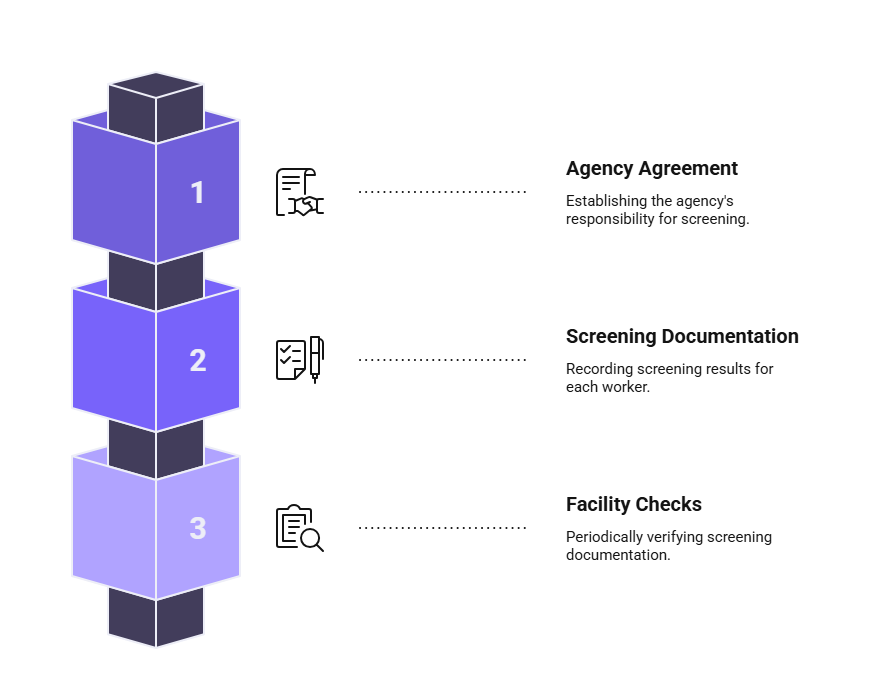
- A signed agreement naming exclusion screening as the agency’s responsibility
- Documentation showing the screening was actually performed for each placed worker
- A record of the facility periodically checking that documentation, rather than taking the agency’s word for it once and filing it away
A staffing agency that cannot readily produce that documentation, or that goes quiet when asked for it, is telling the facility something important about where its own compliance program stands.
Why a check completed at placement stops reflecting reality
The Verification Half-Life concept
A background check answers one question: was this person clear of disqualifying findings on the day the check ran. It says nothing about the day after. A worker can pick up an exclusion, lose a license, or acquire a disqualifying conviction at any point during an assignment, and the original report will not reflect any of it.
GCheck describes this using the concept of Verification Half-Life: the idea that a completed background check has a shelf life, and its usefulness to a decision made months later declines the further that decision sits from the day the check was run. This is a conceptual frame for thinking about screening currency, not a measured rate of decay, and it applies to background checks broadly rather than to any single credential type.
What the guidance and the data both say
HHS-OIG’s own guidance reflects the same concern, and it is more specific than a general recommendation to “check periodically.” Because the exclusion list is updated monthly, OIG’s stated position is that screening employees and contractors each month is what best minimizes overpayment and CMP liability, on top of the requirement to check before hiring or placing someone in the first place. A staffing program that treats exclusion screening as a one-time gate at placement is working from a report that goes stale the day it is issued. Rechecking is not about watching the workforce; it is about keeping the compliance record as current as the placement itself, so both the facility and the worker can stand behind it.
This appetite for ongoing verification is not confined to healthcare. 80% of workers say ongoing or periodic screening is important, not just a one-time check at hire, and 88% agree that candidates who misrepresent their skills or background create risk for businesses (GCheck, 2026 Trust in Hiring Report). That combination, workers themselves asking for periodic rechecks alongside a shared sense that unexamined misrepresentation carries real business risk, lines up with what HHS-OIG’s exclusion-screening guidance already expects. The gap is less about whether monthly rescreening matters and more about whether staffing programs are actually built to do it.
Per diem and travel placements deserve the same standard, not a lighter one
Travel and per diem clinicians routinely move between facilities and carry active relationships with more than one staffing agency at a time. That turnover creates a temptation to treat short-term placements as lower priority for screening rigor than permanent hires, on the logic that a brief assignment carries less risk than a career-length one.
That logic does not hold up against the liability structure described above. The facility’s exposure to a CMP does not scale down because the excluded worker was only there for a few months, and a short assignment that involves billing federal healthcare programs carries the same exclusion risk as a permanent one. This is also the Fair Compliance argument in practice: an individualized, bias-minimizing assessment applied to a consistent standard, rather than a lighter one for workers who happen to move between assignments more often.
| Screening element | Permanent hire | Per diem or travel placement |
| Criminal history | Required | Required |
| License verification | Required | Required |
| Exclusion screening | Required | Required |
| Monthly recheck | Required | Required |
FCRA obligations apply whether the facility or the agency runs the check
The Fair Credit Reporting Act governs background checks whenever a third-party consumer reporting agency prepares a report for employment purposes, and a staffing agency running checks on behalf of a facility falls squarely inside that framework.
| Step | Requirement |
| 1. Disclosure | Standalone written notice that a consumer report may be obtained for employment purposes |
| 2. Authorization | Written consent from the candidate before the report is ordered |
| 3. Pre-adverse action | A copy of the report and a reasonable opportunity to review and dispute it before a final decision |
| 4. Adverse action | A final notice if the decision proceeds, along with a summary of the candidate’s rights |
None of this changes when a staffing agency, rather than the facility, is the party that requested the report (FTC, Background Checks: What Employers Need to Know). The agency holds the FCRA obligations for the check it runs, and the facility should confirm the agency’s process covers the full sequence above, the same way it confirms the agency’s exclusion-screening process. Secure handling and disposal of the underlying data matters here too: 76% of workers say they want secure data storage and deletion as part of how a screening program treats their information (GCheck, 2026 Trust in Hiring Report).
Frequently asked questions
Who is liable if a healthcare staffing agency places an excluded worker?
The healthcare facility that bills for the worker’s services carries the civil monetary penalty exposure, not the staffing agency, even when the agency was contractually responsible for screening. A facility can reduce that exposure by showing it reasonably relied on a documented, verified screening process.
How often should a healthcare organization check the OIG exclusion list?
HHS-OIG recommends checking before hiring or placement and then monthly for current employees and contractors, since the exclusion list itself is updated on a monthly basis.
Do per diem and travel healthcare workers need a new background check for every assignment?
The liability a facility carries does not shrink for a short assignment, so applying the same screening and periodic-rescreening standard to per diem and travel placements as to permanent hires is the more defensible approach, even though the logistics of repeat screening for a high-turnover workforce are genuinely harder to manage.
Does the FCRA apply when a staffing agency, not the facility, runs the background check?
Yes. The FCRA governs any background check prepared by a third-party consumer reporting agency for employment purposes, which includes checks a staffing agency runs on a facility’s behalf. Disclosure, authorization, and adverse action requirements apply to whichever party orders the report.
What should a facility ask a staffing partner for to document “reasonably relied” screening?
A written agreement naming the agency as responsible for exclusion screening, documentation that the screening was actually performed for each placed worker, and evidence that the facility periodically checks that documentation rather than accepting it once at the start of the relationship.
What is the difference between the LEIE and the SAM exclusion list?
The LEIE is maintained directly by HHS-OIG, updated monthly, and lists only OIG’s own exclusion actions. SAM is broader and includes debarment actions from other agencies alongside OIG exclusions, but OIG cannot impose civil monetary penalties based on a debarment alone. HHS-OIG recommends the LEIE as the primary source for exclusion screening.
Sources cited
- U.S. Department of Health and Human Services, Office of Inspector General. (2013, May 8). Updated Special Advisory Bulletin on the Effect of Exclusion from Participation in Federal Health Care Programs. https://oig.hhs.gov/documents/special-advisory-bulletins/881/sab-05092013.pdf
- U.S. Department of Health and Human Services, Office of Inspector General. (2015, March 17). Pennsylvania Staffing Agency Settles Case Involving Excluded Individual. https://oig.hhs.gov/fraud/enforcement/pennsylvania-staffing-agency-settles-case-involving-excluded-individual
- Federal Trade Commission. (2014, February). Background Checks: What Employers Need to Know. https://www.ftc.gov/business-guidance/resources/background-checks-what-employers-need-know
- GCheck. (2026). 2026 Trust in Hiring Report (n=1,500). Protective Compliance pillar figures: 80% ongoing screening importance (PERCEPTION); 88% misrepresentation creates business risk (PERCEPTION); 76% secure data handling preference (PERCEPTION). Question IDs pending, raw Pollfish CSV not available for recomputation. Not yet cleared for publication.

ABOUT THE CREATOR
Charm Paz, CHRP
Recruiter & Editor
Charm Paz is an HR professional at GCheck, specializing in background screening, fair hiring, and regulatory compliance. She holds from the Professional Background Screening Association (PBSA) and helps organizations navigate employment regulations with clarity and confidence.
With a background in Industrial and Organizational Psychology, she translates policy into practice to build ethical, compliant, human-centered hiring systems that strengthen decision-making over time.