

Federal auditors are actively investigating whether nursing home workers were properly screened before their first shift, and the results so far are alarming. We ranked 10 applicant tracking systems on the one feature that matters most in long-term care hiring: how well the platform handles background screening, exclusion monitoring, license verification, and compliance documentation as a built-in workflow rather than a manual afterthought. The gap between the top-scoring and lowest-scoring platforms is significant, and understanding why could change how your facility approaches its next ATS decision.
Key Takeaways:
- Recent OIG audits found that most nursing homes reviewed across multiple states failed to fully comply with federal background check requirements, with some facilities allowing staff to provide resident care before screening was completed.
- Long-term care background screening goes far beyond a criminal check. A complete screening file requires nurse aide registry queries, OIG and SAM exclusion checks, state abuse registry searches, and primary-source license verification, all documented before a worker’s first shift.
- Not every ATS handles background screening the same way. The difference between native partner integrations that automate and document the process inside the platform versus manual export workflows that force recruiters into separate systems has real consequences for audit readiness.
- CNA turnover in nursing homes still exceeds 42%, which means facilities are running the full screening cycle constantly. An ATS that cannot support that volume with automated, role-based, multi-state compliance workflows creates compounding risk with every new hire.
- A screening completed on the hire date is not enough. OIG has specifically cited automated continuous monitoring, including monthly exclusion checks and license expiration tracking, as an effective compliance practice for long-term care facilities.
Long-term care employers need applicant tracking systems that do more than manage resumes. They need platforms where background screening, exclusion monitoring, license verification, and compliance documentation are built into the hiring workflow, not bolted on after the fact. The best ATS for a skilled nursing facility is the one that can prove every worker with resident access was screened, documented, and cleared before the first shift.
This ranking evaluates 10 ATS platforms on how well they support background screening integration, regulatory compliance, and the specific hiring challenges facing nursing homes and skilled nursing facilities in current context.
Why Background Screening Integration Is the Most Important ATS Feature in Long-Term Care
Nursing homes operate under intense regulatory scrutiny. The HHS Office of Inspector General has been conducting a multi-state audit series focused specifically on whether nursing home employees were properly screened before beginning work. In New Jersey, OIG found that 11 of 12 selected nursing homes failed to comply with federal background check requirements. In Alabama, 139 of 439 sampled employees had missing or incomplete screening documentation.
These are not isolated problems. Federal regulation 42 CFR 483.12(a)(3) prohibits facilities from employing individuals with specific disqualifying findings related to abuse, neglect, exploitation, or misappropriation. For other criminal history findings, EEOC guidance and the FCRA still require employers to conduct individualized, job-related assessments rather than applying blanket disqualification policies. Beyond criminal checks, facilities must verify nurse aide registry status, OIG LEIE exclusion lists, SAM databases, state Medicaid exclusion lists, and professional licenses at the primary source. CNA turnover in nursing homes still hovers above 42%, which means facilities are cycling through this screening process constantly, and each cycle requires proper candidate disclosure and written authorization under the FCRA.
An ATS that cannot handle these requirements through automated, documented workflows forces HR staff to manage compliance manually. In an industry where a single documentation gap can trigger survey citations and Medicaid reimbursement risk, the screening integration model is the most consequential technology decision an HR leader in long-term care can make.
The 10 ATS Platforms Compared
1. Paycom
Paycom is a major HCM platform serving over 36,000 clients with a single-database approach unifying payroll, HR, and talent acquisition. Its ATS includes built-in screening functionality with FCRA-compliant disclosure and consent capture.
Background screening features:
- Internal background check ordering within the same platform used for payroll and HR
- FCRA disclosure and candidate consent built into the workflow
- Recurring employee screening for current staff (subject to proper authorization and state law requirements)
- E-Verify integration for employment eligibility
Considerations for long-term care: Paycom’s screening runs through its own proprietary system, which limits flexibility for facilities needing specialized healthcare screening packages. There is no documented native support for nurse aide registry checks, OIG/SAM exclusion monitoring, or state-specific abuse registry searches. Multi-state facilities may find the approach difficult to customize for role-based packages across CNAs, RNs, LPNs, and therapists.
2. UKG Pro
UKG Pro is one of the most widely adopted enterprise HCM platforms in healthcare and long-term care. A case study with NHS Management, supporting skilled nursing and rehab facilities across Alabama, Arkansas, and Florida, documented a 66% reduction in time-to-hire.
Background screening features:
- Robust partner ecosystem for background screening through marketplace integrations
- API-based connectivity that supports real-time status updates and audit trails
- Role-based screening package configuration across multiple facilities and states
- Compliance workflow support for FCRA pre-adverse and adverse action steps
Considerations for long-term care: UKG Pro’s strength in long-term care is well established. The platform supports multi-facility operations, state-specific compliance configurations, and credentialing workflows nursing homes need. Its integration ecosystem connects specialized healthcare screening providers that handle OIG/SAM monitoring, nurse aide registry checks, and license verification. UKG Ready extends similar capabilities to smaller operators.
3. Zoho Recruit
Zoho Recruit is part of the Zoho ecosystem and is widely adopted by small and mid-sized organizations. It offers a cost-effective ATS with customizable workflows and a marketplace of integrations.
Background screening features:
- Marketplace integrations with select background check providers
- Customizable hiring pipelines and workflow stages
- API access for connecting third-party screening tools
- Candidate communication automation
Considerations for long-term care: Zoho Recruit is designed for general-purpose recruiting, and its screening integrations focus on standard criminal and employment verification. The platform lacks native support for healthcare-specific compliance workflows such as exclusion monitoring, abuse registry queries, or primary-source license verification. Multi-state nursing home operators may find the integration depth insufficient for audit-ready documentation.
4. Apploi
Apploi was built specifically for healthcare hiring, with particular strength in skilled nursing and senior living. The platform integrates with PointClickCare, the dominant EHR in skilled nursing, and supports the full hiring lifecycle from job distribution through onboarding.
Background screening features:
- Healthcare-specific screening partner ecosystem with native integrations
- Credential tracking and license expiration monitoring
- Digital onboarding with compliance documentation built into the workflow
- Multi-facility candidate management with role-based screening triggers
Considerations for long-term care: Apploi is purpose-built for the exact hiring environment nursing homes operate in. Its integration with PointClickCare means hiring data flows into the clinical and operational systems where staffing compliance is tracked. The platform supports documentation workflows that OIG auditors look for: proof that screening was completed before resident access, credential verification timelines, and ongoing monitoring records.
5. Breezy HR
Breezy HR is a popular, user-friendly ATS that appeals to small and mid-sized businesses with drag-and-drop pipeline management and affordable pricing.
Background screening features:
- Integrations with background check providers like Checkr
- Automated candidate communication and scheduling
- Customizable pipeline stages
- Team collaboration tools for hiring decisions
Considerations for long-term care: Breezy HR is a solid general-purpose ATS, but its screening ecosystem is limited to basic criminal and identity checks. It does not offer healthcare-specific compliance features such as OIG/SAM exclusion monitoring, nurse aide registry verification, or primary-source license verification workflows. Multi-state nursing home operators will likely need to manage significant compliance work outside the system.
6. ClearCompany
ClearCompany is a talent management platform gaining traction across industries, including healthcare. Its ATS is part of a broader suite covering performance management, onboarding, and workforce planning.
Background screening features:
- Integrated background screening with partner providers through native marketplace connections
- Automated adverse action workflows with FCRA-compliant notice generation
- Configurable screening packages by role, department, and location
- Onboarding compliance checklists and document management
Considerations for long-term care: ClearCompany’s screening integration model supports the multi-layered approach nursing homes need. Role-based screening configurations allow facilities to assign different packages to CNAs, licensed nurses, therapists, and administrative staff. The adverse action workflow is particularly relevant where the distinction between mandatory disqualifiers and findings requiring individualized assessment is critical for compliance and fair hiring.
7. Pinpoint
Pinpoint is a growing ATS positioned for healthcare and social care recruiting, with multi-site hiring support and compliance workflows.
Background screening features:
- Integrations with screening providers through its partner ecosystem
- Role-specific workflow customization
- Audit trail and compliance documentation
- Multi-site hiring management
Considerations for long-term care: Pinpoint is relatively newer to the healthcare space and its screening partner ecosystem is still developing. While it offers compliance-oriented features and multi-site management, the depth of integration for healthcare-specific checks like OIG/SAM monitoring and nurse aide registries may require additional manual processes.
8. Fountain
Fountain is the leading platform for high-volume frontline hiring, serving healthcare, logistics, retail, and hospitality. It processes millions of hires annually and is built for the speed that nursing home recruiting demands, where CNA and aide positions may need filling within days.
Background screening features:
- Native background screening integrations built into the hiring workflow
- Compliance management product with document verification and I-9 processing
- Mobile-first candidate experience with credential upload capabilities
- Automated routing based on screening status and knockout question responses
Considerations for long-term care: Fountain’s strength is speed without sacrificing compliance steps. In an industry where OIG audits have found staff providing care before screening was completed, Fountain’s automated workflow ensures candidates cannot advance past screening stages until documentation is verified. Its mobile-first design is relevant for CNA and aide candidates who apply from their phones, and its compliance product creates the audit trail nursing homes need.
9. Hireology
Hireology is a recruiting platform popular in franchise, automotive, and healthcare sectors, with built-in background screening used by some home care agencies and multi-location healthcare businesses.
Background screening features:
- Built-in background check ordering within the platform
- Candidate verification workflows
- Multi-location hiring management
- Onboarding and employee management tools
Considerations for long-term care: Hireology’s screening capabilities are adequate for standard employment checks, but the platform was not designed for the regulatory complexity of skilled nursing. Facilities subject to 42 CFR requirements, OIG exclusion monitoring, and multi-state abuse registry searches may find that significant compliance work must happen outside the ATS. The platform has stronger roots in home care and franchise models than in facility-based long-term care.
10. Symplr (formerly HealthcareSource)
Symplr is the only platform on this list built exclusively for healthcare workforce management. Its ATS is designed for hospitals, health systems, and senior living operators, with specialized credentialing, compliance, and clinical hiring tools.
Background screening features:
- Healthcare-specific screening partner integrations
- Credential management and license verification tracking
- Behavioral assessments designed for healthcare roles
- Senior living hiring workflows with compliance documentation
Considerations for long-term care: Symplr’s background in healthcare operations gives it a structural advantage for nursing home hiring. The platform understands the difference between a standard criminal check and a complete long-term care screening file that includes registry queries, exclusion monitoring, and license verification. Its Symplr Hiring product was designed for senior care providers with decentralized hiring, which is the reality for most multi-facility nursing home operators.
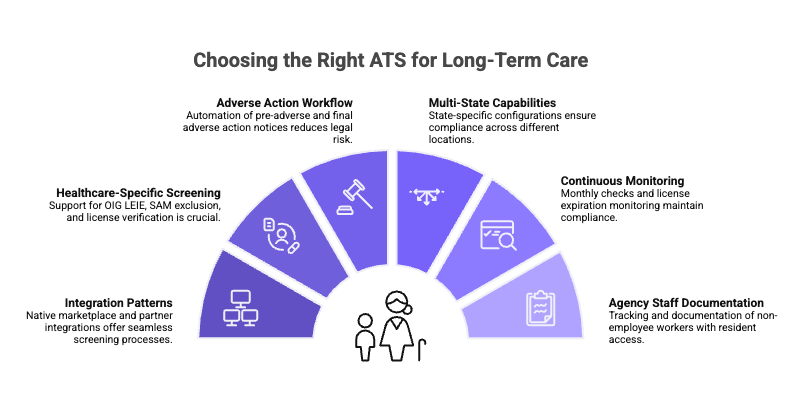
Screening Integration Scorecard: How These ATS Platforms Compare
Not all integration models are equal. The three primary patterns are native marketplace/partner integration (screening triggered and tracked inside the ATS), API/webhook custom integration (data flows between ATS and screening provider), and manual export/portal process (recruiters leave the ATS to initiate screening separately).
The following scorecard rates each platform across five categories critical to long-term care compliance, using a 1 to 5 scale.
| ATS | Screening Depth | LTC Compliance Fit | Multi-State Support | Audit Trail Quality | Overall |
| UKG Pro | 5 | 5 | 5 | 5 | 5.0 |
| Symplr | 5 | 5 | 5 | 5 | 5.0 |
| Apploi | 5 | 5 | 4 | 5 | 4.8 |
| Fountain | 4 | 4 | 4 | 5 | 4.3 |
| ClearCompany | 4 | 4 | 4 | 4 | 4.0 |
| Paycom | 3 | 2 | 3 | 4 | 3.0 |
| Hireology | 3 | 3 | 3 | 3 | 3.0 |
| Pinpoint | 3 | 3 | 3 | 3 | 3.0 |
| Breezy HR | 2 | 2 | 2 | 2 | 2.0 |
| Zoho Recruit | 2 | 1 | 2 | 2 | 1.8 |
The platforms that score highest share common characteristics: robust partner ecosystems for healthcare-specific screening, native multi-layered compliance workflows, configurable role-based screening packages, and audit trails that survive staff turnover. These features separate an ATS that supports a defensible long-term care screening program from one that simply processes applications.
How to Choose an ATS With the Best Background Screening Features for Long-Term Care
Selecting an ATS based on screening capabilities requires evaluating the integration model, not just the feature list.
1. Identify the integration pattern. Native marketplace and partner integrations are the strongest model for long-term care. These allow screening to be initiated, tracked, and documented within the ATS. API/webhook integrations offer similar data flow but may require more technical setup. Manual export processes, where a recruiter copies candidate data into a separate portal, create documentation gaps and slow hiring.
2. Confirm healthcare-specific screening support. A long-term care screening program requires more than criminal checks. Ask whether the ATS and its screening partners support OIG LEIE and SAM exclusion checks, nurse aide registry queries, state-specific abuse and neglect registry checks, and primary-source license verification for RNs, LPNs, therapists, and administrators.
3. Evaluate adverse action workflow support. FCRA requires a pre-adverse action notice, a copy of the consumer report, and a Summary of Rights before making a final decision. If the employer proceeds, a final adverse action notice must follow. The EEOC requires that criminal-record screening be job-related and consistent with business necessity. An ATS that automates these steps reduces legal risk significantly.
4. Test multi-state and multi-facility capabilities. Nursing home operators in multiple states must manage different screening requirements, ban-the-box timing rules, lookback period restrictions, and jurisdiction-specific disclosure and authorization forms. The ATS should support state-specific configurations that adjust based on facility location.
5. Demand continuous monitoring support. A hire-date screening is not enough. Monthly OIG/SAM checks, license expiration monitoring, and nurse aide registry re-verification should be supported through the platform or its integrated screening partners. OIG’s November 2024 assessment of the National Background Check Program cited automated monitoring as an effective compliance practice.
6. Verify agency and contract staff documentation. CMS requires facilities to report staffing data for direct-care, agency, and contract staff through the Payroll-Based Journal system. The ATS should support documentation and tracking for non-employee workers with resident access.
What Long-Term Care Employers Should Prioritize Now
The OIG’s ongoing audit series has made background check compliance a top enforcement priority. Nursing homes that cannot document when screening was completed, which checks were included, and whether all required registries were queried face survey citations, reimbursement risk, and reputational damage.
The platforms that rank highest in this analysis share a critical trait: they treat background screening as a core workflow, not an afterthought. For long-term care employers evaluating ATS platforms, screening integration quality should carry at least as much weight as job posting, candidate sourcing, or interview scheduling.
In a sector where CNA turnover exceeds 42%, where 90% of providers report recruitment difficulties, and where federal auditors are checking whether workers were screened before their first shift, the compliance infrastructure of the ATS is the foundation everything else depends on.
Additional Resources
- HHS OIG Series: Background Checks for Nursing Home Employees (Work Plan W-00-24-31553) https://oig.hhs.gov/reports/work-plan/browse-work-plan-projects/w-00-24-31553/
- OIG New Jersey Nursing Home Background Check Audit (December 2025) https://oig.hhs.gov/reports/all/2025/new-jersey-should-improve-its-oversight-of-nursing-homes-compliance-with-background-check-requirements/
- OIG Alabama Nursing Home Background Check Audit (August 2025) https://oig.hhs.gov/reports/all/2025/alabama-did-not-always-verify-selected-nursing-homes-compliance-with-background-check-requirements/
- AHCA Nursing Home Workforce Report (January 2026) https://www.ahcancal.org/News-and-Communications/Press-Releases/Pages/Report-Nursing-Homes-Making-Significant-Progress-Workforce.aspx
- 2025-2026 Nursing Home Salary and Benefits Report: Turnover Data https://www.ahcancal.org/News-and-Communications/Blog/Pages/2025%E2%80%932026-Nursing-Home-Report-Reveals-Lower-Turnover.aspx
- UKG Rapid Hire Case Study: NHS Management Long-Term Care (January 2026) https://www.businesswire.com/news/home/20260120415586/en/Long-Term-Care-Provider-Reduces-Time-to-Hire-by-66-Drives-2.2-Million-in-New-Revenue-with-UKG-Rapid-Hire

ABOUT THE CREATOR
Charm Paz, CHRP
Recruiter & Editor
Charm Paz is an HR professional at GCheck, specializing in background screening, fair hiring, and regulatory compliance. She holds from the Professional Background Screening Association (PBSA) and helps organizations navigate employment regulations with clarity and confidence.
With a background in Industrial and Organizational Psychology, she translates policy into practice to build ethical, compliant, human-centered hiring systems that strengthen decision-making over time.