

Careerfishing, the systematic embellishment of qualifications as a deliberate hiring strategy, shows up more often in hospitality than in most industries for a specific, measurable reason. The sector’s quits rate ran at 4.5% in June 2026, roughly double the total private-sector average of 2.2%, which means hospitality employers run more hiring cycles, with less time per cycle, than almost anyone else.
Key Takeaways
- Hospitality’s quits rate has run roughly double the total private-sector average through 2026, per BLS data, meaning more frequent hiring with less time to verify each candidate
- The Trust in Hiring Report found 53% of embellishers did so because they believed employers would not verify everything (PERCEPTION), and only 26% report ever being detected (INCIDENCE)
- Several of the claims most likely to be embellished in hospitality, food handler certification, responsible alcohol service certification, carry direct guest-safety consequences, not just a fit-for-role question
- The fix is not slower hiring across the board; it is knowing which specific claims are cheap to fabricate and rarely checked before a shift starts
- If a verification finding leads to declining or removing a placement, that decision is an adverse action under the FCRA regardless of how compressed the hiring timeline was
What Careerfishing Looks Like on a Hospitality Floor
Careerfishing, a term coined in GCheck’s own research, describes the systematic embellishment, distortion, or fabrication of professional qualifications as a deliberate competitive strategy, driven by market pressure and weak verification expectations. In a hospitality setting, it rarely looks like a fabricated resume from top to bottom. It looks like small, specific claims that are easy to make and, in practice, rarely checked before someone starts a shift: a food handler card the applicant says they hold but never produces, a claimed year of supervisory experience that was actually a few weeks of covering for an absent manager, a stated familiarity with a specific point-of-sale or reservation system that turns out to mean a single training session years ago.
None of this requires assuming hospitality workers are less honest than workers in other industries. Research on hiring behavior generally treats embellishment as a rational response to a system that rewards it, and that framing holds here without modification. What is different about hospitality is not the workforce. It is the structural condition the workforce is hired into.
The distinction matters for how an operator should respond to a discovered discrepancy. Careerfishing describes a deliberate strategy, choosing to claim a certification or a level of experience the candidate knows they don’t have, not an honest gap in how a candidate remembers or describes their own history. A candidate who genuinely misremembers how long they held a prior title is a different situation from one who lists a food handler certification they never earned. Treating every discrepancy the same way, either by assuming bad faith across the board or by waving off every gap as immaterial, misses the distinction that actually matters: which claims were made deliberately to clear a bar the candidate knew they hadn’t cleared.
Why Hospitality’s Turnover Rate Is the Mechanism

The U.S. Bureau of Labor Statistics tracks quits rates by industry through its Job Openings and Labor Turnover Survey. In June 2026, Accommodation and Food Services posted a seasonally adjusted quits rate of 4.5%, the highest of any sector BLS reports separately, compared to 2.2% for the total private sector.
| Sector | Quits rate, June 2026 (seasonally adjusted) |
| Accommodation and Food Services | 4.5% |
| Leisure and Hospitality (broader category) | 4.2% |
| Total private sector | 2.2% |
| Professional and business services | 2.2% |
| Manufacturing | 1.5% |
| Financial activities | 1.0% |
This is not a one-month anomaly. The same sector ran at 5.5% a year earlier and moved between 4.0% and 4.2% in the months before June 2026, meaning it has stayed structurally elevated relative to the rest of the private sector every month in the available data, even as the exact figure has moderated somewhat from its 2025 peak.
A quits rate roughly double the private-sector average translates directly into a hiring workload roughly double the private-sector average. Every departure is a vacancy, and every vacancy is a hiring cycle that has to run its course, ideally, before a shift goes unstaffed. An employer running twice as many hiring cycles per year has, by definition, less aggregate time available per candidate to spend on verification, unless it either doubles its screening capacity or accepts that verification depth per hire will fall. Most operators do not have the staffing or budget to double screening capacity, which means the second outcome is the one that tends to happen by default rather than by decision.
This plays out differently across roles within the same property. A general manager search moves slowly enough, and carries enough downstream consequence, that most operators verify thoroughly regardless of turnover pressure elsewhere in the business. A line cook, a housekeeping attendant, or a seasonal front-desk agent hired to cover a shift starting in two days does not get the same treatment, not because the operator has decided those roles matter less, but because the calendar simply does not allow for it under normal staffing conditions. The roles most exposed to Careerfishing are, almost by construction, the roles hospitality businesses fill most often and fastest.
What the Data Shows About the Calculation Candidates Are Already Making

The Trust in Hiring Report surveyed 1,500 U.S. workers who had actively applied for jobs in the past 18 months and found that 93% had embellished or misrepresented some aspect of their experience during the hiring process (INCIDENCE, n=1,500). Fifty-three percent of those who embellished said they did so because they believed employers would not verify everything on their resume (PERCEPTION, n=1,394 embellishers). Only 26% report that an employer actually verified their claims and found a discrepancy (INCIDENCE, n=1,394). Only 28% report an exaggeration being discovered in a way that cost them the opportunity (INCIDENCE, n=1,394).
This data describes a general hiring population, not hospitality workers specifically. What makes it relevant here is straightforward: a candidate’s belief that verification is unlikely is, on the whole, already well-founded across the labor market. Hospitality’s turnover rate does not change that underlying calculation. It removes some of the practical capacity an employer would need to be the exception to it. A hiring manager who is also running the floor tonight, who has three open shifts to fill by the weekend, is working under exactly the condition that makes rigorous verification hardest to sustain, which is also the condition under which a candidate’s bet that nothing will be checked pays off most reliably.
This is the same underlying dynamic the Honesty Tax describes: a structural disadvantage where accurate, transparent self-presentation loses out to confident exaggeration, not because any employer prefers dishonesty, but because the process cannot tell the difference quickly enough to matter. Hospitality does not invent this dynamic. Its turnover rate makes an existing dynamic sharper.
Why Some of These Claims Carry Guest-Safety Stakes
Not every embellished claim in a hospitality hiring process carries the same consequence. A claimed familiarity with a reservation system that turns out to be overstated is an onboarding inconvenience. A few specific categories of claims are different in kind, because they describe compliance with a requirement that exists to protect guests, not just to describe the candidate’s fit for a role.
Food handler certification and responsible alcohol service certification are the clearest examples. Both exist because handling food unsafely or over-serving alcohol creates direct, foreseeable harm to guests, which is why most states require these credentials for specific roles regardless of an employer’s own screening preferences. A candidate who claims to hold one of these credentials without actually holding it has not just overstated their resume. They have represented that a legal, safety-relevant requirement has been met when it has not, and if that representation goes unverified because a shift needed covering tonight, the gap does not surface until something goes wrong.
Supervisory and safety-adjacent claims sit in a middle category worth naming separately. A claimed year managing a kitchen line, or a claimed certification in food storage temperature protocols, is not itself a legal requirement the way a food handler card is, but it directly shapes whether the person making decisions on a shift actually understands the standards they are responsible for enforcing. A supervisor who genuinely doesn’t know proper cooling procedures for a batch of prepared food is a different, and in some ways harder to identify, version of the same underlying problem: a claim that went unverified because verifying supervisory judgment is harder and slower than verifying a certificate number against an issuing body’s database.
This is where the case for verification stops being only a fairness argument about honest candidates and becomes a Protective Compliance argument about the guests and coworkers a hospitality business exists to serve. The two arguments point toward the same fix, which is verifying the specific claims that matter, but they carry different weight, and a hospitality operator prioritizing what to check under time pressure should weigh safety-relevant credentials ahead of resume claims that describe fit rather than compliance.
Closing the Gap Without Slowing Down Hiring
None of this requires an operator to slow down every hire equally, which is not realistic given the volume most hospitality businesses are working under. A few practices narrow the gap without requiring that tradeoff.
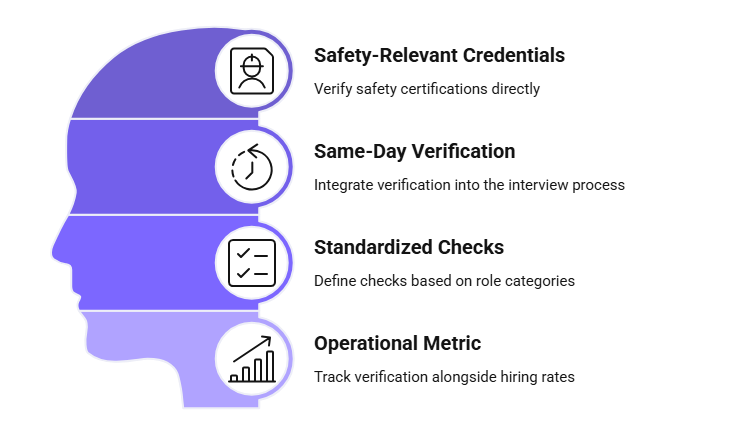
- Separate safety-relevant credentials, food handler cards, alcohol service certification, from general resume claims, and verify the former directly with the issuing body every time, regardless of how urgently the shift needs covering
- Build credential verification into the same day as the interview rather than treating it as a post-hire formality, since a same-day verification request to a certifying body or a former employer does not meaningfully slow down a same-day hiring decision
- Standardize which checks apply to which role categories in advance (front-of-house guest contact, food handling, cash handling, supervisory access) so a rushed hire does not become the reason a role-appropriate check gets skipped
- Track verification completion alongside fill rate as an operational metric, not as a compliance afterthought that only becomes visible once something has already gone wrong
None of these steps require treating every hire the same way, which is the point. A dishwasher role and a shift-supervisor role do not carry the same stakes, and a verification approach that spends equal effort on both is spending too much on one and too little on the other. Matching verification depth to what a role actually controls, guest contact, cash handling, food safety responsibility, lets an operator hold both hiring speed and meaningful verification at once, rather than treating them as a strict tradeoff that has to be resolved the same way for every position on the property.
If a verification step surfaces a discrepancy serious enough that an operator declines to hire a candidate, or removes someone from a role after the fact, and that discrepancy came from a consumer report obtained through a background screening company, that decision is an adverse action under the FCRA. It requires a pre-adverse action notice, a copy of the report, the Summary of Rights Under the FCRA, a reasonable opportunity for the candidate to respond, and a final adverse action notice once the decision is made. A compressed hiring timeline is not an exception to this sequence, and skipping it creates exposure separate from whatever the underlying discrepancy involved.
Where This Fits Alongside Existing Screening Practices
Existing guidance on seasonal hospitality hiring covers the practical checklist for high-volume, compressed-timeline screening: which criminal history categories matter most for guest-facing roles, how state and local disclosure rules apply, and how to sequence checks so a seasonal hiring surge does not outrun compliance requirements. That guidance answers what to check. This piece answers a different question: why hospitality produces more of the specific behavior, embellished claims that go unverified, that makes any checklist necessary in the first place. The two are complementary, not competing; an operator applying the practical checklist benefits from understanding why the underlying pressure exists, and an operator reading this piece still needs the checklist to act on it.
The distinction matters in a concrete way when the two kinds of guidance seem to conflict. A checklist can tell an operator that a given role requires a food handler certification check; it cannot tell the operator why that check keeps getting skipped in practice even when everyone agrees it should happen. The answer is rarely that anyone decided the check didn’t matter. It is that the check competed with an immediate staffing need and lost, quietly, without anyone treating that as a decision at all. Naming the mechanism is what makes it possible to build a process that doesn’t let that happen by default.
Fair Compliance and Protective Compliance, Applied Together
Fair Compliance means applying a consistent verification standard so that accurate, honest candidates are not structurally disadvantaged relative to candidates willing to embellish. Protective Compliance means safeguarding guests, coworkers, and the business itself against the specific risks that unverified safety-relevant credentials create. Both sit inside Compliance for Good™, the operating standard behind this approach, which treats verification as something that protects everyone with a stake in the hire, not just the employer.
Neither pillar asks a hospitality operator to accept a higher vacancy rate in exchange for more thorough screening. Both ask for deliberate prioritization: knowing which specific claims carry safety stakes, verifying those consistently regardless of how urgently a shift needs filling, and treating the remaining resume claims with a level of scrutiny that fits the role rather than defaulting to whatever the calendar allows on a given hiring day. A turnover rate double the private-sector average is a real operational constraint. It is not a reason to let the claims that matter most go unchecked.
Candidates themselves have as much reason to want this distinction made clearly as any operator does. Broader research on hiring consistently finds that most workers want to know what will be verified and how, not because they expect a lie to be discovered, but because a process that verifies inconsistently, thoroughly for some hires and not at all for others, leaves honest candidates with no way to demonstrate that their claims are the real ones. A hospitality worker who genuinely holds a food handler certification benefits from working somewhere that actually checks for it, since that check is what makes the credential worth having in the first place.
Frequently asked questions
What is Careerfishing in hospitality hiring?
Careerfishing describes the systematic embellishment of professional qualifications as a deliberate hiring strategy. In hospitality, it typically involves specific, cheap-to-fabricate claims, such as certifications, supervisory experience, or system proficiency, rather than a wholly fabricated resume, and it is made more likely by the industry’s high turnover rate, which limits how much verification time an employer has per hire.
Why does hospitality see more of this than other industries?
Hospitality’s quits rate has run roughly double the total private-sector average through 2026, per BLS data. A sector losing and replacing staff at that rate runs more hiring cycles with less time per cycle, which reduces the practical verification window without any employer deciding to lower their standards on purpose.
Which hospitality credentials matter most to verify?
Food handler certification and responsible alcohol service certification carry direct guest-safety consequences and should be verified directly with the issuing body every time, regardless of hiring urgency. General resume claims about experience or system familiarity carry lower stakes and can be prioritized differently.
Does verifying these credentials slow down hiring?
Not necessarily. Verifying a credential directly with an issuing body on the same day as an interview, rather than treating it as a post-hire formality, adds little practical delay while closing the specific gap that matters most.
What happens if a background check surfaces a problem?
If a verification finding leads to declining to hire a candidate or removing someone from a role, that decision is an adverse action under the FCRA. It requires a pre-adverse action notice, a copy of the report, the Summary of Rights Under the FCRA, a reasonable opportunity to respond, and a final adverse action notice, regardless of how compressed the hiring timeline was.

ABOUT THE CREATOR
Charm Paz, CHRP
Recruiter & Editor
Charm Paz is an HR professional at GCheck, specializing in background screening, fair hiring, and regulatory compliance. She holds from the Professional Background Screening Association (PBSA) and helps organizations navigate employment regulations with clarity and confidence.
With a background in Industrial and Organizational Psychology, she translates policy into practice to build ethical, compliant, human-centered hiring systems that strengthen decision-making over time.