Automated reference checks collect standardized feedback through digital outreach with no phone calls required, while full-service reference checks add persistent human follow-up to reach reluctant references and catch what a form can’t. Neither is a downgrade of the other. The right choice depends on the role, the volume, and how much a reluctant reference is worth chasing.
Key Takeaways
- Automated reference checks and full-service reference checks answer different problems: speed and consistency at volume, versus depth and persistence for higher-risk hires.
- Nearly every employer checks references in some form, but many former employers limit what they’ll say regardless of how the request arrives, which shapes what any method can extract.
- Standardized questions asked identically to every reference support the consistent-treatment standard that EEOC disparate-treatment analysis looks for.
- Executive and safety-sensitive roles are the ones most often under-screened today, and they’re exactly where human persistence earns its cost.
- The decision isn’t automation versus manual. It’s matching the process to what a specific hire actually needs.
What automated reference checks are, and how they differ from full-service reference checks
Automated reference checks send a standardized digital questionnaire to a candidate’s listed references through email, text, or an online portal, then compile the responses into a consistent report without a recruiter making phone calls. The reference completes it on their own schedule, and every candidate’s references answer the same set of job-relevant questions.
Full-service reference checks start the same way but add a second layer: when a reference doesn’t respond to the automated request, a person follows up directly, by phone or a more personal message, to get an answer a digital form alone wouldn’t produce. The questions stay standardized either way. What changes is what happens when the first attempt goes quiet.
The distinction isn’t automation versus no automation. Both approaches use structured, identical questions and both start with digital outreach. The difference is whether a person picks up the thread when a reference doesn’t respond, and that difference matters most exactly when it’s least convenient: a reluctant reference on a role where the reference actually needs answering.
Why nearly every employer checks references, and why the process still varies so widely

Reference checking is close to universal practice among employers, even though how thoroughly and how consistently it’s done varies a great deal from one organization to the next. The real decision most HR teams face isn’t whether to check references. It’s how thoroughly, and through what process.
That variation exists for a structural reason that has nothing to do with which technology a hiring team uses. Many employers operate under a neutral reference policy, routing all outside reference requests to HR or a designated contact who will confirm only dates of employment and job title. Employment attorneys describe this as a deliberate risk-reduction choice: limiting what’s shared reduces exposure to defamation, negligent misrepresentation, and retaliation claims (SHRM). More than 40 states also provide some form of legal immunity for employers who give truthful, good-faith references, which is part of why practice still varies so much by company and by state.
This matters for the automated-versus-full-service decision because a neutral reference policy affects both approaches the same way. Neither a well-designed digital form nor a persistent phone call can extract information a former employer’s own policy prohibits sharing. What differs between the two methods isn’t how much a policy-bound reference will disclose. It’s whether the reference responds at all, and how consistently the questions land across every candidate a company hires.
It also helps to be clear about what a reference check is trying to accomplish in the first place, since that shapes how much a hiring team should invest in getting a complete answer. A background check is typically run to surface reasons not to move forward with a candidate, while a reference check is better understood as a tool for confirming why a candidate should be hired: how they actually worked, not just whether their record is clean. That distinction matters for both automated and full-service processes, because it means an incomplete or non-responsive reference isn’t just a missing data point. It’s a missed opportunity to confirm a strength the rest of the file doesn’t capture, which is its own argument for following up rather than accepting a blank field.
What automation actually changes, and what it doesn’t
Automated outreach removes the dependency on business hours and recruiter availability that has always slowed manual reference checking down. A reference can complete a short digital questionnaire from a phone at any hour, rather than waiting for a recruiter’s call to land during a narrow window when both parties happen to be free. That structural advantage is real, and it’s the honest basis for automation’s speed benefit, rather than any specific completion-time statistic, since the completion-rate figures circulating publicly come almost entirely from reference-check software vendors marketing their own tools rather than from independent research.
| What changes with automation | What stays the same regardless of method |
| No dependency on business-hours phone tag | Neutral reference policies still limit what a policy-bound reference will disclose |
| Every reference gets the identical question set | The reference decides whether to respond at all |
| References respond asynchronously, on their own schedule | Job-relevant, standardized questions remain the right practice either way |
Automation also standardizes the collection format itself. Every reference sees the same questions in the same order, and every candidate’s report reads the same way when a hiring manager compares them side by side. A manual, unstructured phone call is more prone to drifting into different questions for different candidates depending on how the conversation goes, which is a comparison problem as much as a fairness one.
What automation does not change is a reference’s willingness to engage. A former supervisor operating under a corporate neutral-reference policy will give the same limited answer to a text message that they’d give to a phone call. The gap automation doesn’t close is exactly where full-service follow-up becomes worth its added cost.
Consent handling is another area that shouldn’t change based on which method a hiring team uses. Candidates need to authorize reference outreach before either an automated request or a manual phone call goes out, and that authorization should be documented the same way regardless of channel. A program that automates outreach but treats consent as an afterthought has automated the wrong part of the process. The parts worth automating are the mechanical ones: sending the request, tracking who has responded, and compiling the results into a consistent report. Consent, question design, and the decision about when to escalate to a person are judgment calls that deserve the same care whether the first attempt is a text message or a phone call.
Why standardized questions matter for fair, defensible hiring decisions
Asking every reference the identical, job-related question set isn’t just a data-quality choice. It’s a fairness mechanism with a specific legal grounding. The Equal Employment Opportunity Commission‘s guidance on employment tests and selection procedures explains that disparate-treatment analysis asks whether a selection procedure was applied consistently across candidates, a standard that traces back to the 1978 Uniform Guidelines on Employee Selection Procedures adopted under Title VII (EEOC). A selection procedure, even one that would otherwise be defensible, cannot be applied to some candidates and not others.
Structured reference questionnaires speak directly to that half of the analysis. When every candidate’s references answer the same job-relevant questions in the same format, an employer can show that the reference-check step of its hiring process was applied the same way to everyone, regardless of race, sex, age, or any other protected characteristic. That’s worth being precise about: standardized questions demonstrate consistent application, not automatically job-relatedness. The separate question of whether the criteria themselves are job-related is still something a hiring team has to answer on its own. Standardization removes one specific failure mode, not the entire legal analysis.
Workers themselves have said this kind of consistency is what they want from screening generally. In GCheck’s 2026 Trust in Hiring Report, 75 percent of workers said they want consistent screening standards applied to every candidate. A structured questionnaire, run through either an automated or a full-service process, is a concrete way to deliver exactly that.
When full-service human follow-up earns its cost
Not every role carries the same downside if a hiring team misses something a reference could have flagged. A missed detail on a seasonal frontline hire is a very different problem than a missed detail on an executive, a fiduciary role, or a position with safety or regulatory responsibility. The higher the seniority or the risk profile of the role, the more a reference’s silence deserves a second attempt rather than an empty field in the report. That’s the logic behind matching process to risk rather than defaulting to one method for every hire, and it’s the same logic behind GCheck’s own executive background check guidance, which argues for deeper verification specifically where the cost of getting it wrong is highest.
This is where full-service reference checking does work an automated-only process structurally can’t. A reference who ignores a digital questionnaire because they’re busy, cautious, or simply forgot isn’t the same as a reference who has something to hide, and treating every non-responder as suspicious would be both unfair to candidates and a bad way to run a screening program. But a human follow-up call can distinguish “I meant to get to that” from a reference who is visibly hedging, minimizing, or growing quiet at a specific question, signals a form alone won’t surface and that matter most on roles where the cost of missing them is highest.
Automating the mechanical parts of outreach and adding broader, more persistent human follow-up as the stakes of the hire go up aren’t competing strategies. They’re complementary: automate what can be automated regardless of role, and add human persistence and broader reference coverage as the risk of the specific hire increases.
What the candidate and reference actually experience
The comparison so far has focused on what a hiring team gets out of each method, but both the candidate and the reference are living through this process too, and that experience is worth designing for on purpose rather than as an afterthought. A candidate waiting on an offer wants to know their references were reached and the process is moving. A reference, whether they’re a busy former manager or a colleague doing a favor, wants the request to be clear about what’s being asked, how long it will take, and what happens to what they say.
Automated outreach tends to serve this well by default: a short, mobile-friendly questionnaire that a reference can complete in a few minutes on their own schedule is generally a better experience than an unplanned phone call that catches them at an inconvenient moment. Full-service follow-up should aim for the same standard even when a person is doing the reaching out. A follow-up call that feels like pressure rather than a genuine attempt to give a reference a fair chance to respond undermines the reason full-service exists in the first place, which is to be more thorough and more respectful of a reluctant reference’s situation, not more aggressive about extracting an answer. The goal in either case is the same: a clear, respectful process that treats both the candidate and the reference as participants in a fair hire, not as obstacles to be processed.
How to decide which process fits a given hire
The decision comes down to two questions: how many hires are moving through the pipeline, and how much would it cost this specific hire to miss something a reluctant reference wasn’t going to volunteer to a form. Neither question has a universal answer, which is exactly why treating “automated” and “full-service” as a single company-wide policy choice tends to underserve one part of the hiring pipeline or the other. A staffing team filling dozens of frontline roles a month has a very different risk profile than the same organization filling a single controller position, even though both are reference checks in the same broad sense.
| Hiring situation | What tends to fit best |
| High-volume frontline or seasonal hiring | Automated, for speed and consistency across large candidate pools |
| Standard individual-contributor roles | Automated, with the option to escalate a specific candidate to full follow-up if a reference goes silent |
| Roles with financial, safety, or fiduciary responsibility | Full-service, since the cost of a missed red flag is disproportionately high |
| Executive and senior leadership hires | Full-service, given how often these roles are under-screened relative to their risk |
| Any role where a reference doesn’t respond and the hire matters | Full-service follow-up on that specific candidate, even inside an otherwise automated program |
The last row matters as much as the others. A hiring team doesn’t have to choose one method for its entire pipeline. A sensible default is automated outreach for every candidate, with a clear trigger for escalating a specific reference to human follow-up: no response within a set window, a role above a certain seniority or risk threshold, or a candidate whose file already carries other open questions.
What to ask before you commit to one process
A few questions surface whether a screening partner’s “automated” or “full-service” reference checking claim matches what a hiring team actually needs:
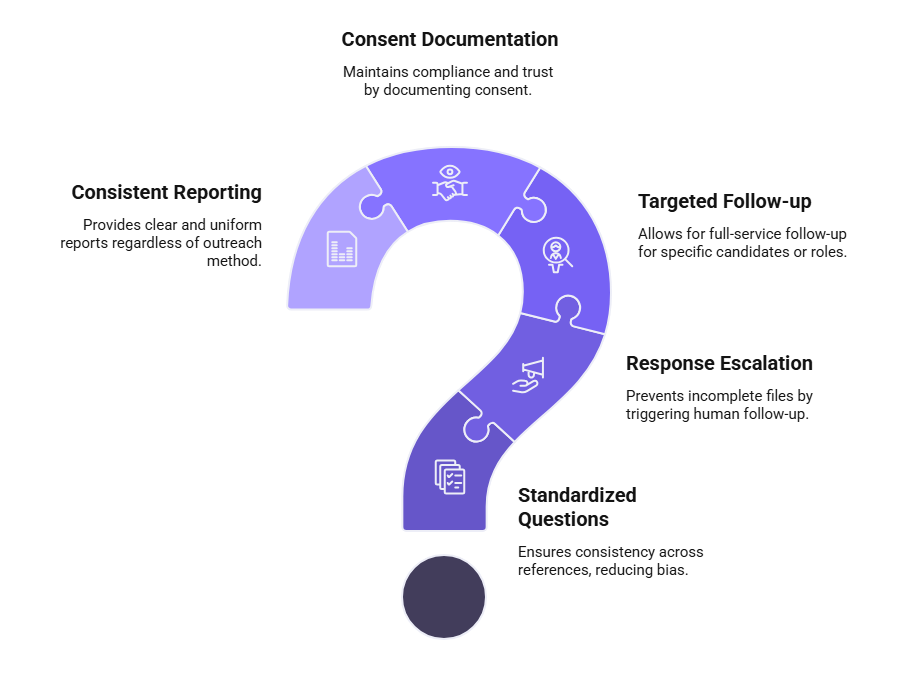
- Does the platform send the identical, standardized question set to every reference regardless of role or seniority?
- What happens when a reference doesn’t respond within the expected window? Is there a defined escalation to human follow-up, or does the file simply stay incomplete?
- Can a hiring team route specific candidates or roles to full-service follow-up while leaving the rest of the pipeline automated?
- How is candidate and reference consent documented before any outreach, automated or manual, begins?
- What does the final report look like, and is it formatted consistently regardless of whether a reference answered a digital form or a follow-up call?
Answers to these questions reveal whether “automated” means a genuinely engineered escalation path or simply an incomplete file when a reference goes quiet.
Frequently asked questions
Is an automated reference check less thorough than a manual one?
Not necessarily. Automated reference checks use the same standardized, job-relevant questions a manual process would use; what changes is the outreach method, not the substance of what’s asked. Thoroughness comes from following up with non-responsive references and asking the right questions, both of which a well-designed automated program can build in through escalation triggers.
Do references respond differently to an automated request than to a phone call?
A reference operating under a company’s neutral reference policy will typically give the same limited response regardless of how the request arrives, since that policy governs what they’re permitted to share, not which channel asked. The difference automation makes is in response rate and speed for references who are simply busy or hard to reach during business hours, not in what a policy-bound reference discloses.
Can a hiring team use both automated and full-service reference checks?
Yes. A common approach uses automated outreach as the default for every candidate, then escalates a specific reference to human follow-up when it doesn’t respond within a set window or when the role carries enough risk to warrant persistence regardless of an initial response. The two methods aren’t mutually exclusive.
Do standardized reference questions actually reduce legal risk?
Standardized, identically applied questions support the consistent-treatment standard that disparate-treatment analysis under EEOC guidance looks for, since a selection procedure has to be applied the same way to every candidate to be defensible on that basis. Standardization doesn’t independently establish that the underlying criteria are job-related; that’s a separate requirement a hiring team still has to satisfy.
Which roles benefit most from full-service reference checking?
Executive, financial, safety-sensitive, and fiduciary roles tend to benefit most, since the cost of missing a red flag on these roles is disproportionately high compared to the cost of a reference simply taking longer to respond. Full-service follow-up is also worth using for any individual candidate whose reference goes silent on a role where missing a red flag would be costly, regardless of the role’s general risk category.
Does automating reference checks make the process feel impersonal to candidates?
It doesn’t have to. A well-designed automated request gives references a clear, mobile-friendly way to respond on their own schedule, which many references experience as more convenient than an unplanned phone call. The bigger factor in candidate experience is usually communication and timing rather than which channel reaches the reference first, so a candidate who’s kept informed about progress tends to have a good experience with either method.
Sources cited
- Society for Human Resource Management. Job References Can Be Misleading. https://www.shrm.org/topics-tools/employment-law-compliance/job-references-can-misleading
- Society for Human Resource Management. Follow Rules of the Road for Limited-Reference Policies. https://www.shrm.org/topics-tools/employment-law-compliance/follow-rules-road-limited-reference-policies
- U.S. Equal Employment Opportunity Commission. Employment Tests and Selection Procedures. https://www.eeoc.gov/laws/guidance/employment-tests-and-selection-procedures
- GCheck. (2026). Trust in Hiring Report (n=1,500 U.S. workers). https://gcheck.com/whitepapers/trust-in-hiring-report/

ABOUT THE CREATOR
Charm Paz, CHRP
Recruiter & Editor
Charm Paz is an HR professional at GCheck, specializing in background screening, fair hiring, and regulatory compliance. She holds from the Professional Background Screening Association (PBSA) and helps organizations navigate employment regulations with clarity and confidence.
With a background in Industrial and Organizational Psychology, she translates policy into practice to build ethical, compliant, human-centered hiring systems that strengthen decision-making over time.