

Driver qualification file management across multiple locations means maintaining a complete, current DQF for every driver no matter which terminal, region, or state they report to, while still producing any file within 48 hours of an FMCSA request. Federal regulation permits storing files at the terminal level (49 CFR §390.29). It does not permit inconsistency between terminals.
Key Takeaways
- Federal regulation allows driver qualification files to be stored at a terminal, regional office, or the driver’s work-reporting location rather than only at a company’s principal place of business.
- That flexibility comes with a fixed obligation: any requested file must be produced within 48 hours of an FMCSA compliance request, regardless of where it physically sits.
- The most common multi-location DQF failure isn’t a missing document at one site. It’s inconsistent document standards between sites that only become visible during an audit.
- A driver transferring between a carrier’s own terminals creates a specific compliance gap if the file doesn’t move with the driver’s qualification history.
- Electronic recordkeeping is explicitly permitted under 49 CFR §390.32, which is what makes centralized, cross-location visibility operationally realistic for growing fleets.
- Drug and alcohol testing records (49 CFR §382.401) and the driver investigation history file (49 CFR §391.53) each carry their own secure, controlled-access storage requirement that matters more, not less, once records are spread across sites.
- Scaling from one terminal to several rarely fails because of the regulation itself. It fails because the manual processes that worked for one location don’t hold their quality at three or ten.
What Changes When DQF Management Spans Multiple Locations
A driver qualification file is the federally required record set, held for every commercial driver, that documents licensing, medical certification, road test results, employment history, and driving record review under 49 CFR Part 391, Subpart F. This is a federal framework; carriers operating only intrastate should confirm whether their state has adopted equivalent or additional requirements, since 49 CFR Part 391 governs interstate commerce directly. At a single-terminal carrier, DQF management is a local problem: one compliance coordinator, one filing system, one set of habits.
Once a carrier operates from more than one terminal, the file requirement itself doesn’t change. What changes is where the file lives, who’s responsible for keeping it current, and how visible its status is to the people who ultimately answer for it. A regional safety manager at Terminal A may have no way of seeing whether Terminal B’s files are complete unless someone builds that visibility deliberately. Nothing in 49 CFR Part 391 assumes a carrier operates from one address, but nothing in it builds cross-location visibility for you either. That’s a program design problem, not a regulatory one.
Consider a carrier with a home terminal in Ohio and satellite terminals in Indiana and Kentucky, each hiring its own drivers, collecting its own applications, and pulling its own motor vehicle records exactly as 49 CFR §391.51 requires. In practice, three separate coordinators are making three separate judgment calls:
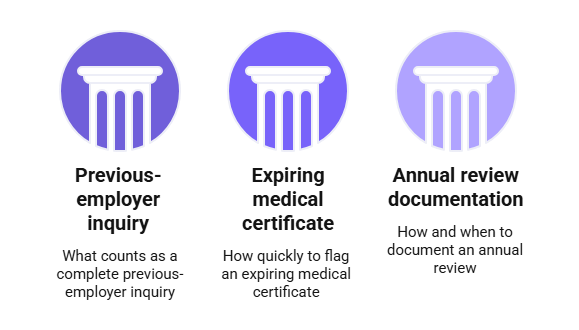
- What counts as a complete previous-employer inquiry
- How quickly to flag an expiring medical certificate
- How and when to document an annual review
None of those calls violates the regulation alone, but together they mean the carrier’s compliance posture is only as strong as its weakest terminal, and no one at the corporate level can see which terminal that is without asking.
What Federal Regulation Actually Requires About File Location
The regulation governing where a DQF may be kept is more permissive than most compliance teams assume; the regulation governing how fast it must be produced is stricter than most teams plan for.
| Regulation | What It Governs | Key Point for Multi-Location Fleets |
| 49 CFR §391.51 | Driver qualification file content | Defines what belongs in the DQF itself, unaffected by how many locations a carrier operates |
| 49 CFR §390.29 | Where records may be stored, and how fast they must be produced | Terminal or regional storage is allowed; production within 48 hours of a request is not optional |
| 49 CFR §390.32 / §390.31 | Electronic recordkeeping and copies of records | Electronic and copied records are permitted, which makes centralized visibility across sites realistic |
| 49 CFR §391.53 | Driver investigation history file | Requires secure, controlled-access storage |
| 49 CFR §382.401 | Drug and alcohol testing records | Requires its own secure, controlled-access storage, separate from the DQF |
Storage Location Is Flexible
49 CFR §390.29 allows a motor carrier with multiple terminals to maintain required records, including the DQF, at its principal place of business, a regional office, or a driver work-reporting location. The rule defining what belongs in the DQF, 49 CFR §391.51, adds no further location restriction. A carrier running terminals across several states faces no penalty for keeping a Texas driver’s file in Texas rather than shipping it elsewhere.
Production Speed Is Fixed
The trade-off for that flexibility is a hard deadline. Records kept at a regional office or terminal must be produced at the carrier’s principal place of business, or another location FMCSA specifies, within 48 hours of a request, excluding weekends and federal holidays (49 CFR §390.29(b)). For a single-terminal carrier, that’s rarely a problem, the file is down the hall. For a multi-terminal carrier, every location needs a retrieval process fast enough to meet a deadline that doesn’t shift with distance.
Electronic Records Close the Distance
Federal Motor Carrier Safety Regulations permit electronic recordkeeping under 49 CFR §390.32, and records may be preserved in copied or converted form under 49 CFR §390.31, provided the copy is legible and accurate. This is the regulatory basis that makes centralized digital DQF management realistic rather than aspirational. A file scanned and stored centrally, accessible from any terminal, satisfies the same requirement as a paper file in a cabinet at the driver’s home terminal.
A Narrower Rule for Sensitive Records
Not every document in a driver’s compliance record carries the same handling standard. The driver investigation history file requires secure, controlled-access storage under 49 CFR §391.53, and drug and alcohol testing records carry their own, separate requirement under 49 CFR §382.401. If either is combined with the standard DQF, the entire file inherits that stricter requirement, even though the DQF itself isn’t subject to it. Programs that skip this distinction risk exposing sensitive records to broader access than allowed.
Where Multi-Terminal DQF Programs Typically Break Down
Three failure patterns show up repeatedly once a driver population spans more than one site, none of them about the base regulation being unclear.
Inconsistent Standards Between Sites
The most common gap isn’t a missing document. It’s a document that exists at every terminal but doesn’t mean the same thing at each one. One coordinator might treat a previous-employer inquiry as complete once a letter is sent; another might wait for a documented response. Both terminals believe they’re compliant, but only one can demonstrate it during a review, since the regulation requires evidence of the inquiry and response, or a documented attempt when none comes.
No Central View of Completeness
A safety director overseeing five terminals with five separate filing systems has no reliable way to answer a basic question: which drivers, fleet-wide, have an expiring medical certificate this month? Without a shared reporting layer, that question gets answered terminal by terminal, after the fact, usually during an audit. Fragmented systems don’t just slow retrieval. They hide a problem’s pattern until it’s already a violation at multiple sites.
This is different from a single missing document at a single terminal, which is a correctable, isolated gap. A completeness pattern spread across several terminals tells a different story to an auditor, for example:
- Three drivers at one terminal with an expired medical certificate
- Two drivers at another terminal with an incomplete annual review
- A third terminal with no documented previous-employer inquiry on file
That pattern doesn’t read as an isolated oversight. It reads as a program with no mechanism for catching its own gaps before an outside party does, and FMCSA’s compliance review process is designed to look for exactly this kind of cross-site pattern rather than a single mistake.
Files That Don’t Follow the Driver
Drivers move between a carrier’s own terminals more often than compliance programs account for: a seasonal reassignment, a permanent transfer, a driver picked up through an acquisition. When a driver’s qualification history doesn’t travel with them, the receiving terminal may unintentionally start a new file, creating gaps in the annual review timeline or duplicate, conflicting records under 49 CFR §391.25.
Inherited Files From Acquisitions and Route Transfers
Carriers that grow by acquiring another company’s routes, or absorbing a smaller carrier’s terminal, inherit those drivers along with whatever records came with them. Those records rarely arrive in the acquiring company’s format, and rarely meet its own standard even if they met the previous employer’s. Treating an inherited file as compliant, rather than auditing it against the receiving carrier’s checklist on day one, is a common way a fleet picks up violations it didn’t create but is now responsible for.
How Compliance Reviews Work for Multi-Location Carriers
When a motor carrier registers with FMCSA, it provides the address of its principal place of business. That address is generally where an FMCSA official goes first, even if the carrier’s drivers and files are spread across a dozen terminals in other states.
This matters practically: the person answering the door needs to either hold the requested files or know how to retrieve them from wherever they sit, inside the 48-hour window. A review that starts at headquarters but needs files from three terminals in different time zones is not hypothetical. It’s the normal case for any carrier operating regionally. The review doesn’t pause because the file is elsewhere. The clock starts the moment the request is made.
| Step | What Happens |
| 1 | FMCSA contacts the carrier’s registered principal place of business |
| 2 | The carrier is asked to produce specific driver files |
| 3 | The 48-hour production clock starts at the time of the request, regardless of file location (49 CFR §390.29(b)) |
| 4 | Each file produced must include MVRs from every state the driver held a license in during the previous three years (49 CFR §391.51(b)) |
Multi-state operations add a layer here. A driver who held a license in more than one state in the previous three years needs an MVR from every one of those states, not just where the terminal is located (49 CFR §391.51(b)). A carrier reviewing files terminal by terminal can miss this if the coordinator only checks the terminal’s own state. This is a driver-level requirement, not a terminal-level one, easy to lose when review is organized around location rather than each driver’s history.
What a Defensible Multi-Location DQF Program Looks Like
A program built for more than one location needs three things a single-terminal operation can often get by without: a shared standard, a shared view, and a clear owner. The common thread is transparency: everyone with a stake, from a terminal coordinator to a corporate safety director, working from the same visible picture of file status rather than separate, unshared ones.
One Standard, Applied Everywhere
Every terminal needs to be working from the same checklist, the same definition of “complete,” and the same interpretation of ambiguous requirements like previous-employer inquiries. This is a documentation decision as much as a technology one: a written DQF standard operating procedure that specifies exactly what satisfies each requirement removes the terminal-by-terminal interpretation gap that creates inconsistent files in the first place.
The standard should answer the judgment calls that vary by site: what counts as a documented attempt to reach an unresponsive employer, how many days before expiration a renewal reminder goes out, and who signs off on an annual review. Leaving these to individual discretion produces the inconsistency a multi-location program needs to eliminate.
Centralized Visibility Without Centralized Storage
Files don’t need to physically live in one place to be visible from one place. A centralized compliance dashboard, built internally or provided through a managed DQF service, lets corporate safety staff see file completeness, upcoming expirations, and outstanding documents across every terminal without waiting for a manual report from each site. This visibility layer should track status, not necessarily expose content: who has access to completeness metadata can be broad, but access to the driver investigation history file and drug and alcohol testing records themselves stays limited to those involved in the hiring decision or controlling access, per §391.53(a)(1) and §382.401, regardless of how centralized the dashboard is. This is the practical version of what §390.29’s storage flexibility and §390.32’s electronic recordkeeping allowance make possible together: local flexibility paired with company-wide oversight.
Clear Division of Responsibility
Someone at the terminal level needs to own day-to-day collection. Someone at the corporate level needs to own the standard, the audit trail, and cross-location reporting. When both roles are explicit, a terminal manager knows what they’re accountable for, and corporate staff know what they’re responsible for catching if a terminal falls behind.
| Terminal-Level Owns | Corporate-Level Owns |
| Signed employment application | Written DQF standard operating procedure |
| Road test certificate or CDL documentation | Cross-location audit trail |
| Previous-employer inquiry follow-up | Completeness reporting across all terminals |
| Local document collection and filing | Standard interpretation for ambiguous requirements |
Consistent Onboarding for the People Doing the Work
A written standard only holds if the people applying it were trained on it the same way. A coordinator hired six months ago and one hired six years ago should make identical judgment calls about a previous-employer inquiry or a certificate renewal. That consistency comes from structured onboarding and periodic refreshers, not from assuming staff converge on the same standard over time. Turnover at the terminal level is one of the more overlooked reasons programs drift out of alignment.
Scaling DQF Management as a Fleet Adds Locations
Growth is usually where multi-location DQF programs are tested, not created. A carrier that manages files well at two terminals often assumes the same manual process will hold at six or ten. It rarely does, because the volume of drivers, renewal dates, and inquiry follow-ups grows faster than a manual system’s capacity to track them without error. A few warning signs tend to show up before a compliance review does:
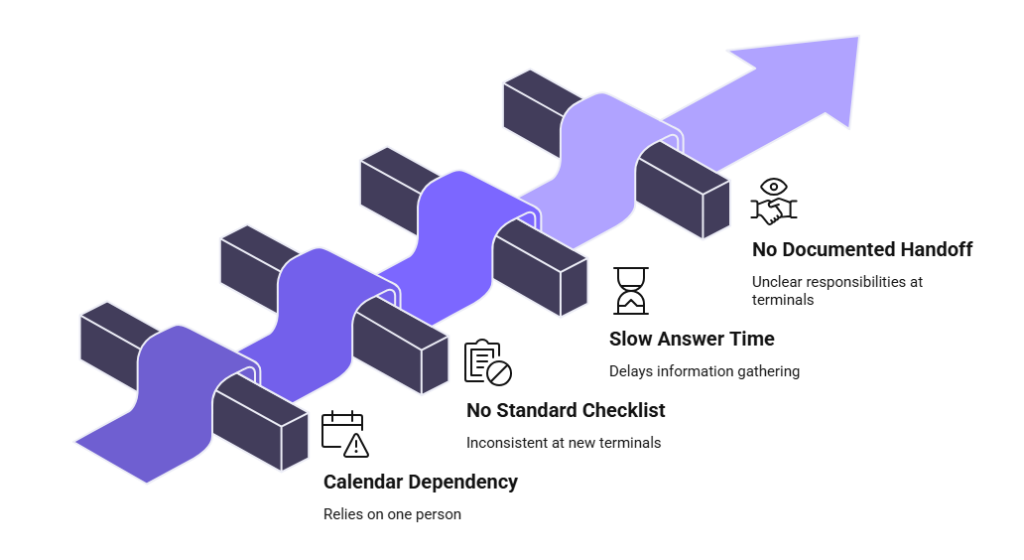
- Renewal reminders that depend on one coordinator’s calendar
- No written checklist matching the corporate standard at new terminals
- Completeness questions that take days to answer instead of minutes
- New terminals brought online without a documented handoff
The carriers that maintain consistent file quality through growth build the standard and the reporting layer before they need it at scale, not after a review reveals that three of eight terminals were quietly falling behind. A program that depends on any single coordinator’s memory or diligence at each site degrades exactly when the driver population it protects is growing fastest.
Frequently Asked Questions
Can we store driver qualification files at each terminal instead of one central office?
Yes. Federal regulation permits a carrier with multiple terminals to maintain required records, including the DQF, at its principal place of business, a regional office, or a driver work-reporting location (49 CFR §390.29). It does not require centralized storage, but does require any requested file be produced within 48 hours regardless of where it’s kept.
How fast must we produce a driver’s file if FMCSA requests it during a compliance review?
Within 48 hours of the request, excluding weekends and federal holidays, regardless of which terminal holds the file (49 CFR §390.29(b)). A compliance review typically begins at the carrier’s registered principal place of business, so that location needs a reliable way to retrieve files from other sites in time.
What happens to a driver’s qualification file when they transfer between our own terminals?
The existing file should transfer with the driver rather than a new file being started at the receiving terminal. Starting a fresh file creates gaps in the annual review cycle under 49 CFR §391.25 and can produce duplicate or conflicting records for the same driver, both of which surface as violations even though the driver has been continuously employed and qualified.
Do drug and alcohol testing records need to be handled differently from the rest of the DQF in a multi-site system?
Yes. Drug and alcohol testing records require secure, controlled-access storage under 49 CFR §382.401, and the driver investigation history file has its own, separate requirement under 49 CFR §391.53. If either is combined with the DQF, the entire file takes on that stricter access requirement, which matters more once records sit across locations with different staff.
Can driver qualification files be maintained electronically across multiple locations?
Yes. Electronic recordkeeping is permitted under 49 CFR §390.32, and copies or converted electronic versions are acceptable under 49 CFR §390.31 as long as they’re legible and accurately reflect the original. This is the regulatory basis for centralized digital DQF systems that give every terminal and corporate staff the same view of file status.
How should compliance responsibility be divided between corporate staff and terminal managers?
Terminal staff are typically best positioned to own day-to-day collection: applications, road test certificates, and previous-employer inquiry follow-up. Corporate staff are best positioned to own the written standard, the audit trail, and completeness reporting. Defining this split closes the gap where each side assumes the other is catching a lapse.
If we acquire another company’s routes and inherit their drivers, do their existing files automatically satisfy our compliance requirements?
Not automatically. Inherited files should be audited against the receiving carrier’s own checklist rather than assumed compliant because they satisfied a previous employer. Standards vary between carriers, and the receiving company is responsible for the file’s compliance status going forward regardless of who assembled it.
Sources cited
- Federal Motor Carrier Safety Administration. 49 CFR §391.51, General requirements for driver qualification files. eCFR. https://www.ecfr.gov/current/title-49/subtitle-B/chapter-III/subchapter-B/part-391/subpart-F/section-391.51
- Federal Motor Carrier Safety Administration. 49 CFR §390.29, Location of records or documents. eCFR. https://www.ecfr.gov/current/title-49/subtitle-B/chapter-III/subchapter-B/part-390/subpart-B/section-390.29
- Federal Motor Carrier Safety Administration. 49 CFR §391.53, Driver investigation history file. eCFR. https://www.ecfr.gov/current/title-49/subtitle-B/chapter-III/subchapter-B/part-391/subpart-F/section-391.53
- Federal Motor Carrier Safety Administration. 49 CFR §382.401, Retention of records. eCFR. https://www.ecfr.gov/current/title-49/subtitle-B/chapter-III/subchapter-B/part-382/subpart-D/section-382.401
- Federal Motor Carrier Safety Administration. 49 CFR §391.25, Annual inquiry and review of driving record. eCFR.
- Federal Motor Carrier Safety Administration. 49 CFR §390.31, Copies of records or documents. eCFR.
- Federal Motor Carrier Safety Administration. 49 CFR §390.32, Electronic records. eCFR.
- Federal Motor Carrier Safety Administration. Regulatory Guidance Concerning Electronic Signatures and Documents. https://www.fmcsa.dot.gov/regulations/regulatory-guidance-concerning-electronic-signatures-and-documents

ABOUT THE CREATOR
Charm Paz, CHRP
Recruiter & Editor
Charm Paz is an HR professional at GCheck, specializing in background screening, fair hiring, and regulatory compliance. She holds from the Professional Background Screening Association (PBSA) and helps organizations navigate employment regulations with clarity and confidence.
With a background in Industrial and Organizational Psychology, she translates policy into practice to build ethical, compliant, human-centered hiring systems that strengthen decision-making over time.