
INDUSTRY GUIDES

Learn about the key driver qualification file requirements and ensure compliance to avoid substantial federal penalties and audits.
Created by

Driver qualification files (DQF) are federally mandated documentation systems distinct from standard personnel files, containing specific records required by the Federal Motor Carrier Safety Administration (FMCSA) to verify commercial driver eligibility and safety compliance. Failure to maintain complete, audit-ready DQFs exposes transportation companies to substantial federal penalties that can reach thousands of dollars per violation per driver, with recent enforcement trends showing increased scrutiny during compliance reviews and roadside inspections.
Driver qualification files serve a fundamentally different purpose than standard personnel records. Personnel files contain employment-related documents such as tax forms, benefits enrollment, performance reviews, and disciplinary actions. In contrast, DQFs exist solely to demonstrate regulatory compliance with FMCSA safety standards.
This distinction matters during DOT compliance reviews. Auditors possess authority to examine DQFs without the same privacy protections that typically shield personnel files. Commingling these records creates two problems: it exposes confidential employment information to regulatory scrutiny, and it makes compliance verification unnecessarily complex during time-sensitive audits. Transportation companies must maintain physically or electronically separate filing systems.
A driver's personnel file might contain salary information, attendance records, and workplace conduct documentation. The corresponding DQF contains only those documents specified in 49 CFR 391.51, each serving to verify that the driver meets federal safety qualifications.
The separation protects both compliance efficiency and legal defensibility. When an FMCSA investigator requests DQFs during a compliance review, companies can provide complete regulatory documentation without inadvertently disclosing sensitive employment information unrelated to safety qualifications.
During audits, commingled files may inadvertently expose employment information that could raise additional questions or concerns with investigators, potentially expanding the scope of review beyond the original compliance check. Separate systems also streamline the three-year post-employment retention requirement. When a driver leaves employment, the company must retain the DQF for three additional years while standard personnel file retention follows different schedules under various employment laws.
Federal regulations specify exactly which documents must appear in every commercial driver's qualification file. Missing even one item during an audit typically triggers violations, regardless of the driver's actual qualifications or safety record. The following requirements form the foundation of DQF compliance:
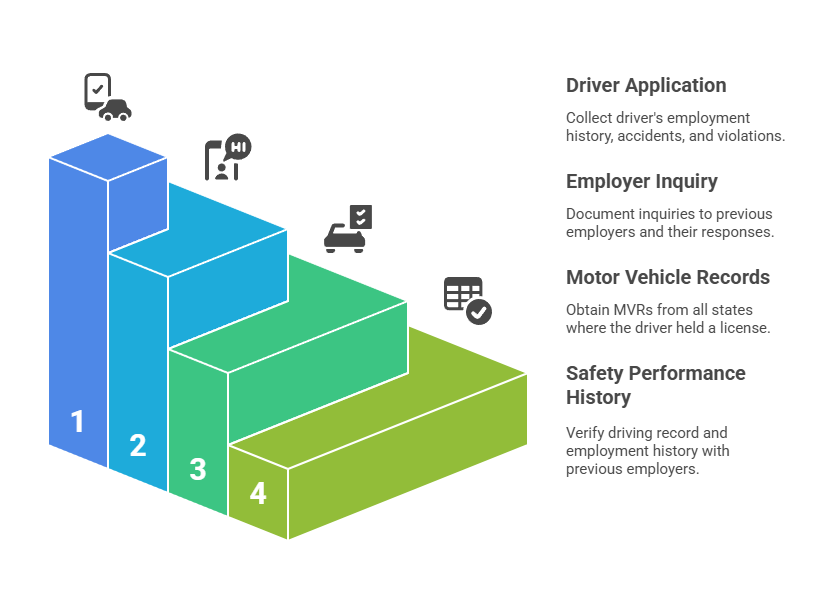
Companies may face violations when they cannot demonstrate they made reasonable efforts to contact previous employers, even if those employers never responded. Best practice involves certified mail or email with read receipts, creating verifiable proof of contact attempts.
Current medical examiner's certificate and medical variance documentation (if applicable) must remain in the file throughout employment. The certificate cannot expire during the driver's operation of commercial vehicles. Additionally, the following medical and testing records are mandatory:
| Document Type | Requirement Details | Critical Deadline |
| Medical Examiner's Certificate | Current certificate with no expiration during operation | Continuous monitoring required |
| Medical Variance/Exemption | FMCSA variance letter with conditions and limitations | Must remain current with medical certificate |
| Road Test Certificate | Proof of passed road test or waiver documentation | Within 30 days of employment |
| CDL Testing Records | Knowledge and skills test proof or exemption documentation | Before first operation |
Each day a driver operates with an expired medical certificate can constitute a separate violation for the employing carrier. Many companies face violations by failing to monitor expiration dates proactively.
Annual review of driving record documentation must include the driver's certification of violations and the company's review note. This review must occur within 12 months of the previous review, not on an anniversary date. A review completed on April 1, 2025, means the next review deadline falls on March 31, 2026.
Many companies inadvertently create violations by using anniversary dates rather than calculating the actual 12-month window. Annual driver's certification of violations requires the driver to list all motor vehicle violations and accidents from the previous 12 months, or certify none occurred. This certification must be signed and dated by the driver.
The company must review this certification, note the review in the DQF, and sign the documentation. Missing either signature can create a violation during audits. A list of commercial motor vehicle accidents recorded in the previous three years must be maintained and updated as new accidents occur or old ones age beyond the three-year window.

Before a driver operates any commercial motor vehicle, specific documents must be completed and placed in the DQF. The employment application represents the first requirement, completed and signed before the first dispatch. Subsequently, companies must address several time-sensitive requirements:
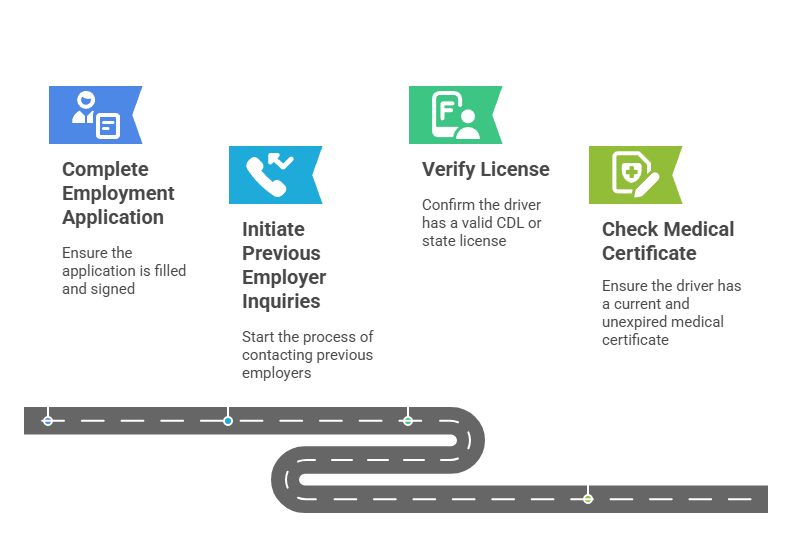
Many violations occur when companies allow drivers to begin work while "finishing paperwork," assuming a day or two delay poses minimal risk. If a company hires a driver on Monday and dispatches them Tuesday without initiating previous employer contacts, that may constitute a violation even if the company eventually receives all responses.
Within 30 days of employment, the company must obtain either a road test certificate or documentation waiving the road test requirement. This 30-day window allows the driver to operate before completing the road test, provided all other qualification requirements are met. After 30 days without proper documentation, continued operation can create daily violations.
Road tests must be administered by someone qualified to evaluate the driver's ability to operate the specific commercial motor vehicle class. The examiner completes a certificate documenting the test date, vehicle type, and the driver's performance. Many companies face violations by using improperly completed road test forms, missing required signatures, or failing to specify the vehicle type tested.
Annual driving record reviews must occur within 12 months of the previous review. Missing this deadline by even one day can create a violation continuing until the review is completed. Companies managing large driver populations should implement systematic review scheduling, typically addressing a portion of drivers each month rather than attempting all reviews in a single period.
| Compliance Item | Frequency | Window/Deadline | Violation Risk |
| Annual Driving Record Review | Every 12 months | Within 12 months of previous review | High - Immediate violation when exceeded |
| Medical Certificate Renewal | Per certificate expiration | Must remain current during all operation | Critical - Daily violations possible |
| Motor Vehicle Record Check | At hire (annual recommended) | Within 30 days of hire | Medium - Single violation if missing at hire |
| Previous Employer Contact | Before first operation | Must initiate before CMV operation | High - Violation for each missing inquiry |
The review process requires the driver's written certification first. After the driver submits their violation certification, the company reviews and documents its review.
The most frequent DQF violations involve missing documents or incomplete versions of required records. During a compliance review examining 20 driver files, an auditor finding multiple files with missing previous employer inquiry documentation can result in multiple separate violations. With significant per-violation penalties, incomplete DQF maintenance quickly escalates to company-threatening exposure levels.
Incomplete employment applications represent another common violation. Applications missing accident or violation history sections, unsigned applications, or applications lacking complete three-year employment history each may constitute violations. Many companies use employment application templates designed for general employment rather than forms meeting specific 49 CFR 391.21 requirements, creating systematic violations across their entire driver population.
Previous employer inquiry responses that lack specific required information can create violations even when companies received responses. The inquiry must cover specific performance history elements outlined in federal regulations. A previous employer response stating "employment verified, no additional information available" does not satisfy the requirement.
Expired medical certificates represent serious violations with compounding penalty exposure. If a driver's medical certificate expires May 15 and the driver continues operating through May 30, the company may face potential violations for 15 days of operation. The base violation applies to the driver's operation; the company faces additional violations for allowing that operation.
Outdated MVRs expose companies to negligent hiring and negligent retention claims beyond direct FMCSA penalties. A driver involved in a serious accident three months after a moving violation appeared on their MVR creates liability exposure if the company failed to pull an updated record. While federal regulations do not mandate annual MVRs, many insurance carriers require them, and they represent industry best practice for demonstrating ongoing safety monitoring.
The three-year post-employment retention requirement catches many companies unprepared. When a driver leaves employment, the company must retain the complete DQF for three additional years. During that retention period, FMCSA maintains authority to audit those files if the driver was involved in an accident or citation while employed by the company.
Companies facing compliance reviews for accidents that occurred months or even years earlier must produce DQFs for drivers no longer employed. Failure to produce these files can result in violations for each missing document. A catastrophic accident triggering an FMCSA investigation two years after the driver left employment may expose the company to significant penalties if the DQF was not retained.
Audit-ready DQF systems begin with consistent organization making any required document immediately locatable. Whether maintaining paper or electronic files, each document should be categorized, dated, and indexed. Auditors expect to find documents quickly; disorganized files signal broader compliance problems and increase scrutiny.
Many companies use DQF checklists as the first document in each file. This checklist itemizes all required documents with date fields showing when each document was obtained and its expiration or renewal date. During an audit, the checklist allows the auditor to quickly verify file completeness, and missing items are immediately apparent.
Electronic DQF systems should use consistent naming conventions and folder structures. Version control becomes critical in electronic systems. When a document is updated (medical certificate renewed, annual review completed), the system should maintain previous versions while clearly marking the current document.
Calendar-based alert systems prevent expiration-related violations. Companies should maintain a centralized calendar showing every driver's medical certificate expiration, annual review deadline, and any other time-sensitive requirement. Automated alerts at 60 days, 30 days, and 7 days before deadlines allow adequate time for completion.
Medical certificate monitoring deserves particular attention because medical certificates must remain current, with expirations strictly enforced during compliance reviews. Some companies require drivers to provide updated medical certificates 15 days before expiration, creating an internal buffer. If a driver's certificate expires September 30, 2026, the company policy might require submission by September 15, providing time to address any delays before the federal deadline.
Annual review cycles benefit from staggered scheduling. Rather than all reviews coming due in January (common when companies use hire-date anniversary scheduling), distributing reviews throughout the year smooths workload and reduces the risk of missed deadlines during busy periods. A company with 120 drivers might schedule 10 reviews monthly, each following the true 12-month window from the previous review.
Process compliance documentation demonstrates systematic rather than reactive compliance approaches. Beyond maintaining required documents in individual DQFs, companies should document their DQF maintenance procedures themselves. During expanded compliance reviews, FMCSA investigators examine whether violations represent isolated oversights or systematic failures.
A written DQF maintenance policy outlining responsibilities, procedures, timelines, and verification processes demonstrates commitment to compliance. This policy should identify who handles previous employer inquiries, who monitors medical certificate expirations, who conducts annual reviews, and who verifies file completeness. Assignment of specific responsibility prevents assumptions that someone else is handling critical deadlines.
The FMCSA Pre-Employment Screening Program provides access to a driver's five-year crash history and three-year inspection history from the Motor Carrier Management Information System. While PSP reports are not federally required DQF documents, including them demonstrates enhanced due diligence in hiring decisions. PSP records can reveal patterns not apparent in MVRs or employment applications.
A driver with a clean MVR might show multiple inspection violations for vehicle maintenance issues or hours-of-service problems in their PSP report. This information helps companies make informed hiring decisions and identify drivers requiring additional training or supervision. Companies using PSP reports should develop consistent policies about their use.
Beyond annual MVR checks, some companies implement continuous monitoring programs receiving automatic alerts when drivers receive citations or are involved in accidents. These real-time notification systems allow immediate investigation and potential intervention before patterns develop into serious safety concerns. Continuous monitoring represents best practice particularly for companies operating in multiple states or managing large driver populations.
A driver receiving a speeding ticket in another state might not report that violation to their employer for months. Continuous monitoring identifies the violation within days, allowing timely counseling, training, or policy enforcement. The effectiveness of continuous monitoring depends on documented response procedures.
Electronic DQF management systems offer significant advantages over paper files for companies managing multiple drivers across dispersed locations. Centralized electronic systems allow authorized personnel to access driver files remotely, critical during roadside inspections or when drivers operate far from the home office. Electronic systems facilitate automated compliance monitoring.
The system can automatically calculate annual review deadlines, flag upcoming medical certificate expirations, and generate task lists for compliance personnel. These automated features reduce human error, the most common cause of deadline-related violations. Document retrieval speed represents another major advantage during audits.
However, electronic systems require robust backup and disaster recovery procedures. A system failure during an audit that prevents document access may create compliance challenges if the company cannot produce required records through alternative means within a reasonable timeframe. Regular system backups stored in separate physical locations protect against data loss from hardware failure, natural disaster, or cyberattack.
DQF management systems often integrate with hours-of-service logging, vehicle maintenance tracking, and safety management systems. Integration reduces duplicate data entry and ensures consistency across compliance functions. When a driver's medical certificate expiration appears in the DQF system, it can also trigger alerts in dispatch systems preventing assignment of loads during the expiration period.
| Integration Type | Benefit | Risk Reduction |
| Hours-of-Service Systems | Automatic alerts for expiring medical certificates prevent dispatch | Prevents operation with expired qualifications |
| MVR Pulling Services | Automated record requests on scheduled intervals | Ensures timely record updates without manual tracking |
| Drug/Alcohol Testing Programs | Testing results automatically populate DQF | Eliminates manual transfer and documentation gaps |
| Dispatch Systems | Real-time qualification status prevents unqualified driver assignment | Stops violations before they occur |
Integrated systems can automatically pull MVRs from state agencies when configured with appropriate access credentials. Rather than manually requesting records, the system generates requests automatically based on scheduled intervals, reducing the administrative burden and ensuring consistency.
Driver qualification file requirements represent non-negotiable federal mandates with significant financial and operational consequences for noncompliance. Transportation companies must maintain complete, current, and properly organized DQFs as distinct systems from personnel files, implementing proactive monitoring for time-sensitive requirements like medical certificate expirations and annual reviews. The systematic approach outlined here, combining mandatory federal requirements with industry best practices, creates an audit-ready compliance framework that protects against costly violations while demonstrating commitment to commercial driver safety.
No, federal regulations require driver qualification files to be maintained separately from personnel files. Commingling these records exposes confidential employment information to regulatory auditors while complicating compliance verification. DQFs contain only the specific documents required by 49 CFR Part 391, while personnel files contain broader employment-related records not subject to the same regulatory access requirements.
You must document your reasonable attempts to obtain the information even if the previous employer never responds. Use methods that create verification records such as certified mail, email with read receipt, or documented phone calls with dates and contact information. During audits, FMCSA typically accepts proof of reasonable inquiry attempts when previous employers are uncooperative or unreachable.
Federal regulations require retention of complete DQFs for three years following driver separation. This retention period allows FMCSA to investigate accidents or violations that occurred during employment even after the driver no longer works for your company. Implement systematic archival procedures ensuring former driver files remain accessible throughout the retention period.
While federal regulations require an MVR at hiring covering the previous three years, annual MVR updates represent industry best practice and may be required by your insurance carrier. Annual checks identify new violations or license suspensions that might not be reported by drivers. Many states also impose more frequent MVR requirements for commercial drivers beyond federal minimums.
A driver holding a valid CDL with appropriate endorsements and vehicle class ratings may be exempt from your company's road test if they obtained or renewed that license within the past year. Place a copy of the current CDL showing the proper endorsements and dates in the DQF as documentation of the road test waiver.
Yes, electronic signatures are acceptable for DQF documents provided they comply with the Electronic Signatures in Global and National Commerce Act requirements for authentication and verification. The electronic signature system must verify signer identity, show signing date and time, and prevent unauthorized modification after signing. Maintain documentation of your electronic signature system's compliance with federal electronic signature standards.
Drivers operating under FMCSA medical variances or exemptions must have both the standard medical examiner's certificate and the variance or exemption documentation in their DQF. The variance or exemption letter from FMCSA specifies conditions and limitations that the driver and company must follow. Ensure both documents remain current, as expiration of either the medical certificate or the variance/exemption ends the driver's qualification.
Creating backdated documentation for requirements that should have been completed earlier may constitute fraud and is legally prohibited. Obtain current, properly dated documents immediately and implement corrective procedures to prevent future gaps. During audits, recent compliance efforts demonstrate corrective action and may influence penalty negotiations, though they do not eliminate violations for previous noncompliance periods.
Intrastate commerce drivers may be subject to state requirements that differ from federal standards, though many states have adopted federal DQF requirements even for intrastate operations. Check your specific state's commercial vehicle regulations to determine which requirements apply. Consider maintaining federal-compliant files for all commercial drivers to ensure consistent compliance if drivers later operate in interstate commerce.
The inquiry must request information outlined in 49 CFR 391.23, including general identification and employment dates, reason for leaving, accidents involving the driver, serious traffic violations, drug and alcohol testing violations or refusals, and whether the driver possessed required licenses and medical certificates. Use FMCSA model forms or ensure your inquiry format explicitly requests all required information categories.
Meet the GCheck Editorial Team, your trusted source for insightful and up-to-date information in the world of employment background checks. Committed to delivering the latest trends, best practices, and industry insights, our team is dedicated to keeping you informed.
With a passion for ensuring accuracy, compliance, and efficiency in background screening, we are your go-to experts in the field. Stay tuned for our comprehensive articles, guides, and analysis, designed to empower businesses and individuals with the knowledge they need to make informed decisions.
At GCheck, we're here to guide you through the complexities of background checks, every step of the way.

Contact us today for efficient, FCRA-compliant screening solutions
designed to keep your hiring process moving safely and smoothly.



LEGAL DISCLAIMER: The information provided in this article is for general informational and educational purposes only and should not be construed as legal advice or a substitute for consultation with qualified legal counsel. While we strive to ensure accuracy, employment screening laws and regulations—including but not limited to the Fair Credit Reporting Act (FCRA), Equal Employment Opportunity Commission (EEOC) guidelines, state and local ban-the-box laws, industry-specific requirements, and other applicable federal, state, and local statutes—are subject to frequent changes, varying interpretations, and jurisdiction-specific applications that may affect their implementation in your organization. Employers and screening decision-makers are solely responsible for ensuring their background check policies, procedures, and practices comply with all applicable laws and regulations relevant to their specific industry, location, and circumstances. We strongly recommend consulting with qualified employment law attorneys and compliance professionals before making hiring, tenant screening, or other decisions based on background check information.