

Hospitality is one of the few industries where background screening is both a speed problem and an access-to-private-spaces problem, and the ATS an employer uses determines whether those two pressures work together or against each other. We scored 10 applicant tracking systems on screening integration depth, compliance workflow automation, and hospitality-specific functionality to see which platforms actually handle that tension well and which ones force HR teams into manual workarounds. The scoring gaps between the top and bottom of the list are wide enough to change how a hotel chain or property management group thinks about compliance risk.
Key Takeaways
- Not all ATS platforms handle background screening the same way. The difference between native screening integration and manual portal-based screening is the difference between compliance steps happening automatically inside the workflow and HR teams tracking deadlines across disconnected systems.
- Hospitality hiring volume makes screening integration a capacity issue, not just a preference. Hotel hiring managers ordered 36% more background checks in the first half of 2025, and with a 3.9% quit rate in accommodation and food services, that volume is not slowing down.
- The FCRA requires a multi-step adverse-action process that many ATS platforms do not automate. Employers must send a pre-adverse notice with the consumer report and summary of rights, wait a reasonable period, and then send a final notice, and skipping any step creates legal exposure.
- Fair-chance hiring laws now cover more than 37 states and 150 localities, and hospitality employers face particular complexity because screening timing rules vary by jurisdiction. An ATS without jurisdiction-aware workflows creates risk every time a property in a covered location runs a background check.
- We identified four distinct ATS integration patterns for background screening, ranging from native marketplace connections to fully manual portal processes. The pattern an employer’s ATS follows has a direct impact on screening speed, compliance accuracy, and the operational burden on hiring teams.
The applicant tracking system a hospitality employer chooses determines whether background screening runs inside the hiring workflow or outside it. That distinction controls screening speed, FCRA compliance accuracy, and how many manual steps HR teams manage during seasonal hiring surges.
This guide ranks 10 applicant tracking systems based on how well their screening ecosystems serve hotels, resorts, and property management groups.
Why Background Screening Integration Matters More in Hospitality
Hospitality hiring combines two risk factors that most industries face separately: high turnover and sensitive access. Housekeepers enter guest rooms alone. Front-desk staff handle payment data and identity documents. Valets drive guest vehicles, and maintenance teams carry master keys.
The labor data confirms the pressure. Leisure and hospitality saw 906,000 job openings, 896,000 hires, and 924,000 separations in a single month (February 2026), with a 3.9% quit rate in accommodation and food services. Hotel hiring managers also ordered 36% more background checks in the first half of 2025 compared with the prior year, driven by increased scrutiny of workforce eligibility.
When an ATS has a native screening integration, the order fires from the candidate record, results return to the same record, and the required adverse-action steps (pre-adverse notice with report copy, waiting period, final notice) can be managed inside the same workflow. Without that, HR teams export data to a separate portal, re-key candidate information, and track compliance deadlines manually. That process breaks down fast when a 200-room property needs to onboard 15 housekeepers in a single week.
How These 10 Systems Were Scored
Each ATS was evaluated on five criteria, weighted toward what matters most for hospitality hiring teams managing background screening at scale:
- Screening integration depth (30%): Native CRA connectors, automated order and results flow, adverse-action workflow support
- Hospitality-specific features (25%): High-volume hiring tools, shift-based scheduling, seasonal onboarding, multilingual candidate flows
- Compliance workflow support (20%): FCRA consent collection, adverse-action automation, ban-the-box jurisdiction handling, audit trails
- Ease of use (15%): Deployment speed, recruiter learning curve, mobile candidate experience
- Ecosystem breadth (10%): Total HR-tech integrations, API openness, webhook support
Scoring draws from official ATS documentation, integration directories, and G2 reviews for hospitality users.
The 10 Systems, Ranked
1. Fountain
Best for: High-volume hourly hospitality hiring with automated screening
Fountain was purpose-built for hourly, high-volume hiring. Screening orders trigger automatically when candidates reach a configured workflow stage, requiring no recruiter intervention. Results post directly to the candidate record, and compliance steps can be configured per location.
SMS-first communication and mobile-first applications reduce candidate drop-off, which is critical when hospitality workers apply from personal devices between shifts. Fountain’s workflow automation is particularly strong for seasonal ramp-ups where onboarding dozens of workers in a compressed window is routine.
2. Zoho Recruit
Best for: Budget-conscious small hotel groups wanting a general-purpose ATS
Zoho Recruit sits inside Zoho’s massive global product ecosystem, giving it broad name recognition and an affordable price point. Its integration marketplace includes some screening partners, but the connections tend to be shallow and often require a separate portal for screening orders.
There is no native adverse-action workflow, so HR teams must track compliance timelines manually. Zoho Recruit also lacks shift-based scheduling and location-tiered hiring, which creates friction for multi-property operations.
3. TalentReef
Best for: Multi-unit restaurant and hotel chains needing location-level hiring with integrated screening
TalentReef was designed for location-based, high-turnover industries. Screening orders trigger from the candidate workflow, results post to the candidate profile, and adverse-action notices are configurable per jurisdiction. Location managers get simplified dashboards while corporate teams maintain compliance oversight.
Spanish-language candidate flows serve the industry’s diverse workforce, given that at least one-third of U.S. travel industry workers are immigrants. TalentReef’s franchise-and-chain architecture allows a 50-location hotel group to enforce consistent screening standards while giving each property hiring autonomy.
4. Freshteam (Freshworks)
Best for: Growing hotel groups wanting low-cost HR suite integration
Freshteam bundles ATS functionality with onboarding and employee data management inside the broader Freshworks platform. Background screening integrations exist but are limited, often requiring HR teams to toggle to an external portal.
There is no native FCRA adverse-action automation, and the platform lacks hospitality-specific tools like SMS-first candidate communication and multi-location dashboards.
5. Rippling
Best for: Mid-market hotel groups wanting unified HR-IT-finance with strong API architecture
Rippling combines HR, IT, and finance in a single platform. Background screening sits in an extensive integration marketplace, and results feed into the employee record that also drives payroll, benefits, and systems access. For hotels, a cleared screening can trigger PMS login provisioning, key card access, and payroll enrollment from the same record.
Multi-state compliance support and open API architecture allow both native and custom integrations. For multi-property hospitality groups, onboarding becomes one automated flow where screening, compliance documents, payroll, IT provisioning, and building access all activate without toggling between separate systems.
6. Breezy HR
Best for: Small independent hotels wanting a simple visual pipeline
Breezy HR is popular with small and mid-sized businesses for its drag-and-drop hiring pipeline. Its integration directory includes some screening partners, but adverse-action automation and jurisdiction-specific compliance features are minimal.
Breezy works for independent hotels or bed-and-breakfasts hiring a handful of people each quarter. It lacks multi-location dashboards, shift-based hiring tools, and the mobile-first candidate experience that high-turnover hospitality chains require.
7. Paycor Recruiting
Best for: Hotel and resort groups needing ATS, payroll, and compliance in one platform
Paycor integrates screening directly into its hiring-to-onboarding workflow. Because screening, payroll, and HR share the same platform, candidate data flows through without manual export. Hotels with tipped employees, shift differentials, and multi-state operations benefit from having hiring and payroll in one system.
Compliance tools cover ACA tracking, wage-and-hour requirements, and new-hire reporting, all recurring pain points for hospitality employers managing labor across jurisdictions.
8. Recruitee (Tellent)
Best for: European-headquartered hospitality groups with U.S. operations
Recruitee is a collaborative hiring platform that emphasizes team-based candidate evaluation and structured interviews. Its integration marketplace leans toward European screening and reference-check providers, so U.S. hospitality employers would likely need external screening or a custom API connection.
GDPR compliance tools are strong, but FCRA-specific workflows and adverse-action automation are not native features.
9. Apploi
Best for: Healthcare and hospitality employers needing mobile-first hiring with credentialing
Apploi was built for industries where hourly workers apply from phones and need both screening and credentialing completed quickly. Screening orders, consent collection, and results are all managed inside the platform. Its healthcare roots give it a more rigorous compliance architecture than most general-purpose platforms.
That rigor carries over to hospitality, where roles often require food-handler certifications, alcohol-service permits, or driver’s license verification. The mobile-first design directly addresses the reality that hospitality candidates apply from personal devices and abandon workflows with too much friction.
10. Hireology
Best for: Multi-location franchise operators wanting hiring-to-payroll connectivity
Hireology combines ATS, onboarding, and payroll-connection tools for multi-location businesses. Background screening is a built-in step, but the CRA partner ecosystem is narrower than open-marketplace platforms. That limits choice for employers who want a screening provider specializing in hospitality or role-specific packages like motor vehicle records.
The franchise-friendly model works for branded hotel groups, but employers who need flexibility to switch CRA providers or configure different screening packages by role may find it constraining.
Background Screening Compliance Scorecard
| ATS | Screening (30%) | Hospitality (25%) | Compliance (20%) | Ease of Use (15%) | Ecosystem (10%) | Weighted Score |
| Fountain | 5 | 5 | 4 | 5 | 4 | 4.70 |
| TalentReef | 5 | 5 | 5 | 4 | 3 | 4.60 |
| Paycor | 4 | 4 | 5 | 4 | 4 | 4.20 |
| Apploi | 4 | 4 | 5 | 5 | 3 | 4.20 |
| Rippling | 4 | 4 | 4 | 4 | 5 | 4.10 |
| Hireology | 3 | 4 | 3 | 4 | 3 | 3.40 |
| Breezy HR | 2 | 3 | 2 | 5 | 3 | 2.85 |
| Zoho Recruit | 2 | 2 | 2 | 4 | 4 | 2.60 |
| Freshteam | 2 | 2 | 2 | 4 | 3 | 2.45 |
| Recruitee | 1 | 2 | 2 | 4 | 3 | 2.10 |
The top five share one trait: deep, native screening ecosystems where CRA partners connect directly to the candidate workflow. Screening orders, consent, results, and adverse-action steps all happen inside the ATS.
The bottom five are solid tracking systems, but their screening integrations are shallower, requiring portal switching, limited CRA choices, or external tools for FCRA compliance. For hotel chains and property management groups running continuous hiring, that gap is a real compliance risk.
How to Choose an ATS With the Best Background Screening Features
Hospitality employers should evaluate ATS options against four integration patterns, ranked strongest to weakest:
- Native marketplace / partner integration: The ATS maintains a verified integration marketplace where screening providers connect directly. Orders, consent, results, and adverse-action workflows all operate inside the ATS. Fountain, TalentReef, Paycor, Apploi, and Rippling follow this model.
- API / webhook custom integration: Open APIs and webhook support let a screening provider build a custom connection. Effective but requires technical resources to maintain.
- Third-party connector integration (Zapier, Workato): The ATS connects to screening through an intermediary. Data flows are possible, but adverse-action steps may not auto-generate, and results may arrive as notifications rather than structured data.
- Manual export / portal process: No direct connection exists. HR teams export candidate data, log into a separate screening portal, initiate checks, and return to the ATS to update records by hand. This is the highest-risk model for hospitality, where more than half of surveyed hoteliers report being understaffed.
Checklist for hospitality ATS buyers
Before committing to an ATS, hospitality hiring teams should verify these capabilities:
- How many CRA partners are available in the integration marketplace, and can screening packages be tailored by role type (such as criminal history searches for guest-access roles, MVR checks for driver positions, and employment verification for management), with results evaluated through individualized assessment rather than automatic disqualification
- Whether the adverse-action workflow is automated end-to-end, including the pre-adverse notice with a copy of the consumer report and summary of rights, a reasonable waiting period, and the final adverse-action notice
- Whether FCRA-required disclosure and authorization forms are presented as standalone documents (not buried in the employment application), and whether those forms are configurable for ban-the-box and fair-chance-hiring jurisdictions where inquiry timing varies
- Whether multi-location support includes corporate-level compliance guardrails with property-level hiring autonomy
- Whether the mobile candidate experience stays intact through the screening consent step, since most hospitality applicants complete the process from a phone
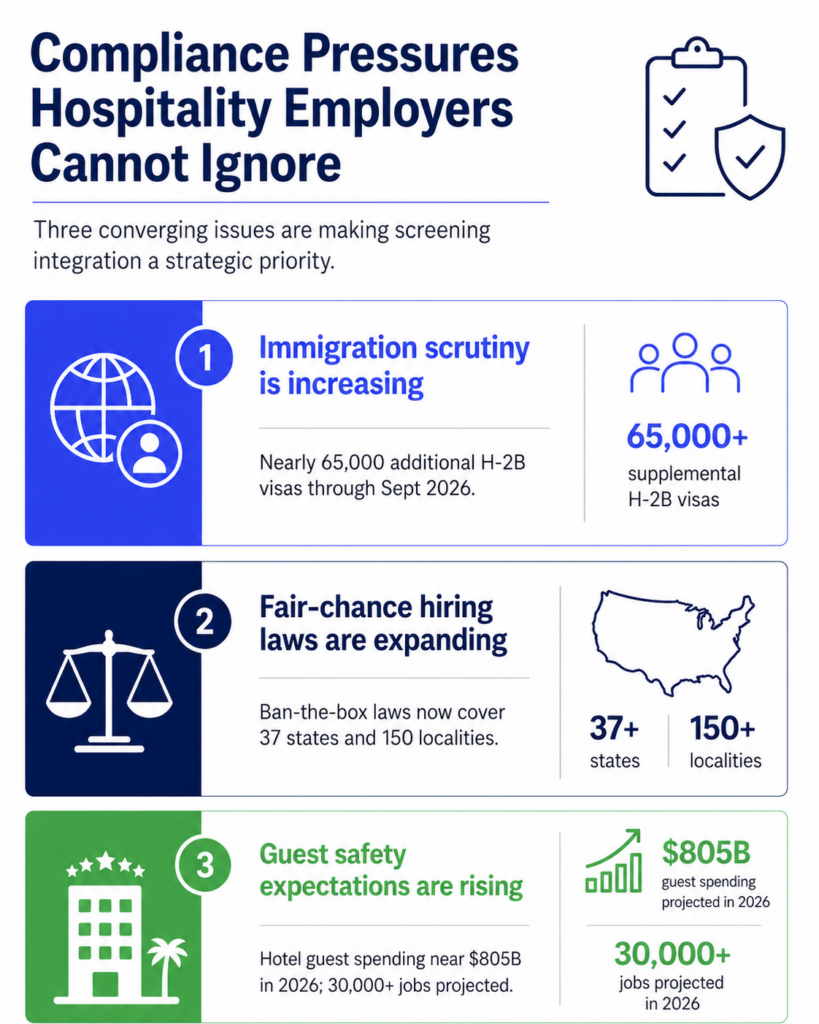
Compliance Pressures Hospitality Employers Cannot Ignore
Three converging issues are making screening integration a strategic concern for hospitality employers.
Immigration scrutiny is increasing screening volume
The federal government added nearly 65,000 supplemental H-2B seasonal worker visas through September 2026. Hotels and resorts in remote vacation destinations rely heavily on this program. More seasonal workers means more screenings and more compliance surface area, reinforcing why background screening and I-9/E-Verify must remain separate legal workflows.
Fair-chance hiring laws keep expanding
Ban-the-box laws now cover more than 37 states and 150 localities. Hospitality is one of the largest employers of people with criminal records, and the industry has legitimate safety concerns around guest-room access, cash handling, and alcohol service. The answer is not blanket exclusion based on criminal history. Federal guidance calls for individualized assessment that considers the nature of the offense, time elapsed, and relevance to the specific role. An ATS that supports jurisdiction-aware timing and structured review workflows makes that assessment process repeatable instead of ad hoc.
Guest safety expectations are rising
Industry projections put hotel guest spending near $805 billion in 2026, with employment growing by more than 30,000 jobs. Negligent hiring claims, insurance scrutiny, and brand-protection concerns all trace back to whether the employer screened appropriately and documented the workflow.
What background checks should hotels run on new hires?
The specific checks depend on the role:
- Criminal history checks are standard for most hospitality positions
- Motor vehicle record checks apply to valets, shuttle drivers, and delivery staff
- Employment verification matters for management and supervisory roles
- Drug screening may apply depending on state law and company policy
Every check requires a standalone FCRA disclosure document and written authorization from the candidate before the screening is initiated. If any screening result leads to a potential adverse employment decision, the employer must follow the full adverse-action process: pre-adverse notice with the report and summary of rights, a reasonable waiting period for the candidate to respond or dispute, and then the final adverse-action notice. This applies regardless of which screening type triggered the decision.
Frequently Asked Questions
What is the best applicant tracking system for hospitality background screening?
Fountain and TalentReef consistently score highest for hospitality-specific background screening integration. Both offer native CRA marketplace connections, automated screening triggers, and jurisdiction-configurable adverse-action workflows. These are the features that matter most for hotels, resorts, and property management groups with high-volume hiring.
Do all applicant tracking systems integrate with background screening providers?
No. Integration depth varies significantly. Some platforms offer native marketplace integrations where screening orders, consent, results, and adverse-action steps all happen inside the system. Others require manual export to a separate screening portal, which introduces data-entry errors and compliance gaps.
Why does background screening integration matter for hospitality compliance?
Hospitality roles frequently involve unsupervised access to guest rooms, payment data, and master keys. The FCRA requires a standalone disclosure and written authorization before any screening, and a multi-step adverse-action process afterward: a pre-adverse notice that includes a copy of the consumer report and a summary of rights, a reasonable waiting period, and then a final adverse-action notice. When those steps happen outside the ATS in a separate portal, compliance gaps are more likely, particularly in jurisdictions with additional timing requirements.
Additional Resources
- Bureau of Labor Statistics, JOLTS Summary, February 2026: https://www.bls.gov/news.release/jolts.nr0.htm
- Bureau of Labor Statistics, JOLTS Quits and Separations, February 2026: https://www.bls.gov/news.release/jolts.t04.htm
- NELP, Ban the Box / Fair Chance Hiring State and Local Guide: https://www.nelp.org/publication/ban-the-box-fair-chance-hiring-state-and-local-guide/
- FTC, Background Checks: What Employers Need to Know: https://www.ftc.gov/tips-advice/business-center/guidance/background-checks-what-employers-need-know

ABOUT THE CREATOR
Charm Paz, CHRP
Recruiter & Editor
Charm Paz is an HR professional at GCheck, specializing in background screening, fair hiring, and regulatory compliance. She holds from the Professional Background Screening Association (PBSA) and helps organizations navigate employment regulations with clarity and confidence.
With a background in Industrial and Organizational Psychology, she translates policy into practice to build ethical, compliant, human-centered hiring systems that strengthen decision-making over time.