

For many entry-level healthcare and education jobs, including CNAs, home health aides, teacher’s aides, and school bus drivers, the credential that typically governs hiring is a high school diploma. Homeschool diplomas satisfy that credential in nearly every case, but employers still need a consistent way to verify them. Federal rules like the Every Student Succeeds Act and EEOC guidance under Title VII set the standard.
Key Takeaways
- Roles like CNA, home health aide, paraprofessional, and school bus driver typically require only a high school diploma or its equivalent, not a college degree, so homeschool diplomas are the credential actually at issue.
- The Every Student Succeeds Act requires Title I paraprofessionals to hold “a secondary school diploma or its recognized equivalent,” language that draws no distinction between homeschool and traditionally issued diplomas.
- Federal CDL rules under 49 CFR Part 383 do not require a high school diploma at all; where school districts require one for bus drivers, that requirement comes from district or state policy, not federal transportation law.
- EEOC guidance, grounded in Griggs v. Duke Power Co., holds that a high school diploma requirement is unlawful under Title VII if it disparately impacts a protected group and isn’t job-related and consistent with business necessity.
- A 2003 EEOC enforcement matter involved a nursing assistant with an intellectual disability terminated after her employer added a high school diploma requirement, despite four years of successful performance in the role.
- Verification standards for homeschool diplomas should mirror whatever standard applies to a traditionally issued diploma for the same role. Homeschool status isn’t itself a protected class under Title VII or the ADA, but applying extra scrutiny without a job-related reason is inconsistent with the standard EEOC applies to diploma requirements generally, and is difficult to defend as a matter of policy.
- Documentation requests should follow the specific regulatory anchor for the role: a Title I personnel file, a state CNA training program’s enrollment record, or a district’s bus driver qualification file.
Which Entry-Level Healthcare and Education Jobs Actually Require a High School Diploma
Several roles inside healthcare and education systems sit at what the Bureau of Labor Statistics classifies as the “high school diploma or equivalent” entry-level tier. In 2024, BLS data placed 35.7% of total U.S. employment inside this tier, the largest of the eight entry-level education categories BLS tracks, ahead of bachelor’s degree roles at 25.0% and no-credential roles at 23.7% (BLS, Employment Projections program, 2024-2034 cycle). Certified nursing assistants, home health aides, entry-tier medical assistants, instructional paraprofessionals, and school bus drivers all fall inside this category in most jurisdictions.
This matters for how employers think about verification. A hiring team that defaults to degree-verification habits built for RN, licensed clinical, or certified-teacher roles is applying the wrong mental model here. The credential in front of them is a secondary school diploma, and a homeschool diploma is a secondary school diploma. The question is not whether the candidate attended college; it’s whether the diploma is genuine and whether it satisfies whatever specific rule governs that role.
| Role | Typical Entry Credential | Governing Framework |
| CNA / Nursing Assistant | HS diploma or GED (often set by training program, not state law) | State nurse aide registry rules; OBRA 1987 training-hour floor |
| Home Health Aide / Entry Medical Assistant | HS diploma or GED, varies by employer and state | State licensing boards, employer policy |
| Instructional Paraprofessional / Teacher’s Aide | Secondary school diploma or recognized equivalent, plus one added qualification | ESSA, Title I, Part A (Sec. 1111(g)(2)(M)) |
| School Bus Driver | Varies; not federally required | District or state education agency policy; CDL itself governed by 49 CFR Part 383 |
How CNA and Home Health Aide Diploma Requirements Work for Homeschool Graduates

Federal law sets a training-hour floor for CNA programs (a minimum of 75 hours, including at least 16 supervised clinical hours, under the Omnibus Budget Reconciliation Act of 1987) but does not itself require a high school diploma to enter a program or sit for the state competency exam. Where a diploma requirement exists, it’s typically set by the individual training program rather than by state law directly, and practice varies even within the same state: some CNA programs waive the diploma or GED requirement entirely, while others require it as a condition of enrollment or before listing a graduate on the state nurse aide registry.
This program-level variation is the practical reason a blanket “we require a traditional diploma” policy doesn’t hold up well for CNA and home health aide hiring. The actual requirement, if one exists, is more likely to sit with the specific training program or state registry than with a uniform federal rule, so an employer verifying a homeschool diploma for these roles should confirm what the specific program and state require rather than assuming a fixed national standard. Where a diploma is required, a homeschool diploma satisfies it in the same way a traditionally issued one does; nothing in the training-program or state nurse aide registry language reviewed distinguishes based on how the diploma was earned.
Documentation Employers Can Request
For CNA and home health aide candidates, a reasonable documentation request includes the diploma itself, a transcript or course record showing completed coursework, and, where the candidate attended an umbrella school, online academy, or correspondence program, contact information for that issuing entity. Where the candidate’s homeschool program was parent-directed with no institutional affiliation, the same standard of review that would apply to a small, unaccredited traditional school’s paperwork applies here: check for internal consistency and completeness rather than requiring a form of institutional backing the role doesn’t call for. GCheck’s education verification service can run this review as part of a standard screening workflow.
How Paraprofessional and Teacher’s Aide Diploma Requirements Work Under Federal Law
Instructional paraprofessionals working in Title I programs have a clear federal anchor. The Every Student Succeeds Act, through Title I, Part A, requires that paraprofessionals hold a secondary school diploma or its recognized equivalent, and separately meet one of three benchmarks: at least two years of study at an institution of higher education, an associate’s degree or higher, or a passing score on a formal state or local academic assessment such as the ParaPro Assessment (ESSA, Sec. 1111(g)(2)(M); ESEA Sec. 1013(f)). That statutory language draws no line between a diploma issued by a traditional school district and one issued by a parent, an umbrella school, or an online academy.
A handful of states don’t build their paraprofessional requirements around the Title I framework at all. Colorado, Florida, and Wyoming currently have no statewide requirement beyond what individual districts set, while Maine, New York, and West Virginia run their own certification tiers (Maine’s Education Technician I, for example, requires a high school diploma or GED and is valid for five years). For a multi-state employer, this means the verification pathway for a paraprofessional candidate depends on which of these three postures the state has adopted, not on a single nationwide rule.
Because the federal statute uses the phrase “secondary school diploma or its recognized equivalent,” a homeschool diploma satisfies the credential requirement on its face. The verification task is confirming the diploma is authentic and that the candidate separately meets one of the three added benchmarks, not applying a heightened diploma standard because the candidate was homeschooled.
Do School Bus Drivers Need a High School Diploma
Federal commercial driver’s license rules do not require a high school diploma at all. Under 49 CFR Part 383, any driver operating a vehicle designed to carry 16 or more people, which covers virtually all school buses, needs a Class B (or higher) CDL with Passenger and School Bus endorsements, along with a DOT medical certification and, since 2022, Entry-Level Driver Training for first-time CDL holders. None of these federal requirements reference secondary education at all.
Where a high school diploma requirement shows up for school bus drivers, it comes from the school district or state education agency’s own hiring policy, not from FMCSA. This distinction matters for verification practice: because the requirement is locally set rather than federally mandated, the district itself controls what counts as satisfying it, and a district that already accepts a GED alongside a traditional diploma has no principled basis for treating a homeschool diploma differently. If a district’s job posting lists “high school diploma or GED,” a homeschool diploma reasonably falls under the diploma half of that phrase, and verification should proceed the same way it would for any other applicant’s diploma.
Why Verification Standards Should Match What the Role Actually Requires
The legal principle behind treating homeschool diploma verification consistently with traditional diploma verification comes from a specific line of EEOC guidance, though it’s worth being precise about what that guidance actually establishes. In Griggs v. Duke Power Co. (401 U.S. 424, 1971), the Supreme Court held that a high school diploma requirement was unlawful because it disparately impacted a racial group and wasn’t job-related or consistent with business necessity. The EEOC has applied that same job-related, business-necessity standard under the Americans with Disabilities Act, holding that a diploma requirement that screens out an individual with a disability is likewise unlawful absent that justification. Neither case addresses homeschool status directly, and homeschool status alone is not a protected characteristic under Title VII or the ADA.
The 2003 EEOC matter involving a nursing assistant with an intellectual disability, terminated after her employer newly added a high school diploma requirement despite four successful years in the role, illustrates the underlying principle rather than a direct holding about homeschool credentials: a diploma requirement has to trace back to what the job actually demands. That principle carries over to homeschool diploma verification, not a claim that homeschooled candidates are a protected class in their own right.
Applied here, the practical guidance is this: verification effort for a homeschool candidate’s diploma should match the effort applied to a traditionally issued diploma for the same role, because that’s the standard the job itself sets, not because falling short guarantees Title VII or ADA liability. Where a homeschool applicant’s religion, national origin, or disability is bound up in why verification proves difficult, and a heightened standard disproportionately affects that group, the Griggs/EEOC framework applies in the ordinary way. Absent that connection, the stronger reason to stay consistent is that it’s what the job’s governing rule, ESSA, the state registry, or district policy, actually requires.
Building a Consistent Policy Across These Four Roles
A written policy keeps this consistent across CNA, home health aide, paraprofessional, and school bus driver hiring rather than leaving it to whoever reviews a given application. The specific rule differs by role, a state nurse aide registry for one, a federal statute for another, a district policy for a third, but the task is the same: name the rule that governs the role, state what documentation satisfies it, and confirm a homeschool diploma is treated as equivalent to a traditionally issued one wherever the underlying rule doesn’t say otherwise.
This is the operating principle behind GCheck’s Protective Compliance pillar: verification protects the patients, students, and communities these roles serve, not friction based on how a diploma was issued. It’s also where Fair Compliance applies directly, since a policy applying one standard to traditionally schooled candidates and a stricter one to homeschool candidates for the same role is exactly the inconsistency both pillars are meant to catch.
A simple internal reference, one line per role naming the governing framework, the documentation that satisfies it, and a note confirming the standard applies regardless of how the diploma was issued, works better for a multi-state employer than a single blanket rule. Reviewing it annually keeps the policy from drifting out of date as state registry rules and district policies change.
What Documentation to Request From Homeschool Graduates Applying to These Roles
Documentation requests work best when they’re tied to the specific regulatory anchor for the role rather than applied as a generic homeschool policy. A Title I paraprofessional file should capture the diploma, evidence of the added ESSA benchmark the candidate meets, and any state assessment score. A CNA training program’s enrollment file should capture whatever the specific state and program require, which may or may not include a diploma at all. A district’s bus driver qualification file should capture whatever the district’s own posted requirement specifies, applied the same way to a GED, a traditional diploma, and a homeschool diploma alike.
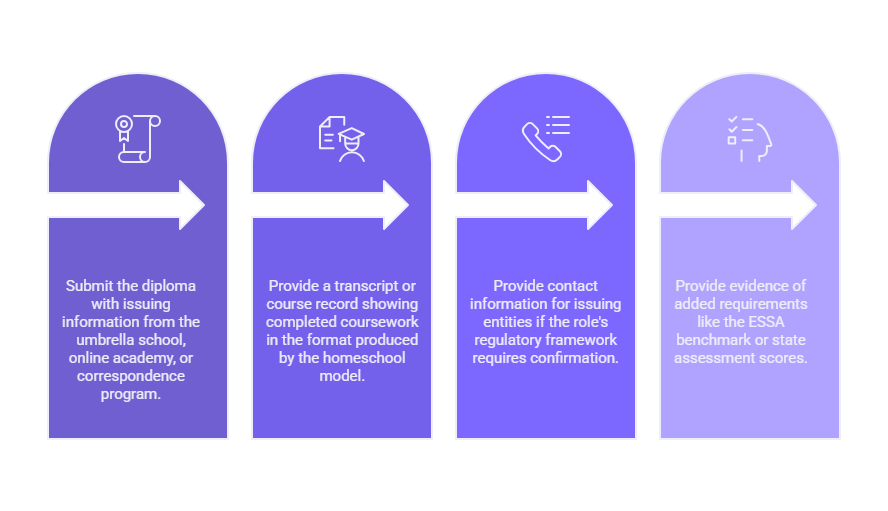
- Diploma document itself, with issuing information where the homeschool operated under an umbrella school, online academy, or correspondence program
- Transcript or course record showing completed coursework, adapted to whatever format the homeschool model produced (parent-maintained, cooperative-issued, or institutionally issued)
- Contact information for any third-party issuing entity, used only where the role’s specific regulatory framework calls for that level of confirmation
- Evidence of any role-specific added requirement, such as the ESSA benchmark for paraprofessionals or a state assessment score
Where documentation requests happen in the hiring process matters as much as what’s requested. Some jurisdictions restrict when education-related background information can be requested relative to a conditional offer under ban-the-box or fair-chance ordinances, so request timing should follow whatever local rules require, applied the same way regardless of how the diploma was issued. And where a third-party consumer reporting agency performs this verification and the result factors into a decision not to move forward with a candidate, FCRA‘s pre-adverse action notice, report copy, summary of rights, and final adverse action notice requirements apply before that decision is finalized.
Where a candidate’s homeschool program was fully parent-directed with no institutional affiliation and the state has no registration system, direct third-party verification may not be available. That’s a known limitation of independent homeschool programs generally, not a signal of anything wrong with this specific candidate, and the appropriate response is the same as it would be for any other credential that can’t be independently confirmed: document the good-faith review of what documentation exists, and, where the role and organization support it, consider a skills-based or competency-focused check as a supplement rather than a replacement for the diploma review.
Conclusion
The roles where homeschool diplomas most often come up in healthcare and education hiring, CNA, home health aide, paraprofessional, and school bus driver, are exactly the roles where a secondary school diploma, not a college degree, is the real requirement. Federal frameworks that touch these roles, from ESSA’s paraprofessional language to FMCSA’s CDL rules, either explicitly accept “a diploma or its recognized equivalent” or don’t reference a diploma requirement at all. The verification task for employers is straightforward once framed this way: confirm the specific rule that applies to the role, apply the same documentation standard to a homeschool diploma that would apply to any other diploma, and let the job’s actual demands, not the credential’s origin, drive how much scrutiny is warranted.
Frequently Asked Questions
Do CNAs need a high school diploma?
It depends on the specific training program and, in some cases, the state’s nurse aide registry rules. Federal CNA training rules under OBRA 1987 set a minimum training-hour floor but don’t themselves require a high school diploma. Individual training programs commonly set this requirement rather than state law doing so directly, and practice varies even within the same state. Employers should confirm the specific program and state requirement rather than assume a uniform national rule.
Can a paraprofessional have a homeschool diploma?
Yes. The Every Student Succeeds Act requires Title I paraprofessionals to hold “a secondary school diploma or its recognized equivalent,” language that doesn’t distinguish based on how or where the diploma was earned. A homeschool diploma satisfies this requirement the same way a traditionally issued one does, provided the candidate also meets one of the law’s added qualification benchmarks.
Do school bus drivers need a high school diploma to get a CDL?
No. Federal CDL rules under 49 CFR Part 383 don’t reference secondary education at all. Where a high school diploma requirement exists for school bus drivers, it comes from the school district or state education agency’s own hiring policy, not from federal transportation law.
Is it legal to require a higher verification standard for homeschool diplomas than for traditional diplomas?
This is legally risky and hard to justify, though the legal theory deserves precision. Homeschool status by itself isn’t a protected class under Title VII or the ADA, so this differs from Griggs v. Duke Power Co. or the EEOC’s ADA guidance, both involving diploma requirements screening out a protected class. What those cases establish is that any diploma requirement, and any verification standard built on it, must be job-related and consistent with business necessity. A stricter standard applied to homeschool diplomas without a job-related reason fails that test as sound policy, and if it falls more heavily on applicants defined by religion, national origin, or disability, the Title VII/ADA disparate-impact framework applies directly.
What should employers request from a homeschool graduate applying for a CNA, paraprofessional, or bus driver role?
The diploma itself, a transcript or course record, and, where applicable, contact information for an umbrella school, online academy, or correspondence program. For paraprofessional roles, also request evidence of the added ESSA qualification benchmark the candidate meets, such as an associate’s degree or a passing assessment score.
What if a homeschool graduate’s diploma can’t be verified through any third party?
This happens most often with fully parent-directed homeschool programs in states with no registration system. Document the good-faith review of whatever documentation the candidate provided, and consider a skills-based or competency-focused assessment as a supplement, not because the diploma is suspect, but because no third party exists to confirm it either way.

ABOUT THE CREATOR
Charm Paz, CHRP
Recruiter & Editor
Charm Paz is an HR professional at GCheck, specializing in background screening, fair hiring, and regulatory compliance. She holds from the Professional Background Screening Association (PBSA) and helps organizations navigate employment regulations with clarity and confidence.
With a background in Industrial and Organizational Psychology, she translates policy into practice to build ethical, compliant, human-centered hiring systems that strengthen decision-making over time.