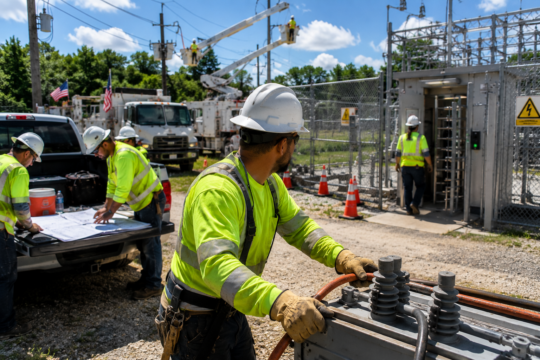

Utility workforce hiring during demand spikes activates a compliance stack that no other sector faces: FCRA, NERC CIP-004, TSA Security Directives, and federal contractor obligations applying concurrently to W-2 employees, contractors, mutual aid crews, and staffing placements. This article maps the regulatory frameworks, failure modes, and pre-event credentialing strategies that determine whether a utility’s hiring program holds up under audit, enforcement review, or post-incident investigation.
Key Takeaways
- NERC CIP-004 requires a qualifying seven-year background investigation before any personnel, including contractors and mutual aid workers, are granted unescorted physical or electronic access to critical cyber assets. Access before credentialing is complete is a violation, not provisional compliance.
- FCRA applies to utility contractors, mutual aid workers, and staffing agency placements whenever a consumer reporting agency compiles the report. No emergency exception or surge-hiring carve-out exists.
- Mutual aid agreements do not transfer or satisfy the receiving utility’s independent NERC CIP-004 and FCRA credentialing obligations. The receiving utility must independently verify each incoming worker regardless of what the sending utility performed.
- TSA Security Directives impose independent personnel vetting requirements on designated critical pipeline and LNG facility operators that must be satisfied alongside, not instead of, FCRA obligations.
- Both the host utility and any staffing intermediary may carry independent FCRA liability when a consumer report is used in a placement decision. Contractual clarity between parties on who holds each obligation is required before a demand event activates multiple simultaneous placements.
- Pre-event credentialing is the primary risk reduction strategy. A vetted contractor and mutual aid crew pool maintained before a demand event removes access credentialing from the critical path during the surge.
When a major storm knocks out power to half a million customers, or when a summer heat dome pushes grid load to historic peaks, utility workforce hiring accelerates from deliberate to urgent inside of hours. That urgency does not pause the compliance clock. Utilities operating under FCRA, NERC CIP, TSA Security Directives, and federal contractor obligations face a regulatory stack that was built for stability, not surge. The gap between what those frameworks require and what demand-compressed timelines allow is where liability accumulates quietly until an audit or incident surfaces it.
This article is built for utility HR directors, compliance officers, legal counsel, and operations leads who manage infrastructure workforce hiring and need a regulatory framework that holds under pressure.
48-72 hours
The window in which major storm restoration events can require deployment of hundreds to thousands of mutual aid line workers, a volume that can equal or exceed a utility’s entire permanent workforce
Edison Electric Institute, Emergency Response and Mutual Aid Programs
Why Utility Workforce Demand Spikes Create a Distinct Compliance Risk
Utility workforce hiring during demand spikes triggers simultaneous obligations under FCRA, NERC CIP-004, TSA Security Directives, and federal contractor requirements. These frameworks apply concurrently to W-2 employees, contractors, mutual aid crews, and staffing placements, creating a compliance stack that compressed timelines cannot legally suspend or waive.
Demand-Driven Surge Patterns That Compress Timelines
Four primary triggers generate the workforce surges that put utility compliance programs under stress. Summer heat events strain transmission infrastructure and require emergency deployment of operations and maintenance personnel on compressed timelines. Storm restoration events, particularly following hurricanes, ice storms, and derecho events, require utilities to absorb hundreds or thousands of mutual aid workers within 48 to 72 hours.
Infrastructure build-out driven by grid modernization, renewable integration, and federal infrastructure investment creates sustained elevated hiring demand across contractor and engineering workforces. Seasonal maintenance cycles generate predictable but concentrated contractor surges that compliance programs often treat as routine when they are not.
The Multi-Regulatory Compliance Stack
What distinguishes utility workforce hiring from hiring in virtually any other sector is the simultaneous application of multiple independent regulatory frameworks, each with its own triggering conditions, personnel scope, and enforcement mechanisms.
| Framework | Governing Body | Primary Personnel Scope | Key Obligation |
| NERC CIP-004 | NERC / FERC | Personnel with unescorted physical or electronic access to critical cyber assets | Seven-year background investigation with specific criminal history criteria, completed before access is granted |
| TSA Security Directives | TSA / DHS | Owners and operators of TSA-designated critical pipeline and LNG facilities | Personnel vetting, access controls, cybersecurity measures; scope based on facility designation |
| Federal Contractor Requirements | OMB / Agency Level | Workers on federally funded infrastructure projects above applicable thresholds | Background investigations per applicable agency and contract requirements |
| FCRA | FTC / CFPB | Any applicant or worker screened using a consumer reporting agency | Disclosure, authorization, adverse action, and permissible purpose requirements |
Why Utility Employers Carry Higher Liability Exposure
Most industries carry FCRA obligations. Few carry FCRA obligations layered on top of a sector-specific safety and security credentialing regime with its own enforcement apparatus. When a retail employer skips a background check during a hiring rush, the exposure is primarily civil liability under FCRA and negligent hiring tort risk. When a utility employer does the same for a worker who will have unescorted access to a substation or pipeline control system, the exposure includes NERC CIP enforcement penalties, TSA directive violations, potential federal contractor disqualification, and FCRA liability, all arising from the same hiring decision.
NERC CIP-004 and Physical Access Credentialing: The Obligation Most HR Teams Underestimate
NERC CIP-004 is the personnel and training standard within NERC’s Critical Infrastructure Protection reliability standards suite. It is also the standard most frequently underestimated by utility HR teams who conflate it with a standard commercial background check. The two are not the same instrument, and treating them as interchangeable creates audit exposure that is difficult to close after the fact.
What NERC CIP-004 Requires for Personnel With Unescorted Physical Access
The NERC CIP-004 Personnel and Training Standard requires covered utilities to perform background investigations on individuals before granting unescorted physical access to physical security perimeters containing critical cyber assets, or before granting electronic access to bulk electric system cyber systems. The background investigation must cover a minimum of seven years of criminal history. The standard identifies specific criminal offense categories that must be verified, including felony convictions and other designated offense types that the utility’s risk-based access management program must address.
The investigation must be completed before access is granted, not after. This point is operationally critical during demand spikes, when the pressure to put workers on-site before credentialing is complete is greatest. A utility that grants unescorted access pending completion of a background investigation is not in provisional compliance. It is in violation.
Legal Notice: Satisfying NERC CIP-004’s background investigation requirement does not constitute FCRA compliance, and FCRA compliance does not satisfy NERC CIP-004. Both frameworks apply independently when a utility uses a consumer reporting agency to fulfill its NERC CIP-004 background investigation obligation. Both exposures exist simultaneously.
How Demand Spikes Create Pressure to Bypass Credentialing Timelines
During post-storm or post-event audits, regulators routinely examine access logs against credentialing records. When a worker appears in an access log before a completed background investigation appears in the personnel file, the violation is self-documenting. The operational pressure to move workers on-site before credentialing is complete is highest exactly when the consequences of doing so are most severe.
Utilities that grant temporary or provisional unescorted access while background investigations are pending, without satisfying the specific procedural requirements for temporary access that NERC CIP-004 permits, create a paper trail that is straightforward for auditors to identify.
The EEOC enforcement guidance on individualized assessment adds a further layer. When criminal history information gathered through a NERC CIP-004 background investigation results in a decision to deny access or terminate employment, that decision may trigger EEOC individualized assessment obligations if treated as an employment action. Utilities should work with legal counsel to establish written protocols distinguishing access credentialing decisions from employment decisions and documenting how individualized assessment is applied to each.
Contractor and Mutual Aid Crew Screening: The Gap That Demand Spikes Expose
No compliance gap in utility workforce hiring is more consistently underaddressed than the assumption that mutual aid agreements handle contractor and crew credentialing. They do not.
Why Mutual Aid Crew Screening Is the Most Acute Compliance Gap in Storm Restoration
Mutual aid agreements between utilities are operational coordination instruments. They establish how labor, equipment, and logistical support will be shared during emergency response. They do not transfer the receiving utility’s independent regulatory obligations to the sending utility.
When a sending utility dispatches a crew and represents that those workers have been credentialed, the receiving utility cannot rely on that representation as a substitute for its own verification. The receiving utility’s NERC CIP-004 obligations are site-specific and organization-specific. A background investigation that satisfied the sending utility’s access management program does not automatically satisfy the receiving utility’s program, which may have different impact designation categories, access zones, and criminal history assessment protocols.
Audit Warning: Utilities that accept mutual aid representations of prior screening without independent verification are creating an audit gap that is difficult to close retroactively. Post-event regulatory reviews routinely examine whether receiving utilities can produce their own credentialing documentation for each worker who accessed critical infrastructure, regardless of what the sending utility’s records show.
The Contractor Substitution Failure Mode
The contractor substitution failure mode occurs when a credentialed contractor firm sends an uncredentialed individual worker to a utility job site in place of, or in addition to, the personnel who were vetted and listed on the access authorization record. This happens when a listed worker becomes unavailable, a contractor firm draws from a secondary roster, or an undisclosed subcontractor relationship exists. The result in each case is an individual with no verified background investigation present at a facility with access to critical infrastructure.
During surge events, the contractor substitution failure mode is amplified because site supervisors are managing restoration priorities rather than access verification, and the documentation processes that catch substitutions during normal operations are compressed or bypassed entirely.
What a Defensible Pre-Event Screening Protocol Looks Like
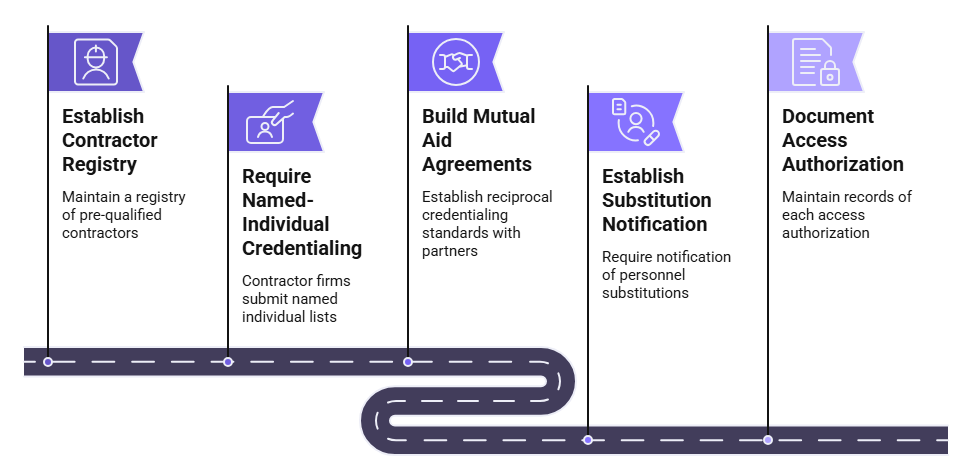
- Establish a Pre-Qualified Contractor Registry: Maintain a registry of contractor firms and individual workers who have completed access-tier-appropriate background investigations, including NERC CIP-004 qualifying investigations for critical asset access roles. Update the registry on a defined cycle, not only at contract renewal.
- Require Named-Individual Credentialing: Require contractor firms to submit named individual lists, not company-level certifications, and credential each named individual independently. Document that the credentialing applies to the specific individual, not the firm.
- Build Mutual Aid Credentialing Agreements Into Pre-Event Coordination: Work with mutual aid partners in advance of storm season to establish reciprocal credentialing standards, documentation exchange protocols, and written acknowledgment that the receiving utility retains independent verification obligations.
- Establish Substitution Notification Requirements: Require by contract that contractor firms notify the utility of any personnel substitution before the substitute individual accesses the site, and that substitutes must be confirmed against the pre-qualified registry or complete an expedited credentialing pathway before access is granted.
- Document Every Access Authorization Decision: Maintain a contemporaneous record of each access authorization, including the background investigation that supports it, the access tier authorized, and the date of authorization relative to the date of first site access.
FCRA Compliance in Utility Workforce Surges: The Obligations That Do Not Compress
FCRA applies to background checks on utility contractors, mutual aid workers, and staffing agency placements whenever a consumer reporting agency is used to compile the report. FCRA’s disclosure, authorization, and adverse action obligations are not suspended during storm restoration events or declared emergencies.
The failure patterns that emerge during demand events often do not surface as liability until months later, when a post-incident audit or regulatory review reopens the hiring records.
The Adverse Action Failure Pattern in Surge Utility Hiring
The adverse action failure pattern in surge utility hiring follows a consistent sequence. Under time pressure, a utility or staffing intermediary obtains a background report on an incoming contractor or mutual aid worker. The report returns information that would ordinarily trigger a pre-adverse action letter and waiting period. Under surge conditions, the hiring manager makes a real-time access decision based on the report without initiating the adverse action process, either denying access without notice or granting access without completing the required review.
Both outcomes create FCRA liability. The denial without proper adverse action notice violates the statute’s procedural requirements. The FTC and CFPB have made clear in enforcement actions that adverse action obligations are procedural requirements tied to the act of using a consumer report, not to the outcome of the hiring or access decision. Operational urgency does not modify statutory obligations.
The adverse action failure pattern creates a delayed liability problem. The worker who was denied access without proper adverse action notice may not file a complaint for weeks or months. The documentation of what triggered the denial, and whether the required notice was issued, is often incomplete by the time the complaint surfaces.
When evaluating criminal history information that surfaces during NERC CIP or surge-hire screening, utilities must also apply individualized assessment principles consistent with EEOC guidance. A blanket policy of denying access based on any felony conviction may create disparate impact exposure under Title VII.
The Staffing Agency Dual-Accountability Gap
When a utility relies on a staffing agency to place workers, FCRA obligations do not consolidate neatly into a single responsible party. Both the host employer and the staffing intermediary may carry independent FCRA liability when a consumer report is used in connection with a placement decision.
This dual-accountability structure creates a contractual clarity obligation that many utility-staffing agency agreements do not satisfy. The agreement must specify which party is the consumer reporting agency’s client of record, which party obtains disclosure and authorization from the worker, which party initiates and completes the pre-adverse and adverse action process, and which party retains the documentation. Absence of contractual clarity does not eliminate liability. It distributes it to both parties.
FCRA Dual-Accountability: For utilities that use multiple staffing agencies simultaneously during surge events, the dual-accountability gap is multiplied by the number of agency relationships in play. Each relationship requires its own contractual clarity on FCRA obligations before a demand event activates multiple simultaneous placements. Address this in the staffing agreement before the event, not during it.
TSA Pipeline Security Directives and Federal Contractor Obligations
For natural gas distributors, interstate pipeline operators, and liquefied natural gas facility operators, the compliance stack for utility workforce hiring includes TSA Security Directives issued following DHS review of critical energy infrastructure vulnerability. These directives apply to owners and operators of pipeline and LNG facilities designated as critical by TSA and impose personnel security requirements that are independent of, and must be satisfied alongside, FCRA obligations.
What TSA Pipeline Security Directives Require
TSA’s pipeline security directives impose cybersecurity and access control requirements on covered owners and operators. The regulatory scope is based on facility-level designation by TSA, not limited to a specific personnel access category. Personnel vetting components require covered operators to implement access controls for operational technology and control system environments, conduct personnel risk assessments for individuals with privileged access to those systems, and maintain documentation of those assessments.
During workforce surges, particularly when contractors or temporary workers are being granted access to SCADA systems or pipeline control room environments, the personnel vetting component of TSA directive compliance is directly activated. The directives do not prescribe a single background check format in the same way NERC CIP-004 does, but they require a documented personnel security program that addresses insider threat risk to control systems.
Applicability Note: TSA Security Directives for pipelines apply to owners and operators of pipeline and LNG facilities designated as critical by TSA. Not every natural gas distributor or pipeline operator is subject to the specific directives. Covered operators should verify their designation status and applicable directive requirements with legal counsel familiar with TSA pipeline security requirements.
Federal Contractor Background Check Obligations
Utility employers working on federally funded infrastructure projects may carry background check obligations established at the federal contractor or subcontractor level through OMB memoranda and agency-level requirements. The specific requirements vary by agency, program, and contract type. Some federally funded utility infrastructure projects require personnel investigations at the NACI or equivalent level for workers with access to federal facilities or systems. Others impose background check requirements through contract clauses that flow down to subcontractors.
In a surge hire scenario where a pipeline operator is simultaneously responding to a service disruption, bringing in contractors for emergency repair work on federally funded infrastructure, and granting those contractors access to control system environments, all three parallel frameworks are active simultaneously. None waives the others, and the documentation supporting each must be separately maintained and available for the relevant enforcement authority.
Building a Surge-Ready Compliant Hiring Workflow
The compliance problems created by utility workforce demand spikes cannot be solved during the demand spike. They can only be managed before it begins. Pre-event credentialing is the primary instrument for reducing the liability exposure that surge conditions create.
Pre-Event Credentialing as the Primary Risk Reduction Strategy
Pre-event credentialing means that before storm season, before a heat event forecast, before a major maintenance cycle, and before a federally funded infrastructure project activates its contractor workforce, the utility has already identified the contractor firms and individual workers it will call upon. Each named individual has completed access-tier-appropriate background investigations. Any adverse information findings have been resolved through a documented individualized assessment process. Access authorizations have been issued, and a current-status registry has been established that can be queried in real time during a demand event.
The Minimum Defensible Screening Stack by Access and Infrastructure Tier
Not every worker in a utility workforce surge requires the same level of screening. A tiered approach calibrated to actual access and infrastructure risk is both operationally defensible and regulatory-compliant, provided the tiers are defined and documented in advance.
| Access Tier | Worker Examples | Minimum Screening Stack | NERC CIP-004 Applicability |
| Tier 1: Cyber-Physical Critical Assets | Control room operators, SCADA technicians, substation personnel with unescorted access | NERC CIP-004 qualifying 7-year background investigation, identity verification, FCRA-compliant consumer report, individualized assessment documentation | Required before access granted |
| Tier 2: OT Environments | OT network technicians, metering infrastructure contractors, communications system workers | Criminal history (7-year), identity verification, employment history verification, FCRA-compliant consumer report | May apply depending on system designation |
| Tier 3: Field Infrastructure | Line workers, mutual aid crews, field maintenance contractors | Criminal history (minimum 7-year per mutual aid protocol), identity verification, FCRA-compliant consumer report, individualized assessment as applicable | Applies if work involves access to physical security perimeters |
| Tier 4: Administrative and Support | Logistics support, administrative contractors, non-infrastructure site personnel | Criminal history (role-appropriate lookback), identity verification, FCRA-compliant consumer report | Generally not applicable absent unescorted critical asset access |
Documentation Requirements for Surge Hires, Mutual Aid Crew Placements, and Contractor Substitutions
Documentation is the evidentiary record that protects a utility in a post-incident investigation, NERC audit, TSA review, or FCRA enforcement proceeding. The documentation standard for surge hires must be the same as for permanent hires, because the regulatory frameworks that apply do not distinguish between the two categories.
Each surge hire file must contain the background investigation report, the FCRA disclosure and authorization obtained before the report was procured, the access authorization record showing the date authorization was issued and the tier of access granted, and any adverse information assessment documentation.
For mutual aid crew placements, the file must additionally contain the receiving utility’s independent verification of the incoming worker’s identity and credentialing status, the specific access authorization issued by the receiving utility (not merely a reference to the sending utility’s authorization), and a record of any site access events tied to that worker during the mutual aid deployment.
For contractor substitutions, the documentation file must identify the originally credentialed worker, the substitute worker, the date and circumstances of the substitution, the credentialing status of the substitute at the time of substitution, and either confirmation of pre-event credentialing or the expedited credentialing record completed before access was granted.
Conclusion
Utility workforce hiring during demand spikes activates a compliance stack that operates independently of operational urgency. NERC CIP-004 requires credentialing before access, not after. FCRA requires disclosure, authorization, and adverse action procedures regardless of the emergency context. TSA Security Directives impose personnel vetting requirements that must be satisfied alongside, not instead of, other frameworks. Mutual aid agreements coordinate operations; they do not transfer regulatory obligations.
The answer to this compliance challenge is architectural, not reactive. Pre-event credentialing, tiered screening protocols calibrated to actual access profiles, contractual clarity with staffing intermediaries, and documentation frameworks built before the surge begins are the instruments that determine whether a utility’s hiring program holds under the audit scrutiny that follows every major demand event.
Frequently Asked Questions About Utility Workforce Hiring Compliance
What background checks are required for utility workers with critical infrastructure access?
Utility workers with unescorted physical or electronic access to critical cyber assets must complete a NERC CIP-004 qualifying background investigation covering a minimum seven-year criminal history lookback with specific offense categories before access is granted. FCRA compliance requirements apply simultaneously when a consumer reporting agency conducts the investigation. Both frameworks must be satisfied independently.
Does NERC CIP-004 require background checks on contractors and mutual aid crews?
Yes. NERC CIP-004 applies to all personnel who will have unescorted physical access to physical security perimeters or electronic access to bulk electric system cyber systems, including contractors and mutual aid workers. The receiving utility must independently verify that each individual satisfies its own NERC CIP-004 requirements, regardless of what the contractor firm or sending utility performed.
Does FCRA apply to background checks on utility contractors and mutual aid workers?
Yes. FCRA applies whenever a consumer reporting agency compiles a background report on any individual for employment purposes, including utility contractors, mutual aid workers, and staffing agency placements. FCRA’s disclosure, authorization, and adverse action obligations apply regardless of the emergency or operational context. No surge-hiring carve-out or emergency exception exists.
What screening is required for workers with access to pipeline control systems?
TSA Security Directives require designated critical pipeline and LNG facility operators to implement personnel vetting programs for workers with access to pipeline control systems and operational technology environments. These requirements apply alongside FCRA and must be documented independently. Applicable obligations vary by operator designation status and specific directive requirements. Operators should verify their designation status and applicable requirements with legal counsel.
How should utilities screen workers during emergency storm restoration events?
Utilities should rely on pre-event credentialing: maintaining a vetted pool of contractors and mutual aid crew members whose background investigations were completed before the event. During the event, access should be granted only to workers confirmed in the pre-qualified registry, or to workers who complete a documented expedited credentialing pathway before access is granted. FCRA disclosure and authorization must be obtained before any consumer report is ordered, even under emergency conditions.
Can a utility rely on a staffing agency to handle FCRA compliance for placed workers?
Not without explicit contractual clarity specifying each party’s obligations. Both the host utility and the staffing intermediary may carry independent FCRA liability when a consumer report is used in a placement decision. The staffing agreement must specify which party obtains disclosure and authorization, which party initiates the adverse action process, and which party retains the documentation. Absence of contractual clarity distributes liability to both parties, it does not eliminate it.
Does the documentation standard change for surge hires made during a storm restoration event?
No. Regulators reviewing post-event access records do not apply a lower evidentiary standard because the hiring occurred during an emergency. Each surge hire file must contain the same documentation required for a permanent hire: the background investigation report, FCRA disclosure and authorization obtained before the report was procured, the access authorization record, and any adverse information assessment documentation. The documentation framework must be built before the event, not reconstructed after it.
Additional Resources
- NERC CIP Standards: CIP-004 Personnel and Training
https://www.nerc.com/pa/Stand/Pages/CIPStandards.aspx - NERC Compliance Monitoring and Enforcement Program
https://www.nerc.com/pa/comp/Pages/default.aspx - FTC: Using Consumer Reports for Employment Purposes
https://www.ftc.gov/business-guidance/resources/using-consumer-reports-what-employers-need-know - CFPB: Fair Credit Reporting Act
https://www.consumerfinance.gov/compliance/compliance-resources/other-applicable-requirements/fair-credit-reporting-act/ - DOE Office of Electricity: Grid Reliability and Infrastructure
https://www.energy.gov/oe/office-electricity

ABOUT THE CREATOR
Charm Paz, CHRP
Recruiter & Editor
Charm Paz is an HR professional at GCheck, specializing in background screening, fair hiring, and regulatory compliance. She holds from the Professional Background Screening Association (PBSA) and helps organizations navigate employment regulations with clarity and confidence.
With a background in Industrial and Organizational Psychology, she translates policy into practice to build ethical, compliant, human-centered hiring systems that strengthen decision-making over time.