
INDUSTRY GUIDES

We ranked 10 applicant tracking systems on background screening integration and compliance for behavioral health hiring. See which ATS platforms support role-based screening, adverse action workflows, and audit-ready documentation for SUD treatment centers.
Created by

We ranked 10 applicant tracking systems on the one capability that matters most in behavioral health hiring: how well the platform handles background screening integration across clinical, peer support, transport, billing, and residential roles. With HRSA projecting major workforce shortages through 2038 and 80% of people needing SUD treatment still not receiving it, behavioral health employers cannot afford screening workflows that slow hiring or create compliance gaps. The gap between ATS platforms built for healthcare screening and those designed for general recruiting is wider than most HR leaders expect, and the difference shows up in audit readiness, adverse action safety, and day-to-day hiring speed.
Behavioral health and SUD treatment centers need to fill roles quickly in a severe workforce shortage while running layered, role-based background screening across clinical, peer support, transport, billing, and residential direct-care positions. The applicant tracking system an organization uses determines whether that screening happens inside a connected workflow or outside it, through manual portals and disconnected spreadsheets.
This article ranks 10 applicant tracking systems on how well their ecosystems support background screening integration for behavioral health employers. The focus is on screening workflows, compliance tooling, and the integration models that matter when every hire touches vulnerable patients, controlled substances, or Medicaid reimbursement.
Behavioral health employers operate under overlapping compliance requirements that make screening far more complex than standard employment verification. HRSA’s 2025 behavioral health workforce brief projects substantial shortages across addiction counselors, mental health counselors, and psychiatrists through 2038. SAMHSA’s 2024 NSDUH data found that 80% of people who needed substance use treatment did not receive it. Every unfilled role widens that gap.
These organizations must screen against OIG LEIE exclusion lists, SAM databases, state abuse registries, professional license databases, and criminal conviction records (many jurisdictions restrict consideration of arrest records), often with packages that differ for a prescriber, a transport driver, a billing coordinator, and a peer recovery specialist. The EEOC’s criminal-record guidance, ban-the-box laws in 37 states and over 150 cities, and ADA protections for individuals in recovery add further workflow requirements.
An ATS with a strong screening ecosystem handles this through native integrations, automated adverse-action workflows, role-based package configuration, and real-time status tracking. One without these features pushes the compliance burden onto already stretched HR teams.
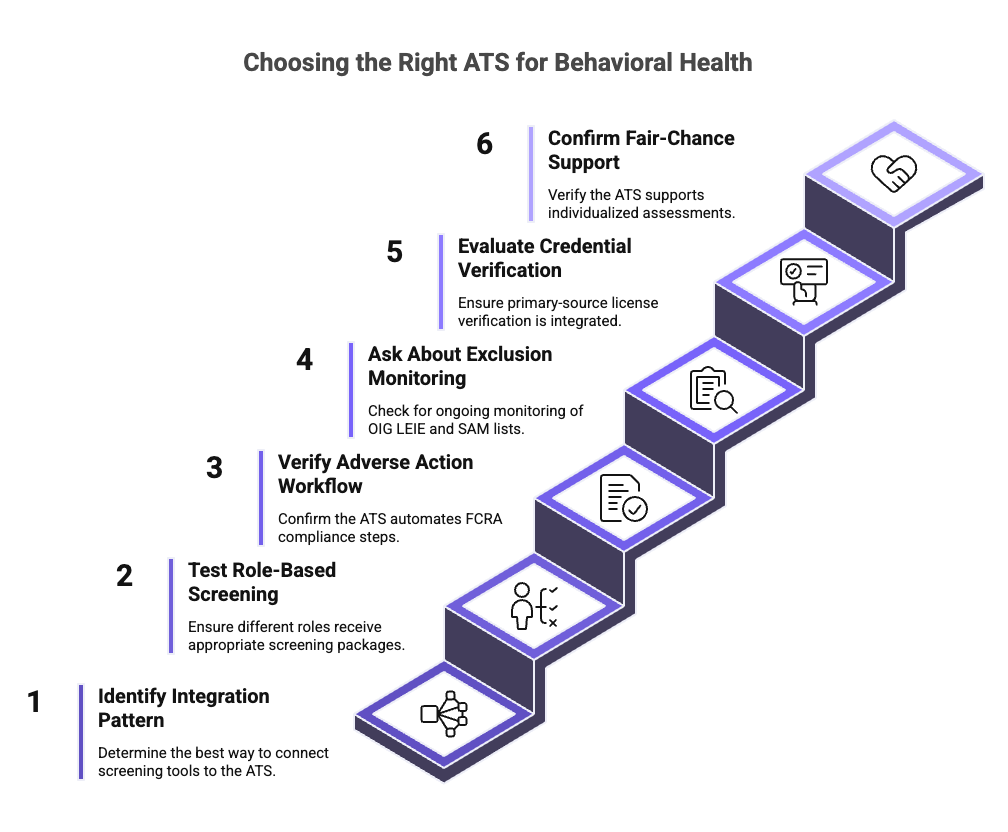
Each ATS was assessed across five dimensions relevant to behavioral health hiring:
Paycom serves over 36,000 clients with a single-database HCM platform that unifies payroll, HR, and talent acquisition. Its screening module runs through a proprietary system and earned PBSA accreditation in 2025.
Background screening features:
Key consideration for behavioral health: Paycom’s proprietary screening system limits flexibility for organizations needing specialized healthcare packages. There is no documented native support for OIG/SAM exclusion monitoring or state-specific abuse registry searches. Multi-state behavioral health organizations may find the platform difficult to customize for the role-based screening that residential treatment, OTP, and crisis programs require.
Apploi is a workforce management platform built specifically for healthcare, with a dedicated behavioral health vertical serving over 9,000 healthcare organizations. It combines applicant tracking with credentialing, onboarding, and ongoing license verification in a single system.
Background screening features:
Key consideration for behavioral health: Apploi’s healthcare-native design means the platform distinguishes between a licensed clinician, a peer recovery specialist, and a behavioral health technician. Credential tracking and license verification are not afterthoughts. For treatment centers hiring across multiple care settings, the behavioral health focus translates into fewer workarounds and more defensible documentation.
Zoho Recruit is part of the broader Zoho ecosystem and serves organizations globally across industries. It offers screening integration through third-party marketplace connections, primarily via browser extensions from providers like Checkr, HireRight, and Verified First.
Background screening features:
Key consideration for behavioral health: Zoho Recruit’s screening integrations rely on browser extensions rather than deep native connections. For behavioral health employers needing automated OIG/SAM checks, license verification, and role-specific package assignment, the workflow requires significant manual configuration. The platform lacks the healthcare-specific credentialing and compliance features that behavioral health organizations depend on for accreditation readiness.
ClearCompany (recently rebranded as ClearCo) is a unified talent management platform with a robust ATS. The platform has built background checks directly into its core product rather than relying solely on third-party integrations.
Background screening features:
Key consideration for behavioral health: ClearCompany’s embedded screening approach is significant for behavioral health organizations that need defensible hiring records. Assigning different screening packages to clinical staff, peer specialists, transport drivers, and billing coordinators without leaving the platform reduces both compliance risk and administrative burden. Healthcare is among ClearCompany’s strongest adoption verticals.
Breezy HR is a visual, user-friendly ATS popular with small to mid-sized organizations. It earned top Gartner customer satisfaction ratings for HR and applicant tracking.
Background screening features:
Key consideration for behavioral health: Breezy HR is designed for simplicity. However, it lacks healthcare-specific compliance features such as license verification, credentialing workflows, OIG/SAM monitoring, or abuse registry integration. Behavioral health organizations with complex screening requirements may find it insufficient for audit-ready documentation in Medicaid-participating or Joint Commission-accredited settings.
Symplr is the only platform on this list built exclusively for healthcare workforce management. Its ATS is purpose-built for hospitals, health systems, senior care, and behavioral health providers.
Background screening features:
Key consideration for behavioral health: Symplr’s healthcare-native architecture gives it a structural advantage for treatment center hiring. The platform distinguishes between a standard criminal check and a complete behavioral health screening file requiring exclusion monitoring, registry queries, and license verification. For multi-facility organizations, decentralized hiring support is particularly relevant.
Ashby is a fast-growing, analytics-focused ATS popular with technology companies. It positions itself on structured hiring and recruiting operations data.
Background screening features:
Key consideration for behavioral health: Ashby’s strength is hiring analytics, not healthcare compliance. The platform does not offer native credentialing, license verification, exclusion monitoring, or healthcare-specific screening workflows. For behavioral health employers, significant compliance work would happen outside the ATS.
Fountain is a high-volume hiring platform serving frontline industries, including healthcare, with over 3 million hires facilitated annually. The platform is designed for organizations processing thousands of applicants through screening and onboarding at speed.
Background screening features:
Key consideration for behavioral health: Fountain’s workflow flexibility is valuable for large behavioral health organizations hiring across residential, outpatient, crisis, and community settings simultaneously. The ability to configure different screening workflows by requisition means a transport driver and a licensed counselor move through appropriately different pipelines. In a sector where the average behavioral health wait time is 48 days, faster time-to-hire for properly screened candidates directly addresses the treatment access gap.
Manatal is an AI-powered ATS that has gained global traction with affordable pricing and a modern interface.
Background screening features:
Key consideration for behavioral health: Manatal’s AI capabilities are strong for general talent acquisition, but the platform has limited depth in U.S. healthcare compliance. There are no native features for FCRA adverse action workflows, OIG/SAM exclusion monitoring, credentialing, or license verification. Behavioral health employers under Joint Commission accreditation or Medicaid participation requirements would manage most compliance documentation outside the platform.
Bullhorn is a CRM and ATS platform built for staffing and recruiting firms, with deep adoption in healthcare staffing. It serves over 10,000 organizations and is widely used by agencies placing behavioral health professionals.
Background screening features:
Key consideration for behavioral health: Bullhorn’s staffing focus is particularly relevant for treatment centers relying on contract or agency staff for clinical, direct-care, and crisis roles. The credential tracking capabilities align well with licensed therapists, counselors, and addiction specialists. For centers managing both permanent and contingent workforce screening, Bullhorn’s compliance features reduce duplication.
| Platform | Screening Integration Model | Role-Based Config | Compliance Workflow | Healthcare Relevance | User Base Scale | Total (out of 50) |
| Symplr Recruiting | 10 | 9 | 9 | 10 | 7 | 45 |
| ClearCompany | 9 | 9 | 9 | 8 | 8 | 43 |
| Apploi | 9 | 9 | 8 | 10 | 7 | 43 |
| Bullhorn | 9 | 8 | 8 | 9 | 8 | 42 |
| Fountain | 8 | 9 | 7 | 8 | 8 | 40 |
| Paycom | 7 | 6 | 7 | 5 | 9 | 34 |
| Breezy HR | 6 | 5 | 5 | 3 | 7 | 26 |
| Zoho Recruit | 6 | 5 | 5 | 3 | 8 | 27 |
| Ashby | 6 | 5 | 4 | 2 | 6 | 23 |
| Manatal | 5 | 4 | 3 | 2 | 6 | 20 |
The scoring reflects a clear pattern: platforms with deep healthcare screening ecosystems outperform general-purpose ATS platforms, even when those general-purpose tools have larger user bases.
For behavioral health and SUD treatment organizations, the platforms with the strongest screening ecosystems are Symplr Recruiting, ClearCompany, Apploi, Bullhorn, and Fountain. Each offers multi-vendor screening integration, role-based package configuration, and compliance documentation that behavioral health hiring demands.
The gap between these platforms and general-purpose alternatives is structural. A behavioral health employer using a platform without native healthcare compliance tooling manages OIG/SAM checks, license verification, adverse action workflows, and abuse registry queries through manual processes. In a sector where HRSA projects major shortages through 2038 and the treatment gap remains severe, that manual overhead directly competes with hiring speed.
General-purpose platforms like Paycom, Zoho Recruit, Breezy HR, Ashby, and Manatal handle standard hiring workflows well. But behavioral health screening involves controlled-substance-adjacent roles, Medicaid reimbursement exposure, 42 CFR Part 2 privacy considerations, fair-chance hiring for recovery-experienced candidates, and accreditation requirements demanding audit-ready files.
Selecting an ATS for background screening capability requires evaluating the integration model, not just the feature list:
The ATS decision in behavioral health is not primarily a recruiting technology decision. It is a compliance infrastructure decision. The platform determines whether background screening is a documented, role-based, audit-ready workflow or a manual process held together by spreadsheets and separate portals.
In a sector facing projected workforce shortages, active federal fraud scrutiny, fair-chance hiring obligations, and accreditation requirements, the screening ecosystem is the most consequential feature an ATS can offer.
Recruiter & Editor
Charm Paz is an HR professional at GCheck, specializing in background screening, fair hiring, and regulatory compliance. She holds from the Professional Background Screening Association (PBSA) and helps organizations navigate employment regulations with clarity and confidence.
With a background in Industrial and Organizational Psychology, she translates policy into practice to build ethical, compliant, human-centered hiring systems that strengthen decision-making over time.

Contact us today for efficient, FCRA-compliant screening solutions
designed to keep your hiring process moving safely and smoothly.



LEGAL DISCLAIMER: The information provided in this article is for general informational and educational purposes only and should not be construed as legal advice or a substitute for consultation with qualified legal counsel. While we strive to ensure accuracy, employment screening laws and regulations—including but not limited to the Fair Credit Reporting Act (FCRA), Equal Employment Opportunity Commission (EEOC) guidelines, state and local ban-the-box laws, industry-specific requirements, and other applicable federal, state, and local statutes—are subject to frequent changes, varying interpretations, and jurisdiction-specific applications that may affect their implementation in your organization. Employers and screening decision-makers are solely responsible for ensuring their background check policies, procedures, and practices comply with all applicable laws and regulations relevant to their specific industry, location, and circumstances. We strongly recommend consulting with qualified employment law attorneys and compliance professionals before making hiring, tenant screening, or other decisions based on background check information.