

Returning seasonal workers are not automatically re-cleared by a prior season’s background check, yet most organizations treat re-engagement as an extension of the original hire rather than a new compliance event. This guide explains the FCRA obligations, negligent hiring exposure, and policy framework that apply every time a seasonal worker returns, regardless of prior familiarity or prior clearance.
Key Takeaways
- A prior season’s background check clearance reflects a worker’s record at a specific point in time and does not carry forward to a new re-engagement. Criminal records, registry status, and professional license standing can all change between seasons.
- When a consumer reporting agency is used to re-screen a returning seasonal worker, FCRA requires a new standalone disclosure and written authorization. The prior season’s authorization does not carry forward.
- If a re-screen surfaces a finding that affects the re-engagement decision, the full FCRA two-step adverse action process applies. There is no abbreviated version for returning workers.
- Negligent hiring doctrine applies to re-engagement decisions with the same force as initial hires. Prior familiarity with a returning worker is not a defense if disqualifying information became available between seasons.
- A defensible re-screening policy specifies an elapsed time threshold and a role-based scope tier, applies both consistently across all returning workers, and retains documentation independently of the original hire file.
- Re-screening obligations differ by worker type: W-2 employees, 1099 contractors, and volunteers each carry different FCRA applicability considerations, but all carry some level of negligent hiring or duty-of-care exposure.
Every year, as peak seasons approach, HR teams in retail, hospitality, logistics, event staffing, and healthcare face the same compressed timeline: hundreds of returning workers to re-engage, limited onboarding bandwidth, and a silent assumption embedded in the process. That assumption is: if a worker was cleared last season, they are cleared now. It is operationally intuitive, administratively convenient, and legally indefensible.
This guide is built for HR professionals, operations leads, compliance officers, and employment counsel who manage seasonal employee rehiring at scale and need a policy framework that holds up under audit, in court, and before a regulator.
The Returning Worker Assumption and Why It Creates Risk
Does a Prior Season Background Check Clearance Apply to Re-Engagement?
No. A background check clearance from a prior season reflects a worker’s record at that specific point in time. It does not carry forward to a new re-engagement. Criminal or registry changes that occurred between seasons are invisible to a prior season’s report.
The misconception is understandable. An organization ran a background check on a worker twelve months ago. The check came back clear. The worker performed without incident. The operational logic says: the work is already done. The compliance reality says: it was never done for this engagement.
A background check is a snapshot. It captures the records that existed and were reportable as of the date the check was run. In the window between the close of last season and the start of the current one, a worker may have been arrested, convicted, added to a sex offender registry, or excluded from federal healthcare programs. None of that appears in last year’s report.
Under negligent hiring doctrine, a court examining whether an employer took reasonable steps to verify a worker’s background will focus on what the employer knew, or should have known, at the time of the re-engagement decision, not at the time of a prior season’s check. The re-engagement is, for most practical compliance purposes, a new decision point that warrants a new review.
Compliance Warning: Treating a prior season’s background check clearance as sufficient for a current re-engagement is one of the most common and least-examined compliance gaps in seasonal workforce management. The between-season gap is the blind spot. A documented re-screening policy is the only reliable defense.
This does not mean every returning worker requires an identical full-scope re-screen regardless of elapsed time or role. What it means is that the decision about what to re-screen, when, and at what scope must be made deliberately, documented formally, and applied consistently. An organization that cannot produce a written re-screening policy when a negligent hiring claim is filed is in a materially harder position than one that can.
What Can Change Between Seasons: The Between-Check Gap
The between-season gap is not an abstract compliance concern. It covers specific categories of risk, each with a different detection mechanism and a different consequence for the employer who misses it.
Criminal Records
Criminal activity occurring after the prior season’s check closed is invisible to that check by definition. A worker who had a clean record in October may have been arrested, charged, or convicted by the following March. County court records, statewide repository records, and federal court records all have reporting lags that vary by jurisdiction, and the window between seasonal engagements commonly spans six to eighteen months.
Organizations that re-engage without running a new check are relying on a snapshot that predates potentially disqualifying events. For programs that run continuous criminal monitoring between engagement periods, this gap is substantially reduced. For point-in-time programs, the between-season gap is real and unmitigated.
Sex Offender Registry Changes
Sex offender registries across all fifty states are updated on an ongoing basis. A worker who was not on the registry during the prior season may have been added in the intervening months. A returning worker’s registry status at re-engagement may differ materially from their status at the prior screen.
All 50 States
Have sex offender registries that are updated on an ongoing basis, meaning a returning worker’s registry status can change at any point between seasons
U.S. Department of Justice National Sex Offender Public Website (NSOPW.gov)
OIG LEIE Exclusions for Regulated Roles
For healthcare employers re-engaging seasonal clinical staff, including per-diem nurses, seasonal home health aides, and temporary allied health workers, the HHS OIG List of Excluded Individuals and Entities (LEIE) is a mandatory pre-engagement verification. Workers can be added to the LEIE at any time, including between seasonal engagements. A prior season’s check that predates an exclusion addition provides no protection against Civil Monetary Penalty liability.
Professional License Status
For roles requiring active licensure, including nurses, pharmacists, commercial drivers, and licensed contractors, a license that was active during the prior season may have lapsed, been suspended, or been subject to disciplinary action in the intervening months. Nursing license status can be verified in real time through the Nursys system maintained by the National Council of State Boards of Nursing. Re-engaging a worker in a role requiring licensure without verifying current license status is both a negligent hiring exposure and, in regulated industries, a direct compliance violation.
FCRA and the Rehire: What the Law Requires
When a consumer reporting agency is used to re-screen a returning seasonal worker, the full suite of FCRA pre-screen requirements applies. These requirements attach to the use of a consumer reporting agency for employment purposes, not to whether the subject is a new hire or a returning worker.
Required pre-screen steps when using a CRA include: a clear and conspicuous disclosure in a standalone document, the worker’s written authorization before the report is procured, and the provision of a Summary of Rights. The FTC’s employer guidance confirms these requirements apply each time a consumer report is obtained, with no exception for workers who previously authorized a check.
Legal Notice: FCRA adverse action obligations apply every time a CRA-obtained consumer report is a factor in an employment decision, including decisions not to re-engage a returning seasonal worker. The prior season’s relationship with the worker is not a basis for abbreviating any step.
Adverse Action When a Re-Screen Surfaces a Finding
If a re-screen surfaces a finding that affects the re-engagement decision, the FCRA’s two-step adverse action process applies in full, identically to how it applies for initial hires.
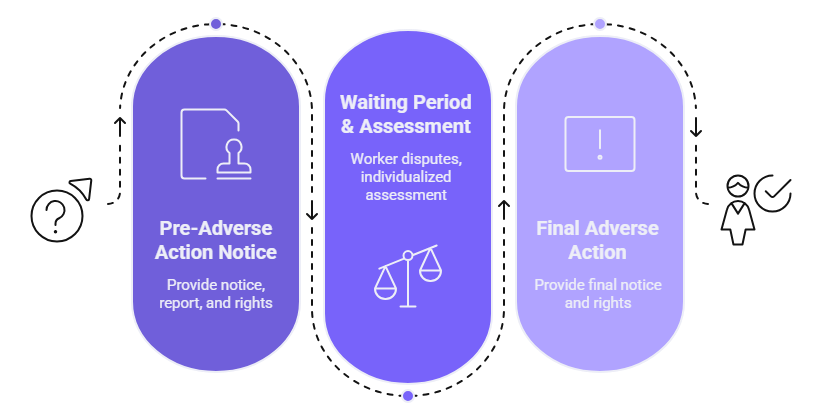
- Pre-Adverse Action Notice: Before making a final decision not to re-engage, provide the worker with a pre-adverse action notice, a copy of the consumer report, and a copy of the CFPB Summary of Rights. This must occur before the final decision is communicated.
- Waiting Period and Individualized Assessment: Allow a reasonable period for the worker to dispute the report’s accuracy or provide context. Apply individualized assessment consistent with EEOC guidance: consider the nature of the offense, time elapsed, and nexus to the job.
- Final Adverse Action Notice: If the decision not to re-engage is finalized, provide a final adverse action notice that includes the name and contact information of the CRA, notice that the CRA did not make the employment decision, and the worker’s right to obtain a free copy of the report within sixty days.
There is no abbreviated adverse action process for returning workers. An organization that skips pre-adverse action notice because the worker is a known quantity from a prior season is exposed to FCRA statutory damages and potential class liability.
Record Retention for Re-Screening Records
Re-screening records, including the new disclosure and authorization, the consumer report, any pre-adverse action notice, and any final adverse action notice, must be retained independently of the original hire file. These records document the re-engagement decision separately from the initial hire decision and form the evidentiary foundation for both FCRA compliance and negligent hiring defense.
Negligent Hiring Doctrine and Returning Workers
Prior familiarity with a returning seasonal worker is not a defense to a negligent hiring claim. Courts evaluate what the employer knew or reasonably should have known at the time of re-engagement. A prior season’s clearance documents what the employer knew about the worker at a prior point in time, not at re-engagement.
Negligent hiring claims arise when a third party is harmed by an employee and can demonstrate that the employer knew or should have known, at the time of the re-engagement decision, that the worker posed a risk a reasonable background inquiry would have revealed. The doctrine applies to re-engagement decisions with the same force it applies to initial hires.
Foreseeability Standard: The core negligent hiring inquiry is foreseeability: was the harm caused by the worker foreseeable based on information the employer had, or should have had, at the time of the engagement decision? When re-engagement is made without a current background check, the employer has effectively chosen not to know.
Documentation as the Primary Defense
The strongest negligent hiring defense available to an organization that re-engages seasonal workers is documentation of a deliberate re-screening decision. This means a written policy specifying the re-screening trigger, the scope of the re-screen by role and access tier, the individualized assessment process for any findings, and the record retention protocol.
An organization that can produce this documentation, along with evidence that it was followed consistently, is in a materially stronger position than one that relied on institutional memory of a prior season’s clearance.
A re-screen that comes back clear is not wasted effort. It is evidence that the employer exercised reasonable care at the time of re-engagement.
Re-Screening Policy by Worker Type
Re-screening obligations differ by worker classification. W-2 seasonal employees trigger full FCRA obligations when a CRA is used. Independent contractors present a more complex FCRA applicability question. Volunteers are not exempt from negligent hiring exposure even when FCRA technical applicability is unclear.
| Worker Type | FCRA Applicability | Re-Screen Trigger | Negligent Hiring Exposure | Key Re-Engagement Requirement |
| W-2 Seasonal Employee | Full FCRA applies when CRA used | Any re-engagement after gap; accelerated by elapsed time or access change | High | New disclosure, authorization, and adverse action process |
| 1099 Independent Contractor | FCRA applies; “employment purposes” interpretation varies by circuit | New contract term; elapsed time threshold per policy | Moderate to high depending on control and placement | New authorization if CRA used; document re-engagement basis |
| Seasonal Volunteer | May not apply if no compensation; state law varies | Any new volunteer season; role risk profile determines scope | Moderate; organization owes duty to persons served | Policy-driven re-screen; document regardless of FCRA applicability |
W-2 Seasonal Employees
For W-2 seasonal employees, re-engagement is functionally a new hire for FCRA purposes when a CRA is used. A new standalone disclosure and written authorization must be obtained before the re-screen is run. If the re-screen surfaces a finding that bears on the re-engagement decision, the full two-step adverse action process applies.
Returning 1099 Contractors and Gig Workers
The FCRA’s “employment purposes” definition has been applied to contractor relationships in ways that vary by circuit and context. Employers and staffing organizations should not assume that 1099 classification eliminates FCRA obligations when a CRA is used. The operationally safer approach is to apply the same disclosure and authorization mechanics as for employee re-screening and to document the basis for any approach that differs.
Seasonal Volunteers
FCRA applicability to volunteer screening depends on whether the relationship involves compensation and how the CRA characterizes the purpose of the report, and it varies by state law. However, the absence of FCRA applicability does not eliminate negligent hiring or duty-of-care exposure. An organization that places a volunteer in a role with access to vulnerable populations, inventory, or sensitive facilities owes a duty of care to the persons who interact with that volunteer. Policy-driven re-screening of volunteers in high-access roles, applied consistently, is the defensible practice.
Building a Defensible Re-Screening Policy Before the Seasonal Ramp-Up
A defensible seasonal re-screening policy is built on two variables: an elapsed time threshold that triggers the re-screen, and a role and access tier that determines its scope. Both variables should be set in consultation with legal counsel before the seasonal ramp-up begins.
The operational challenge is not understanding that re-screening needs to happen. It is building a policy that can be executed consistently across hundreds of returning workers in a compressed timeframe without producing the ad hoc decision-making that creates compliance gaps and disparate treatment exposure.
Variable One: Elapsed Time Threshold
The elapsed time threshold is the policy variable that determines when a returning worker triggers a re-screen. There is no statute or regulation that specifies a mandatory re-screen interval. The threshold is a policy decision and must be documented as such, set in consultation with legal counsel based on the organization’s risk profile, industry, and regulatory environment.
Common policy approaches establish different thresholds for different role tiers. A worker in a low-access, supervised role with a short gap may be re-engaged with a more limited verification. A worker in a high-access role with direct contact with vulnerable populations or access to cash or inventory may trigger a full re-screen regardless of elapsed time. The threshold must be applied consistently by role tier, not case by case.
Variable Two: Role and Access Tier
The scope of the re-screen should be determined by the worker’s role and access tier at re-engagement. A tiered scope framework might look like this:
| Access Tier | Re-Screen Scope |
| Tier 1: General Access (supervised, low-risk) | Criminal history check |
| Tier 2: Elevated Access (cash, inventory, unsupervised) | Criminal history + sex offender registry |
| Tier 3: Vulnerable Populations (healthcare, childcare, elder care) | Full re-screen + OIG LEIE + professional license verification |
Documentation and Communication Requirements
A re-screening policy that holds up under audit must include four documentation elements:
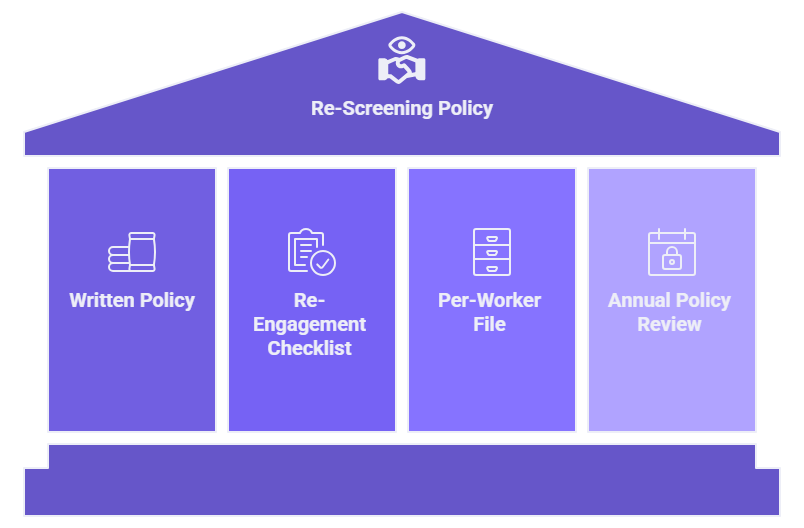
- The written policy specifying thresholds and scope by tier
- A re-engagement checklist that operationalizes the policy for HR coordinators and hiring managers
- A per-worker file documenting the new disclosure, authorization, report, and any adverse action steps
- An annual policy review record confirming the policy was reviewed and current before the season began
Communication to returning workers is also a policy variable worth addressing explicitly. Workers informed at the start of the re-engagement process that re-screening is a standard condition applied consistently to all workers in their role category are more likely to complete the authorization process promptly and less likely to experience the re-screen as a signal of distrust.
Policy Note: Fair chance hiring laws in some jurisdictions govern the timing of background checks relative to conditional offers, and these laws apply to re-engagement decisions as well as initial hires. Review applicable state and local requirements before finalizing the re-screening timeline in your policy.
The EEOC’s enforcement guidance on the consideration of arrest and conviction records applies to individualized assessment decisions that arise from re-screening findings. When a re-screen surfaces a criminal history record, the individualized assessment framework must be applied before a final re-engagement decision is made. This framework considers the nature and gravity of the offense, the time elapsed, and the nature of the job. It is not optional and it is not abbreviated for returning workers.
Conclusion
A prior season background check clearance reflects who a worker was at a prior point in time. For repeat workforce hiring, it does not carry forward to a current re-engagement as a matter of law or defensible practice. The re-engagement event triggers fresh FCRA obligations when a CRA is used and fresh negligent hiring exposure in every seasonal employee rehiring context. Neither the worker’s prior performance nor the organization’s familiarity with them changes that calculus.
A documented re-screening policy, built before the seasonal ramp-up begins, applied consistently by role and access tier, and retained as part of the re-engagement record, is the organization’s primary compliance defense and its primary negligent hiring defense.
Frequently Asked Questions About Seasonal Employee Rehiring
Does a background check from a prior season satisfy re-screening requirements?
No. A prior season’s background check reflects a worker’s record at that specific point in time and does not carry forward to a new re-engagement. Criminal records, sex offender registry status, OIG exclusion status, and professional license standing can all change between seasons. Re-engagement is treated as a new decision point for both FCRA and negligent hiring purposes.
Is a new FCRA disclosure and authorization required when re-screening a returning seasonal worker?
Yes, when a consumer reporting agency is used. The FCRA requires a new standalone disclosure and written authorization each time a consumer report is obtained for employment purposes. A prior season’s authorization does not carry forward. FTC employer guidance confirms this requirement applies each time a report is procured, regardless of the worker’s prior relationship with the organization.
How often should employers re-screen returning seasonal employees?
There is no legally mandated re-screen interval. The elapsed time threshold that triggers a re-screen is a policy variable that should be set in consultation with legal counsel based on the organization’s industry, role risk profile, and regulatory environment. High-access and regulated roles generally warrant more frequent or more comprehensive re-screening than low-risk supervised roles.
Does the FCRA adverse action process apply the same way to a returning seasonal worker as to a new hire?
Yes. The FCRA adverse action process is identical for returning workers and new hires when a CRA-obtained report is a factor in the employment decision. Pre-adverse action notice, a waiting period, individualized assessment, and final adverse action notice are all required. The prior season’s relationship with the worker does not abbreviate any step.
Can prior familiarity with a returning worker serve as a defense to a negligent hiring claim?
No. Courts evaluating negligent hiring claims focus on what the employer knew or reasonably should have known at the time of the re-engagement decision. A prior season’s clearance documents what the employer knew about the worker at a prior point in time, not at re-engagement. Documented re-screening at re-engagement is the primary negligent hiring defense.
Does re-screening apply differently to seasonal volunteers versus seasonal employees?
FCRA applicability to volunteer screening depends on whether compensation is involved and how the CRA characterizes the report’s purpose. However, the absence of FCRA applicability does not eliminate negligent hiring or duty-of-care exposure for volunteers in high-access roles. Policy-driven re-screening applied consistently to volunteers in sensitive roles is the defensible practice.
Does the 13-week rehire rule affect re-screening obligations?
The 13-week rule is a tax and benefits classification concept, not a background check standard. It has no direct effect on re-screening obligations under the FCRA or negligent hiring doctrine. Re-screening policy should be built on elapsed time thresholds and role risk profiles determined with legal counsel, not on benefits-classification intervals.
What records must an employer retain from a seasonal worker re-screening?
Re-screening records should be retained independently of the original hire file and should include the new disclosure and authorization, the consumer report, any pre-adverse action notice, any final adverse action notice, and the individualized assessment documentation. These records form the evidentiary foundation for both FCRA compliance and negligent hiring defense in any subsequent claim.
Additional Resources
- FTC: Using Consumer Reports for Employment Purposes
https://www.ftc.gov/business-guidance/resources/using-consumer-reports-what-employers-need-know - CFPB: Fair Credit Reporting Act
https://www.consumerfinance.gov/compliance/compliance-resources/other-applicable-requirements/fair-credit-reporting-act/ - OIG List of Excluded Individuals and Entities (LEIE)
https://exclusions.oig.hhs.gov - DOJ National Sex Offender Public Website (NSOPW)
https://www.nsopw.gov - Nursys License Verification (National Council of State Boards of Nursing)
https://www.nursys.com - DOL Wage and Hour Division: Worker Classification
https://www.dol.gov/agencies/whd/flsa/misclassification - SAM.gov Federal Exclusions Database
https://sam.gov/content/exclusions

ABOUT THE CREATOR
Charm Paz, CHRP
Recruiter & Editor
Charm Paz is an HR professional at GCheck, specializing in background screening, fair hiring, and regulatory compliance. She holds from the Professional Background Screening Association (PBSA) and helps organizations navigate employment regulations with clarity and confidence.
With a background in Industrial and Organizational Psychology, she translates policy into practice to build ethical, compliant, human-centered hiring systems that strengthen decision-making over time.