

Most intern programs are built around campus relationship management, not compliance, leaving FCRA obligations unmet, negligent hiring exposure unaddressed, and a conversion pipeline where unscreened interns become unvetted permanent hires. This guide identifies the structural assumptions that drive intern screening gaps and provides a defensible framework for access-tiered screening, FCRA-compliant workflows, and volume-compressed cohort hiring.
Key Takeaways
- FCRA applies to background checks on unpaid interns when a consumer reporting agency is used. Unpaid status, short duration, and educational credit classification do not create exemptions from disclosure, authorization, or adverse action requirements.
- University partnership agreements do not satisfy an employer’s independent duty of care. Career services offices are not consumer reporting agencies, and GPA verification or conduct record reviews do not constitute FCRA-compliant background checks.
- Negligent hiring doctrine applies to intern placements with the same force as permanent hires. Courts assess the employer’s duty of care based on the intern’s access profile, not their employment classification.
- Volume-compressed cohort hiring produces predictable FCRA failure patterns: batch adverse action processing, waiting period compression, and disclosure document embedding. Each failure converts an individual violation into a class.
- The appropriate background check scope for an intern is determined by role access profile, not intern classification. IT credentials, PII access, healthcare placement, and contact with vulnerable populations each add specific check requirements.
- Returning interns and co-op students require a new background check each term. A prior-term clearance is a point-in-time determination and does not carry forward as ongoing clearance for a subsequent engagement.
More than half of employers who hire interns convert a portion of that class to full-time offers. That conversion pipeline means that an unscreened intern is, in many cases, a future unvetted permanent hire. The intern hiring challenges most program leads identify are logistical: offer letter timing, university relationship coordination, housing stipend approvals. The compliance gaps that actually generate liability are structural, embedded in program design assumptions that have never been tested against the legal obligations they quietly violate.
This guide is built for early talent program leads, HR compliance officers, and employment counsel who manage intern hiring at scale and need a screening framework that holds up under audit and in litigation.
50%+
Of employers who hire interns convert a portion of their intern class to full-time offers, creating a pipeline where unscreened interns become unvetted permanent hires
NACE Internship & Co-op Report
Why Intern Screening Gets Skipped: Three Structural Assumptions
Intern screening gaps are not individual oversights by overworked recruiters. They are the predictable output of programs designed around campus relationship management, not around the compliance requirements that apply to any worker with meaningful system access, client exposure, or sensitive data handling. Three organizational assumptions operate as the structural drivers of this gap.
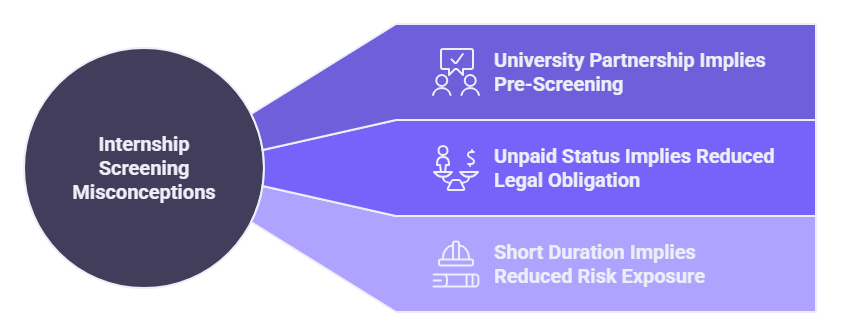
Assumption One: University Partnership Implies Pre-Screening
A signed partnership agreement with a university career services office creates a strong organizational perception that the employer’s due diligence obligation has been satisfied. Career services offices facilitate matching, collect resumes, and sometimes verify GPA or conduct records. None of that constitutes an FCRA-compliant background check. When these activities are conducted directly by the university without using a consumer reporting agency, they do not trigger FCRA requirements and they do not satisfy the employer’s independent duty of care. The employer’s screening obligation is not transferable through a partnership agreement.
Assumption Two: Unpaid Status Implies Reduced Legal Obligation
Employers frequently apply a mental model where compensation level correlates with compliance obligation. Unpaid interns generate no payroll liability and often no workers’ compensation exposure, so the assumption follows that they generate less legal risk overall. The FCRA does not operate on this model. When a consumer reporting agency is engaged to evaluate a person for any position, the statute’s employment purposes definition applies regardless of compensation structure. See 15 U.S.C. § 1681a(h).
Assumption Three: Short Duration Implies Reduced Risk Exposure
A ten-week internship feels categorically different from a multi-year employment relationship from a risk standpoint. But the harm enabled by a placement that should not have been made is not duration-dependent. An intern with access to patient records in week two can create a HIPAA violation in week two. An intern with physical facility access on day one can cause harm on day one. Duration of placement does not limit the window of potential harm in the way this assumption implies.
Compliance Warning: These three assumptions are structural, not individual. They are embedded in program design. When the program design does not include screening, screening does not happen consistently regardless of individual recruiter effort.
What Access Interns Actually Receive
The access profile of a role, not the employment classification, is the operative factor in both the negligent hiring liability analysis and the appropriate screening depth determination.
| Access Type | Common in Intern Roles | Liability Mechanism |
| IT system credentials and network access | Technology, finance, consulting, healthcare | Data breach exposure; negligent hiring if prior fraud or cybercrime history undiscovered |
| Client-facing interaction | Marketing, sales, legal, financial services | Client harm; respondeat superior liability; negligent hiring defense unavailable without screening |
| Access to PII or financial records | HR, finance, healthcare, legal | Identity theft facilitation; regulatory violation; negligent hiring liability |
| Physical facility access including restricted areas | Manufacturing, research, government contractors | Physical harm; property theft; negligent hiring if relevant prior history undiscovered |
| Access to minors or vulnerable populations | Education, social services, healthcare, nonprofits | Heightened duty of care; sex offender registry checks required for regulated positions with direct child access; requirements vary by state and sector |
Courts have upheld negligent hiring liability in cases where an employer failed to conduct a background check that would have revealed a relevant prior offense. Courts have not distinguished between permanent employees and intern workers when establishing the employer’s duty of care. The access profile of the role is the operative factor in the liability analysis.
FCRA and Intern Screening: The Unpaid Exemption That Does Not Exist
The FCRA applies to background checks on unpaid interns when a consumer reporting agency is engaged. The statute defines “employment purposes” to cover any evaluation for a position regardless of compensation structure. Unpaid status does not create an exemption. All disclosure, authorization, and adverse action requirements apply identically to intern screening as to employee screening.
When your organization engages a consumer reporting agency to conduct a background check on an intern candidate, every FCRA procedural obligation that applies to a permanent hire also applies to that intern. There are no exceptions based on compensation, duration, or educational credit status.
FCRA Compliance Steps for Intern Screening
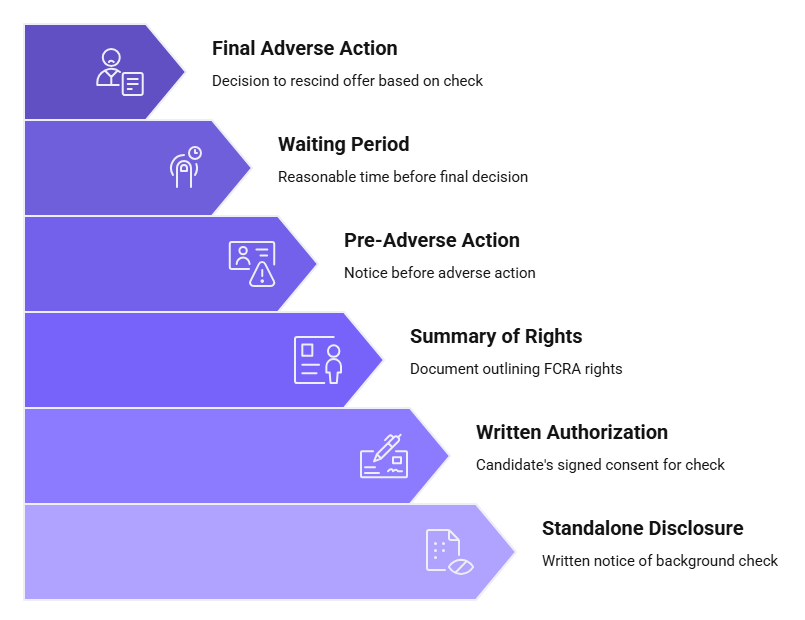
- Standalone Disclosure: Before ordering a consumer report, provide the candidate with a written disclosure that a background check may be obtained. This document must stand alone and may not be embedded in an employment application, offer letter, or onboarding packet.
- Written Authorization: Obtain the candidate’s written authorization to order the report. This authorization may appear on the same document as the disclosure, but the combined document must still be standalone. Verbal authorization is insufficient.
- Summary of Rights Delivery: Provide the candidate with the current version of “A Summary of Your Rights Under the Fair Credit Reporting Act” before or at the time the disclosure is provided.
- Pre-Adverse Action Notice: If a background check finding may affect the intern’s placement offer or cohort continuation, provide a pre-adverse action notice before taking any adverse action. Include a copy of the report and the Summary of Rights.
- Waiting Period: Allow a reasonable waiting period after delivery of the pre-adverse action notice before issuing a final adverse action notice. FTC and CFPB guidance indicates that at least five business days is generally considered reasonable, though this is not a statutory bright-line rule.
- Final Adverse Action Notice: If the decision is made to rescind the placement offer based on background check findings, issue a final adverse action notice including the CRA’s name, address, and phone number, and a statement that the CRA did not make the decision.
Legal Notice: The adverse action two-step is not optional for intern placements. When a background check finding affects a placement offer, cohort continuation, or a transition to a full-time role, the pre-adverse action notice and waiting period must precede the final adverse action notice. This sequence also applies when a returning intern’s background check affects their transition to a permanent offer at the end of the program.
The EEOC’s Enforcement Guidance on the Consideration of Arrest and Conviction Records requires that when criminal history information affects a hiring decision, employers conduct an individualized assessment considering the nature of the offense, time elapsed, and the nature of the role. This obligation applies to intern placement decisions regardless of whether the position is paid or unpaid.
The University Partnership Screening Assumption
An employer cannot rely on a university to screen interns before placement. University career services offices facilitate matching and logistics but do not conduct FCRA-compliant background checks. The employer’s independent duty of care and FCRA obligations cannot be transferred or satisfied through a university partnership agreement.
| University Career Services Activity | FCRA-Compliant Screening? | Satisfies Employer Duty of Care? |
| Resume collection and forwarding | No | No |
| GPA verification from student records | No | No |
| Student conduct record review | No | No |
| Faculty recommendation collection | No | No |
| Eligibility confirmation for credit-bearing internship | No | No |
How to Structure University Partnership Agreements
The partnership agreement is the right instrument for documenting screening accountability, but only if drafted to address it explicitly. Most partnership agreements are silent on background screening or use vague language that does not assign a specific obligation to either party.
Partnership agreements should include language that identifies the employer as the party responsible for any required background check, specifies that the university’s eligibility verification processes do not substitute for the employer’s screening program, and authorizes the employer to communicate background check requirements directly to students.
Policy Note: When communicating background check requirements to university contacts, frame the requirement as a condition of the employer’s program, not as a supervisory mechanism. Language that implies the employer controls the student’s academic experience can create misclassification signals under the FLSA primary beneficiary test for unpaid intern classification.
Summer Cohort Volume Compression: The FCRA Failure Pattern
Summer cohort hiring creates a distinct FCRA failure pattern when 50 to 100 interns are processed in a compressed window against a hard start date. The adverse action two-step is the first compliance workflow to collapse under volume pressure. Batch processing of cohorts with individual adverse findings produces systemic violations, not isolated ones.
5 business days
Is the minimum waiting period between pre-adverse action notice and final adverse action notice, a window routinely compressed or eliminated during high-volume cohort hiring
FTC FCRA Guidance and CFPB Enforcement Policy Statements
Failure Mode One: Batch Adverse Action Processing
When a cohort of 80 interns is processed together and background check results arrive in batches, the organizational instinct is to process findings in batches as well. The adverse action process is an individual process, not a group process. Each candidate with a finding must receive their own pre-adverse action notice, their own copy of the report, their own waiting period, and their own final adverse action notice. Batch processing that collapses individual timelines into a group timeline violates these requirements for every individual whose timeline was not independently honored.
Failure Mode Two: Waiting Period Compression
With a hard start date of June 3 and background check results arriving May 28, the math does not leave room for a five-business-day waiting period. The organizational response is typically to compress or eliminate the waiting period. This is an FCRA violation. The waiting period exists to allow the candidate to identify and dispute inaccuracies before a final decision is made. Compressing it eliminates that right.
Failure Mode Three: Disclosure Document Embedding
Volume-compressed onboarding workflows create pressure to bundle FCRA disclosures into offer letters, onboarding packets, or electronic signature batches. The standalone disclosure requirement prohibits this. A disclosure document embedded in or presented alongside other onboarding materials is not a standalone document regardless of whether it contains the correct substantive language.
Class Action Risk: Failure to use a standalone disclosure form and failure to complete the two-step adverse action process are among the most commonly cited violations in FCRA class action litigation. When a cohort of 80 interns is processed with a defective disclosure document, the class is 80 people, not one.
Workflow Design Principles for Screening at Volume
- Staggered Initiation Timelines: Initiate background checks in rolling batches rather than simultaneously for the full cohort. Staggering initiation by one to two weeks creates space for findings to surface and be individually adjudicated before the start date.
- Role-Based Triage Queuing: Prioritize screening initiation for roles with the highest access and exposure profiles. Interns with IT credentials, healthcare placements, or PII access should be cleared before lower-exposure roles.
- Individual Adverse Action Tracking: Maintain a per-candidate adverse action log tracking disclosure delivery, authorization receipt, report order date, result receipt, pre-adverse notice delivery, waiting period expiration, and final disposition. This log must function at the individual level, not the cohort level.
- Start Date Contingency Language: Structure offer letters to make the start date contingent on satisfactory completion of the background check process, including any required waiting period. This removes the organizational pressure to compress the waiting period to meet a fixed start date.
- Escalation Protocol for Late Findings: Define in advance the escalation path for a background check finding that surfaces within five business days of the start date, specifying who has authority to delay a start date and who manages the individual adverse action process.
Access-Tiered Screening for Interns: Matching Check Depth to Actual Exposure
The appropriate background check for a summer intern depends on role access profile, not the intern classification label. Two failure modes exist at opposite ends of the spectrum: universal minimal screening that ignores role-specific risk, and full-employee screening applied without regard to actual exposure. An access-tiered model resolves both by treating check depth as a function of what the intern will actually access, handle, and interact with.
| Access or Exposure Variable | Check Type Warranted |
| Physical facility access (restricted areas) | County + Federal Criminal |
| IT system credentials and network access | County + Federal Criminal |
| Access to PII or financial records | County + Federal Criminal + SSN Trace |
| Client-facing interaction | County + Federal Criminal |
| Healthcare placement (any role) | + OIG LEIE Check |
| Access to minors or vulnerable populations | + Sex Offender Registry (state and national; requirements vary by state and sector) |
| Driving required for role | + Motor Vehicle Record (MVR) |
| Credential-dependent role (nursing, engineering, etc.) | + Education/Credential Verification |
The Minimum Defensible Check Stack for Interns with Meaningful Access
For any intern with IT system credentials, client-facing responsibility, access to PII or financial records, or physical access to restricted facilities, the minimum defensible check stack is: SSN trace to confirm identity and establish address history for county search jurisdiction; county criminal search in all counties of residence identified through the SSN trace; and federal criminal search. This minimum stack cannot be reduced based on the intern’s student status, placement duration, or the employer’s prior relationship with the individual.
For healthcare placements, the OIG LEIE search is not optional. Placing an intern who appears on the LEIE in a healthcare organization that bills federal programs can trigger Civil Monetary Penalty liability. The LEIE check is low-friction and should be a standard component of any healthcare intern’s screening package regardless of role level.
Geographic Placement Considerations
Intern programs that place candidates across multiple states must account for the jurisdiction in which the search is conducted, not just the state where the employer is headquartered. A county criminal search must cover counties of residence. An intern who grew up in one state, attended university in a second, and is being placed in a third may require county searches in all three jurisdictions to produce a defensible result.
Building a Defensible Intern Screening Program Before the Cohort Arrives
The most preventable compliance failures in intern programs occur because the compliance framework was never built, not because it was built incorrectly. The pre-cohort window, typically eight to twelve weeks before the program start date, is the right time to close structural gaps before volume pressure makes individual adjudication impossible.
Pre-Cohort Compliance Review Checklist
- Confirm CRA Permissible Purpose Coverage: Review the permissible purpose language in your CRA service agreement to confirm it covers intern positions, not just employees. Some agreements define permissible purpose narrowly using employment language that may not explicitly cover unpaid or temporary educational placements. Confirm coverage in writing before the cohort screening cycle begins.
- Audit Disclosure and Authorization Documents: Pull the disclosure and authorization forms that will be presented to intern candidates and confirm they meet the standalone requirement, contain no extraneous content, reference the correct CRA, and reflect the current CFPB Summary of Rights version.
- Audit the Adverse Action Workflow: Map the actual workflow that will be followed when a background check finding surfaces. Confirm the workflow produces individual pre-adverse notices, tracks the waiting period at the individual level, and issues final adverse action notices with all required CRA contact information.
- Apply State-Law Overlays for All Placement Jurisdictions: Identify every state in which interns will be placed and confirm that the screening program applies the applicable state-law requirements for each jurisdiction, including criminal history look-back period limitations and ban-the-box compliance obligations.
- Document the Re-Screening Policy for Returning Interns: Establish and document the organization’s policy on re-screening returning interns and co-op students across multiple terms. A prior-term clearance is a point-in-time determination. A background check from a prior summer does not satisfy the screening obligation for a subsequent spring co-op term.
The Returning Intern Re-Screening Obligation
A background check conducted in May of one year reflects the individual’s history as of that date. An eighteen-month gap between terms is an eighteen-month window in which new information could have been generated. Programs that carry prior-term clearance forward without re-screening are making an undocumented risk assumption that may not be defensible if a subsequent incident surfaces information a re-screen would have revealed.
Record Retention: FCRA-related records, including disclosure acknowledgments, authorization signatures, copies of consumer reports, pre-adverse action notices, and final adverse action notices, should be retained for a minimum period consistent with the applicable statute of limitations in the placement jurisdiction. Consult legal counsel for jurisdiction-specific retention requirements.
Conclusion
Intern hiring challenges are structural, not logistical. The compliance gaps that generate liability are embedded in program design assumptions about university pre-screening, unpaid status, and short-duration risk, none of which hold up against the legal obligations that actually apply. The FCRA applies to unpaid interns. Negligent hiring doctrine applies to intern placements. The adverse action two-step applies to cohort hiring.
A defensible intern screening program is built before the cohort arrives, applied consistently by access tier, and documented at the individual level regardless of volume. The pre-cohort window is the only time that structural work can be done without the pressure of a hard start date compressing the decisions that need to be made carefully.
Frequently Asked Questions About Intern Hiring Challenges and Background Checks
Do employers need to run background checks on interns?
No federal law universally mandates background checks for interns, but employers may face negligent hiring liability if an intern causes harm and a background check would have revealed a relevant prior offense. Courts do not distinguish between intern and employee classifications when assessing the employer’s duty of care. Screening is strongly warranted for any intern with meaningful system access, client exposure, or sensitive data handling.
Does FCRA apply to background checks on unpaid interns?
Yes. The FCRA applies to any background check conducted through a consumer reporting agency for employment purposes. The statute defines employment purposes to cover any evaluation for a position regardless of compensation. Unpaid status does not create an FCRA exemption. All disclosure, authorization, and adverse action requirements apply identically to intern screening as to employee screening.
Can an employer rely on a university to screen interns before placement?
No. University career services offices are not consumer reporting agencies and do not conduct FCRA-compliant background checks. GPA verification, conduct record reviews, and faculty recommendations do not substitute for an employer’s independent background screening. The employer’s duty of care and FCRA obligations cannot be transferred through a university partnership agreement.
What background check is appropriate for a summer intern?
The appropriate check depends on the intern’s access profile, not their classification. The minimum defensible stack for interns with meaningful access includes an SSN trace, county criminal search, and federal criminal search. Healthcare placements add an OIG LEIE check. Roles involving access to minors add a sex offender registry search where required by state law or sector regulation. Driving roles add an MVR. Credential-dependent roles add education verification.
Does a returning intern or co-op student need a new background check each term?
Yes, in most cases. A prior background check is a point-in-time determination that reflects the individual’s history as of the check date. It does not carry forward as ongoing clearance for subsequent terms. Programs that treat prior-term clearance as permanent status are making an undocumented risk assumption that may not be defensible if a subsequent incident surfaces information a re-screen would have revealed.
What are the biggest FCRA failure risks in large cohort intern hiring?
The three most common failure modes in volume-compressed cohort hiring are: batch processing of adverse action notices rather than individual processing; compression or elimination of the required waiting period between pre-adverse and final adverse action notices; and embedding FCRA disclosure documents inside offer letters or onboarding packets rather than providing them as standalone documents. Each of these failures, when applied to a cohort, converts individual violations into potential class action exposure.
What happens if an intern causes harm and the employer never ran a background check?
The employer may face negligent hiring liability if a reasonable background check would have revealed information relevant to the harm caused. Courts have upheld negligent hiring claims in these circumstances and have not distinguished intern from employee placements in assessing the duty of care. The absence of any screening record weakens the employer’s defense substantially.
Additional Resources
- FTC: Using Consumer Reports for Employment Purposes
https://www.ftc.gov/business-guidance/resources/using-consumer-reports-what-employers-need-know - CFPB: Fair Credit Reporting Act
https://www.consumerfinance.gov/compliance/compliance-resources/other-applicable-requirements/fair-credit-reporting-act/ - OIG List of Excluded Individuals and Entities (LEIE)
https://exclusions.oig.hhs.gov - DOJ National Sex Offender Public Website (NSOPW)
https://www.nsopw.gov - DOL: Primary Beneficiary Test for Unpaid Internships
https://www.dol.gov/agencies/whd/fact-sheets/71-flsa-internships - SAM.gov Federal Exclusions Database
https://sam.gov/content/exclusions

ABOUT THE CREATOR
Charm Paz, CHRP
Recruiter & Editor
Charm Paz is an HR professional at GCheck, specializing in background screening, fair hiring, and regulatory compliance. She holds from the Professional Background Screening Association (PBSA) and helps organizations navigate employment regulations with clarity and confidence.
With a background in Industrial and Organizational Psychology, she translates policy into practice to build ethical, compliant, human-centered hiring systems that strengthen decision-making over time.