


Continuous background monitoring for volunteers is an ongoing criminal record surveillance program that checks enrolled volunteers against court records, criminal databases, and sex offender registries on a recurring basis, generating alerts when new records appear. It closes the time gap between a volunteer’s most recent point-in-time background check and the present, surfacing disqualifying activity that a one-time onboarding check cannot detect.
Key Takeaways
- A background check answers one question accurately: does this person have a disqualifying record as of the date the check was run. It cannot answer whether they have one now.
- Organizational exposure concentrates in the longest-tenured volunteers, whose clearances are oldest and whose trust relationships are most established, not in recently screened new volunteers.
- Continuous monitoring closes the time gap between scheduled re-screens. It does not replace periodic re-screening, which is needed to refresh geographic scope, re-verify identity, and restart clearance currency.
- If you use a CRA for continuous monitoring, FCRA applies. This includes the initial disclosure requirement, the authorization requirement, and the two-step adverse action process when a monitoring alert leads to a removal decision.
- The initial FCRA disclosure obtained at onboarding must cover post-hire monitoring. A disclosure that only covers the pre-hire check does not authorize ongoing monitoring.
- When a monitoring alert fires, the two-step FCRA adverse action process applies before any removal decision is final. The volunteer has the right to dispute the accuracy of the record before a final adverse action notice is issued.
- The minimum program architecture for a youth-serving volunteer organization includes annual full re-screening, continuous monitoring enrollment for all volunteers with recurring access to vulnerable populations, a documented alert review and adverse action workflow, and updated FCRA disclosures covering ongoing monitoring.
The Problem With Point-in-Time Background Checks
Most volunteer programs describe what happens at onboarding. Very few describe what happens in the months and years after. The result is a roster where every active volunteer was screened at some point, but none are screened now. For programs running no re-screening, the average age of clearances grows every month. A check that cleared someone two years ago says nothing about that person today.
Three Structural Gaps a One-Time Check Cannot Close
Three structural gaps drive this problem. First, new criminal activity after onboarding stays invisible to the organization. This remains true unless the volunteer self-discloses, which most programs do not require and most volunteers do not do voluntarily. Second, new sex offender registry listings represent a distinct gap. A volunteer not registered at onboarding may appear on a registry after a subsequent conviction, or after a registration requirement from a prior offense in another jurisdiction surfaces. These listings can appear months or years after a volunteer cleared. Third, clearance age accumulates silently. Organizations often do not know how old their volunteers’ clearances are until an incident forces a review.
What This Means for Organizational Risk
Organizational confidence in a volunteer roster is only as current as the most recent check. For most programs, that check is months or years old for the majority of active volunteers. The gap between a clean clearance and the present is where liability concentrates. It is precisely where point-in-time screening programs have no visibility.
What Continuous Monitoring Actually Does and Does Not Do
Continuous background monitoring checks a volunteer’s record against criminal court databases and sex offender registries on a recurring basis, typically daily, and generates an alert when a new record appears.
| What Monitoring Surfaces | What Monitoring Does Not Replace |
| New criminal charges filed | Full geographic scope of a periodic re-screen |
| New convictions and sentencing records | Identity and address re-verification |
| New sex offender registry listings (where included) | Records in jurisdictions outside the monitoring network, including tribal and federal courts where not covered |
| Updated case dispositions on prior matters | The complete suite of checks a re-screen includes |
A monitoring alert is not an adverse action trigger by itself. The organization reviews the alert and determines whether the record is disqualifying under its policies. If the organization uses a CRA for the monitoring service, it then follows the FCRA adverse action process before removing the volunteer. Organizations should document both adverse action decisions and no-action determinations after alert review. Both types of documentation are equally important for demonstrating a consistent and defensible program. Alerts typically fire within days of a new record appearing in the court system, with county-level update variability of generally 24 to 72 hours for most major jurisdictions.
“What happens when a volunteer who was cleared two years ago is no longer the same person today?” What I have learnt about working with such people is that trust and security can never be assured at one point in time. While a background check done once may reveal the identity of a person back then, a program should also consider the situation a few months or even a year later, after the person has been exposed to certain responsibilities within the program. �
The Between-Check Gap: Where Most Organizational Risk Lives
The between-check gap is the period between a volunteer’s most recent background check and the present. For most programs, this gap grows silently as volunteers continue serving.
The Illustrative Exposure Profile
Consider a typical mid-size youth-serving nonprofit. It has 80 active volunteers, onboarding checks run for all 80 at the time of joining, an average volunteer tenure of 3.4 years, no formal re-screening policy, and an average clearance age of 2.1 years across the active roster. The highest-exposure individuals are not the newest volunteers, who were just screened. They are the longest-tenured volunteers. These individuals have the deepest trust relationships, the most established access to facilities and schedules, and background checks that may be three or four years old. They are also the least likely to trigger re-screening under a policy that only checks new volunteers. In litigation, their undetected post-hire activity would create the most significant organizational exposure.
The Annual Re-Screening Benchmark
The ACA accreditation standard for camp programs requires an annual criminal background check on all seasonal staff. It serves as a recognized best-practice benchmark for volunteer organizations more broadly. For organizations without a sector-specific standard, annual re-screening is the cadence most courts apply when evaluating reasonable care. A program that re-screens only at onboarding does not meet this benchmark. In a negligent hiring or negligent retention claim, the absence of a documented re-screening policy is the evidentiary gap that plaintiff counsel targets first.
How Continuous Monitoring and Periodic Re-Screening Work Together
Periodic re-screening and continuous monitoring address different parts of the same problem. Periodic re-screening closes the scope gap. Continuous monitoring closes the time gap. Neither tool does what the other does, and a program using only one has left a specific vulnerability open. Together, they form a more comprehensive solution for safety, responsibility, and risk management. Companies who employ both will be able to react more proactively rather than simply using old clearance data.
Why Both Tools Are Necessary
When re-screening runs annually, a criminal charge filed the week after the re-screen stays undetected for nearly a year. Continuous monitoring addresses that gap directly. A charge filed the day after an annual re-screen generates an alert within days, not months. Conversely, a monitoring service covering a defined set of court databases does not provide the jurisdictional breadth a full re-screen delivers across all current and prior addresses. The re-screen catches what monitoring cannot reach. Monitoring catches what the re-screen’s timing would miss.
The Practical Program Architecture
The practical program architecture for a youth-serving volunteer organization includes four elements:
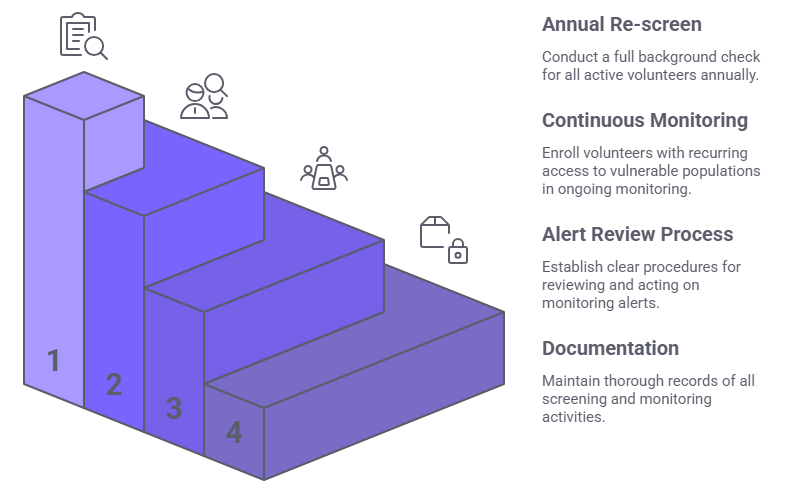
- Annual full re-screen for all active volunteers as the minimum best-practice cadence.
- Continuous monitoring enrollment for all volunteers with recurring access to vulnerable populations.
- A monitoring alert review process specifying who receives alerts, what the review criteria are, and what the FCRA adverse action workflow looks like when a disqualifying record is found.
- Documentation of all re-screens, monitoring alerts, alert reviews, and adverse action decisions in each volunteer’s file.
This architecture demonstrates reasonable care to a court. It shows the organization was actively monitoring, not passively assuming.
FCRA Compliance for Continuous Monitoring Programs
If your organization uses a consumer reporting agency to conduct continuous monitoring of volunteers, FCRA applies. The same organization that treats FCRA as a pre-hire requirement must extend that compliance to post-hire monitoring. The nonprofit or volunteer nature of the program creates no exemption. The test is whether a CRA conducted the monitoring.
The Disclosure Gap Most Programs Miss
The initial FCRA disclosure obtained at volunteer onboarding must state that the organization intends to conduct ongoing monitoring. A disclosure form covering only the pre-hire check does not authorize continuous post-hire monitoring. Organizations enrolling currently active volunteers in a new monitoring program must re-issue an updated disclosure and obtain new written authorization before enrollment. This step is the most commonly skipped FCRA compliance requirement in continuous monitoring implementations. Without it, the monitoring program itself creates a FCRA violation before it surfaces a single alert.
Many volunteer programs discover this gap when they attempt to add monitoring. Their existing disclosure forms cover a one-time pre-hire check. Every active volunteer enrolled without an updated disclosure represents an unauthorized consumer report. Correcting this requires re-issuing updated disclosures to the entire active roster before enrollment begins, not just to new volunteers going forward.
Adverse Action When a Monitoring Alert Leads to Removal
When a monitoring alert surfaces a new record and the organization determines it is disqualifying, the two-step FCRA adverse action process applies before any removal decision is final. The organization must first send a pre-adverse action notice with a copy of the consumer report and the Summary of Rights Under the FCRA. The volunteer then has a waiting period of generally at least five business days per CFPB and FTC guidance to review the record and dispute its accuracy. The final adverse action notice must identify the CRA by name, address, and telephone number. It must also state that the CRA did not make the removal decision and inform the volunteer of their right to obtain a free copy of the report within 60 days and to dispute its accuracy or completeness.
The Urgency Problem
The instinct to act immediately when a sex offender registry alert fires is understandable, particularly in programs serving children. The legal requirement, however, is to follow the adverse action process. The volunteer must have the right to dispute the accuracy of the record before a final decision is made. Registry data contains errors, and acting on an inaccurate alert without providing dispute rights creates FCRA liability. In situations involving a genuinely urgent safety concern, organizations should consult qualified legal counsel immediately. Interim protective measures may include temporary suspension of volunteer duties or restricted access to program areas pending completion of the adverse action process. The availability and lawfulness of specific measures depend on jurisdiction, organizational policy, and the facts of the situation.
FCRA obligations vary by jurisdiction and circumstance. This section is informational only and does not constitute legal advice. Consult qualified legal counsel before establishing or modifying a monitoring program and adverse action workflow.
Building a Continuous Monitoring Program: The Implementation Checklist
Before Enrolling Volunteers in Monitoring
Complete these steps before any volunteer is enrolled:
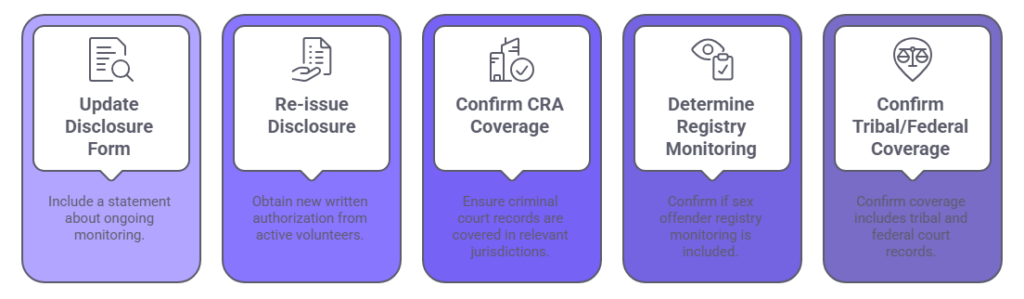
- Update the onboarding FCRA disclosure form to include a statement that ongoing monitoring will be conducted.
- Re-issue the updated disclosure to all currently active volunteers and obtain new written authorization before enrolling them.
- Confirm with your CRA that the monitoring service covers criminal court records in the jurisdictions relevant to your program.
- Determine whether sex offender registry monitoring is included or requires separate enrollment.
- Confirm whether monitoring coverage includes tribal and federal court records for programs operating in relevant geographies.
Enrollment Priorities
When enrolling volunteers, apply the following priorities:
- Enroll all volunteers with recurring access to vulnerable populations at the time of onboarding.
- Enroll existing active volunteers whose clearances are more than 12 months old, with updated disclosure and authorization obtained before enrollment.
- Prioritize the longest-tenured volunteers first, as their clearances are the oldest and their established access represents the highest exposure.
Alert Review and Adverse Action Process
When a monitoring alert arrives, follow these steps:
- Route alerts to the designated reviewer with decision authority.
- Apply documented review criteria distinguishing disqualifying records from records requiring individualized assessment.
- Document the alert, the review determination, and the basis for the determination in the volunteer’s file, whether the determination results in adverse action or no action.
- If the record is disqualifying and a CRA conducted the monitoring, follow the FCRA two-step adverse action process before any removal decision is final.
Ongoing Program Management
Maintain the program with the following ongoing requirements:
- Run an annual full re-screen for all active volunteers. Continuous monitoring does not substitute for this comprehensive refresh.
- Retain monitoring enrollment records and alert logs in each volunteer’s file.
- Review and update disclosure language annually or whenever your CRA’s terms or monitoring scope changes.
Conclusion
A complete volunteer background check program closes three gaps. Continuous monitoring closes the time gap between scheduled checks, surfacing new records within days rather than waiting months or years for a re-screen. Annual re-screening closes the scope gap, refreshing the full background check stack across all relevant jurisdictions and restarting clearance currency. FCRA-compliant documentation, including updated disclosures authorizing ongoing monitoring and a documented adverse action workflow for monitoring-triggered removal decisions, closes the liability gap. An organization that builds all three into its volunteer program has done what reasonable care requires and has the records to demonstrate it.
Frequently Asked Questions
What is continuous background monitoring for volunteers?
Continuous background monitoring is an enrollment-based service that checks a volunteer’s record against criminal court databases and sex offender registries on a recurring basis, typically daily, generating an alert when a new record appears. It closes the time gap between a volunteer’s most recent point-in-time check and the present. If your organization uses a CRA for this service, FCRA applies.
How often should volunteers be re-screened?
Annual re-screening is the recognized best-practice benchmark and the cadence the ACA accreditation standard requires for camp programs. For other volunteer organizations, courts evaluating reasonable care look for regular re-screening at a documented interval. Annual re-screening combined with continuous monitoring between re-screens represents the complete program that best-practice standards reflect.
Does FCRA apply to volunteer background monitoring programs?
FCRA applies if you use a consumer reporting agency to conduct the monitoring, regardless of whether volunteers are paid or unpaid. The nonprofit or volunteer nature of the program does not create an exemption. FCRA requires updated disclosure and authorization before monitoring begins, and the two-step adverse action process applies when a monitoring alert leads to a removal decision.
What is the difference between re-screening and continuous monitoring?
Re-screening provides a comprehensive refresh of the full background check stack across all relevant jurisdictions and restarts clearance currency. Continuous monitoring fills the time gap between re-screens by checking a narrower set of records daily and generating alerts for new activity. The two serve different functions and work together as complements, not alternatives.
Can an organization remove a volunteer immediately when a monitoring alert fires?
Not without following the FCRA adverse action process first, if a CRA conducted the monitoring. The organization must provide a pre-adverse action notice with a copy of the report and allow a waiting period before issuing a final adverse action notice. If an urgent safety concern exists, consult qualified legal counsel immediately about whether interim protective measures are available while the process proceeds.

ABOUT THE CREATOR
Charm Paz, CHRP
Recruiter & Editor
Charm Paz is an HR professional at GCheck, specializing in background screening, fair hiring, and regulatory compliance. She holds from the Professional Background Screening Association (PBSA) and helps organizations navigate employment regulations with clarity and confidence.
With a background in Industrial and Organizational Psychology, she translates policy into practice to build ethical, compliant, human-centered hiring systems that strengthen decision-making over time.