

Half of working mothers with children under 18 concealed caregiving responsibilities during the hiring process, compared to 38% of fathers. That 12-point gap is not a communication preference. It is a rational response to a hiring environment where authenticity, for certain candidates, carries a documented cost.
Key Takeaways
- 50% of working mothers concealed caregiving responsibilities during hiring, compared to 38% of fathers, a 12-point gap tied to the documented motherhood penalty in hiring.
- Identity concealment extends well beyond caregiving: 64% of Hispanic and 56% of Black candidates altered their appearance or communication style for interviews.
- 32% of Black respondents used a different name on applications to avoid ethnicity-based assumptions.
- 36% of all candidates concealed age indicators, rising to 47% among Baby Boomers.
- Candidates are not withholding information out of deception. They are responding rationally to a system they experience as structurally biased.
- Employers are making hiring decisions based on incomplete signals, not because candidates are hiding who they are, but because candidates have learned that full disclosure carries risk.
- Concealment behaviors and credential embellishment are distinct problems with different causes and require different organizational responses.
- Transparent, standardized screening criteria applied consistently across all candidates can reduce the conditions that make concealment feel necessary.
The Signal Problem in Modern Hiring
Hiring depends on signal quality. Employers evaluate candidates based on what they disclose, how they present, and what verification confirms. When those signals are systematically shaped by fear of bias rather than professional reality, the foundation of that evaluation is compromised. Not because candidates are being deceptive, but because they have learned, through experience or observation, that full authenticity is not safe.
The 2026 Trust in Hiring Report puts a number on that dynamic. Among working mothers with children under 18, 50% concealed caregiving responsibilities during the hiring process. Among fathers in the same situation, the rate was 38%. That 12-point difference is not explained by communication style or personal preference. Research on the motherhood penalty in hiring has consistently documented that mothers are evaluated differently than fathers on measures of competence, commitment, and hirability. Candidates know this. The concealment rate reflects that knowledge.
Employers believe they are evaluating candidates as they are. In many cases, they are evaluating a carefully edited version, shaped by each candidate’s rational calculation of what disclosure costs. That is the signal problem, and it sits at the center of what the 2026 data is telling us.
The Motherhood Penalty in Practice
The motherhood penalty in hiring refers to the documented pattern in which mothers face lower callback rates, lower salary offers, and harsher competence evaluations than childless women or fathers with equivalent qualifications. It is not a perception. It is a measured outcome replicated across audit studies and survey research over multiple decades.
What the 2026 data adds is a behavioral response layer, and it is the part that carries the most operational weight. When 50% of working mothers actively conceal caregiving responsibilities during hiring, the penalty is no longer operating only through employer bias. It is now shaping candidate behavior upstream, before the interview begins, before the resume is submitted, before the hiring manager ever forms an impression. The penalty has become internalized as a learned calculation about what is safe to disclose, and the cost of that internalization runs in both directions.
Where Concealment Begins
Caregiving concealment takes several forms in practice. Organizations that understand these patterns are better positioned to address the conditions producing them.
- Removing references to volunteer work connected to school or family organizations
- Avoiding discussion of employment gaps tied to parental leave
- Declining to mention flexible scheduling needs during early hiring stages
- Not raising the subject in interviews where it would naturally come up
None of these behaviors are dishonest in the way that credential fabrication is dishonest. A mother who does not volunteer that she has children is not lying. She is making a calculated decision about what information is safe to share in a system she has reason to distrust. That distinction matters, because how an organization frames this problem determines how it responds to it.
Identity Concealment Is Broader Than Caregiving
The caregiving concealment finding does not exist in isolation. The broader pattern the 2026 data reveals deserves more attention than it typically gets in conversations about hiring integrity. Identity concealment extends across race, ethnicity, and age and follows the same structural logic throughout: candidates edit their authentic presentation in response to perceived or anticipated bias.
Race, Ethnicity, and Appearance
The data shows that identity modification for interviews varies significantly by demographic group. Each behavior reflects a calculated response to documented or perceived hiring bias.
| Population | Concealment Behavior | Rate |
| Hispanic respondents | Altered appearance or communication style for interviews | 64% |
| Black respondents | Altered appearance or communication style for interviews | 56% |
| White respondents | Altered appearance or communication style for interviews | 39% |
| Black respondents | Used a different name to avoid ethnicity assumptions | 32% |
| All respondents | Used a different name to avoid ethnicity assumptions | 21% |
| Asian respondents | Removed cultural or identity-related details from resume | 40% |
| All respondents | Removed cultural or identity-related details from resume | 31% |
Source: GCheck 2026 Trust in Hiring Report, n=1,500
Name-based discrimination in hiring has been documented extensively in audit research. Audit research has consistently documented that resumes with names perceived as belonging to Black applicants receive fewer callbacks than identical resumes with names perceived as White. Candidates who use different names are not gaming the system. They are responding to documented evidence about how the system works. That framing is important for any organization serious about fair hiring.
Age and Generational Concealment
Thirty-six percent of all respondents concealed age indicators during the hiring process, rising to 47% among Baby Boomers. Age-related concealment takes forms including removing graduation dates, omitting early career positions, and adjusting resume formatting to obscure tenure length.
Age discrimination in hiring is prohibited under the Age Discrimination in Employment Act for workers 40 and older. Legal prohibition and lived experience, however, are different things. Candidates who conceal age indicators are responding to a perception of risk that research on age discrimination in hiring consistently validates.
The Difference Between Concealment and Careerfishing
The 2026 Trust in Hiring Report also documents widespread credential embellishment, a phenomenon called careerfishing, in which candidates exaggerate qualifications, fabricate references, or claim credentials they do not hold. Conflating concealment and careerfishing is one of the more consequential mistakes an organization can make. They are not the same problem, and treating them as such compounds the harm the concealment is trying to avoid.
| Dimension | Identity Concealment | Careerfishing |
| Primary driver | Perceived or documented bias | Competitive market pressure |
| Nature of behavior | Withholding personal identity information | Fabricating or inflating professional qualifications |
| Organizational risk | Incomplete hiring signal, equity exposure | Credential integrity failure, negligent hire risk |
| Appropriate response | Structural equity and transparency design | Verification rigor and source-level confirmation |
Concealment is a structural equity problem. Careerfishing is a credential integrity problem. Each requires a distinct response built around its actual cause.
What Employers Are Actually Evaluating
When identity concealment is this widespread, hiring decisions are not being made on complete information. They are being made on curated signals shaped by each candidate’s individual calculation of what is safe to reveal. That calculation varies by demographic group, which means the information distortion is not evenly distributed. That asymmetry matters for hiring quality, and it matters for equity.
The Cost to Hiring Quality
A working mother who conceals caregiving responsibilities may have developed exceptional scheduling discipline, negotiation skills, and capacity for managing competing priorities. A candidate who uses a different name to avoid bias filtering may be removing the only piece of information triggering an algorithmic or unconscious disadvantage. In both cases, the employer is receiving less information than needed to make a well-grounded decision. The downstream effects show up in organizations that wonder why post-hire performance does not match interview signals. Incomplete signals produce incomplete predictions.
The 2026 data reinforces this. Among all respondents who engaged in some form of misrepresentation, including both concealment and embellishment, 39% experienced stress or anxiety after being hired and 29% found their presented identity became apparent on the job. Post-hire mismatch, misaligned expectations, and early attrition are predictable outcomes when the hiring process itself creates the conditions for edited information. These are not just candidate outcomes. They are organizational ones.
The Structural Source
The concealment behaviors documented in the 2026 data are not primarily a communication problem. They are a trust problem. Candidates conceal because they do not trust that disclosure will be received fairly, and in many cases that assessment is grounded in documented reality rather than unfounded fear. Addressing the signal quality problem in hiring requires addressing the conditions that make concealment rational: standardized evaluation criteria applied consistently, screening processes transparent about what is being assessed and why, and review mechanisms that allow candidates to provide context for information that might otherwise be misread.
What Candidates Say They Need
The same population that conceals identity information has clear views about what would make disclosure feel safer. Those preferences deserve to be taken seriously. The 2026 data shows that 82% of respondents want a clear explanation of what is being checked during the screening process. Seventy-five percent want consistent screening standards applied to all candidates for the same role. Seventy-seven percent want the ability to review or dispute findings.
Transparency as a Structural Deterrent
When candidates do not know what will be evaluated, concealment becomes the default risk management strategy. The less visibility a candidate has into how information will be used, the more conservative their disclosure calculus becomes. Organizations that communicate evaluation criteria clearly, before the application stage, change that calculus and create conditions where full disclosure carries less perceived risk.
Fifty-six percent of respondents cited not understanding what employers can see or verify as a significant concern. That uncertainty is concentrated in the same populations who report the highest concealment rates. The connection between opacity and concealment is not coincidental. Transparency disrupts it at the source, and in practice, it is one of the lowest-cost interventions available to organizations serious about improving signal quality.
Consistent Standards and Human Review
Candidates’ preferences for screening fairness cluster around three consistent themes, each with direct equity implications.
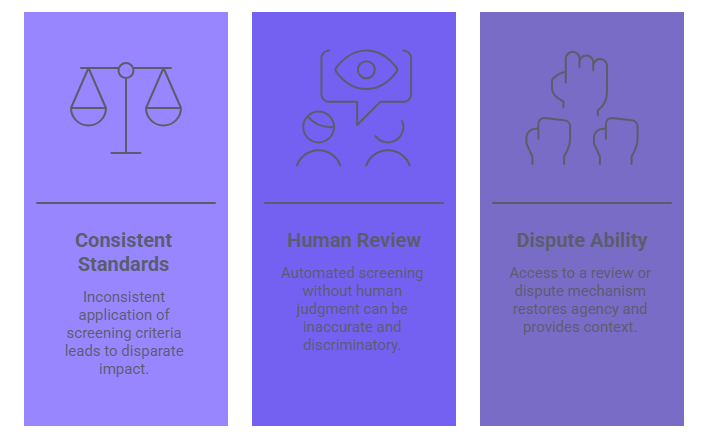
- Consistent standards (75%): Inconsistent application of screening criteria is one documented mechanism through which disparate impact occurs in hiring. When different standards apply to different candidates, the screening process amplifies rather than corrects for structural bias.
- Human review (81%): The EEOC’s guidance on individualized assessment recognizes that automated screening without human judgment can produce outcomes that are both inaccurate and discriminatory. Candidates asking for human review are asking, in practical terms, to be seen as individuals rather than filtered through criteria that may not account for their full circumstances.
- Dispute ability (77%): Access to a review or dispute mechanism restores some of the agency that concealment is currently serving as a proxy for. It gives candidates a legitimate channel for providing context rather than a binary choice between full disclosure and concealment.
These are not aspirational preferences. They are operational design choices organizations can implement and communicate proactively.
The Organizational Imperative
Fifteen years in background screening has given me a particular vantage point on this. The tools and processes organizations use to evaluate candidates carry significant power over what information enters the hiring decision, and what does not. That power carries responsibility.
Rethinking What Verification Is For
Verification is typically framed as a risk management tool: confirm what candidates claim and identify discrepancies. That framing is incomplete. Verification, done well, is also a trust-building mechanism. It signals to candidates that the process is systematic, consistent, and applied fairly to everyone, not a source of unpredictable exposure. When candidates experience screening as a threat rather than a neutral process, they respond accordingly. Reframing verification as a transparency mechanism changes what it communicates to candidates and, over time, what candidates are willing to share.
Fair Compliance as Operational Practice
The 2026 data identifies three conditions that candidates associate with trustworthy screening: transparency about what is being checked, consistent standards applied to all candidates, and human review of findings. These are operational design choices. Organizations can build them into hiring workflows, communicate them proactively to candidates, and treat them as baseline requirements rather than optional enhancements.
The motherhood penalty in hiring, and the broader pattern of identity concealment the 2026 data documents, will not be resolved by any single intervention. Organizations that design screening and evaluation processes around these principles create conditions where concealment is less necessary, where authentic signals are more likely to reach the decision-maker, and where hiring quality improves for everyone involved. It is not just about catching dishonesty. It is about building a system where the incentive to hide is smaller than the benefit of being seen.
Thoughts? Where do you stand on how screening transparency connects to candidate disclosure behavior?
Conclusion
The working mothers concealing caregiving from employers are not the problem. The conditions that make concealment rational are. Organizations that treat this as a disclosure problem will keep addressing the symptom. The ones that treat it as a structural design problem will build something worth disclosing to.
About the 2026 Trust in Hiring Report
The 2026 Trust in Hiring Report is a proprietary research study published by GCheck, based on a national survey of 1,500 U.S. adults employed full-time who actively applied for at least one job in the past 18 months. Fielded February 14-22, 2026 via Pollfish, the study examines how Careerfishing, AI-assisted deception, identity concealment, and broken verification expectations are reshaping the employer-candidate trust gap. The report introduced the Careerfishing framework and documented that 93% of recent job seekers have engaged in at least one form of resume embellishment or misrepresentation. The full report, including methodology, demographic breakdowns, and the Compliance for Good framework for rebuilding trust in hiring, is available at gcheck.com/whitepapers/trust-in-hiring-report/.
Frequently Asked Questions
What is the motherhood penalty in hiring?
The motherhood penalty in hiring refers to the documented pattern in which mothers receive lower callback rates, lower salary offers, and harsher competence evaluations than childless women or fathers with equivalent qualifications. Research has replicated this finding across audit studies and survey data for decades. It shapes candidate behavior upstream of the interview, as the 2026 Trust in Hiring Report’s caregiving concealment data demonstrates.
Why do working mothers hide caregiving responsibilities from employers?
The 2026 Trust in Hiring Report found that 50% of working mothers with children under 18 concealed caregiving responsibilities during hiring, compared to 38% of fathers. The 12-point gap reflects a rational response to the documented motherhood penalty, not a communication preference. Candidates who conceal are making calculated assessments about what disclosure is likely to cost them.
Is identity concealment in hiring the same as lying on a resume?
No. Identity concealment involves withholding personal identity information in response to perceived bias. Credential fabrication involves creating a false picture of professional qualifications. These are different behaviors with different causes and require different organizational responses.
How does race affect job applications and hiring outcomes?
The 2026 Trust in Hiring Report found that 64% of Hispanic and 56% of Black job seekers altered their appearance or communication style for interviews, compared to 39% of White respondents. Thirty-two percent of Black respondents used a different name to avoid ethnicity-based assumptions. These behaviors reflect documented patterns of bias that audit research has consistently identified.
What screening practices reduce bias-driven identity concealment?
The 2026 data points to three conditions candidates associate with trustworthy screening: a clear explanation of what is being checked, consistent standards applied to all candidates for the same role, and human review of findings rather than fully automated decisions. Organizations that communicate these practices proactively reduce the opacity that makes concealment feel necessary.
Does DEI background screening address the motherhood penalty?
Background screening alone does not address the motherhood penalty, which operates primarily through evaluation bias rather than verification gaps. Screening programs designed around consistent, transparent, and human-reviewed criteria reduce the conditions that make identity concealment rational. Fair compliance practices, applied systematically, can reduce the discretionary judgment points where bias most often enters hiring decisions.
Why do candidates conceal age during the hiring process?
Thirty-six percent of all respondents in the 2026 Trust in Hiring Report concealed age indicators during hiring, rising to 47% among Baby Boomers. Age discrimination in hiring is prohibited under federal law for workers 40 and older, but candidates respond to perceived risk based on observed patterns rather than legal protection alone. Age concealment behaviors, including removing graduation dates and omitting early career positions, reflect that perceived risk.
What is the connection between caregiving discrimination and hiring bias statistics broadly?
The caregiving concealment finding in the 2026 data is one expression of a broader pattern. Identity concealment across race, ethnicity, gender, and age follows the same structural logic: candidates edit their authentic presentation in response to documented or perceived bias. The most effective organizational response addresses that underlying condition rather than each concealment behavior separately.

ABOUT THE CREATOR
Pat Hartonian
Chief Compliance Officer
Pat Hartonian is the Chief Compliance Officer at GCheck, where he leads compliance strategy and ensures every background screening program meets the highest standards of accuracy, regulatory alignment, and fairness. He brings over 15 years of executive experience in the background screening industry, with deep expertise in criminal records research, employment and education verification, and FCRA compliance frameworks.
Pat holds an , a certification in Generative AI and Large Language Models from AWS, and completed the CORe program from Harvard Business School Online. He is also the author of Decoding Humans: How Fear, Happiness, and AI Shape Every Decision We Make, where he explores the intersection of ethics, decision-making, and emerging technologies..