

International nonprofit volunteer screening should apply the same disclosure, consent, and adverse-action discipline regardless of where a document comes from, and a separate, unsettled legal question sits underneath that practice: whether the Fair Credit Reporting Act’s consumer-report framework technically extends to a foreign document a volunteer obtains and hands over personally. Layered on top is a practical reality familiar to anyone who has tried it: national police certificate systems, document authentication requirements, and funder-mandated screening obligations all work differently once a placement crosses a border.
Key takeaways
- The safe default is to apply FCRA-style disclosure, authorization, and adverse action procedure to every volunteer check, regardless of source. Separately, whether FCRA’s consumer reporting agency framework technically applies to a foreign police certificate a volunteer obtains and submits personally is an unsettled legal question nonprofits should raise with counsel, not resolve on their own by skipping protections.
- National police certificate systems vary widely by country. Some, like Canada’s and the UK’s, are centralized and relatively fast. Others require an in-person application at a local police station with no national database behind it.
- An apostille authenticates a U.S. document for use in a Hague Convention country; documents for non-Hague countries need State Department authentication plus embassy legalization instead.
- Nonprofits receiving USAID funding face an Anti-Terrorism Certification and, in some cases, a more intensive Partner Vetting System review, as a condition of the grant itself, independent of whatever criminal background check the organization runs on its own.
- Some countries’ record systems are inaccessible rather than simply slow, whether due to lack of centralization, conflict, or the aftermath of a disaster, which calls for alternative verification methods rather than an indefinite wait for a functioning registry.
Applying FCRA discipline to a volunteer’s own foreign document
The safest, and simplest, practice for any nonprofit is to apply the same FCRA-style disclosure, written authorization, and adverse action process to a volunteer’s background check regardless of whether the underlying document came from a U.S. consumer reporting agency or was obtained by the volunteer directly from a foreign government. That consistency protects the volunteer’s expectations, costs the organization little, and avoids the need to make a legal judgment call in the moment about which documents do or don’t require it.
Underneath that practice sits a genuinely unsettled legal question worth flagging to counsel, not resolving alone: FCRA defines a consumer reporting agency at 15 U.S.C. §1681a(f) as any person who, for a fee or on a cooperative basis, regularly assembles or evaluates consumer information for the purpose of furnishing consumer reports to third parties. When a host-country national or a deploying volunteer requests their own police certificate directly from their national police agency and hands it to the nonprofit personally, it’s not obvious that a third party is “furnishing” a “consumer report” in the sense the statute describes. No court ruling directly on point was found in researching this piece, so this is a reasoned observation about the statutory text, not a conclusion nonprofits should rely on to reduce the protections they apply. Organizations that want a definitive answer for their specific screening workflow should raise it with counsel rather than treat this article as resolving it.
Why the domestic volunteer question matters here too
This sits on top of a separate question domestic nonprofit screening already has to answer: whether FCRA treats a volunteer like an employee at all when a consumer reporting agency is involved. The FTC’s own 2011 staff report on FCRA takes the position that the statute’s “employment purposes” language can extend to a nonprofit staffed in whole or in part by volunteers, which is why most nonprofits already apply employee-style disclosure and adverse action procedure to domestic volunteer checks run through a CRA. That domestic precedent doesn’t resolve the international question on its own, since it assumes a CRA is in the chain in the first place, but it does explain why most nonprofits default to FCRA-style process even when a stricter reading might not require it: the domestic volunteer question already pushed them in that direction before the international one ever came up.
How national police certificate systems vary by country
The single biggest practical difference between screening domestically and screening across borders is that “run a background check” isn’t one process internationally, it’s a different process in every country, with wildly different levels of centralization behind it.
Centralized systems: Canada, the UK, and Australia
Canada’s Royal Canadian Mounted Police issues a national criminal record check through its Civil Fingerprint Screening Services, generally requiring fingerprint submission but drawing on a single centralized database. The United Kingdom’s ACRO Criminal Records Office issues a Police Certificate specifically designed for uses like this, also centralized nationally. Australia’s Federal Police provides a National Police Check that applicants can request from abroad directly through the AFP’s website. These three systems share a common feature: one national request, one centralized database, a result in a predictable timeframe.
Decentralized systems: China and similar models
Other countries work nothing like this. China requires the application to be made in person: a volunteer or host-country national applies for a Certificate of Criminal Record at the local Public Security Bureau in the district tied to their household registration, then takes that document to a separate notary office for a formal certificate, and typically needs a professional English translation before a U.S.-based nonprofit can use it. There is no single national database a nonprofit’s screening provider can query the way it would for a Canadian or UK applicant. Many countries where international nonprofits operate most heavily, across parts of Sub-Saharan Africa, South Asia, and Latin America in particular, sit closer to the Chinese model than the Canadian one: a district or provincial police office issues the certificate, records aren’t networked nationally, and the applicant typically needs to appear in person with an original identity document.
| Country | Issuing authority | Structure |
| Canada | Royal Canadian Mounted Police (Civil Fingerprint Screening Services) | Centralized national database, fingerprint-based |
| United Kingdom | ACRO Criminal Records Office | Centralized national database, Police Certificate format |
| Australia | Australian Federal Police | Centralized national database, applicants can apply from abroad |
| China | Local Public Security Bureau, plus notary office | No national database; in-person application, district-specific, requires translation |
A nonprofit standardizing its international screening program needs to know, country by country, which model it’s dealing with before it can set a realistic expectation for either timeline or reliability. Volunteer-sending organizations that operate in dozens of countries typically maintain their own country-by-country reference guide for exactly this reason, since a one-size-fits-all instruction to “get a police certificate” means something completely different depending on where the person is applying from. Telling a volunteer plainly, before they start the process, which system their specific country uses and how long it realistically takes is Transparent Compliance applied to an international placement rather than a domestic one. That reference guide is also where translation requirements belong: a certificate issued in a language other than English needs a professional translation before it’s useful to a U.S.-based reviewer, and that step should be planned for the same way the certificate request itself is, not discovered after the document arrives.
What apostille and document authentication actually require
An apostille is a certification under the 1961 Hague Convention that authenticates a public document for use in another Hague Convention member country. A document destined for a country that hasn’t joined the Hague Convention needs a State Department authentication certificate instead, which then typically requires further legalization by that country’s embassy before it’s accepted.
For a nonprofit sending U.S.-based staff or volunteers abroad, this usually comes up when a partner organization or host government wants the person’s U.S. background check certified before accepting it. Federal documents, an FBI Identity History Summary is the most common example, go through the State Department’s Office of Authentications directly, at a $20 government fee per document. Processing time depends heavily on how the request is submitted: mailed requests currently take five weeks or more from the date the Department of State receives them, while a walk-in drop-off at the Washington, D.C. office is processed in about seven business days, and same-day service is reserved for documented life-or-death emergencies. State-issued documents go through that state’s Secretary of State office instead, on a separate timeline that varies significantly by state. The table below breaks down which authentication path applies and what it adds to a placement timeline.
| Document type | Authentication path | Typical added time |
| Federal document (e.g., FBI Identity History Summary) for a Hague Convention country, mailed request | Apostille via U.S. Department of State, Office of Authentications | Five weeks or more from receipt, plus mailing time |
| Federal document for a Hague Convention country, walk-in submission | Apostille via U.S. Department of State, Office of Authentications | Approximately seven business days |
| Federal document for a non-Hague country | State Department authentication, then embassy legalization | Authentication timeline above, plus embassy processing, which varies by country |
| State-issued document (e.g., a state-level background check) | Apostille or authentication via the issuing state’s Secretary of State | Varies significantly by state; a separate queue from federal processing |
None of this is optional lead time a nonprofit can absorb by moving faster internally; the processing happens at a government office the organization doesn’t control. Building it into placement planning from the start, rather than discovering it’s needed after a partner organization rejects an uncertified document, is the practical lesson here.
Anti-terrorism certification and vetting: a funding condition, not a choice
Nonprofits receiving USAID funding encounter a screening obligation that has nothing to do with criminal history and exists independently of whatever background check program the organization runs on its own. USAID grant agreements have required an Anti-Terrorism Certification since 2002, now embedded in ADS Chapter 303 (Section 303.3.8(a)(4)), under which the grantee certifies that it has checked personnel and partners against U.S. government and UN terrorist lists and found no connections. A 2020 revision narrowed this obligation in a grantee-favorable direction, reducing the look-back period from ten years to three and clarifying that only U.S. government and UN lists need to be checked, not the broader universe of watchlists some organizations had been checking against.
The heavier version: Partner Vetting
Beyond the standard certification, USAID’s Partner Vetting System, finalized at 2 CFR Part 701 effective July 27, 2015, is a more intensive review requiring submission of identifying information for “key individuals,” a category that includes employees, subrecipients, and subcontractors alike, checked against government intelligence databases. Historically, this heavier process has been piloted in a specific set of higher-risk countries (Guatemala, Kenya, Lebanon, the Philippines, and Ukraine) rather than applied to every USAID award. The legal basis for both the certification and the vetting system traces back to the material-support statutes at 18 U.S.C. §§2339A and 2339B, several terrorism-related executive orders, and Title VIII of the USA PATRIOT Act.
The practical point for an internationally operating nonprofit: this is a condition of accepting the funding, not a discretionary risk-management choice layered on top of it. A criminal background check and an Anti-Terrorism Certification answer different questions, and satisfying one doesn’t satisfy the other. One more distinction worth holding onto: outside of USAID’s specific PVS requirement, humanitarian organizations generally aren’t required to share the underlying personal data from their screening or vetting process with a donor. PVS is the notable exception, since it’s built around USAID directly collecting identifying information and running the comparison itself, rather than simply requiring the grantee to certify that it did its own check.
When a country’s record system is inaccessible, not just decentralized
General guidance on international screening notes that some countries lack a centralized, electronic criminal record system, which slows verification but doesn’t stop it. A smaller set of situations goes further: the records office itself may be inaccessible for reasons that have nothing to do with how the country normally operates, a conflict disrupting government function, or a natural disaster damaging the physical infrastructure records depend on.
There isn’t a documented legal rule for this situation, because it’s a fact on the ground rather than a statutory question, so a nonprofit’s response has to be operational rather than procedural. Alternative verification methods carry real weight in this specific context: a partner organization already operating in the region vouching for someone based on direct working knowledge, a documented history of prior work with a known organization, or in-person community verification through local staff who know the individual’s standing. None of these replace a criminal background check where one is genuinely obtainable. They are what a nonprofit reasonably relies on when the record system a check would normally query doesn’t currently function, and documenting that gap honestly, rather than treating a check as complete when it couldn’t actually run, is the more defensible position if the decision is ever scrutinized later.
Building a screening framework that holds up across borders
A nonprofit operating internationally is really managing two separate screening problems at once: the general mechanics of any check crossing a border (covered in depth in GCheck’s guide to how domestic and international background checks differ), and the volunteer-specific, funder-specific layer this article addresses. A framework that holds up treats both as permanent parts of the process rather than one-off exceptions handled differently every time.
Four practices consistently separate organizations that manage this well from those that improvise it every time:
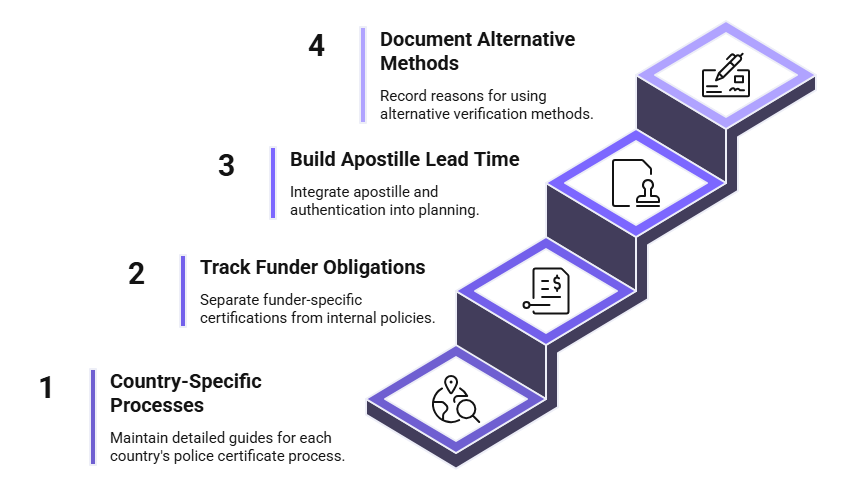
- Maintain a country-by-country reference for how each destination’s police certificate process actually works, rather than issuing a single generic instruction to “obtain a background check” that means something different in every country.
- Track funder-specific obligations, like USAID’s Anti-Terrorism Certification, separately from the organization’s own criminal background check policy, since the two serve different purposes and satisfying one says nothing about the other.
- Build apostille and authentication lead time into placement planning by default for any role where a partner organization or host government is likely to require certified documentation, rather than treating it as a surprise step discovered mid-process.
- Keep a written record of why an alternative verification method was used whenever a country’s record system was genuinely inaccessible, since a documented, reasoned gap holds up to scrutiny far better than an undocumented one, even when the underlying limitation was completely outside the organization’s control.
Framing this work as protecting the people a program serves, rather than treating international staff or host-country nationals as harder to trust because their country’s records are harder to access, is what Protective Compliance looks like once a placement crosses a border: it keeps the framework honest about what it’s actually protecting against, gaps in verification infrastructure, not the character of the people being screened. That distinction matters practically as well as ethically, since a screening program that quietly treats certain nationalities as inherently higher-risk is both a fairness problem and, eventually, a documentation problem when someone asks why.
Frequently asked questions
Does FCRA apply to a background check on an international nonprofit volunteer?
Apply FCRA-style disclosure, written authorization, and adverse action procedure to every volunteer check regardless of source; that’s the safe default and it costs little to maintain. Separately, when the check comes through a consumer reporting agency, FCRA clearly applies. When a volunteer personally obtains a foreign police certificate directly from their national police agency and submits it themselves, whether FCRA’s consumer reporting agency definition technically covers that scenario is an unsettled legal question. Nonprofits should raise it with counsel rather than use it as a reason to apply fewer protections.
How do national police certificates differ from country to country?
Some countries, including Canada, the UK, and Australia, maintain a centralized national database and issue a certificate through a single national agency. Other countries, including China, require an in-person application at a local office with no national database behind it, often followed by a separate notarization step and a certified translation. A nonprofit needs to know which model applies before setting a timeline expectation for any specific country.
What is an apostille and when does a nonprofit need one?
An apostille is a certification authenticating a U.S. document for use in a country that has joined the 1961 Hague Convention. A nonprofit typically needs one when a partner organization or host government requires a deploying volunteer’s or staff member’s background check to be officially certified before accepting it. Documents for non-Hague countries need State Department authentication and embassy legalization instead.
Do nonprofits have to screen staff against terrorism watchlists?
Nonprofits receiving USAID funding are required to, as a condition of the grant, through an Anti-Terrorism Certification that involves checking personnel against U.S. government and UN terrorist lists. Some awards require the more intensive Partner Vetting System review as well. This obligation exists separately from any criminal background check the organization runs on its own.
What should a nonprofit do if a country’s criminal record system isn’t accessible?
Treat it as an operational gap to manage honestly rather than a step to skip silently. Alternative methods, like verification through a partner organization with direct working knowledge, documented history with a known organization, or local community verification, carry real weight when the underlying record system is genuinely inaccessible, whether due to lack of centralization, conflict, or disaster.
Sources cited
- Fair Credit Reporting Act, 15 U.S.C. §1681a(f) (consumer reporting agency definition), via law.cornell.edu/uscode/text/15/1681a.
- U.S. Department of State, Office of Authentications, apostille and authentication program information: https://travel.state.gov/content/travel/en/replace-certify-docs/authenticate-your-document/office-of-authentications.html
- Royal Canadian Mounted Police, Civil Fingerprint Screening Services program information.
- ACRO Criminal Records Office (UK), Police Certificate program information.
- Australian Federal Police, National Police Check program information.
- USAID, ADS Chapter 303, Grants and Cooperative Agreements to Non-Governmental Organizations, Section 303.3.8(a)(4) (Anti-Terrorism Certification).
- Charity & Security Network, “USAID Revises Grantee Documents Relating to Anti-Terrorism Requirements” (summarizing the 2020 ADS Chapter 303 revision).
- 2 CFR Part 701 (Partner Vetting in USAID Assistance); Federal Register final rule, effective July 27, 2015: https://www.federalregister.gov/documents/2015/06/26/2015-15017/partner-vetting-in-usaid-assistance

ABOUT THE CREATOR
Charm Paz, CHRP
Recruiter & Editor
Charm Paz is an HR professional at GCheck, specializing in background screening, fair hiring, and regulatory compliance. She holds from the Professional Background Screening Association (PBSA) and helps organizations navigate employment regulations with clarity and confidence.
With a background in Industrial and Organizational Psychology, she translates policy into practice to build ethical, compliant, human-centered hiring systems that strengthen decision-making over time.