


Healthcare background check findings fall into three legally distinct categories, and treating them as a single list of disqualifiers is one of the most common sources of both compliance failure and unnecessary hiring loss. This guide gives HR managers and compliance teams a defensible framework for distinguishing mandatory bars from discretionary findings and executing the adverse action process correctly when rejections are warranted.
Key Takeaways
- Healthcare disqualifiers operate across three tiers: statutory bars that legally prohibit employment, employer-discretionary findings subject to individualized assessment, and licensing board actions that run independently of the hiring process.
- Patient abuse, neglect, exploitation, and healthcare fraud are the most common absolute statutory bars. They typically prohibit employment in direct-care roles regardless of time elapsed.
- Federal OIG exclusion and state healthcare worker registries are the two primary statutory bar mechanisms. Both must be checked independently.
- Most non-statutory criminal findings, including many felonies, require individualized assessment before adverse action under FCRA requirements and Title VII disparate impact doctrine. Blanket disqualification policies create significant legal exposure.
- The FCRA seven-year lookback rule applies to consumer reports, not to statutory bar offenses, which typically carry no lookback limit.
- Ban-the-box laws have expanded to cover more healthcare employers. Some states have carve-outs for regulated healthcare roles, and others do not.
- Licensing boards may independently suspend or revoke a clinical license based on criminal history, regardless of the employer’s hiring decision.
- FCRA adverse action requires a specific sequence of steps. A correct disqualification decision executed incorrectly still creates liability.
The Three-Tier Disqualifier Framework
Why the Framework Matters
The word “disqualifies” covers three legally distinct situations in healthcare hiring. Conflating them creates two opposite failure modes. The first is legal overstatement: telling an applicant they are barred from healthcare when no statutory bar exists, then applying a blanket rejection to a finding that requires individual review. The second is legal understatement: treating a statutory bar as a judgment call, exercising employer discretion where the law removes it, and creating CMP liability by employing an excluded individual. In short, understanding which tier a finding falls into determines what the employer must do, what the employer may do, and what the FCRA requires before any adverse action is taken.
The Three Tiers Defined
The three-tier framework organizes every healthcare background check finding into a clear decision path. Each tier carries different legal consequences and different employer duties.
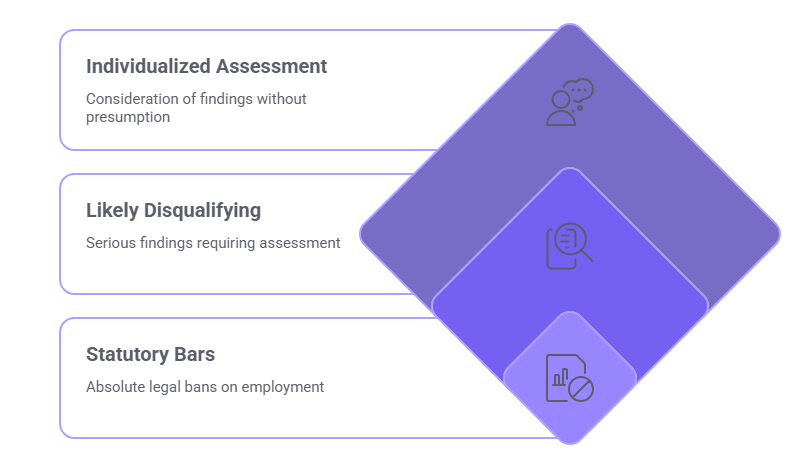
- Tier 1: Statutory bars. A specific offense type or regulatory finding creates a legal ban on employment in a covered role. The employer has no discretion to override the bar. Common examples include patient abuse findings on a state healthcare worker registry and active OIG LEIE exclusion. The bar applies regardless of how long ago the offense occurred and regardless of any evidence of rehabilitation.
- Tier 2: Likely disqualifying, individualized assessment required. A finding does not trigger a statutory bar but is serious enough that most employers will not hire. The employer keeps discretion but must conduct a documented individualized assessment before taking adverse action. Blanket policies that skip this step create Title VII disparate impact exposure and may also fail to satisfy FCRA adverse action process requirements.
- Tier 3: Individualized assessment, no presumption of disqualification. A finding exists but carries no legal bar and no presumption of unfitness. The employer may consider it, but must apply genuine individual review. Many misdemeanors, older convictions, and expunged records fall into this tier.
Finally, licensing board actions operate alongside this framework rather than within it. A board may act independently of the employer’s decision, and its action may affect the employer’s ability to keep an employee even after hire.
The greatest misconception with healthcare recruitment is the assumption that all background check findings carry the same level of risk and legal liability. In truth, good adjudication involves knowledge of the differences among statutory barriers, discretionary findings, and scenarios where individualization of the decision-making process is needed.The strongest HR teams are not the ones making the fastest decisions. They are the ones making decisions that are thoughtful, documented, and grounded in both compliance and fairness. In healthcare environments, especially, responsible hiring requires both structure and sound judgment. �
What Disqualifies Someone from Working in Healthcare: Disqualifier Matrix
Offense Type by Tier and HR Implication
The table below organizes common healthcare background check findings across the three-tier framework. Statutory bar determinations vary by state, role type, and facility certification status. This matrix is a decision framework, not legal advice. Employers should therefore confirm specific obligations with qualified legal counsel for their state and role type.
| Offense Type | Disqualifier Tier | HR Implication |
| Abuse, neglect, or exploitation of a patient or vulnerable adult | Statutory bar | Legally prohibited in most direct-care roles. No individualized assessment required or permitted in many states. |
| Healthcare fraud or Medicare and Medicaid fraud | Statutory bar | Federal OIG exclusion likely. LEIE check will flag. Employment creates CMP liability. |
| Sexual offense involving a minor | Statutory bar | Prohibited in virtually all healthcare roles involving patient or client contact. Registry check required. |
| Financial exploitation of a vulnerable adult | Varies by state | May be a statutory bar where the state registry statute covers financial exploitation. Coverage varies widely. Confirm with legal counsel before treating as a statutory disqualifier. |
| Felony drug offense within lookback period | Likely disqualifying | Varies by state, role, and time elapsed. Individualized assessment required before rejection. |
| Felony violent offense not involving a patient | Likely disqualifying | Role and recency dependent. Direct patient care roles carry a higher bar. Individualized assessment required. |
| DUI or DWI | Individualized assessment | Not an automatic bar in most states. Recency, role type, and pattern matter. Licensing board may act independently for licensed clinicians. |
| Misdemeanor theft or fraud not involving healthcare | Individualized assessment | Employer discretion applies with individualized assessment obligation under Title VII and FCRA adverse action requirements. Rarely a statutory bar. |
| Expunged or sealed record | Individualized assessment, state-specific | Cannot be used as a basis for adverse action under general employment law in many jurisdictions. Some states have healthcare-specific exceptions for direct-care roles. Confirm applicable rules with legal counsel for each hiring state. |
Statutory bar status depends on the specific state registry statute, the facility’s certification status under Medicare or Medicaid, and whether the role is direct-care or non-clinical. As a result, employers operating across multiple states should maintain state-specific adjudication criteria reviewed by qualified legal counsel.
Absolute Disqualifiers: Offenses That Create a Legal Bar
State Healthcare Worker Registries
Most states maintain one or more healthcare worker registries. These list individuals found to have abused, neglected, or financially exploited patients or vulnerable adults. A confirmed finding on a state registry is a legal bar to employment in covered roles in that state, regardless of whether a criminal conviction resulted. Registry checks are mandatory for employers of certified nursing assistants and other direct-care workers in Medicare and Medicaid-certified facilities under federal law. The specific registry names, search steps, and covered role definitions vary by state. Consequently, employers must check the registry for every state where an applicant has previously worked in a healthcare capacity, not only the state where the new position is located.
A registry finding is also distinct from a criminal background check finding. An individual may appear on a healthcare worker registry without any criminal conviction. Conversely, a criminal conviction for patient abuse may not automatically result in a registry listing if the investigation was never completed. Both checks serve different compliance functions and must therefore be run independently.
Federal OIG Exclusion
Active OIG LEIE exclusion is a federal legal bar to employment in any role that generates items or services paid under Medicare, Medicaid, or other federal healthcare programs. Importantly, the scope extends beyond clinical roles. Employing an excluded individual creates Civil Monetary Penalty liability under 42 U.S.C. Section 1320a-7a regardless of employer knowledge. Exclusion may result from healthcare fraud, controlled substance offenses, patient abuse, or other qualifying events.
The LEIE must be checked at hire and monitored monthly for all employees, contractors, and vendors whose roles connect to federally reimbursed services. The scope of this monthly duty is defined by the role’s connection to federal program billing, not by clinical status alone. As a result, an individual with an active exclusion is in Tier 1 for any role that touches federally reimbursed services. Employer discretion does not apply.
Individualized Assessment: The Requirement Most Employers Underuse
The Legal Obligation
For findings that do not trigger a statutory bar, Title VII’s disparate impact framework and the FCRA’s adverse action process requirements create a legal duty to conduct individualized assessment before acting on a criminal record. In practice, this means reviewing the specific finding against the specific role using defined factors. EEOC guidance has historically identified three core factors: the nature and gravity of the offense, the time elapsed since the offense or completion of sentence, and the nature of the job and its connection to the offense.
However, the specific guidance documents on these factors have been subject to revision and change. Employers should therefore confirm the current operative EEOC framework with qualified legal counsel. The underlying Title VII duty to conduct individualized review remains in force regardless of the status of any specific agency guidance.
What the Process Requires
Individualized assessment is a documented process, not an informal judgment call. For each finding that does not constitute a statutory bar, the employer should record the following:
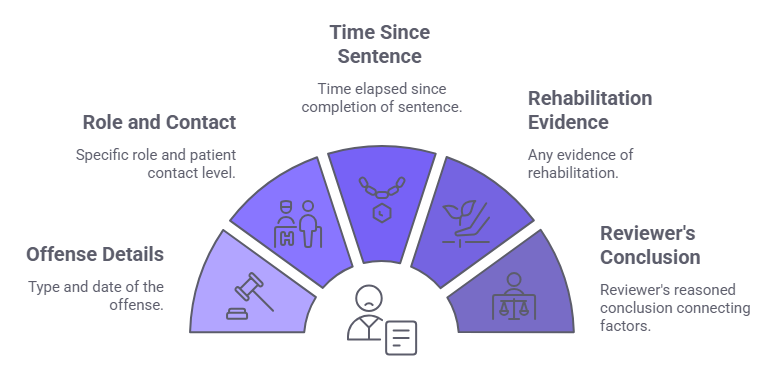
- The offense type and date.
- The specific role and its patient contact level.
- The time elapsed since completion of sentence.
- Any evidence of rehabilitation.
- The reviewer’s reasoned conclusion connecting those factors to the hiring decision.
Healthcare employers frequently err in two directions. Some apply informal blanket standards, rejecting all felonies in direct care roles regardless of offense type or recency. Others conduct the assessment but fail to document it, leaving no evidence of compliance when a rejected applicant challenges the decision. Both failures create liability.
When the Assessment Concludes in Rejection
Completing a thorough individualized assessment and concluding that a finding is disqualifying for a specific role is a legally defensible outcome. The goal is not to force a hire despite a serious finding. Rather, the goal is to ensure the decision is role-specific, documented, and not applied as a blanket rule. A healthcare employer who rejects all applicants with felony convictions, without individualized assessment, creates exposure under Title VII’s disparate impact framework. That employer may also fail to satisfy the FCRA’s adverse action process requirements, which assume a record-specific review before adverse action is taken. Employers should therefore confirm their adjudication policies with qualified legal counsel.
Lookback Periods: How Far Back Healthcare Background Checks Go
The FCRA Salary Threshold
The FCRA sets a salary threshold above which the seven-year lookback limit does not apply to consumer reports. The specific threshold is defined in the statute and has not been automatically adjusted for inflation. Employers should therefore confirm the current threshold with qualified legal counsel before relying on any specific dollar figure. For healthcare roles with expected salaries above the applicable threshold, the FCRA does not impose a lookback limit. Moreover, many clinical and supervisory roles exceed the federal threshold, meaning background check providers may legally report older convictions for those positions.
State Lookback Rules
State law may impose shorter lookback periods independent of the federal FCRA rule. Some states limit most criminal record reporting regardless of salary level. As a result, employers across multiple states must confirm the applicable standard for each hiring state. For example, California imposes lookback limits on most criminal record reporting. Furthermore, certain positions, including regulated healthcare roles, may be subject to specific exceptions under state law. California employers should therefore confirm the applicable standard and any healthcare-specific exceptions with qualified legal counsel rather than applying a single statewide rule.
Statutory Bars Have No Lookback Limit
The FCRA lookback rule applies to consumer reports only. It does not, however, limit the scope of statutory bar obligations. A state healthcare worker registry finding from 15 years ago remains a legal bar if it is still listed. Similarly, an OIG exclusion from a decade ago stays in effect until the exclusion period ends and the individual is formally reinstated. Employers should first confirm whether a finding is a statutory bar before applying any lookback analysis. In summary, lookback is a Tier 2 and Tier 3 consideration and does not apply to Tier 1 findings.
Ban-the-Box and Healthcare: Where the Exemptions Apply
The Core Tension
Ban-the-box laws limit when and how employers may ask about criminal history. Most statutes bar criminal history questions on job applications and require employers to delay inquiry until later in the process, often after a conditional offer. This creates direct tension with healthcare-specific screening laws that require pre-offer checks for certain regulated roles. For example, federal law requires background screening of certified nursing assistants before employment in Medicare and Medicaid-certified facilities. Similarly, some state healthcare worker registry statutes impose pre-employment check requirements.
How States Resolve the Conflict
The resolution of this tension varies by state. Some states have explicit healthcare carve-outs that exempt regulated roles from the delayed inquiry rule. Others have no carve-out, creating real legal confusion for healthcare employers in those states. Consequently, employers in states with active ban-the-box laws should confirm, with qualified legal counsel, whether their specific roles and facilities fall within a statutory exception.
The 2026 Compliance Landscape
Ban-the-box legislation has grown significantly in recent years, and its interaction with healthcare-specific requirements has become more complex as a result. An HR policy built before 2022 may not reflect the current legal framework in the employer’s state. For multi-state healthcare employers, varying ban-the-box timelines, different state registry duties, and individualized assessment requirements under Title VII and the FCRA together create a layered compliance challenge. Generic background check policies cannot address this complexity. State-specific adjudication policies, reviewed annually with qualified legal counsel, are therefore the right approach.
Licensing Board Actions: The Parallel Disqualifier Layer
How Board Actions Differ from Employment Screening
A licensing board’s response to a criminal history finding operates on its own timeline, separate from the employer’s hiring decision. A healthcare employer may complete a background check, finish individualized assessment, and extend a conditional offer, all before the relevant board has finished its own review. The board may then suspend or revoke the license, leaving the employee unable to practice regardless of the employer’s earlier decision. Conversely, an employer may decline to hire based on a background check finding, while the board takes no action and the applicant’s license stays active. These are separate processes governed by different legal standards and different levels of proof.
Ongoing Monitoring After Hire
Many healthcare HR teams treat license verification as a one-time check at hire. This approach is not enough. Licensing boards issue sanctions, suspensions, and revocations on an ongoing basis, often in response to events that happen after the employee was hired. For example, an employee with a clean license at hire may face a board action months later based on a prior incident or a new complaint. Employers who do not monitor license status after hire may not learn of a board action until the license is already suspended. Therefore, ongoing license monitoring, through Nursys for nursing licenses or through the relevant state board’s tools for other license types, is a risk management practice that pre-employment checks alone cannot replace.
FCRA Adverse Action: What Employers Must Do When Declining to Hire
The Required Four-Step Sequence
When a background check finding is a factor in a decision not to hire, the FCRA requires a specific sequence of steps. This applies whether the finding is a statutory bar or a discretionary call.

- Step 1: Before taking final adverse action, provide the applicant with a pre-adverse action notice. Include a copy of the consumer report and a copy of the Summary of Rights Under the FCRA.
- Step 2: Allow a reasonable waiting period, generally at least five business days per regulator guidance, for the applicant to review the report and dispute any inaccurate information.
- Step 3: If proceeding after the waiting period, provide a final adverse action notice.
- Step 4: The final notice must identify the consumer reporting agency, state that the agency did not make the hiring decision, and inform the applicant of their right to dispute the report’s accuracy.
Skipping or shortening any step creates FCRA liability, independent of whether the underlying disqualification decision was correct.
What Applicants Can Do
The pre-adverse action notice and waiting period exist for a clear reason. They give applicants a chance to find and dispute inaccurate information before the employer makes a final decision. Background check reports do contain errors. Court records are sometimes misattributed, identities are confused, and expunged records occasionally appear. When an applicant disputes a report, the consumer reporting agency must investigate and correct the record if the dispute is valid. If the record changes, the employer must then reconsider the decision based on the corrected information.
Recourse Beyond the Dispute Process
An applicant who believes a report is inaccurate should dispute it directly with the consumer reporting agency. An applicant who believes the employer used a blanket disqualification without individualized assessment may, in addition, have recourse under Title VII’s disparate impact framework, applicable state fair chance laws, or other anti-discrimination statutes. It is important to note that the FCRA’s adverse action rules govern the process of taking adverse action, not the adjudication criteria the employer uses. Employers should therefore confirm the applicable recourse framework with qualified legal counsel.
Conclusion
What disqualifies someone from working in healthcare is not a single list. It is a three-tier framework that separates statutory bars from discretionary findings from licensing board actions, and applies different legal duties to each. Healthcare employers that build adjudication policies around this framework, conduct documented individualized assessment for non-statutory findings, follow the FCRA adverse action sequence correctly, and monitor both OIG exclusion status and license standing after hire are running defensible, legally sound programs. Requirements vary significantly by state, role type, and facility certification status. All adjudication policies should be reviewed with qualified legal counsel.
Frequently Asked Questions
What automatically disqualifies someone from working in healthcare?
Absolute statutory bars include confirmed findings of patient abuse, neglect, or exploitation on a state healthcare worker registry, active OIG LEIE exclusion, and sex offenses involving minors. These prohibit employment in covered roles regardless of time elapsed or evidence of rehabilitation. The specific offenses that form a statutory bar vary by state, role type, and facility certification status.
Can you work in healthcare with a misdemeanor?
Most misdemeanors do not trigger a statutory bar to healthcare employment. Employer discretion applies, and Title VII’s disparate impact framework and the FCRA’s adverse action requirements call for individualized assessment before adverse action on any criminal finding. The nature of the misdemeanor, its connection to patient care, and the time elapsed since the offense are the key variables.
Does a DUI disqualify you from healthcare work?
A DUI is rarely a statutory bar to healthcare employment but frequently triggers independent licensing board review for licensed clinicians, which may result in license conditions, suspension, or revocation. From an HR perspective, a DUI requires individualized assessment considering role type, recency, and whether a pattern exists. Automatic rejection without documented review creates legal exposure.
How far back do healthcare background checks go?
The FCRA sets a salary threshold above which the seven-year lookback limit does not apply to consumer reports. Employers should confirm the current threshold with qualified legal counsel. Many clinical roles may allow unlimited lookback, state law may impose shorter limits, and statutory bar offenses carry no lookback limit.
Can you appeal a failed healthcare background check?
The FCRA requires employers to provide a pre-adverse action notice, a copy of the report, and a summary of rights before taking final action. This gives applicants a chance to dispute inaccurate information. If a dispute changes the report, the employer must reconsider the hiring decision based on the corrected information.
What is a healthcare worker registry and how does it affect hiring?
A healthcare worker registry is a state-maintained database listing individuals found to have abused, neglected, or financially exploited patients or vulnerable adults. A registry finding is a statutory bar to employment in covered direct-care roles. Employers must check registries in all states where an applicant has previously worked in a healthcare capacity.
Do ban-the-box laws apply to healthcare employers?
Ban-the-box laws limit when employers may ask about criminal history, but some states have carve-outs for regulated healthcare roles. Others do not, creating legal tension with healthcare-specific screening mandates. Healthcare employers in states with active ban-the-box laws should confirm with qualified legal counsel whether their roles and facilities qualify for any applicable exemption.
What is individualized assessment and when is it required?
Individualized assessment is a documented review of a specific criminal finding against a specific role before adverse action. Title VII’s disparate impact framework and the FCRA’s adverse action process requirements call for it on non-statutory findings. The review must consider the nature and gravity of the offense, time elapsed, and the connection between the offense and the job duties. Blanket disqualification policies that skip this process create exposure under both frameworks.
Additional Resources
- EEOC Enforcement Guidance on Consideration of Arrest and Conviction Records in Employment Decisions
https://www.eeoc.gov/laws/guidance/enforcement-guidance-consideration-arrest-and-conviction-records-employment-decisions - OIG List of Excluded Individuals and Entities (LEIE) Search Tool
https://exclusions.oig.hhs.gov - FTC: Using Consumer Reports for Employment Purposes
https://www.ftc.gov/business-guidance/resources/using-consumer-reports-employment-purposes - CMS: Nurse Aide Registry and Background Check Requirements
https://www.cms.gov/Medicare/Provider-Enrollment-and-Certification/SurveyCertificationGenInfo/Downloads/Survey-and-Cert-Letter-12-46.pdf - CFPB: Summary of Consumer Rights Under the FCRA
https://www.consumerfinance.gov/consumer-tools/credit-reports-and-scores/consumer-reporting-companies/fcra-summary-of-rights/ - HHS OIG: Exclusions Program Overview
https://oig.hhs.gov/exclusions/

ABOUT THE CREATOR
Charm Paz, CHRP
Recruiter & Editor
Charm Paz is an HR professional at GCheck, specializing in background screening, fair hiring, and regulatory compliance. She holds from the Professional Background Screening Association (PBSA) and helps organizations navigate employment regulations with clarity and confidence.
With a background in Industrial and Organizational Psychology, she translates policy into practice to build ethical, compliant, human-centered hiring systems that strengthen decision-making over time.