


A high-volume logistics background check program for peak season should include a role-stratified verification framework covering the full warehouse-to-wheel spectrum, documented FCRA accountability for every staffing agency relationship, a CDL driver regulatory screening stack initiated well before the first scheduled route, and a platform-managed adverse action workflow that applies individually to every candidate regardless of volume. Screening speed in logistics peak season is a workflow design problem, not a check-depth problem.
Key Takeaways
- Logistics peak season creates a stacked volume surge running from summer through Q4 with no steady-state recovery window between them. Many logistics employers are still onboarding summer hires when Q4 hiring begins.
- The warehouse-to-wheel workforce spans materially different access profiles and regulatory obligation stacks. A uniform screening package applied across all role types creates either over-screening that slows hiring or under-screening that creates exposure.
- Staffing agency dual-accountability is the most common FCRA failure mode in logistics peak hiring. Neither the agency nor the facility should assume the other has handled FCRA compliance without a documented contractual agreement.
- CDL drivers require a distinct regulatory screening stack beyond FCRA. Peak season timeline pressure creates no accommodation in FMCSA requirements, and no component of the CDL regulatory stack can be skipped or compressed.
- In ban-the-box jurisdictions that include major logistics markets, the conditional offer must precede the background check. Initiating checks before extending a conditional offer creates legal exposure on top of the operational problem.
- Documentation of screening decisions is the negligent hiring defense and the operations audit record simultaneously.
Why High-Volume Logistics Hiring Breaks Standard Screening Programs
Most logistics HR screening programs were built for steady-state hiring. They handle requisitions as they open, process candidates individually, and rely on manual workflows that hold together at low volume. Peak season breaks this design in four specific ways unique to the logistics operating environment.
The Stacked Surge Problem
Unlike retail or hospitality, logistics peak season is not a single event. Summer e-commerce volume drives a warehouse and fulfillment ramp-up that begins in May and accelerates through August. Q4 holiday preparation begins before the summer surge fully clears. As a result, many logistics employers are still onboarding summer hires when Q4 hiring begins, and their screening program faces continuous volume pressure for five to six months with no recovery window between surges.
Workforce Classification Complexity
A single fulfillment center at peak capacity may simultaneously employ W-2 warehouse associates, CDL drivers under DOT regulation, 1099 last-mile delivery contractors, and temporary workers placed by two or three staffing agencies. Each classification carries different FCRA obligations, different regulatory requirements, and a different liability profile. Applying a uniform screening package across all four groups either over-screens roles with limited access profiles, slowing the hiring pipeline, or under-screens roles with high access profiles and regulatory obligations, creating negligent hiring and regulatory exposure. Importantly, FCRA disclosure, authorization, and adverse action requirements apply equally to all role classifications regardless of access profile.
The Staffing Agency Assumption
Logistics facilities with high temp labor dependency often assume that staffing agencies have handled FCRA compliance for placed workers. Agencies frequently assume the client facility has established the screening standard and will handle adverse action if a finding surfaces. Neither assumption is typically documented in the staffing agreement. Consequently, the gap between those two assumptions is where FCRA violations and negligent hiring exposure accumulate during peak season.
CDL Driver Regulatory Complexity
Logistics operations that deploy CDL drivers face a regulatory screening stack that goes well beyond FCRA. FMCSA Clearinghouse queries, multi-state MVR pulls, Safety Performance History requests, and pre-employment drug testing are each mandatory and cannot be compressed or skipped regardless of dispatch urgency. Moreover, peak season timeline pressure creates no accommodation in this stack.
“Pressure does not break hiring systems. It exposes the weak ones.” One thing I have learned about high-volume hiring is that the real test is not when operations are calm, but when teams are hiring at scale under tight timelines. For example, in logistics, things happen very fast, from the storage facilities to deliveries, and the systems need to be resilient enough to keep up with the pressure. To me, strong hiring leadership is about building processes that people can trust even during the busiest seasons, because consistency matters most when the pressure is highest.
What Background Checks Do Logistics Employers Need to Run on Peak Season Workers?
Job title and employment classification are poor proxies for the actual risk variables in logistics, which are physical access level, asset exposure, and regulatory obligation. The framework below organizes verification across the warehouse-to-wheel spectrum by access and regulatory profile.
Tier 1: Warehouse and Fulfillment Associates
Supervised floor access with no independent asset or system access. Examples include pick-and-pack, receiving, and sorting roles. This tier requires:
- Identity verification and SSN trace.
- National criminal database check.
- Sex offender registry search.
- Employment verification for prior warehouse roles.
Tier 2: Warehouse Leads, Inventory Control, and Shipping Coordination
Workers with access to inventory systems, loading dock, and outbound logistics. This tier requires:
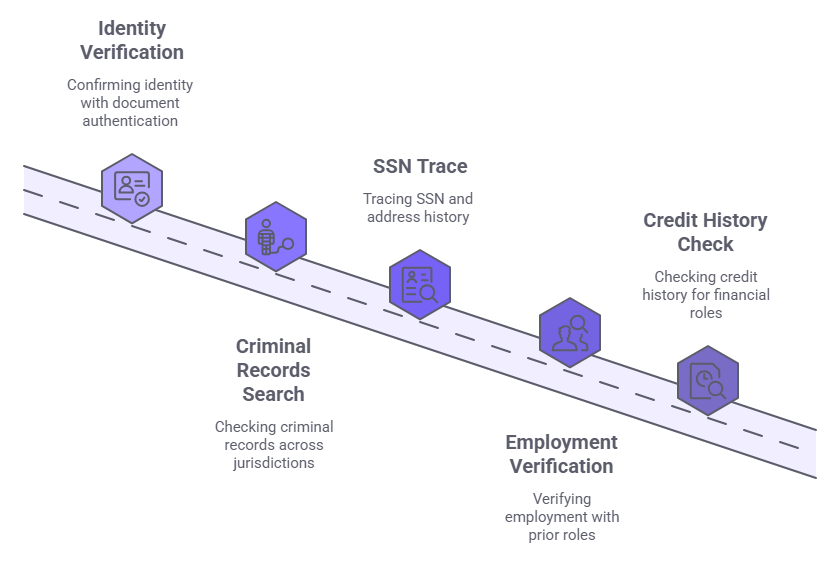
- Identity verification with document authentication.
- Multi-jurisdiction county and state criminal records search.
- SSN trace and address history.
- Employment verification with reference to prior access-level roles.
- Credit history check for roles with financial system or high-value inventory access, where applicable, FCRA-compliant, and permitted under applicable state law. Several states restrict or prohibit employer use of credit history in employment decisions, with limited exceptions. Logistics employers in California, Illinois, New York, Washington, and other states with credit history restrictions should confirm applicability with qualified legal counsel before including this check in the Tier 2 stack.
Tier 3: Last-Mile and Local Delivery Drivers Without CDL
Drivers operating vehicles under 26,001 lbs GVW without a commercial license requirement. This tier requires:
- MVR from current state of licensure.
- Identity verification and national criminal database check.
- County criminal records search.
- Sex offender registry search.
- Employment verification for prior driving roles.
- Motor vehicle history review for at-fault incidents.
Tier 4: CDL Drivers Under FMCSA Jurisdiction
Drivers operating vehicles requiring a commercial license. This tier requires the full DOT regulatory screening stack:
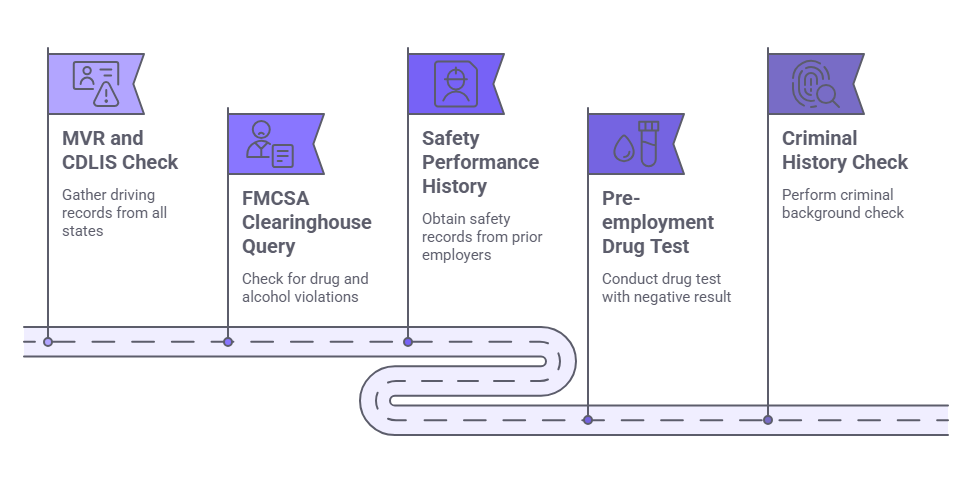
- MVR from every state where the driver held a CDL in the past three years, with CDLIS check to identify all states.
- FMCSA Drug and Alcohol Clearinghouse full query before any safety-sensitive function.
- Safety Performance History from all prior DOT-regulated employers.
- Pre-employment DOT drug test with negative result confirmed before any safety-sensitive function.
- FCRA-compliant criminal history check per company policy.
Tier 5: Third-Party Logistics Contractors and Independent Delivery Contractors
Workers with regular facility or route access under a 1099 or third-party arrangement. This tier requires:
- FCRA disclosure and authorization before any CRA-ordered check, with degree-of-control analysis confirming applicability.
- Identity verification and national and county criminal records search.
- MVR where applicable to the role.
- Employment or engagement verification.
| Verification Component | Tier 1 | Tier 2 | Tier 3 | Tier 4 | Tier 5 |
| Identity verification and SSN trace | Yes | Yes, with document authentication | Yes | Yes, full identity proofing | Yes |
| National criminal database check | Yes | Yes | Yes | Yes | Yes |
| County criminal records | No | Yes | Yes | Yes, including federal | Yes |
| Sex offender registry | Yes | Yes | Yes | Yes | Yes |
| MVR | No | No | Current state | All CDL states, 3 years | Where applicable |
| FMCSA Clearinghouse | No | No | No | Yes, full query | No |
| Pre-employment drug test | No | No | No | Yes, DOT 5-panel | No |
| Safety Performance History | No | No | No | Yes | No |
| Employment verification | Prior warehouse roles | Prior access-level roles | Prior driving roles | Prior DOT employers | Prior engagements |
The tier-to-role mapping should be documented and shared with HR, operations, and any staffing agency partners before peak season volume begins.
Staffing Agency Dual-Accountability: The FCRA Gap Peak Season Makes Worse
Staffing agency dependency is structurally embedded in logistics peak hiring. It is also the most reliably exploited gap in logistics FCRA compliance during high-volume periods. Three specific failure modes drive this exposure.
The Mutual Assumption Gap
Logistics facilities assume the agency has run FCRA-compliant checks. Agencies, in turn, assume the facility has defined the standard and will handle adverse action. Neither assumption is documented, and both parties carry FCRA exposure for checks that were either not run, not run compliantly, or not followed by a proper adverse action process. When a post-hire incident surfaces a worker's undisclosed history, both parties face the question of who was responsible.
The Surge-Placement and Temp-to-Perm Gaps
During a peak surge, agencies placing workers on short notice may compress their own screening timelines or rely on prior-season clearances not yet refreshed. Workers screened months ago under a different program standard arrive at the facility with no current clearance. Additionally, logistics employers who convert temp workers to permanent employees at the end of a peak season frequently treat the agency's original screening as sufficient, without recognizing that the change in employment relationship may warrant a review of the program and, in some circumstances, a new employer-initiated screening process. When a logistics employer initiates a new background check at the point of temp-to-permanent conversion, the full FCRA process applies to that check, including a new standalone disclosure, new written authorization, and the two-step adverse action process if the conversion decision is affected by the result. The prior screening authorization does not carry forward to a new employer-initiated check.
The Contractual Solution
Logistics employers should specify in their staffing agency agreements exactly what screening components are required, which party is responsible for FCRA disclosure and authorization, how adverse action will be handled when a finding surfaces, and what screening documentation the agency must provide before a worker is placed. This agreement should be in place before the first peak season placement is made, not after the first incident prompts a review.
FCRA obligations in multi-party staffing arrangements vary by circumstance and contractual structure. This section is informational only and does not constitute legal advice. Consult qualified legal counsel for your specific program structure.
CDL Driver Screening in Peak Logistics Season: The Regulatory Stack That Cannot Be Compressed
CDL drivers under FMCSA jurisdiction carry a regulatory screening stack that is entirely separate from FCRA and operates on its own non-negotiable timeline. Peak season dispatch urgency creates no accommodation in this stack. Three timing failures are most common in logistics operations during high-volume periods.
Clearinghouse Query Timing
FMCSA requires a full Clearinghouse query before a CDL driver performs any safety-sensitive function. A driver who starts a route before the Clearinghouse query returns is in violation regardless of how urgent the delivery schedule is. Specifically, the query must be completed and return a Not Prohibited result before the driver operates.
Pre-Employment Drug Test Timing
FMCSA requires a confirmed negative pre-employment drug test result before a CDL driver performs any safety-sensitive function. Running the test the same day as the first route does not satisfy this requirement if the result has not been returned and confirmed. The result, not the test initiation, is the compliance trigger.
MVR Multi-State Pull and Advance Initiation
FMCSA requires an MVR from every state where the driver held a CDL in the past three years. Logistics operations hiring CDL drivers from multiple states during peak season frequently miss the full multi-state pull because the CDLIS check that identifies which states to pull was not part of the standard screening workflow. The advance initiation solution is to begin the full regulatory screening stack three to four weeks before the first scheduled route. For any components of the CDL screening stack ordered through a CRA, the FCRA standalone disclosure and written authorization must be obtained before those checks are initiated, regardless of the broader FMCSA regulatory timeline. Building FCRA disclosure and authorization into the initial offer acceptance step ensures this requirement is satisfied before the three-to-four-week CDL screening window begins.
FCRA Compliance Under Volume Pressure: The Failure Modes Peak Season Creates
FCRA applies to seasonal, temporary, and part-time logistics workers identically to permanent employees. Peak season volume creates no FCRA accommodation. Four specific failure modes are most common in high-volume logistics peak hiring.
Batch Adverse Action
Processing 20 to 30 candidate checks simultaneously and issuing adverse action decisions in batch without individual pre-adverse notices and waiting periods is the most common FCRA violation in high-volume logistics hiring. Each candidate is entitled to an individual pre-adverse action notice, a copy of their consumer report, and the Summary of Rights Under the FCRA. Each candidate also has a waiting period of generally at least five business days per CFPB and FTC guidance before a final adverse action notice goes out. The final adverse action notice must identify the CRA by name, address, and telephone number, state that the CRA did not make the adverse action decision, and inform the candidate of their right to a free copy of the report within 60 days and their right to dispute its accuracy or completeness.
Disclosure Bundled in Onboarding Packets
Logistics onboarding packets are typically dense, with safety acknowledgments, equipment policies, and facility rules. The FCRA standalone disclosure requirement is frequently violated when the disclosure sits inside a multi-document packet rather than going out as a separate document before any check is initiated.
Missing Conditional Offer Sequencing and Individualized Assessment
Major logistics markets including California, Illinois, New York, New Jersey, and Washington have conditional offer or ban-the-box requirements. A logistics HR team whose workflow initiates background checks before a conditional offer is extended creates legal exposure in covered markets. Furthermore, many ban-the-box jurisdictions impose individualized assessment requirements before adverse action can be finalized based on criminal history findings. Logistics employers operating in covered markets should confirm both the conditional offer sequencing requirements and any individualized assessment obligations applicable to their specific jurisdiction with qualified legal counsel. This list is illustrative rather than exhaustive, and requirements vary by jurisdiction.
Re-Engaging Seasonal Workers Without Re-Screening
Logistics employers frequently re-engage workers from prior peak seasons without running new checks, treating prior-season clearances as current. Each seasonal re-engagement is a new hiring event for FCRA purposes and prior clearances do not carry forward.
FCRA requirements and applicable state and local laws vary by jurisdiction. This section is informational only and does not constitute legal advice. Consult qualified legal counsel for your specific markets and program structure.
Workflow Design for Peak Season Logistics: Screening at Volume Without Losing Candidates
Logistics employers who maintain screening consistency across the warehouse-to-wheel spectrum during peak season do not screen fewer roles or run less thorough checks. Instead, they design their workflow for volume before the surge begins. Five design principles separate programs that hold up from programs that create violations.
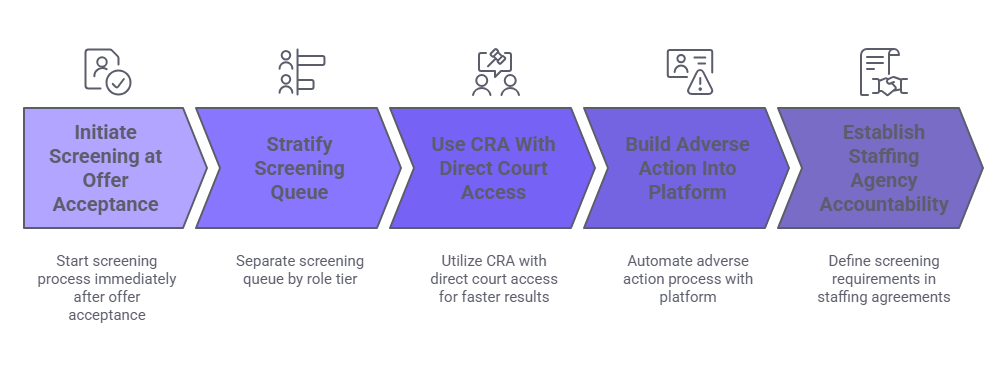
Principle 1: Initiate at Offer Acceptance, Not at Onboarding Appointment
Building FCRA disclosure and authorization into the offer acceptance workflow reduces the total screening timeline by two to five days for most candidate pools. For CDL drivers specifically, initiation should begin three to four weeks before the first scheduled route, with FCRA disclosure and authorization completed at offer acceptance before the CDL screening window begins. Every day between offer acceptance and check initiation is a day added to the total onboarding timeline.
Principle 2: Stratify the Screening Queue by Role Tier
Warehouse associate checks process faster than CDL driver checks with multi-state MVR pulls and Clearinghouse queries. Processing all roles in a single queue means CDL driver checks delay warehouse associate clearances. Separating the queue by role tier and setting role-appropriate start date expectations with operations prevents this and keeps both pipelines moving at their natural pace.
Principle 3: Use a CRA With Direct County Court Access
For major logistics markets, direct court access can reduce county record turnaround from five to seven business days to 24 to 48 hours. That difference is amplified during peak season when county courts are processing higher volumes alongside increased employer demand. Confirming direct access before the surge begins, rather than after the first delay surfaces, is the operationally correct approach.
Principle 4: Build Adverse Action Into the Platform
Manual adverse action tracking fails at volume. A platform that automatically generates individual pre-adverse notices, tracks individual waiting periods by candidate, and triggers final adverse action notices removes the human failure point. Before implementing platform automation, confirm that the platform generates final adverse action notices that identify the CRA by name, address, and telephone number, state that the CRA did not make the adverse action decision, and inform the candidate of their right to a free copy of the report within 60 days and their right to dispute its accuracy or completeness.
Principle 5: Establish Staffing Agency Accountability in Writing
Staffing agreements governing peak season placements should specify screening requirements, FCRA responsibility allocation, adverse action handling procedures, and required documentation before the first surge hire is placed. An agreement reached after a placement incident is not a compliance program. It is a liability negotiation.
Conclusion
Logistics employers whose screening programs hold up across the warehouse-to-wheel spectrum during peak season built them for role-stratified volume. Staffing agency accountability was established in writing before the surge began. CDL driver screening started far enough in advance to satisfy the FMCSA regulatory stack, with FCRA disclosure and authorization confirmed before CRA-ordered checks began. The adverse action workflow applied individually to every candidate regardless of how many ran simultaneously. The gap between a program that works in February and one that holds up in July is a workflow design problem, and it is solvable before peak season begins.
Frequently Asked Questions
Logistics recruitment at high volumes also has a new dimension of stress, especially in situations where time is of the essence and any delays could be detrimental to operations. It’s not surprising that many questions emerge regarding screening, compliance, staffing companies, and drivers’ qualifications within very short notice at peak seasons. Here are some Frequently Asked Questions that will help clarify the situation.
What background checks do logistics employers need to run on peak season workers?
Logistics employers should use a role-stratified framework across the warehouse-to-wheel spectrum. Warehouse associates need identity verification, a national criminal check, a sex offender registry search, and employment verification. Delivery drivers add an MVR. CDL drivers require the full FMCSA regulatory stack. Third-party contractors require FCRA disclosure and authorization with degree-of-control analysis confirming applicability.
Who is responsible for background checks when using a staffing agency for logistics workers?
Both the staffing agency and the client facility may carry FCRA exposure depending on contractual structure and degree of control. The mutual assumption gap, where each party assumes the other has handled FCRA compliance, is the most common logistics staffing failure mode. Logistics employers should specify screening requirements and FCRA responsibility in the staffing agreement before peak season placements begin.
How long does a logistics background check take in peak season?
Tier 1 warehouse checks typically clear in 24 to 72 hours with direct county court access. CDL driver checks with the full FMCSA regulatory stack require three to four weeks before the first scheduled route. Late initiation, not check processing time, is the primary cause of peak season delays.
Does FCRA apply to temporary and seasonal logistics workers?
Yes. FCRA applies to temporary, seasonal, and part-time logistics workers identically to permanent employees. Standalone disclosure and written authorization are required before any CRA-ordered check. The two-step adverse action process applies to every candidate whose engagement is affected by a background check result, regardless of how many candidates are being processed simultaneously.
What is the difference between a background check for a warehouse worker and a CDL driver in logistics?
A warehouse associate check is governed by FCRA and focuses on criminal history, identity, and employment history. A CDL driver check must satisfy both FCRA and a separate FMCSA regulatory stack, including a Clearinghouse full query, pre-employment DOT drug test, multi-state MVR, and Safety Performance History. The CDL regulatory stack cannot be compressed regardless of dispatch urgency.

ABOUT THE CREATOR
Charm Paz, CHRP
Recruiter & Editor
Charm Paz is an HR professional at GCheck, specializing in background screening, fair hiring, and regulatory compliance. She holds from the Professional Background Screening Association (PBSA) and helps organizations navigate employment regulations with clarity and confidence.
With a background in Industrial and Organizational Psychology, she translates policy into practice to build ethical, compliant, human-centered hiring systems that strengthen decision-making over time.