


Fleet operators managing high-volume driver hiring background checks face a structural tension between operational speed and regulatory compliance that intensifies as hiring pipelines grow. This article provides a process-level framework for compliance teams navigating DOT and FMCSA obligations, FCRA requirements, and adjudication consistency across large, distributed hiring programs.
Key Takeaways
- High-volume driver hiring background checks require a purpose-built workflow architecture, not a scaled-up version of single-hire processes.
- The DOT and FMCSA regulatory stack for commercial drivers is materially distinct from general employment screening and must be treated as a separate compliance domain.
- The FMCSA Drug and Alcohol Clearinghouse established mandatory query obligations that apply to every covered driver hire, regardless of hiring volume.
- Adjudication matrix design is the most commonly neglected compliance control in high-volume environments and the most frequent audit finding.
- MVR monitoring programs differ operationally from pre-employment MVR checks and serve distinct risk management functions at different fleet sizes.
- FCRA adverse action failures cluster around three specific process failures at volume: skipped pre-adverse notice, compressed waiting periods, and non-individualized denial language.
- Turnaround time is primarily a function of data source latency and integration quality, not screening diligence, and legitimate acceleration is possible without compliance compromise.
- A fleet’s screening program should be formally re-evaluated at defined operational triggers, not only after an audit finding or litigation event.
The Scale-Compliance Tension in Fleet Hiring
The Structural Conflict
Fleet operators at scale do not face a larger version of the same compliance challenge that smaller organizations face. Instead, they face a qualitatively different one. When a single hiring manager processes three driver applications per week, a missed pre-adverse notice step is an isolated error. However, when a regional logistics operation onboards 40 drivers across five terminals in the same week, that same missed step becomes a systemic failure embedded in a repeating process.
That distinction, between isolated error and process-level defect, defines compliance risk at volume. The practical manifestation is familiar to anyone who has managed a hiring surge: operations leadership sets a go-live date, the safety or compliance function sets a screening requirement, and the gap between those two timelines creates pressure to compress or skip steps. At low volumes, that pressure is manageable. At scale, however, it becomes a compliance liability that compounds with every hire cycle.
Why Standard Processes Break at Volume
Standard screening processes are typically designed for sequential, one-at-a-time processing. A compliance officer reviews a report, makes a determination, and moves to the next file. That model fails not because people stop caring about compliance, but because the process was never engineered for concurrent workload.
The consequences are predictable:
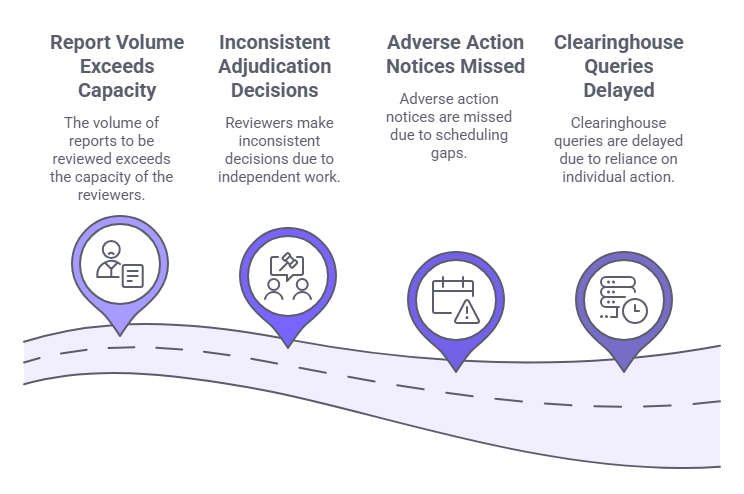
- Queue backlogs form as report volume exceeds reviewer capacity.
- Adjudication decisions become inconsistent across reviewers working independently.
- Adverse action notices fall through scheduling gaps when teams generate them manually.
- Clearinghouse queries get missed or delayed when initiation depends on individual action.
Importantly, none of these failures require bad intent. They require only a process that the organization never built for the volume it now handles.
Defining “High Volume” for This Purpose
The term high volume circulates loosely across the industry. Some compliance teams apply it at 50 or more hires per quarter. Others encounter it at 500 or more concurrent onboarding pipelines running simultaneously across multiple locations. The specific threshold matters less than the operational condition it describes. Specifically, it marks the point at which a screening program requires deliberate workflow engineering rather than individual case management. For fleet operators, that threshold tends to arrive earlier than in other industries because driver screening carries an additional regulatory layer that adds mandatory process steps regardless of hiring speed.
Volume hiring reveals the gap between processes that work in some situations and those that are truly scalable. For fleets, compliance problems tend not to stem from a single major screw-up. Instead, they arise from minor oversights that happen over and over again among many dozens or even hundreds of new hires under time pressure. The strongest hiring programs are usually the ones designed with structure, workflow consistency, and accountability built into every stage of the process. As hiring volume grows, operational discipline becomes just as important as speed. �
The Regulatory Framework Specific to Drivers
DOT and FMCSA Requirements as a Distinct Compliance Domain
Commercial driver screening does not operate under the same regulatory framework as general employment screening. Rather, it operates under that framework plus an additional layer of DOT and FMCSA-specific obligations that are independent of, and in some respects more demanding than, FCRA requirements alone. Treating these as a single unified compliance challenge is one of the most common structural errors in fleet HR programs.
| Requirement | Applies To | Source Authority |
| Motor vehicle record check | CDL drivers pre-employment | FMCSA |
| Prior employer inquiry (3 years) | CDL drivers pre-employment | FMCSA |
| Drug and Alcohol Clearinghouse query | CDL drivers pre-employment and annually | FMCSA |
| Pre-adverse and adverse action notice | All CRA-based employment background checks | FCRA |
| Individualized criminal record assessment | Varies by jurisdiction | State/municipal law |
Each obligation carries its own documentation standard and record retention timeline. Furthermore, in the case of Clearinghouse queries, each obligation carries its own federal database interaction requirement. No general employment background check can satisfy these obligations on its own.
The FMCSA Drug and Alcohol Clearinghouse
The FMCSA Drug and Alcohol Clearinghouse established mandatory query obligations that apply to every covered CDL driver hire and to annual reviews of current drivers. Motor carriers must conduct a full Clearinghouse query for every prospective CDL driver before allowing that driver to operate a commercial motor vehicle subject to FMCSA jurisdiction. Notably, limited queries, which were available during the Clearinghouse’s initial implementation period, are no longer a permissible substitute for pre-employment checks. Compliance teams should verify all requirements against current FMCSA guidance.
At scale, Clearinghouse query management becomes a workflow integration requirement rather than a manual task. Queries must be initiated, driver consent must be obtained, and results must be reviewed. Additionally, where a violation record exists, the Return-to-Duty process must be confirmed before hire. Each step depends on the prior one. Consequently, when onboarding pipelines run in parallel across multiple locations, a missed or delayed Clearinghouse query creates regulatory exposure for every operating day that driver is on the road before the query clears. Compliance teams should therefore treat Clearinghouse query initiation as a triggered, automated step in the onboarding workflow.
FCRA Obligations and Ban-the-Box Intersections
The Fair Credit Reporting Act applies to background checks that consumer reporting agencies conduct for employment purposes, and CDL driver hiring is no exception. The core FCRA obligations apply to every driver hire where a CRA performs the check, regardless of hiring volume. What changes at scale is the operational surface area across which compliance teams must consistently execute those obligations.
State and municipal ban-the-box laws interact with CDL driver hiring in ways that are not always obvious. Some jurisdictions require formalized individualized assessment of criminal records, including written assessments with specific factors and additional notice obligations. Requirements vary significantly by jurisdiction. As a result, compliance teams should confirm these requirements with qualified legal counsel before implementing adjudication criteria in any covered location. Fleet operators hiring across multiple states must also confirm that their adjudication criteria account for applicable state-level restrictions as well as DOT safety fitness standards.
What “At Scale” Actually Requires: Workflow Architecture
The Case for Purpose-Built Workflow Design
A high-volume driver hiring background check program that produces consistent, compliant outcomes is not doing the same thing as a single-hire program, only faster. Instead, it is doing something structurally different. That difference is workflow architecture: the deliberate design of processing sequences, handoff points, queue management rules, and system integrations that allow a compliance program to produce reliable outcomes regardless of concurrent volume. The practical starting point is a process map of the current screening workflow from application trigger to hire decision.
ATS and Onboarding System Integration
Background check initiation that depends on a manual step is a process design vulnerability at any volume. For example, when a recruiter must remember to submit a check request after completing an application review, that dependency creates risk. Integrating applicant tracking systems with screening workflows allows the program to trigger initiation automatically at a defined application stage, eliminating that individual-action dependency entirely. The same logic applies to result delivery and adjudication routing.
When a report returns a record requiring review, the program should route that case automatically to the appropriate decision-maker, not leave it sitting in someone’s inbox. Similarly, when a pre-adverse notice is triggered, system management of notice generation and waiting period tracking is far more reliable than recruiter-managed calendars.
Turnaround Time and Queue Management
Turnaround time for driver background checks varies based on required data sources, jurisdictions involved, and workflow integration quality. Understanding component-level timelines helps compliance teams identify where delays are controllable and where they are not.
| Component | Typical Latency Driver | Controllable? |
| County criminal record search | Local court processing time | No |
| MVR report | State DMV system availability | No |
| FMCSA Clearinghouse query | Near real-time post-consent | Partially |
| Employment verification | Prior employer responsiveness | No |
| Internal adjudication | Reviewer queue and workflow design | Yes |
In a well-designed workflow, the program triggers parallel-eligible components simultaneously rather than sequentially. Sequential initiation of parallel-eligible components is one of the most common sources of avoidable delay in high-volume driver screening programs. Fortunately, it is also one of the easiest to fix through workflow redesign.
Adjudication Consistency at Volume
Why Adjudication Is the Most Common Audit Finding
In high-volume hiring programs, adjudication is where compliance programs most frequently break down. The failure mode is rarely bad intent. Instead, it is the absence of a documented, consistently applied decision framework. When multiple hiring managers across multiple locations make individual judgment calls on background check results without a shared standard, the program produces inconsistent outcomes. Each inconsistency is a potential adverse action challenge and, taken together, a pattern that does not survive audit scrutiny.
Building an Adjudication Matrix
An adjudication matrix is a documented decision framework that maps specific background check result types to defined disposition categories. Where criminal records are involved, the matrix must accommodate individualized assessment requirements rather than apply categorical disqualification rules. EEOC guidance and applicable state and municipal fair chance laws define the factors that reviewers must consider. Therefore, qualified legal counsel should review the matrix to confirm it meets those requirements before the program deploys it.
For fleet operators, the matrix must account for at least two dimensions:
- DOT safety fitness standards, which establish specific disqualifying conditions for CDL drivers under federal regulation.
- Applicable state-level individualized assessment requirements, which may require consideration of offense nature, time elapsed, and relationship between the record and job duties.
Qualified legal counsel should review the matrix before implementation and update it whenever relevant laws or regulations change.
Distributed Review Consistency
In large fleet operations with multiple hiring locations, different people in different locations may apply the same matrix to make adjudication decisions. Ensuring consistency across that distributed environment requires more than distributing the matrix document. It also requires training, calibration, and a process for escalating edge cases to a centralized review function. Calibration exercises, where reviewers independently assess the same hypothetical case and then compare outcomes, are a practical tool for identifying divergence before it surfaces in actual hiring decisions.
MVR Monitoring: Pre-Employment vs. Continuous
The Operational Distinction
A pre-employment MVR check is a point-in-time assessment. It reflects a driver’s motor vehicle record on the day the check ran, not six months later after that driver has been on the road. Continuous MVR monitoring programs address that gap by sending notification when a driver’s record changes after hire. These are not competing approaches. Rather, they serve different functions, and the appropriate choice depends on fleet size, operational risk profile, and applicable compliance obligations.
Pre-Employment MVR in a High-Volume Context
At high hiring volumes, the program must integrate pre-employment MVR processing into the workflow architecture with batch initiation and automated result routing. The volume of MVR returns, and the range of record types they may contain, makes manual review of each report impractical without a triage system. State MVR systems vary in processing time, data currency, and the scope of information they return. Moreover, the federal Driver’s Privacy Protection Act governs access to motor vehicle records and defines permissible purposes for obtaining and using MVR data. Compliance teams should therefore confirm, with qualified legal counsel, that their MVR check scope meets both federal DPPA requirements and applicable state law requirements for each jurisdiction in which they hire.
Continuous Monitoring as a Fleet Safety Program Component
For larger fleets, continuous MVR monitoring serves a risk management function that pre-employment screening alone cannot fulfill. A driver who was clean at hire may accumulate violations that affect safety fitness status before the next scheduled MVR review. Continuous monitoring alerts the fleet to those changes in closer to real time, enabling earlier intervention.
The operational integration of continuous monitoring alerts requires its own workflow design. An alert that a team reviews weekly is not operationally equivalent to one that triggers an immediate case review. Accordingly, fleets implementing continuous monitoring should define the response workflow, including the protocol for different alert types, before deployment, not after alerts begin arriving.
Adverse Action at Scale: Where Fleets Get It Wrong
The FCRA Adverse Action Sequence
The FCRA adverse action process requires a specific sequence of steps that employers must follow in order. When a consumer report contributes to a decision not to hire, the employer must first provide a pre-adverse action notice along with a copy of the report and a summary of the candidate’s rights. The employer must then allow a reasonable period of time for the candidate to review and dispute the report before taking final action. Regulators have informally indicated that a reasonable period is generally at least five business days, though the FCRA does not codify a specific minimum. Employers should therefore confirm the applicable standard with qualified legal counsel. If the employer proceeds, it must then provide a final adverse action notice. Operational urgency does not shorten this sequence.
How Volume Creates Adverse Action Failures
At high volumes, three specific failure modes emerge with regularity:
| Failure Mode | Description | Risk |
| Skipped pre-adverse notice | Candidate never receives required notification before final decision | FCRA violation, litigation exposure |
| Compressed waiting period | Candidate does not receive reasonable time to review or dispute | FCRA violation, state law exposure |
| Non-individualized denial language | Adverse action letter does not reference the specific report finding | FCRA and state fair chance law exposure |
All three are process-level defects, not isolated errors. As a result, each one repeats across every hire cycle until the program corrects it. Compliance teams must enforce waiting periods through system controls, not individual judgment. Furthermore, adverse action notice generation should be automated where possible, but each notice must dynamically reflect the specific report findings that drove the decision. Generic or static template letters that omit the actual record type may not satisfy individualization requirements under the FCRA or applicable state law.
Common Misconceptions About Screening Speed
The Slower Equals More Compliant Assumption
A persistent belief in some compliance functions is that slower screening is inherently more careful and therefore more compliant. This belief conflates process duration with process quality. A screening program that takes three weeks to return a result is not more compliant than one that returns a result in five days. It is simply slower. Compliance depends on whether the program completed required steps correctly, not on how long those steps took. Consequently, compliance teams that resist workflow improvements out of concern that acceleration implies cutting corners may instead be protecting a slow, error-prone process.
What Actually Drives Turnaround Time
Turnaround time in driver background checks primarily depends on two factors: data source latency and internal process design. Data source latency refers to the time external repositories need to return results, including county courts, state DMV systems, and the FMCSA Clearinghouse. These timelines are largely outside the program’s control. Internal process design, by contrast, covers everything else: how quickly the program initiates checks, whether it triggers parallel-eligible components simultaneously, how quickly it routes results for review, and how quickly reviewers document adjudication decisions.
Legitimate acceleration targets the internal process design components, which the program can control, rather than reducing check scope or skipping required data sources. A compliance team that understands this distinction can pursue genuine efficiency improvements without introducing regulatory exposure.
Decision Framework: When to Revisit Your Screening Program
Operational Triggers That Signal Process Inadequacy
A screening program appropriate for a fleet of 50 drivers may not serve a fleet of 500. The trigger for re-evaluation is not always a compliance failure. Often, it is a change in operational scale, structure, or regulatory environment that the existing program was not designed to handle. Each of the following conditions signals that a formal program review is warranted:
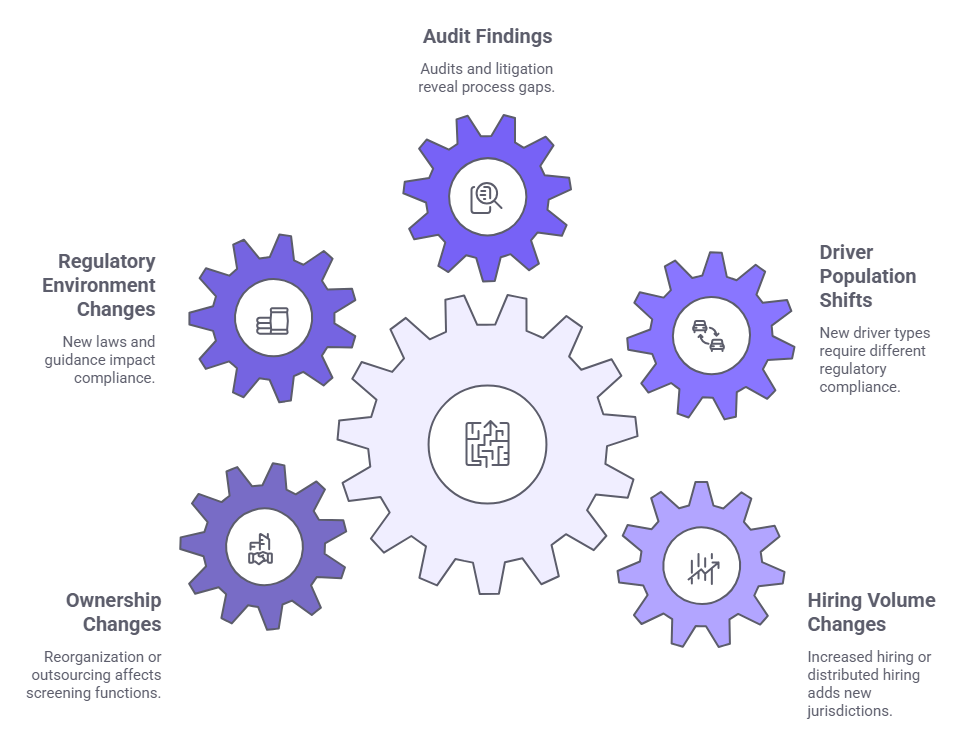
- A significant change in hiring volume, or a shift to more geographically distributed hiring that adds new jurisdictions to the compliance footprint.
- A change in the driver population being hired, such as adding CDL-B drivers, delivery drivers, or gig-affiliated drivers with different regulatory requirements.
- An audit finding, litigation event, or regulatory inquiry that identifies a process gap.
- A change in the regulatory environment, including FMCSA Clearinghouse requirements, state ban-the-box laws, or FCRA guidance.
- A change in the internal ownership of the screening function due to reorganization, turnover, or outsourcing.
Post-audit remediation is more expensive and more disruptive than proactive re-evaluation. Moreover, the most common audit findings in this domain are foreseeable process gaps, not novel regulatory interpretations.
Practical Review Cadence
Compliance teams should schedule formal program reviews at least annually, independent of trigger events. Each review should assess whether the adjudication matrix reflects current regulatory requirements and current fleet risk criteria, whether workflow automation is functioning as designed, whether adverse action processes are running consistently, and whether the scope of checks remains appropriate for the roles being hired. Annual review gives the program an opportunity to identify regulatory changes before they become compliance gaps.
Conclusion
High-volume driver hiring background checks are not simply a scaling challenge. They are a process design challenge that sits at the intersection of DOT and FMCSA regulatory obligations, FCRA requirements, and internal adjudication consistency. Fleet operators that treat screening as an operational workflow rather than a compliance checklist are better positioned to sustain both speed and defensibility as their hiring programs grow. Regulatory requirements in this domain continue to evolve, and compliance programs should be reviewed regularly against current legal standards with qualified counsel.
Frequently Asked Questions
Some of the key issues that fleet managers deal with when conducting background checks on drivers on a high-volume basis have been listed below. Due to the overlap of responsibilities under DOT, FMCSA, and FCRA requirements in a high-volume employment setting, any gap in the process may easily lead to compliance problems. This list aims to assist you in avoiding this situation.
What makes driver background checks different from standard employment background checks?
Commercial driver background checks carry a distinct regulatory layer under DOT and FMCSA rules that does not apply to general employment. This includes mandatory motor vehicle record checks, prior employer inquiry obligations, and required queries to the FMCSA Drug and Alcohol Clearinghouse. These requirements apply to covered CDL drivers in addition to FCRA obligations that govern background checks conducted through consumer reporting agencies. The combined regulatory stack is materially more complex than standard employment screening.
Is a full Clearinghouse query required for every new CDL driver hire?
Under FMCSA regulations, motor carriers must conduct a full Clearinghouse query for every prospective CDL driver before that driver operates a commercial motor vehicle subject to FMCSA jurisdiction. Limited queries, available during the Clearinghouse’s initial implementation period, are no longer a permissible substitute for pre-employment checks. Requirements should be confirmed with qualified legal counsel and verified against current FMCSA guidance, as regulatory details are subject to change.
What is the required waiting period between a pre-adverse action notice and a final adverse action decision?
The FCRA does not specify a fixed number of days. Regulators have informally indicated that a reasonable period is generally at least five business days, but employers should confirm the applicable standard with qualified legal counsel before finalizing their adverse action workflow. Fleets managing high-volume driver hiring background checks should build waiting period tracking into their workflow systems rather than managing it manually.
What is an adjudication matrix, and does every fleet need one?
An adjudication matrix is a documented decision framework that maps specific background check result types to defined disposition categories. Where criminal records are involved, the matrix must accommodate individualized assessment requirements rather than apply categorical disqualification rules. Any fleet with more than one person making adjudication decisions benefits from a formally documented matrix reviewed by qualified legal counsel, as inconsistent outcomes across reviewers are a common finding in compliance audits.
What is the difference between pre-employment MVR checks and continuous MVR monitoring?
A pre-employment MVR check is a point-in-time review conducted before hire. Continuous MVR monitoring provides ongoing alerts when a driver’s record changes after hire. Pre-employment checks inform hire decisions, while continuous monitoring supports ongoing safety management and allows fleets to respond to record changes before the next scheduled review cycle.
How do ban-the-box laws affect CDL driver hiring decisions?
Ban-the-box laws apply to CDL driver hiring in covered jurisdictions and interact with, but do not replace, DOT and FMCSA safety fitness considerations. Some jurisdictions require formalized individualized assessments with specific factors and additional notice obligations that go beyond a general review of criminal history. Fleet operators hiring across multiple states should confirm that their adjudication criteria and adverse action processes account for applicable requirements, which vary by jurisdiction and are subject to ongoing legislative change.
What specific adverse action failures are most common in high-volume driver hiring programs?
The three most common failures are: skipped pre-adverse notice steps, where the candidate never receives required notification before a final decision; compressed waiting periods, where candidates do not receive reasonable time to dispute; and non-individualized adverse action language that does not reference the specific report finding. All three are FCRA compliance exposures and may trigger additional obligations under applicable state laws.
At what point should a fleet formally re-evaluate its screening program?
Formal re-evaluation is warranted when there is a significant change in hiring volume, driver categories, the legal environment, or internal compliance ownership, and also after any audit finding or regulatory inquiry. Re-evaluation should occur on a scheduled annual basis independent of any specific trigger event.
Additional Resources
- FMCSA Drug and Alcohol Clearinghouse Overview
https://clearinghouse.fmcsa.dot.gov - FMCSA Driver Qualification File Requirements
https://www.fmcsa.dot.gov/regulations/driver-qualifications - Federal Trade Commission: Background Checks and the FCRA
https://www.ftc.gov/legal-library/browse/rules/fair-credit-reporting-act - CFPB Adverse Action Notice Requirements Under the FCRA
https://www.consumerfinance.gov/compliance/compliance-resources/other-applicable-requirements/fair-credit-reporting-act/ - U.S. DOT Office of Drug and Alcohol Policy and Compliance
https://www.transportation.gov/odapc - EEOC Enforcement Guidance on Criminal Records in Employment Decisions
https://www.eeoc.gov/laws/guidance/enforcement-guidance-consideration-arrest-and-conviction-records-employment-decisions

ABOUT THE CREATOR
Charm Paz, CHRP
Recruiter & Editor
Charm Paz is an HR professional at GCheck, specializing in background screening, fair hiring, and regulatory compliance. She holds from the Professional Background Screening Association (PBSA) and helps organizations navigate employment regulations with clarity and confidence.
With a background in Industrial and Organizational Psychology, she translates policy into practice to build ethical, compliant, human-centered hiring systems that strengthen decision-making over time.